Today In Charleston History: May 18

1673
Sir John Yeamans

Sir John Yeamans

Lord Anthony Ashley Cooper, one of the Lords Proprietors, sent Joseph West a patent making him a Landgrave, and gave him the commission as Governor of Carolina. The Proprietors had received numerous letters of complaints about Governor Sir John Yeamans, 

1682 

Joseph Morton of Barbados replaced Joseph West as Governor. According to the Proprietors the change was due to West’s involvement in Indian slave trading. In reality, it was most likely a move to encourage more immigration from Barbados and other islands.

Today In Charleston History: May 17

1751
South Carolina Society

South Carolina Society

The South Carolina Society was incorporated by the Assembly, making it one of the most important organizations in the colony.

In 1732, a French Huguenot named Elisha Poinsett opened a tavern in Charleston.  Several friends agreed to help him out his business by spending an evening or two each week in his tavern. They began to collect two bits (sixteen pence) a week for a fund to help any of their members with a need; they soon became known as the “two-bit society.” When Poinsett’s business no longer needed their help, they formalized their association with the idea that education would be their main charity.

1781 – British Occupation

In violation of Gen. Lincoln’s terms of surrender, Charles Pinckney and other militiamen on parole were arrested and placed aboard two British prison ships in the Charlestown harbor – the Pack Horse and the Torbay. Conditions on the ships were horrendous. More than one third of the prisoners held in Charlestown by the British died in captivity.

Charles Pinckney wrote a letter to Colonel Balfour complaining about:

a most injurious and disagreeable confinement … the idea of detaining in close custody as hostages a number of men fairly taken in arms … is so repugnant to the laws of war and the usage of civilized nations …

1787-Constitutional Convention
Indian Queen Tavern, Philadelphia

Indian Queen Tavern, Philadelphia

John Rutledge arrived in Philadelphia and found lodgings at the Indian Queen Tavern on Third Street, which he described as having “sixteen rooms for lodgers, plus four garret rooms … greeted by a liveried servant in coat, waistcoat, and ruffled shirt.” Other delegates who stayed at the Tavern included George Mason and Alexander Hamilton.

Charles Pinckney stayed at the home of Mrs. Mary House, at the corner of Fifth and Market Street, with James Madison.

1828   

Horatio Allen, chief engineer of the Delaware & Hudson Canal Company, met with officials of the South Carolina Canal & Rail Road Company and discussed the type of road to build and recommended using a steam locomotive. Allen had studied steam locomotives in England and was positive that steam locomotives were the future.

1840-Births
John Reeks aka ... Francis Dawson

Austin John Reeks (Francis Dawson)

Austin John Reeks was born in London. The Reeks were one of the oldest Catholic families in England and traced their roots back to the War of Roses. He would later join the Confederacy under the name Francis Warrington Dawson and re-locate to Charleston where he would become publisher of the News and Courier.

Today In Charleston History: May 16

1838-Slavery.

Angelina Grimke Weld gave a lecture at Pennsylvania Hall to the Anti-Slavery Convention of American Women, a gathering of mixed-race abolitionists, amid a hostile atmosphere on the streets of Philadelphia, packs of mobs parading through the streets protesting the “amalgamation” of people inside the hall. 

As Angelina took the podium bricks and stones were thrown through the windows, with jeering from the outside easily carrying inside the hall, but she lectured for more than an hour, addressing the mob outside the hall:

What is a mob? What would the breaking of every window be? Any evidence that we are wrong or that slavery is a good and wholesome institution? What if that mob should now burst in upon us, break up our meeting and commit violence upon our persons – would this be anything compared with what the slaves endure? 

The next day a mob stormed Pennsylvania Hall and burned it to the ground. The city’s official report concluded that the fire and riots were the fault of the abolitionists, saying they had upset the citizens by encouraging “race mixing” and inciting violence.

Pennyslvania Hall burning

Pennyslvania Hall burning


1918
Edmund Thorton Jenkins

Edmund Thorton Jenkins

Edmund Thornton Jenkins was awarded the Charles Lucas Prize for Composition at the Royal Academy. Jenks ( as he was called) was the son of Rev. Daniel Jenkins, of the Jenkins Orphanage House in Charleston. The Jenkins Band had been performing at the Anglo-America Expo in London, but the outbreak of World War I caused the Expo to shut down. Jenks remained in London and enrolled at the Royal Academy of Music.

During his fifth year at school Will Marion Cook’s Southern Syncopated Orchestra played at London’s Philharmonic Hall. Jenks looked upon Cook as the type of musician he aspired to be – a serious black musician.

Today In Charleston History: May 15

1863

  Angelina Grimke Weld gave the closing speech at the convention of the American Anti-Slavery Society titled “Address to the Soldiers of our Second Revolution” in which she said:

This war is not, as the South falsely pretends, a war of races, not of sections, nor of political parties, but a war of Principles; a war upon the working classes, whether white or black, a war against Man, the world over … The nation is in a death-struggle. It must either become one vast slaveocracy of petty tyrants, or wholly the land of the free …

1864-Bombardment of Charleston.  

Gus Smythe, serving in the Confederate Signal Corps in Charleston wrote:

Just at the corner of Tradd & the Bay, as I was going to step on one end of a cellar door, a shell fell thro’ the other end, not three ft. from me, & burst down in the cellar, covering me with dirt & smoke, but leaving me unharmed.

Gus Smythe

Gus Smythe

Today In Charleston History: May 14

1660-Restoration
General_Monck, by David_Loggan, 1661, National Portrait Gallery, London

General Monck, by David Loggan, 1661, National Portrait Gallery, London

With the military support of General George Monck, governor of Scotland and Duke of Albemarle, Charles II was proclaimed king of England. For his service, Monck was named one of the original Lords Proprietors of Carolina in 1663.

1729 – Royal Colony

King George bought out the Lords Proprietors, finalizing South Carolina’s transformation into a Royal Colony. The agreed payment was £2500 sterling ($250,000) and £5000 sterling to cover incidental expenses.

1802 – Aaron Burr

Vice President Aaron Burr dined at the Carolina Coffee-House at 120 East Bay Street in the company of Captain John Blake. Eighteen toasts were drunk during the evening. Burr was in Charleston to visit his daughter, Theodosia, on the occasion of the birth of her son. 

1838 – Marriage

In Philadelphia, Angelina Grimke of Charleston married Theodore Weld, editor of the abolitionist newspaper The Emancipator.  The ceremony was attended by eighty mixed race guests. Their wedding cake was made by a Negro confectioner, using only “free sugar” – sugar not harvested and manufactured by a slave system.

1863 – Abolition

 Angelina Grimke Weld attended the national convention of the American Anti-Slavery Society. She gave a speech titled “Address to the Soldiers of our Second Revolution” and stated:

My country is bleeding, my people are perishing around me, but I feel as a South Carolinian, I am bound to tell the North, go on! go on! Never falter, never abandon the principles which you have adopted. 

Angelina Grimke Weld

Angelina Grimke Weld


#Today In Charleston History: May 13

1862 – The Escape of The Planter
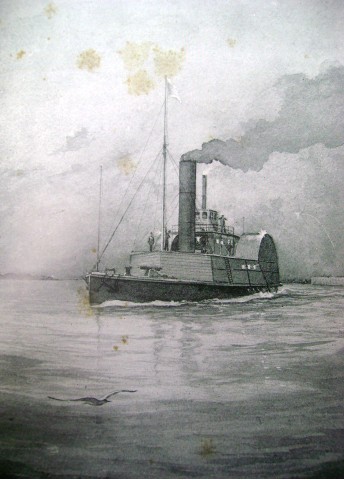
Z_The_Planter

The Planter

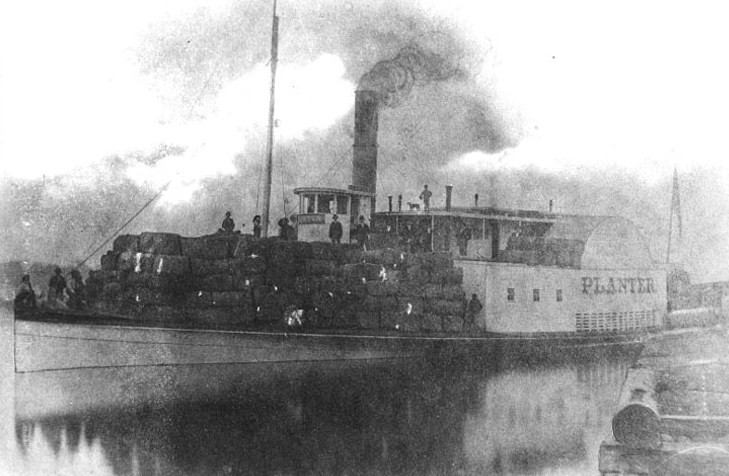
The Planter was a high-pressure, side-wheel steamer, one hundred and forty feet in length, and about fifty feet beam. She was built in Charleston, was formerly used as a cotton-boat, and was capable of carrying about 1400 bales. On the organization of the Confederate navy she was transformed into a gun-boat, and was the most valuable war vessel the Confederates had at Charleston. Her armament consisted of one 32-pound rifle gun forward, and a 24-pound howitzer aft.

On the night of May 12-13 The Planter also had on board one seven-inch rifled gun, one eight-inch Columbiad, one eight-inch howitzer, one long 32-pounder, and about two hundred rounds of ammunition, which had been consigned to Fort Ripley, and which would have been delivered at that fortification on Tuesday had not the designs of the rebel authorities been frustrated.

The Planter’s slave pilot was named Robert Smalls. On this night, three white officers decided to spend the night ashore. About 3:00 am on the 13th, Smalls and seven of the eight enslaved crewmen decided to make a run for the Union vessels that formed the blockade.

Robert Smalls

Robert Smalls

Smalls dressed in the captain’s uniform was wearing a straw hat similar to that of the white captain. He backed the Planter out of what was then known as Southern Wharf around 3 a.m. The Planter stopped at a nearby wharf to pick up Smalls’ family and the relatives of other crewmen, who had been concealed there for some time. With his crew and the women and children, Smalls made the daring escape. The Planter had as cargo four valuable artillery pieces, besides its own two guns. Perhaps most valuable was the code book that would reveal the Confederate’s secret signals, and the placement of mines and torpedoes in and around Charleston harbor. Smalls used proper signals so the Confederate soldiers would not know he was escaping in the ship.

Smalls piloted the ship past the five Confederate forts that guarded the harbor, including Fort Sumter. The renegade ship passed by Sumter approximately 4:30 a.m. He headed straight for the Federal fleet, which was part of the Union blockade of Confederate ports, making sure to hoist a white sheet as a flag.

The first ship he encountered was USS Onward, which was preparing to fire until a sailor noticed the white flag. When the Onward’s captain boarded the Planter, Smalls requested to raise the United States flag immediately. Smalls turned the Planter over to the United States Navy, along with its cargo of artillery and explosives intended for a Confederate fort.

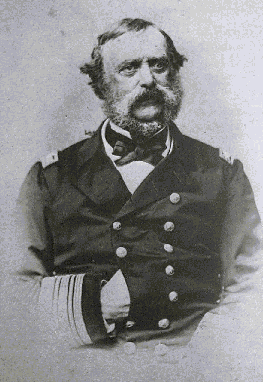
Admiral Samuel DuPont

Admiral Samuel DuPont

Because of his extensive knowledge of the shipyards and Confederate defenses, Smalls provided valuable assistance to the Union Navy. He gave detailed information about the harbor’s defenses to Admiral Samuel Dupont, commander of the blockading fleet.

Smalls quickly became famous in the North. Numerous newspapers ran articles describing his daring actions. Congress passed a bill, signed by President Abraham Lincoln, that rewarded Smalls and his crewmen with the prize money for the captured Planter. Smalls’ own share was $1,500 (about $34,000 adjusted for inflation in 2012 dollars), a huge sum for the time.

 The names of the black men of the crew were:

  • Robert Smalls, pilot;
  • John Smalls and Alfred Gradine, engineers;
  • Abraham Jackson, Gabriel Turno, William Morrison, Samuel Chisholm, Abraham Allston, and David Jones.
The Planter, loaded with bales of cotton at Georgetown, SC

The Planter, loaded with bales of cotton at Georgetown, SC

#Today In Charleston History: May 12

1780 – The Surrender of Charlestown.

At 2:00 pm Gen. Lincoln and Gen. Moultrie met the British commanders at the horn work and gate and surrendered the city of Charlestown. It was the British army’s greatest prize of the Revolutionary War, capturing the majority of the Southern Continental Army regulars. Sir Clinton wrote:

Whatever severe Justice might dictate, we resolved not to press to unconditional Submission a reduced army whom we hoped Clemency might yet reconcile to us.

He ordered all regular army and militia to “bring all their arms with them, guns, swords and pistols.”

Henry Laurens also complained about surrendering the troops, “Thousands of Muskets … useless in Charles Town which might have been shouldered in our defence.”

A marked man by the British, Gov. John Rutledge traveled to Philadelphia and spent the rest of the war living with other Southern refugees. He spent most of his time trying to secure help from Congress for South Carolina.

Casualties during the Charlestown siege were:

  • American: 150 dead; 138 wounded
  • British: 99 dead; 217 wounded.

British soldiers were given the power to arrest people on any pretext’ citizens could be jailed without a pre-trial hearing. They also cut down the Liberty Tree on Mazyck’s Pasture and burned the stump. Thus began a two-and-a-half year occupation.

1781-American Revolution. 

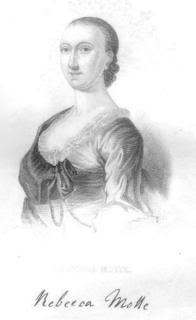
motte1Rebecca Brewton Motte’s plantation home on the Congaree River in St. Matthews Parish, was called Mt. Joseph. It had fallen in British hands, by British Lt. Donald McPherson with over 150 men who threw up earthworks and dug a deep ditch around the house. The British called it Fort Motte.

Rebecca Motte, whose Charleston home was also being occupied by occupying British officers, was distressed that both of her homes were now in British hands. The British ordered Motte to gather what belongings she wanted and move to her overseer’s house nearby – a rough structure, covered with weather-boards, and only partially finished.

Patriot leaders were determined to re-take Ft. Motte. Gen. Francis Marion thought that the best thing would to be set fire to the mansion house and burn the British out. When Rebecca was told of their plans she:

“immediately and cheerfully consented, assuring him that the loss of her property was nothing compared to the advancement of their cause.”

Imacon Color Scanner

Rebecca Motte directing Gen. Marion and Lt. Col. “Light Horse” Harry Lee to use the arrows to ignite her house.

To facilitate the effort she handed three special arrows to Lt. Col. “Light Horse” Harry Lee. The arrows had given to her by her deceased brother, Miles Brewton. These East Indian, chemically-tipped arrows, were supposed to be “ignited upon contact with any hard substance.” The arrows had been kept in the plantation house, but Rebecca had managed to take them with her as she evacuated to the cottage.

motte3

Ft. Motte as the combustible arrows ignite the house’s roof. In this painting Lt. Col. Lee consoles Mrs. Motte while Gen. Marion watches.

The combustible arrows were fired from a musket; two of them sputtered out, but the third hit its mark and set fire to the roof of the house. The British, sneaking out of the attic dormer windows in effort to the flames, were easy targets for the Patriot riflemen and were quickly driven back inside. Lt. McPherson ran up the white flag, fearing they would be blown up if the gunpowder stored in the house were set on fire. Together, British and American soldiers put out the flames, saving most of the house.

Rebecca then invited both the American and British officers to join her for dinner in the main house.

1790
State legislature met in Columbia for the first time, in a newly constructed wooden State House. Gov. Charles Pinckney presided during the writing of a new state constitution.
1828

The South Carolina Canal & Rail Road Company (SCC&RR) was chartered, and the Charleston & Hamburg Rail Road became one its projects. Elias Horry was the president of the SCC&RR.

Today In Charleston History: May 11

1780- The Seige of Charlestown

Lt. Governor Christopher Gadsden wrote to Gen. Lincoln encouraging him that

“no time should be lost in renewing the negotiation with Sir Henry Clinton on the Subject of Articles of Capitulation.”

1838
Loquat tree, Charleston

Loquat tree, Charleston

The Loquat came to Charleston. First known as the Japanese Medlar, the loquat became a garden fixture in the 1850s and early 60s when pomologist A. Pudgion sold hundreds of trees from his nursery on King Street Road. It was viewed as the Asian equivalent of the American persimmon—a yellow-orange stone fruit that was “ripe when it was rotten.” It was described as “a fine table fruit, and very desirable for jellies and preserves” and was attractive because it set fruit over winter and ripened in March, thus making it the first fruit in the year harvest cycle.

The first tree for which a record exists was one planted by Miss M. Smith on Broad Street in 1838.

Today In Charleston History: May 10

1682

Governor Joseph West signed an act for “suppressing idleness, drunkenness, and profanity.”

1740 – Slavery

In reaction to the Stono Rebellion, a new Slave Code was enacted by the Assembly. It provided the following:

  • levied a penalty of £5 upon any person who employed a slave on the Lord’s Day.
  • Selling of liquor to slaves was prohibited.
  • Slaves were to be provided sufficient clothing, food and shelter.
  • Slaves could work no more than 15 hours a day between March 25-September 25, no more than 14 hours the other half of the year.
  • Imposed a tax on newly purchased Negro slaves by height.
1775 –American Revolution – Continental Congress

The Second Continental Congress met in Philadelphia. Representing South Carolina was Edward Rutledge, Thomas Heyward, Jr., Thomas Lynch and Arthur Middleton.

1789-Births

James Louis Pettigrew was born near Abbeville, South Carolina. He later changed the spelling of his last name to “Petigru.”

1849

In celebration of his 60th birthday, James Petigru’s daughters hosted a party in his new elegant office building at 8 St Michael’s Alley. Sue and Caroline, “in their usual high spirits,” presided over an afternoon feast “of cold meats, strawberries and cream, ice cream and an abundance of champagne & punch.”  

1899 – Confederate Reunion

A story from the Associated Press, printed in the Los Angeles Herald. 

CONFEDERATE VETS BEGIN THE ANNUAL REUNION AT CHARLESTON
Charleston, S. C.,—Fully 25,000 visitors and Confederate veterans are here today attending the annual reunion of the Confederate Veterans’ Society. Every hotel and boardinghouse in the city is filled, and cots were today placed in the public buildings. The feature of the day was the parade of the veterans, succeeded by the reunion exercises at the new auditorium. Ten thousand veterans were in line when the procession moved, shortly before 3 o’clock. The divisions in each department were arranged in the order of the dates of succession, followed in the order by those which did not leave the Union, placed in the order of their joining the United Confederate Veterans… When General C. L. Walker called the first session of the reunion to order with the gavel used at Secession Assembly, in 1800, over 75OO people were in the auditorium. Thousands were turned away. Governor Ellerhee could not attend the reunion, on account of illness and the ad>dress of welcome was delivered by Lieut. Governor McSweeney. Mayor J. A. Smyth followed. His reference to South Carolina and Charleston as the cradle of the secession brought forth the rebel yell. The yell was caught up by the crowd on the outside and passed along for blocks. At 11:30 General Walker introduced General John B. Gordon, Commander-in-Chief of the United Confederate Veterans. The audiences arose and for several minutes shouted like demons. Hats were thrown in the air and the band played “Dixie.” Every sentence pf his speech was applauded. General Gordon closed his speech with these words: “I feel power by your confidence to send to every patriot in every section and State the fraternal greetings of this convention and of the whole people, and to pledge in the name of every Confederate and son or daughter of Confederates of the South’s eternal loyalty to every cause for the uplifting of manhood, the perpetuity of American freedom, the unity of the American people, that by all these agencies we may accelerate the upward march of the republic in its benign mission to humanity.” It was several minutes after he had taken his seat before quiet could be restored. When order was secured General Gordon said: “I want every comrade to stand and sing ‘Praise God from whom all blessings flow.’ ” Mrs. Stonewall Jackson was introduced by General Gordon. As Mrs. Jackson appeared, the veterans went wild with enthusiasm. “I am going to shake her hand, comrades,”‘ cried General Gordon. “I am going to hug her,” and he caught her in his arms and pressed her to his bosom. 

reunion badge

A conservative estimate places the number of visitors here at between 23,000 and 35,000. When John B. Gordon, the commander-in-chief, appeared before the convention he received a tremendous ovation. The old Confederate chieftain was presented by General Walker, and delivered an eloquent address. When he closed, General Gordon led Mrs. Stonewall Jackson to the front of the stage, and she was enthusiastically applauded. The parade of the veterans occurred this afternoon, and they marched through a dense crowd of cheering people, led by Generals Gordon and Wade Hampton, along the line of grizzled old warriors. At intervals along the line the fluttering of a war-worn and shot-torn flag called forth cheers, while many heads were bared as the frayed emblems of a dead cause gleamed over some organization whose name is a household word to the south. Hampton and Gordon were cheered vociferously at every step, and rode almost the entire route with bared heads. The absence of General Wheeler in the line was a source of considerable disappointment. He reached the city early today, but did not participate in the parade.
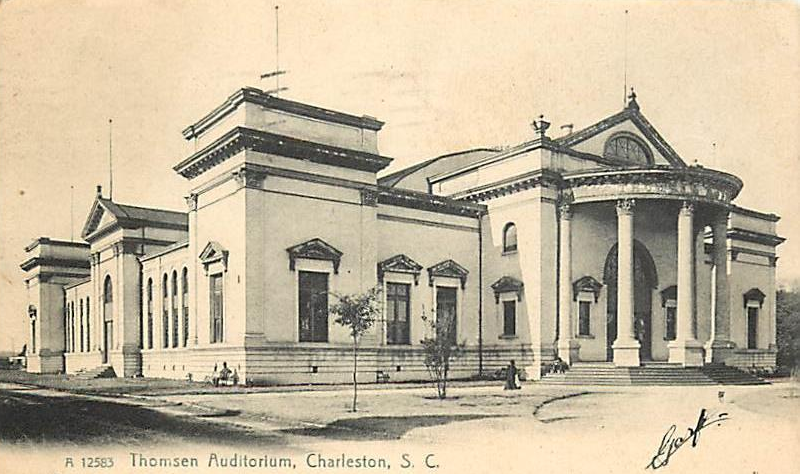
Thompson Auditorium, built for the Confederate Reunion and later became the Charleston Museum. It later burned, with only the columns remaining in Cannon Park.

Thompson Auditorium, built for the Confederate Reunion and later became the Charleston Museum. It later burned, with only the columns remaining in Cannon Park.

1919 – Charleston Riot – Red Summer 

In the words of the Navy investigation,

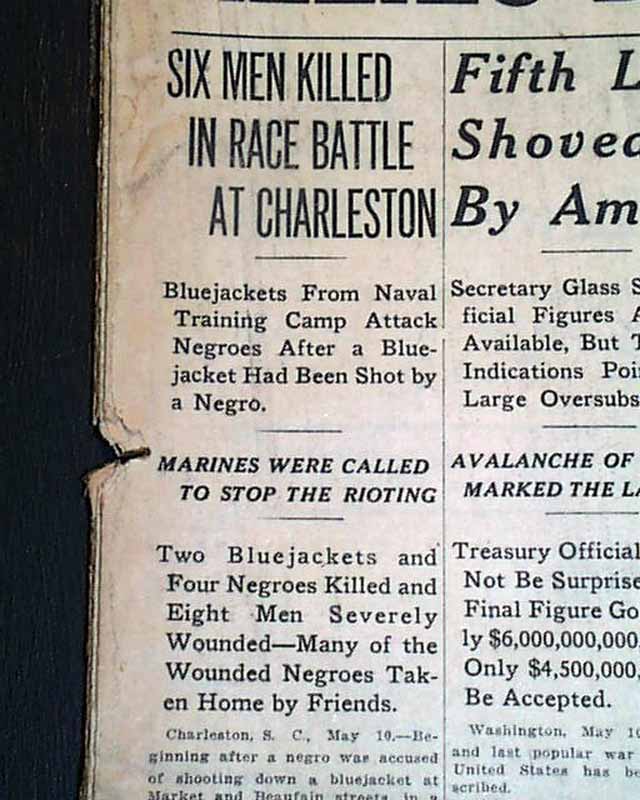
“a disturbance which assumed the nature and proportions of a race riot took place in the city of Charleston, South Carolina, on the night of May 10-11, 1919, between the hours of 7:00 p.m., and 3:00 a.m.”

race riotAt the time, Charleston’s population was 80,000, more than half of whom were black.  On one side of the conflict were black civilians, and on the other was “a mixed crowd of whites” including mostly sailors, along with civilians, and “a scattering of soldiers and marines.” The incident started when an unidentified black man allegedly pushed Roscoe Coleman, U.S. Navy, off the sidewalk. A group of sailors and civilians chased the man, who took refuge in a house on St. Philip Street. A fight then took place there, with both sides throwing bricks, bottles, and stones. The crowd dispersed when one of the black civilians “drew a revolver and fired four shots without injuring anyone.” There followed “wild rumors and stories of a sailor having been shot by a negro” and general rioting. Beginning near Harry Polices’ Poolroom at the corner of George and King streets, rioting spread to other parts of the city and continued with varying intensity until about 3:00 a.m.  

Charleston’s Mayor Hyde requested assistance in restoring order. The Charleston Navy Yard sent a detachment of soldiers and marines to help.“Bluejackets” were rounded up by the Marines and either taken back to the Navy Yard or held at the police station. All blacks were told to get off the streets.

During the riot, both sides used firearms. Sailors stole thirteen 22-calibre rifles from the shooting galleries of H.B. Morris and Fred M. Faress. Rioters robbed and vandalized W. G. Fridie’s barber shop at 305 King Street and James Freyer’s shoe shop, both black-owned businesses. Eighteen black men were seriously injured, as were five white men. Three black men, William Brown, Isaac Doctor, and James Talbot, died of gunshot wounds.

Today In Charleston History: May 9

1780-The Siege of Charlestown

Sir Henry Clinton refused Gen. Lincoln’s terms of surrender for Charlestown and ordered hostilities to commence at 8:00 pm. Lt. Colonel Grimke wrote it was “a most furious cannonade & bombardment which continued throughout the night.” Overnight the British launched 814 shots into the city, and the Americans responded with 380. Gen. William Moultrie called it “a dreadful night.”

1791 – George Washington in Charleston
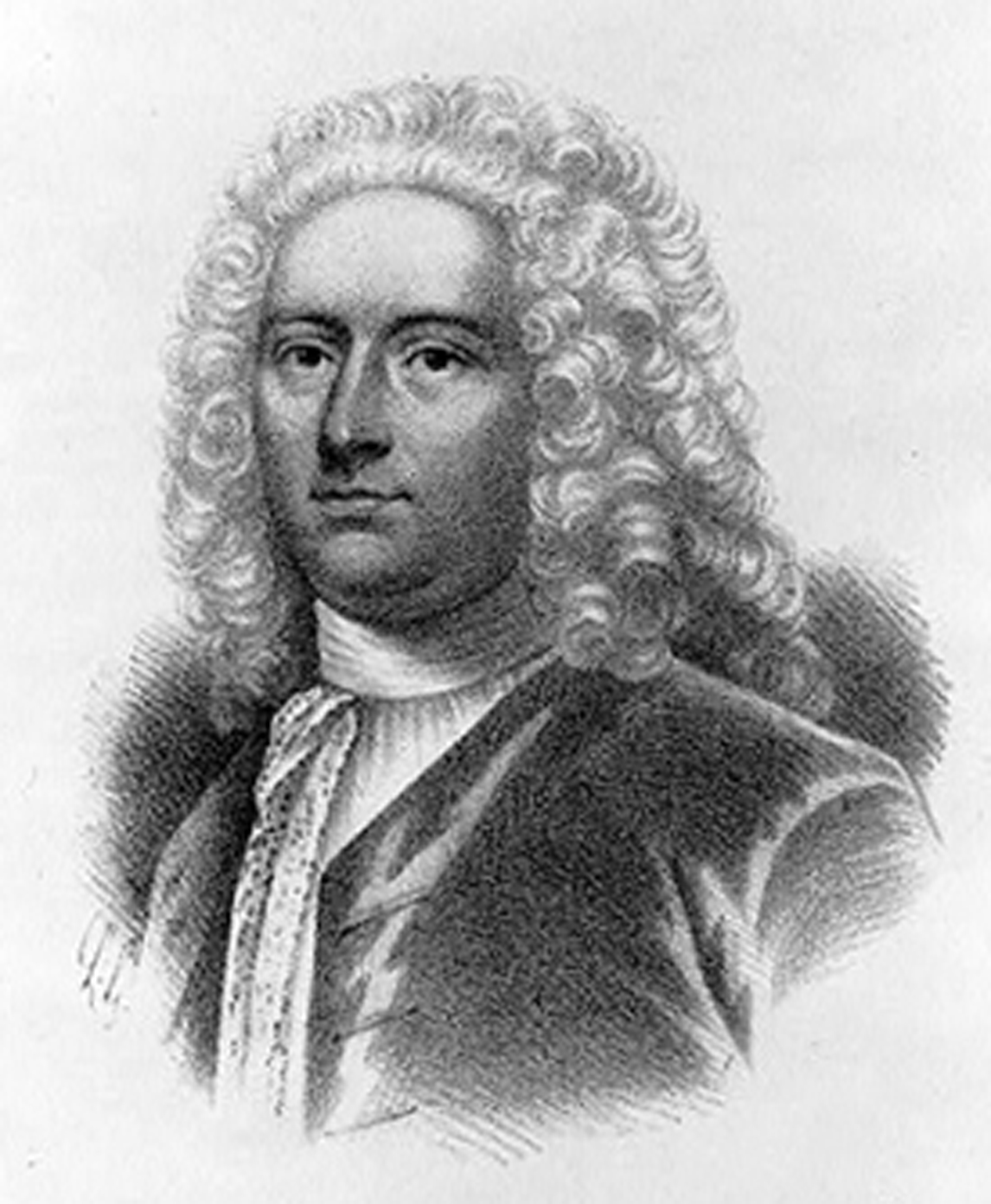
Pierce Butler

Pierce Butler

 Early in the morning Washington left for Savannah in the company of Gov. Charles Pinckney, Gen. Charles Cotesworth Pinckney and Sen. Pierce Butler. They escorted Washington to his cousin’s (Col. William Washington) plantation Sandy Hill for the evening meal and lodgings. Butler remained with President Washington for the entire journey to Savannah, where Butler owned several plantations on St. Simon’s Island.