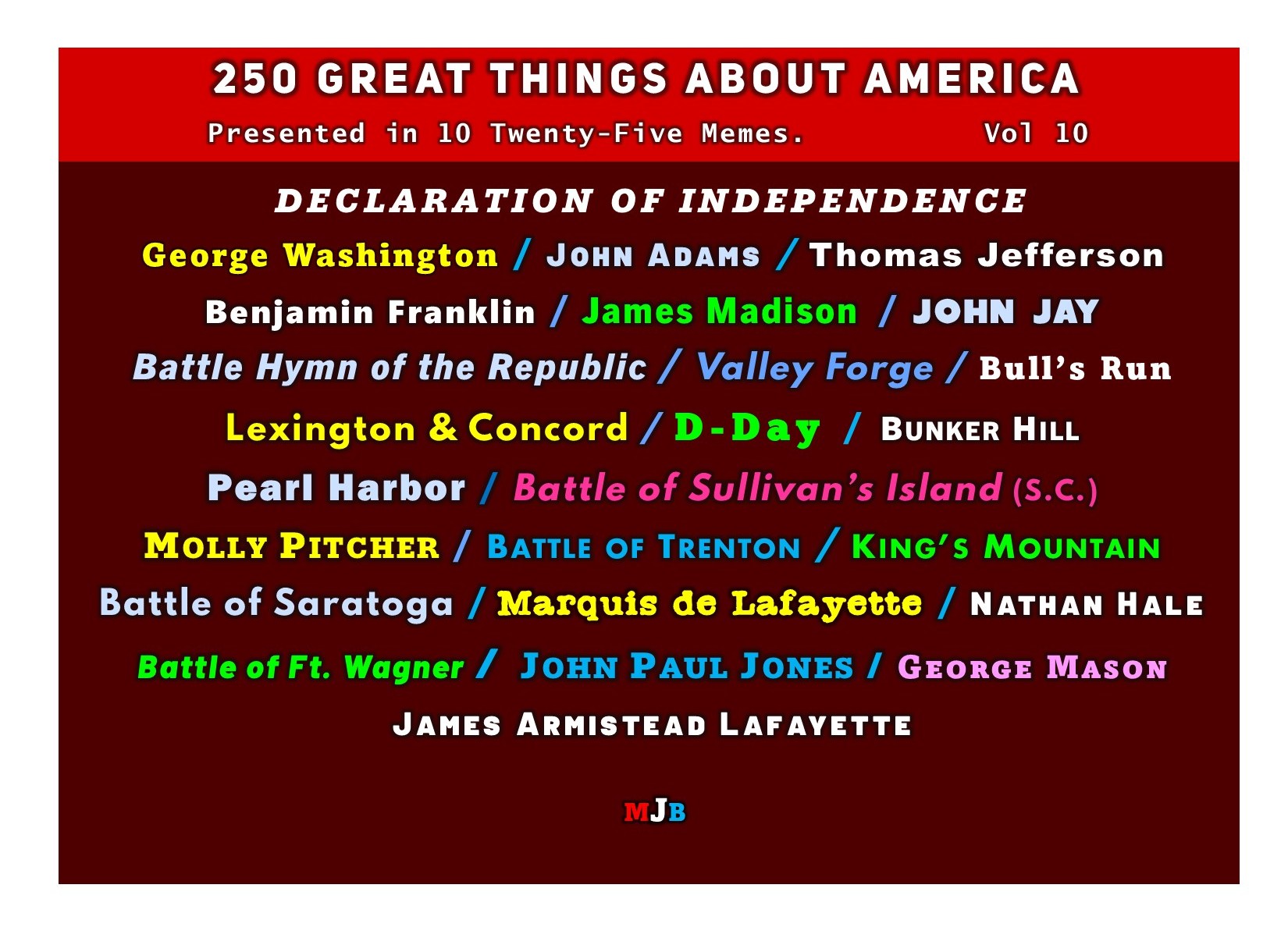
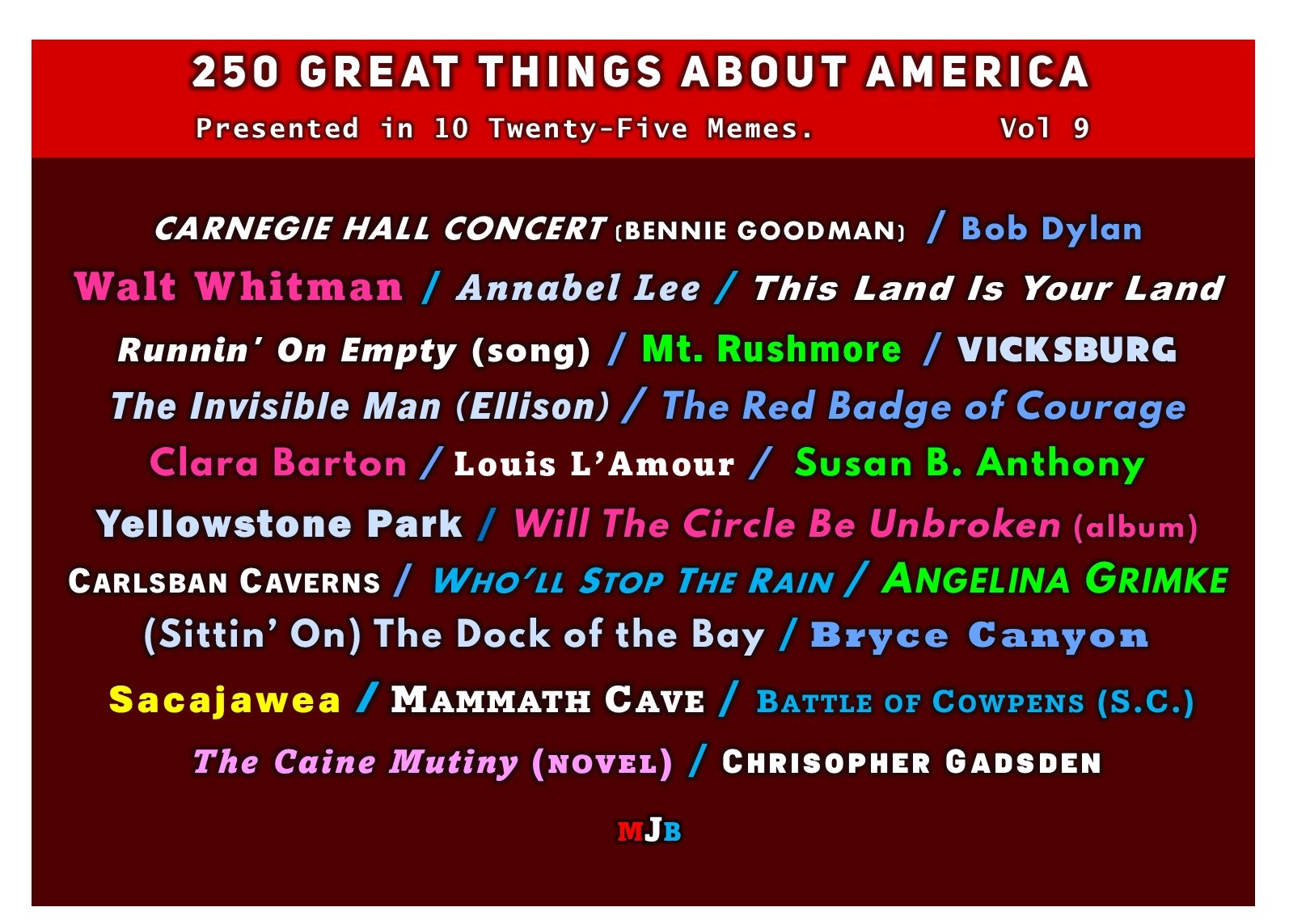
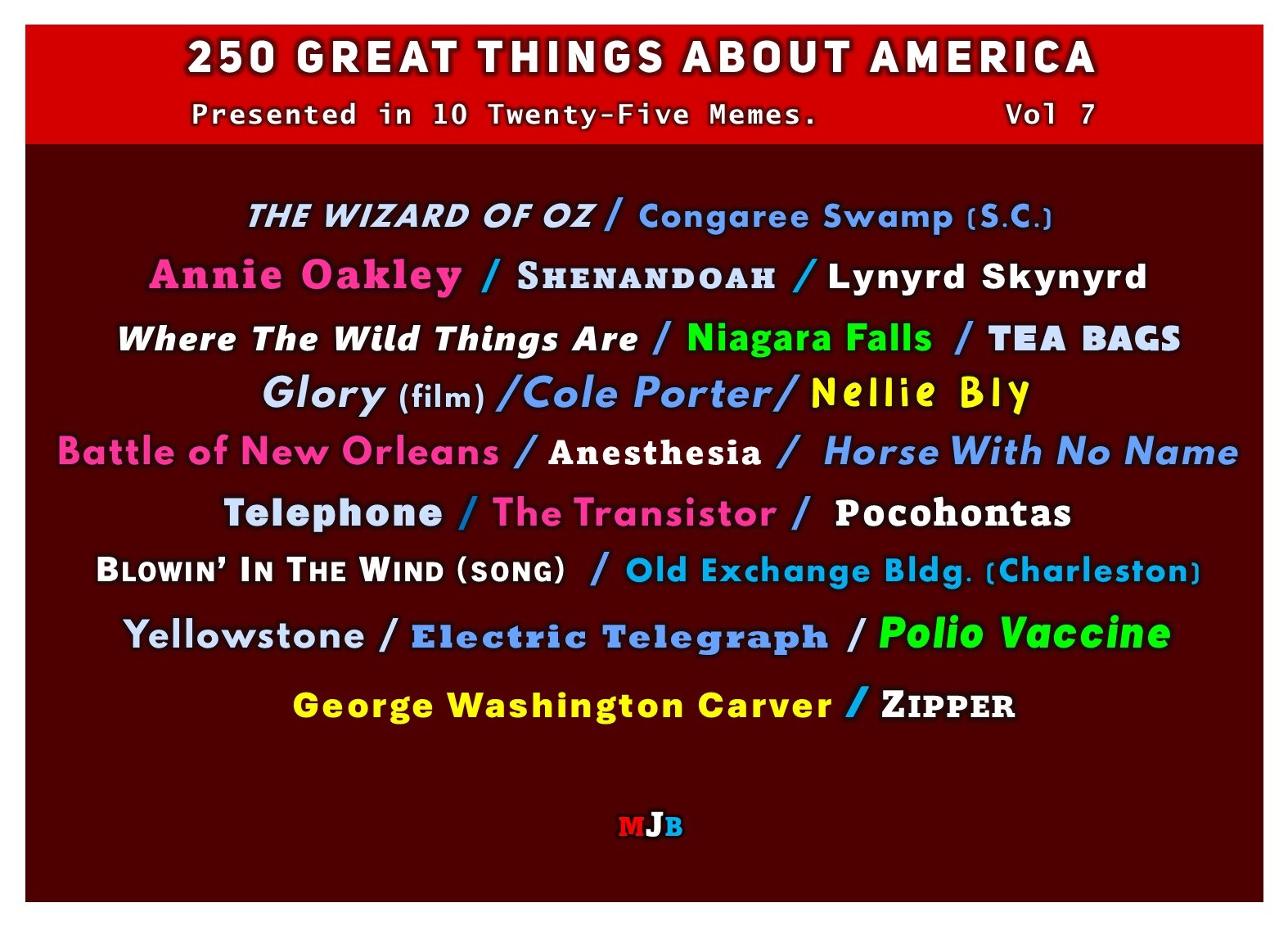
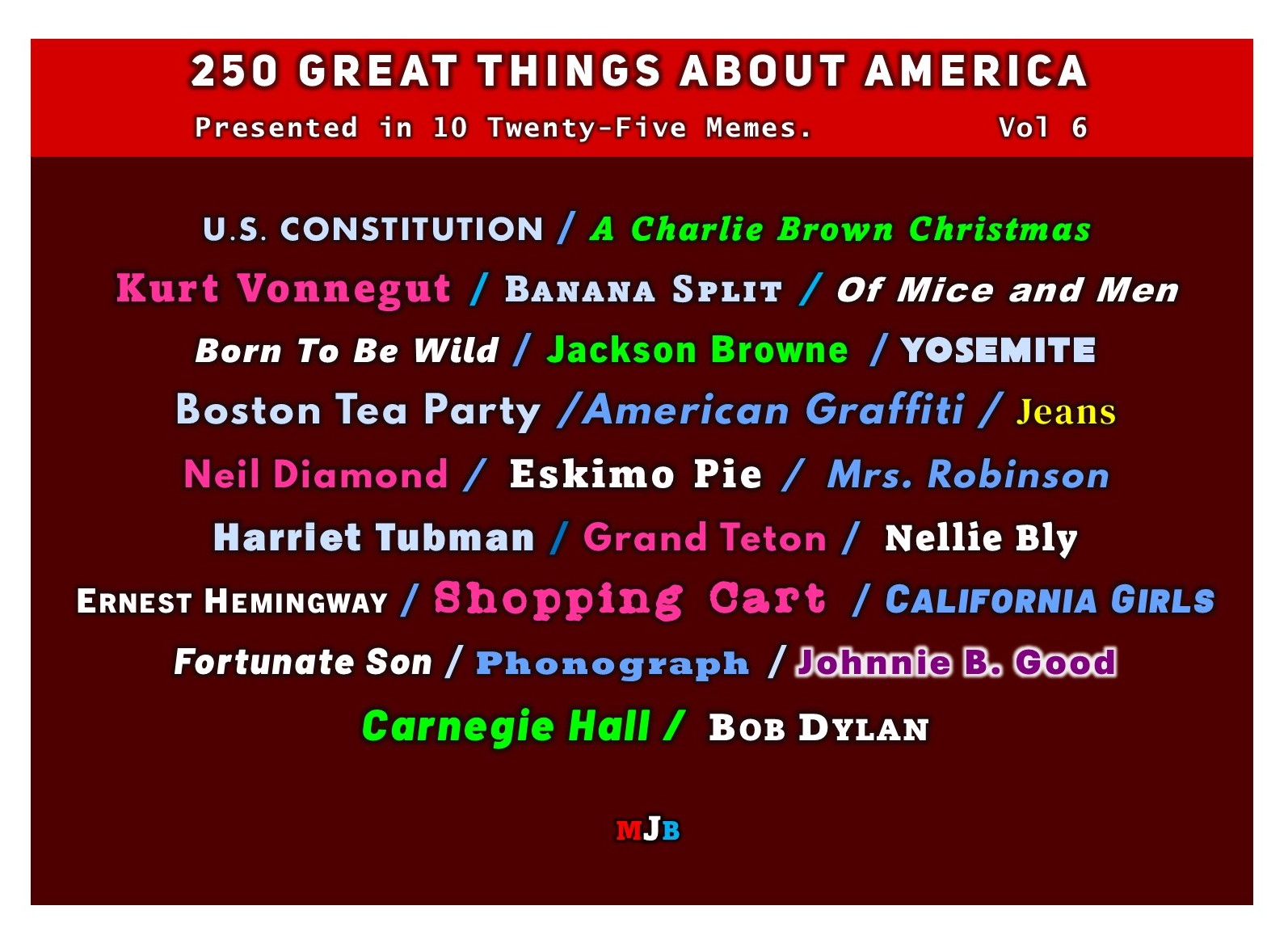
250 Great Things About America, Vol 1.
IDLE & AGITATED: SOUTH CAROLINA GENTRY (Part 1)

Why were the South Carolina gentry more extreme, and more obstinate than other Southerners?
The Colony of a Colony. Unlike most earlier colonists to Virginia and Chesapeake, many early Carolina settlers came not from England, but from Barbados, an important distinction. During the English Civil War (1642-51) Barbados became an asylum for Royalists seeking to avoid the conflict, and the violent Puritanism of Oliver Cromwell. After the 1649 execution of Charles I, Parliament sought to punish Barbados for their loyalty to the monarchy by restricting their trade, creating an economic crisis for the small island. To sustain their economy, Barbadians began to rely on trade with the Dutch Republic, until Cromwell and Parliament passed the Navigation Act of 1651, which banned the use of non-English ships to carry English goods. This essentially prohibited all trade with the Dutch, but Barbadian merchants carried on illicit privateering until England invaded the island and the Royalist Barbadian House of Assembly surrendered. The Carolina colony would soon become the “promised land” for many Barbadian merchants and planters.

In March 1663, Charles II granted the territory called Carolana to the “true and absolute Lords and Proprietors,” eight men who had been instrumental in restoring him to the throne after Cromwell’s death. There was a strong consensus among the Proprietors that the colony could be more easily, and inexpensively, developed luring experienced settlers from established Caribbean colonies by offering large grants in lieu of providing financing. Three months later, John Colleton of Barbados informed the Lord Proprietors that “many citizens were interested in moving to Carolina.” The Colleton family gathered two hundred “Barbadian Adventurers” and engaged Captain William Hilton to explore the Carolina coast to search for suitable settlement sites. Each member of the “Adventurers” was entitled to five hundred Carolina acres for every 1,000 pounds of sugar contributed.

The Proprietors also adopted the Fundamental Constitutions of Carolina, that, they hoped, would establish a “perfect government.” The Constitutions were “a grand and impractical political framework … that envisioned an orderly, quasi-feudal system under their immediate control.” Although never formally adopted, the Constitutions did become the working blueprint for settling and governing the new colony. It offered “religious freedom for anyone who believed in God”, established the Church of England as the tax-supported religion, and forbade Catholicism. It also created a system of government by the landed gentry. To vote a man must own fifty acres and to hold a seat in the Assembly, he must own five hundred. All “free settlers over the age of sixteen” were promised 150 acres, and an additional 100 for every able-bodied servant.” Servants could include family members and “indentured servants”. Every individual that acquired 3,000 acres “would have all the rights of a lord of the manor established by English law.” The Proprietors forbid the enslavement of the local Natives in Carolina but set out specific and strict laws for African slavery, based on the Barbadian system which declared “Every freeman of Carolina shall have absolute power and authority over his negro slaves.”
In April 1670, the first English settlement south of Virginia was established in Carolina, called Charles Town. Barbadians cast a long shadow and influenced much of the life in Charles Town, establishing the model for what became romanticized as “the Old South.” They lived with “a combination of old-world elegance and frontier boisterousness. Ostentatious in their dress, dwellings, and furnishings, they liked hunting, guns, dogs, military titles like ‘Captain” and ‘Colonel’ … They enjoyed long hours at their favorite taverns over bowls of cold rum punch or brandy.”

They also had little interest in the Proprietors’ lofty notions of a perfect government, and quickly controlled the colony by dominating the Council and the governorship. John Coming, from England, wrote that “the Barbadians endeavor to rule all.” The Council claimed that since the Carolina charter was issued after the Navigation Act, it superseded that law and claimed that they “totally disclaimed the authority of the British Parliament in which they were not represented.” So, from the beginning of Carolina, the landed gentry were already at odds with the British authority to regulate their trade, and their lives. Their argument was that since they were governed without representation in Parliament, the Council felt within their rights to ignore the law and trade as they pleased. This would become a recurring theme in South Carolina politics for the next 200 years.
The Bloodless Revolution – Proprietors Overthrown. In 1715, the Assembly officially asked the London Board of Trade to void the Proprietor’s charter. Forty years into the life of Carolina, the Proprietors had become disenchanted with a colony that “failed to produce the great wealth and prestige they had expected.” That disappointment evolved into apathy and soon, the colonists learned to “survive with minimal assistance … from their increasingly passive proprietors.”

The fate of Proprietary Rule was sealed with two events, the devasting, and almost catastrophic Yemassee War (1715-1718), and the battle against pirates (1718-1719.) Both events “provided the colonists with galling evidence that the men in London had placed personal profit above the public welfare.”
At the end of 1719, the South Carolina Assembly convened “a convention of the people” and denounced the rule of the Lord Proprietors. They vowed “to get rid of the oppression and arbitrary dealings of the Lords Proprietors” and declared itself “the government until His Majesty’s pleasure be known.” They officially petitioned King George I to purchase the Carolina colony from the Proprietors.
Governor Robert Johnson, appointed by the Proprietors, refused to acknowledge this new government. In response the Assembly elected General James Moore Jr. as “provisional governor.” During the swearing-in ceremony Gov. Johnson arrived and ordered the militia to disperse and the illegal Assembly to desist. The militia “leveled their muskets at Governor Johnson and bid him standoff.” Johnson ultimately departed for England and for all intents and purposes, the propriety government of Carolina ended. Even though the first royal governor did not appear for eighteen months, the Provisional Government maintained power and steered the colony into a sound economy. At its heart was the concept that the revolution was to protect the “incontestable right” of Englishmen to be governed “by noe laws made here, but what are consented to by them.”
On August 11, 1720, the Lord Justices of Great Britain declared that the colony “shall be forthwith taken provisionally into the hands of the Crown.” South Carolina’s first rebellion was a polite coup d’état. They did not grab the reins of power by force, nor did they imprison their opponents. Rather, it was a “polite and passive-aggressive course of action that reflected a very British sense of honor and decorum.”

Patriots & Printers: The Timothy Family of Charleston
Louis Timothée, the infant son of a French Huguenot, took refuge in Holland with his family following the revocation of the Edict of Nantes. In 1731, Lewis sailed onboard the Britannia from Rotterdam to Philadelphia in with his Dutch-born wife, Elizabeth, and their four small children. Shortly after his arrival in North America, he anglicized his name to Lewis Timothy, swore a loyalty oath to King George II, and placed an ad in the Pennsylvania Gazette (October 14, 1731) seeking employment. By May 1732 Lewis was working with Benjamin Franklin on the publication of the German language newspaper called the Philadelphische Zeitung. He also became a journeyman printer for the Pennsylvania Gazette and the first librarian of the Library Company of Philadelphia.
In 1733 Franklin sent Timothy to Charlestown, South Carolina to succeed the deceased Thomas Whitmarsh in publishing the South-Carolina Gazette, with a six-year publishing agreement whereby Franklin furnished the press and other equipment, paid one-third of the expenses, and was to receive a third of the profits from the enterprise. The South-Carolina Gazette resumed weekly publication under Timothy’s name on February 2, 1734.

Lewis became the official colonial printer and his family were members of St. Philip’s Church Lewis became a founder and officer of the South Carolina Society, a social and charitable organization made up of Huguenots. Lewis organized a subscription postal system originating at his printing office and by 1736 he obtained land grants totaling six hundred acres and a town lot in Charleston.
Lewis died during the Christmas season of 1738 with a year remained on his contract with Franklin. The contract provided for Timothy’s son, Peter, to carry on the business until the contract expired. Due to Peter’s youth, Lewis’s wife, Elizabeth Timothy, assumed control of the printing operation and published the next weekly issue of the South-Carolina Gazette. The publisher, however, was listed as Peter Timothy.
In the first issue of the Gazette, Elizabeth Timothy informed readers that it was customary in a printer’s family in the colonies and in Europe for wife and sons to help with the printing operation. So it isn’t surprising that Elizabeth was able to continue the work of her husband, with the help of her son Peter, then only 13 years old. Elizabeth wrote:
“Whereas the late Printer of this Gazette hath been deprived of his life, by an unhappy accident, I shall take this Opportunity of informing the Publick that I shall continue the said Paper as usual; and hope, by the Alliance of my friends, to make it as entertaining and correct as may be reasonably expected.”
Elizabeth Timothy, as Official Printer for the Province, printed acts and other proceedings for the Assembly. In addition to the Gazette, she printed books, pamphlets, tracts, and other publications. Although the colophon “Peter Timothy” appeared after each, there was no doubt who made most of the decisions in the operation of the business.

Years later, in his autobiography, Franklin described Lewis Timothy as “a man of learning, and honest but ignorant in matters of account; and tho’ he sometimes made me remittances, I could get no account from him, nor any satisfactory state of our partnership while he lived.” On the other hand, he had only praise for Elizabeth Timothy. Franklin wrote she “operated the Printing House with Regularity and Exactitude …and manag’d the Business with suck Success that she not only brought up reputably a Family of children, but at the Expiration of her Term was able to purchase of me the Printing House and establish her Son in it!”

When Peter Timothy turned 21 in 1746, he assumed operation of the Gazette. Prior to taking over the publishing, he married Ann Donavan and their union produced twelve children. His mother opened a book and stationery store next door to the printing office on King Street. She died on April 2, 1757, and was buried at St. Philip’s. Elizabeth Timothy is now recognized as America’s first female newspaper editor and publisher and one of the world’s first female journalists. She was inducted into the South Carolina Press Association Hall of Fame in 1973. A plaque recognizing her unique role in South Carolina business and journalism occupies a spot “on the bay near Vendue Range,” where she last served as publisher of the South-Carolina Gazette. She was inducted into the South Carolina Business Hall of Fame in 2000. She was also featured in my book CHARLESTON FIRSTS.

Her son, Peter, became one of the most widely known Southern journalists of the 18th century. He became postmaster general for Charleston in 1756, and during the Stamp Act Crisis he became deputy postmaster of the southern colonies. Under his guidance, the South-Carolina Gazette became increasingly partisan in the colonial crisis, criticizing Governor James Glen, and supporting the Wilkes Fund. He passionately condemned the Boston Massacre.
He carried on the publication of the Gazette continuously as publisher or proprietor until February 1780, citing his closure due to lack of material due to the British blockade of Charlestown. On the second of August 1776, Timothy began printing the Declaration in the form of broadsides, which would be hung in public places, such as churches, in order to distribute the bold establishment of a new country, separate from Great Britain. It is unknown if Timothy printed several copies which were then destroyed or if he only printed one, as the copy in the Gilder Lehrman Collection is the only known existing copy printed by Timothy. It is also the only surviving copy of the Declaration that was printed south of Philadelphia.

Timothy’s printing of the Declaration had repercussions. In 1780, after the fall of Charlestown to the British, he was arrested for treason by the British and was one of twenty-eight Carolina patriots sent to a prisoner-of-war ship and ultimately, exiled in prison in St. Augustine, Florida.
In 1782, rather than return to Charlestown, Peter Timothy decided to explore the possibility of settling in Antigua. However, during the voyage, his ship sank in a gale off the Delaware capes, and everyone on board drowned.
Peter’s wife, Ann Donavan Timothy, returned to Charlestown and resumed publication of her husband’s newspaper on July 16, 1783, on Broad Street. Nine years later, she was succeeded as publisher by Benjamin Franklin Timothy, her son and Elizabeth Timothy’s grandson.
Thus we have two women in Colonial America, who took over their husband’s career as publisher/editor of the most important publication in the South during that time.
The Greatest GREATEST HITS Albums
I have never considered “Greatest Hits” or “Best Of” collections as REAL albums. Most of them are simply a record company’s device for easy profits, often issued with no approval or assistance from the artist, and sometimes, against the artist’s wishes. However, for many artists with just a handful of hits, “Best Of” collections are usually the only album most of us will ever need to own.
However, there are a few collections that have had such enduring success, and in some instances re-defined an artist’s career, to the point that they are essential additions to their catalogue. Here are my greatest “Greatest Hits,” listed alphabetically by artist.
ENDLESS SUMMER / The Beach Boys (1974)
Endless Summer was compiled by their old label, Capitol Records, following the success of the film American Graffiti, in which several Beach Boys songs were featured. After years of lukewarm sales, this album revitalized the band’s popularity and inspired nostalgia for their early surfing and hot rod-themed music. Four months after its release, the album reached number 1 in the United States and Canada. It was the group’s second chart-topping album in the US and returned them to a level of commercial success they had not experienced since the mid-1960s. A pale version of the Boys tour every year on the Oldies circuit, mainly because of this album.
1962-1966 – (Red Album) / The Beatles (1973)
1967-1970 (Blue Album) / The Beatles (1973)
These two compilation albums were released simultaneously and helped cement the Beatles’ legacy for the next generation (Me) who were too young to remember the initial Beatlemania. We grew up with the solo Fab Four on 70s radio. The legacy of the Beatles was assured well before these releases, but these two double albums served as a portal for the discovery of their collective brilliance retroactively for kids into the 90s.
The success of these two compilations inspired Capitol’s repackaging of the Beach Boys’ 1960s hits with the Endless Summer the next year.
CHANGESONEBOWIE/ David Bowie (1976)
Eleven songs from the 1969–1976 period, starting with “Space Oddity” to “Golden Years.” It also included single versions of both “Ziggy Stardust” and “Suffragette City.”
CHRONICLE, VOL. 1 / Creedence Clearwater Revival (1976)
This collection of 13 A-sides and seven B-sides from Creedence Clearwater Revival. For a band who ruled AM radio from 1968-71, putting eighteen songs on the charts (14 in the Top 10), this is an essential collection.
LEGEND / Bob Marley (1984)
The best-selling reggae album of all-time, with over 12 million sold in the US, and an estimated 25 million copies sold globally. It contains all ten of Bob Marley’s Top 40 hit singles in the UK up to the time, plus three songs from the original Wailers with Peter Tosh and Bunny Livingston in “Stir It Up,” “I Shot the Sheriff,” and “Get Up, Stand Up.”
THE HITS 1&2 / Prince (1993)
Unless you are a completist … for the casual fan this is the ONLY Prince release you need to own. Chock full of B-sides and alternate takes, while also featuring the dozen+ of Prince’s most popular songs.
HOT ROCKS 1964-1971 / The Rolling Stones (1971)
It became the Rolling Stones’ best-selling release of their career and an enduring and popular retrospective. The album includes a mixture of hit singles, such as “Jumping Jack Flash”, B-sides such as “Play with Fire”, and album tracks such as “Under My Thumb” and “Gimme Shelter.”
The album has gone 12-times Platinum in the United States and traces the Stones from their initial hits “Time Is On My Side”/“Satisfaction”/“Under My Thumb” years to “Sympathy For the Devil” and “Brown Sugar.”
DECADE / Neil Young (1977)
This one is rare: a Greatest Hits collection from an artist who actively complied it, which became a template for the box set collections that would follow in the 1980s and beyond. Decade is a extensive deep dive into the first decade of Young’s career, 35 songs recorded between 1966 – 1976. The liner-notes were written by Young himself, giving the collection a rare insight that is often missing in most “Best Of” collections.
How South Carolina Started The War of Northern Aggression
Historical Echoes – May
Historical Echoes – April
R.I.P. Gary Rossington
“Whiskey bottle. Brand new car. Oak tree you’re in my way.”
Gary Rossington, the last surviving original member of Lynyrd Skynyrd, died on March 5, 2023. No cause of death was given, although Rossington had battled several heart problems, including emergency heart surgery in 2021. He is survived by his wife Dale, and two daughters.
I was a teenager in South Carolina during the 1970s and Skynyrd was a major part of the soundtrack of those years. Their music was blasting from every car 8-track player in our small town. Now, at age 63, after attending more than 200 live concerts in 50 years, I can safely say Skynyrd was the greatest live band I ever saw, and the greatest concert I ever attended was in 1976, The Outlaws & Lynyrd Skynyrd.

Rossington’s death of what most would call “natural causes” was something of a miracle for a man who lived a successful, turbulent, and somewhat charmed rock star life. Labor Day weekend 1976, while under the influence of alcohol and drugs, he crashed his new Ford Torino into a tree, which led to their song, “That Smell.”

Thirteen months later, Rossington survived the 1977 plane crash that killed band members Ronnie Van Zant and Steve Gaines, as well as backup singer Cassie Gaines, a road manager and the pilots.
Despite breaking both arms, legs, wrists, and ankles, as well as his pelvis, Rossington recovered from his injuries. He battled serious drug addiction throughout the next several years, largely the result of his heavy dependence on pain medication taken during his recovery from the plane crash.

In 1980, Rossington co-founded the Rossington Collins Band with fellow Skynyrd guitarist, Allen Collins. During that time Rossington married fellow band member, Dale Krantz. The band released two albums but disbanded in 1982 after the death of Collins’ wife, Kathy.
If I leave here tomorrow
Would you still remember me?
For I must be traveling on now
‘Cause there’s too many places I’ve got to see.

U.S. Custom House – Charleston, SC
By the 1840s, due to increased Atlantic trade, the U.S. Custom Service had outgrown their office in the Exchange Building. Congress appropriated funds in 1847 and a waterfront site known as Fitzsimmon’s Wharf on the Cooper River was purchased for $130,000. When construction began and while digging the foundation workers found the remains of Craven’s Bastion, a Colonial-era fortification. Due to the marshy location, a grillage of timber was constructed to support the weight of the building. In 1859, with South Carolina’s secession becoming more possible, Congress refused to allocate funds and construction ceased.
In 1867, Congress revived the construction and it was completed in 1879. The original design included a large dome and four porticos, one on each side. However, due to post-War financial concerns, only the east and west porticos were completed, eliminating the north and the south.
In 1903, President Theodore Roosevelt appointed William C. Crum, MD, graduate of the Avery Institute, University of South Carolina, and Howard University Medical School as port collector. Crum was the son of Darius Crum, a German American, and Charlotte C. Crum, a free woman of color. He grew up near Orangeburg. Returning to Charleston, he began his practice and later joined the staff of the Crum joined the staff of the African American–operated McClennan Hospital and Training School for Nurse and eventually became the hospital’s chief administrator and Charleston’s most prominent black resident. In 1883 he married Ellen Craft, the daughter of the famous fugitive slave abolitionists William and Ellen Craft of Georgia.
The New York Times and the New York Herald criticized the nomination as ill advised. In South Carolina, U.S. Senator Ben Tillman and the editor James C. Hemphill of the Charleston News and Courier jointly denounced Crum. Tillman exclaimed, “We still have guns and ropes in the South.” James C. Hemphill wrote that Crum “is a colored man and that in itself ought to bar him from office.” Tillman temporarily derailed the nomination, but Roosevelt kept Crum in the position through interim appointments, until his January 1905 confirmation. There are remnants of Dr. Crum’s tenure inside the Custom House. There is evidence of a metal structure placed in the front of his office giving the collector a safe place to hide. As well as a desk believed to belong to Crum. Resigning his office in 1909 when President William Taft took office. In 1910 he was appointed the Minister to Liberia. by Pres. McKinley, a more traditional posting for an African American.
In 1908, Dr. Crum appointed Mr. Clarence O. Brown, an African American, as collector of customs, where he served for nearly half a century. He later received the Treasury Department’s Albert Gallatin Award for distinguished service.