Black History Month: Freddie Green – “Mr. Rhythm.”

Frederick “Freddie” William Green (guitar, banjo, vocals,) 1911-1987

“Rhythm guitar is like vanilla extract in cake. You can’t taste it when it’s there, but you know when it’s left out.” – Irving Ashby

Freddie Green had the longest job in jazz history – guitar player in the Count Basie band from 1937 until his death fifty years later. In a Downbeat article in 1939 Billie Holiday was asked about marriage and she said:

I’ve loved three men. One was a Marion Scott, when I was a kid. He works for the post office now. The other was Freddie Green, Basie’s guitar man. But Freddie’s first wife is dead and he has two children and somehow it didn’t work out. The third was Sonny White, the pianist, but like me, he lives with his mother and our plans for marriage didn’t jell. That’s all.

63_jazzpodium

Freddie Green, cover of Jazz Podium

Freddie was born Charleston, South Carolina in 1911. He lived at 7 Dalts Court near Rutledge Avenue. Freddie’s first musical memories were at home. His father played the pump organ and his mother sang in the AME Church choir. He played the ukulele and sang baritone in barbershop quartets as a kid. They performed Irish songs on the street corners of Charleston for nickels and dimes. He was also a good dancer. That’s how he first ran into the Jenkins Orphanage Band. Green recalled: 

They used to come into my neighborhood. The minute I heard that brass I used to stop whatever I was doing and follow them all over the city … There was a group called the Nighthawks in Charleston and the trumpet player’s father was one of the teachers at the Jenkins Orphanage. His son was Samuel Walker. He was a terrific trumpet player so he had this group. I think it was trumpet, drums, saxophone, and piano … Most of the bands back in those days had banjos.

Freddie Green’s father died and at the age of twelve Freddie moved to New York City to live with his maternal aunt. They had an apartment in Harlem, on 141st Street, between Seventh and Eighth Avenues, close to The Rhythm Club. That was where Freddie heard Jelly Roll Morton for the first time.  He attended PS-5l, located near 141st Street and Edgecombe Avenue, but left school at age sixteen. He remembered:

My aunt used to give house rent parties in Harlem. And she used to hire a guy to come in and play the piano. His name was Rock. He was a stride piano player. I really enjoyed the way he played. My aunt would keep drinks on the piano for him.

I made a friend with one of the guys in the neighborhood who was supposedly the baddest guy in the neighborhood. I think we had a fight one day. And after a while, I think I kind of knocked him down. And everybody was amazed that I did that to the bad guy. So then he and I were real close friends. And he was the leader of the gang on the block. We used to go around on different corners, that’s when the Charleston was out and I could always dance.  So he had a ukulele and we used to go on corners and dance.

Freddie Green returned home to Charleston for his mother’s funeral. His former neighbor from Dalts Court, Leotha Elmo, met him at the train station. She became Freddie’s girlfriend and later, his wife. He recalled how he became a professional musician:

There was a professor of brass instruments at Jenkins. Professor Blake was his name. We became good friends. I used to go to his house. He was a graduate of Howard University. He was a tuba player. On Sundays we would go through his library where his music books would be, and he’d help me. We would use a blackboard. We would go through the routine of scales, and what not.

My father-in-law was a contractor [in Charleston] and I used to help him quite a bit doing odd jobs and what-not … I tried all kinds of jobs and I was never pleased with whatever I did until music came.

We had our first kid. Then I left Charleston. The Jenkins [Orphanage] group had a show. They were going to tour the state of Maine. I left with them [as a non-resident of the orphanage and a grown man] and went up to Maine with this show they had. Went on the road with them with my banjo. We toured the state of Maine playing in Grange Halls, whatever they had up there in order to accommodate this traveling show. It was something! I don’t think we got paid. We played for contributions and the like.

The band had two alto saxes, one tenor sax, two trumpets, two trombones, one tuba, one banjo [Freddie] and drums. We used to have to get up around noon and play all through the streets … a parade, you  know. We were in the small towns of Maine. And we had dress uniforms that we wore.
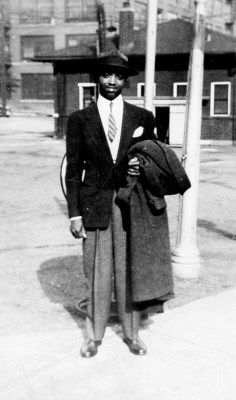
green2

Freddie Green, 1940s

The Jenkins Band stopped in New York and Freddie decided to stay. He sent for Leotha and their son to join him.

During the early 1930s Freddie had two jobs in New York, working at a factory upholstering chairs during the daytime, and playing in a dance trio at night.

I was working in a club called the Yeah Man Club. I knew how to play the ukulele. And the banjo, well, I could tune it, you know what I mean (laughs). Then I got a few books on banjo chords. As soon as I picked up the banjo, the guitar came in (laughs).

At the Yeah Man I was playing banjo. And the manager of the club said “Well, everybody’s playing guitar now. You have to get a guitar, okay?” I got one from a music store on 47th Street. King’s Music Store. I bought it on time.

In 1937 Freddie was hired at the Black Cat Club in Greenwich Village for eleven dollars a week. Record producer and talent scout, John Hammond was a regular customer at the Black Cat. Hammond later achieved mythical status for his keen eye of spotting talent. Through the years he was given credit for “discovering” Billie Holiday, Pete Seeger, Count Basie, Aretha Franklin, George Benson, Bob Dylan, Bruce Springsteen and Stevie Ray Vaughn. In his autobiography John Hammond on Record he discussed his first impressions of Green:

One of my favorite clubs was the Black Cat, a mob-owned joint. The band included two cousins, the drummer Kenny Clarke and the bass player Frank Clarke, but it was the guitarist that interested me the most. His name was Freddie Green, and I thought he was the greatest I had ever heard. He had unusually long fingers, a steady stroke, and unobtrusively held the whole rhythm section together. He was the antithesis of the sort of stiff, chugging guitarist Benny Goodman liked. Freddie was closer to the incomparable Eddie Lang than any guitar player I’d ever heard. He was perhaps not the soloist that Lang was, but he had a beat.
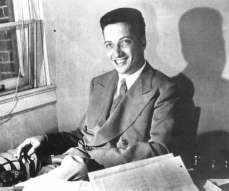
john hammond, 1939

John Hammond, 1939

Hammond had brought the Basie Band from Kansas City to New York and he thought a good rhythm guitar was the missing piece for the band’s sound. Green auditioned in Basie’s dressing room at Roseland. When the Basie Band left for Pittsburgh the next day, Freddie Green was on the bus and he stayed on it for the next five decades.

In 1938 the Count Basie Orchestra became one of the leading dance bands in America, due in part to what has been called “the All-American Rhythm Section”: Count Basie, piano; Jo Jones, drums; Walter Page, bass and Freddie Green, guitar.

cb02

The All-American Rhythm Section, (L-R): Freddie Green, Jo Jones, Walter Page, Count Basie.

As the years passed, Freddie Green’s importance to the Count Basie Band increased. The numerous nicknames he acquired are good illustration of his musical stature: “Esquire” – because he was such a cool gentleman; “Pepper” or just “Pep” short for “Pepperhead”, because his head was shaped like a pepper; “The Fourth Wheel”, short for “the fourth wheel on the Basie band wagon”, “Quiet Fire” and “Mr. Rhythm.” Count Basie called Freddie Green “my left hand.”

Buck Clayton, trumpet player with Basie explained, “Basie never did play much with his left hand, so Freddie substituted for it.” Basie’s adopted son, Aaron Woodward III said, “… everyone knew Freddie’s position was of equal importance to Dad’s.”

Quincy Jones, who arranged for Basie as a young man before becoming more famous as Michael Jackson’s musical mentor and producer, said about Freddie:

That man is a sort of spirit. He doesn’t talk loud and he doesn’t play loud. But man! You sure know he’s there.

The brass and reeds can be up there shouting away, but there’s Freddie, coming right through it all, steady as a rock and clear as a bell. He’s something special. What he represents is the only one of its kind in existence.

green - mr rhythm

Freddie Green’s 1955 solo swing classic LP. Author’s collection

Saxophonist Paul Quinichette once observed of Green:

He’s got it right there, in his wrist. What he has is the key to a musical era, an unmatched mastery of big band rhythms.

Green did not live the stereotypical life of jazz musicians. He ate smartly, rarely drank or smoked. Even while on the road with the Basie band, he rose at 7 or 8 a.m. each morning to take a long walk or play golf. Singer Joe Williams, recalling his own philandering youth, says:

At a critical time, Freddie took me aside and advised, “Take some and leave some. Don’t try to get it all. You’ll enjoy it more and you’ll last much longer, no matter what it is.” Since it came from Freddie Green, who doesn’t say that much, he only had to say it once, and I’ve never forgotten it.

When Charlie Christian introduced the electric guitar with the Benny Goodman in 1939, the jazz world changed dramatically. Freddie, however, continued to use his acoustic guitar on stage. Harry Edison recalls:

Charlie Christian and he [Freddie] were very close friends, and Christian gave him an amplifier. But whenever Freddie would lay out of the band to take his solo, the whole rhythm section used to fall apart. It got to the point where we had to do something about it. So one night I would remove the plug from Freddie’s amplifier wire and it wouldn’t work. Next night Herschel Evans would break a wire in it so it wouldn’t play, and Freddie would have it fixed … So finally we took all the guts out of the amplifier. Freddie got ready to play one night and there was nothing but a box. Naturally he got furious but nobody paid him any attention. So he reached a point where he said, “Well, to hell with it. I won’t play anymore solos.” So that’s the reason he’s not a soloist today. He probably could have been one of the best at that time, but we had to sacrifice him for the good of the band.

One of the greatest Freddie Green stories was how Freddie re-hired himself to play with Basie in 1950. After World War II most of the big bands were struggling to make money. So, Basie, like other top bands, was forced to downsize. He put together a small group that included Clark Terry, Buddy DeFranco, Bob Graf, Jimmy Lewis, and Gus Johnson. They worked a month at the Brass Rail in Chicago. Everyone in the audience was surprised that Freddie Green was not with the group.

When the sextet met in New York for their next gig, Green was sitting on the bandstand with his guitar. Clark Terry recalled the dialogue between Basie and Green:

Basie: “Say, Pep, you’re not on this gig, are you?”

Green: “You’re workin’, aren’t you? After I gave you the best years of my life, you think you’re going to leave me now?”
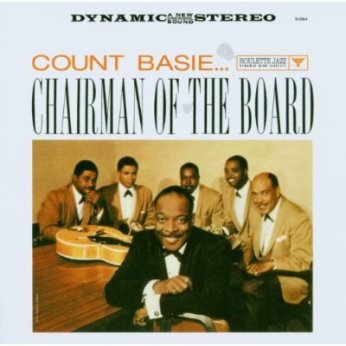
basie, chairman board

So the sextet became a septet and Freddie Green remained the anchor of the rhythm section until his death. During his career Freddie Green performed worldwide, made over 1,000 recordings with the Basie band, and appeared as a sideman on over 700 recordings by other jazz artists.  The list of artists he recorded with are a Who’s Who of the 20th century: Mildred Bailey, Emmett Berry, Ruby Braff, Kenny Burrell, Benny Carter, Buck Clayton, Al Cohn, Harry Edison, Duke Ellington, Herb Ellis, Karl George, Benny Goodman, Lionel Hampton, Woody Herman, Billie Holiday, Illinois Jacquet, Jo Jones, Joe Newman,  Paul Quinichette, Jimmy Rushing, Pee Wee Russell, John Sellers, Sonny Stitt, Joe Sullivan, Jack Teagarden, Joe Turner, Earl Warren, Dicky Wells, Teddy Wilson, and Lester Young.

green with ellington and  basie

Duke Ellington, Freddie Green, Count Basie

Through the years Freddie Green also became the gauge of quality. Byron Stripling, trumpet player with Basie said, “If an arranger comes in and his work is jive, Freddie just shakes his head and it’s all over.”

According to Dennis Wilson (trombone), all new Basie Band members had to deal with:

… the intimidation of Freddie Green. You never know if Freddie likes you. It worries you until that mystical, magical day when he finally says a couple of words to you. Then you know you’re okay, and you realize he hasn’t been testing you; he’s been allowing you to test yourself.

When Count Basie died in 1984 almost every publication in the world offered a eulogy. Freddie Green simply said: “I’ve been with the band since 1937, what am I to do now?”

Thad Jones, the popular trumpeter and Basie sideman, was chosen to take up the reins of the Basie Band after the Count’s death. He commented:

I don’t think it’s possible to speak of the Basie band without Freddie Green. He’s the link that keeps the tradition alive. He’s the dean, the guy we look to for that spiritual thing.

In the May 1983 issue of Guitar Player, Jim Hall wrote:

If you pruned the tree of jazz, Freddie Green would be the only person left. If you have to listen to only one guitarist, study the way he plays rhythm with Count Basie.

One of the longest and quietest careers in musical history came to a conclusion on March 1, 1987.  Freddie Green died of a heart attack after playing a Basie show in Las Vegas. Tributes and obituaries poured in from all over the world. Several days later, what was intended to be a surprise tribute to Green in Los Angeles organized by jazz critic Leonard Feather was turned into a memorial featuring the Basie band, vocalist Sarah Vaughan, and guitarist Kenny Burrell. Los Angeles mayor Tom Bradley declared March 19 Freddie Green Day.
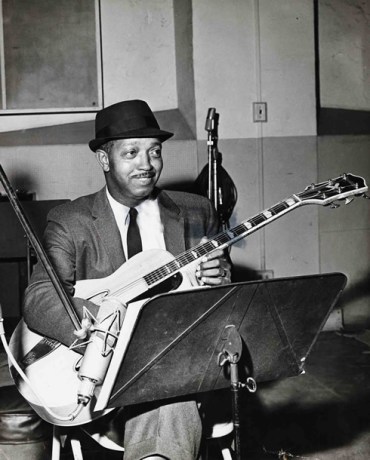
greenfreddie-003-ijs

Freddie Green, “Mr.Rhythm”

Sonny Cohn said, “The most important part of your body is your heart. It keeps everything else going. That’s what Freddie does.”

Dennis Wilson, a trombonist and composer-arranger with Count Basie said, “It’s as if in the Bible they said, ‘Let there be time’, and Freddie started playing.”

Freddie’s son, Al Green, eulogized his father:

Dad had a quiet dignity about him, with a demeanor of an elder statesman, unassuming, diplomatic, and fair. I spent three days with Dad to celebrate his Grammy nomination as a member of The Swing Reunion album. As we got dressed for the affair that evening, he asked if I would help him with his bow tie, a kind of reversal of roles that we both acknowledged warmly. After the Grammys when we were departing, we kissed and embraced, (not knowing that it would be for the last time), he said, “I really enjoyed this time we got to spend together. It was special.”

You’ve lost Mr. Rhythm. We’ve lost our Dad. I’ve lost my hero.

Freddie once discussed about his role in the Basie band:

The main thing is the Basie band. I get a joy out of keeping the band together and supplying the soloists with a foundation. That’s more soloing to me than soloing. I’ve played rhythm so long that it’s just the same as playing solos as far as I’m concerned. The rhythm guitar is very important. A performance has what I call a “rhythm wave”, and the rhythm guitar can help to keep that wave smooth and accurate. I have to concentrate on the beat, listening for how smooth it is. If the band is moving smoothly, then I can play whatever comes to mind, but that doesn’t happen too often.

      I feel responsible for keeping my part in the structure going, as from the original band. I do what I do. That’s enough.  It’s given me a whole lot of joy, pleasure, good feeling. And some bad feeling which goes with everything – you’ve got to take the bitter with the sweet. I’m part of it, and I’m doing a job, and that’s it. I realize that the public likes the band. And I appreciate it. And I think that’s what keeps us going. I go along. After all, you have to live.

greenfreddie-rhythm section

The rhythm section at work. 


FREDDY GREEN DISCOGRAPHY

Selected Count Basie Recordings:

  • The Complete Decca Recordings, 1937-39. Verve, 1992
  • Count Basie Live – 1938 At The Famous Door, NYC. Jazz Hour Records, 1997
  • April In Paris. Polygram Records, 1956
  • The Complete Atomic Basie. Blue Note Records, 1958
  • Chairman of the Board. Blue Note Records, 1958

Other Recommended Recordings:

  • Rhythm – Freddie Green. Fresh Sound Records.

These are the only recording sessions available with Green as band leader. As one would expect, its filled with sharp, tight arrangements of swinging songs, all propelled by Freddie’s steady rhythm guitar playing.

  • Billie Holiday – The Legacy. AMG, 1991.

This three-boxed set offers more than 50 songs that cover Lady Day’s career. Twenty-three of the songs feature Freddie’s very audible guitar strumming.

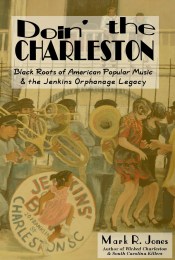
From the book Doin’ the Charleston (2013)
1. doin book cover (create space) official - front

The Irrepressible Daisy Breaux

In 1864 a young girl was born in Philadelphia. She was christened Margaret Rose Anthony Julia Josephine Catherine Cornelia Donovan O’Donovan. Her friends called her “Daisy.” Her father, Cornelius McCarthy Moore Donavon O’Donavon, died when she was three, and her mother moved to New Orleans and married Gustave Breaux, a wealthy member of an aristocratic French family. 

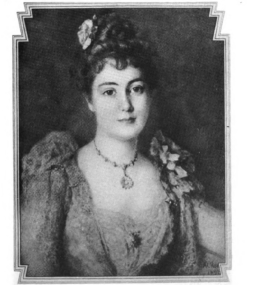
daisy breaux - Copy

From New York Public Library – Public Domain. Author’s Collection.

Daisy was brought up in wealth and high southern society. She became known for her smart alecky sense of humor and attitude. When schoolmates would make fun of her – “Why do you have a French name and look so Irish?”- she usually responded with a slap in the face. However, once she started turning the heads of boys, Daisy became a popular girl. So much so that her mother sent Daisy off to the Georgetown Visitation convent school in Washington, D.C.

After her schooling was finished Daisy returned to New Orleans and fielded dozens of offers of marriage. In 1885 she married a wealthy Charleston banker, Andrew Simonds, who had lavished her with gifts like a diamond necklace and diamond pendant. She wore both at the altar.  

In Charleston, Daisy immediately turned heads. The couple was given a new house on the Battery as a wedding present and Daisy was told her to “decorate it anyway you wish.” She erected scaffolding in the drawing room and personally painted clouds with roses on the ceiling … all while receiving formal guests. Daisy was also fond of giving her guests unflattering nicknames, which she then proceeded to use in public. There was one grand old Charleston dame who always wore a tiara whom Daisy called “the Comb.” Another woman with unfortunately prominent teeth became known as “the Piano.” 

However, the most shocking event may have been when Daisy ordered her wedding present destroyed and a new mansion was built in its place at 4 South Battery.  It was an Italian Renaissance villa with four Corinthian columns along the front, designed by Frederick P. Dinkelberg who later became famous as the designer of the Flatiron Building in New York.    

In 1905, Simonds’s premature death left Daisy and their 5-year-old daughter, Margaret, in a precarious financial position. Ever the practical woman, Daisy turned her Charleston home into a luxury hotel. She named it after herself: the Villa Margherita — “margherita” being Italian for “daisy.”

south battery - villa margarite - postcard

The “Villa Margherita” (to the left) at 4 South Battery, Charleston, SC. Author’s Collection. 

Daisy invented the hotel’s motto out of fractured Latin: “Sic tibi pecunia non intrare non licet est.” Daisy translated it as: “If you ain’t got no money you needn’t come around.” She leased the property to Miss Ina Liese Dawson, who operated the Villa Margherita, serving wealthy northerners on their winter excursions to South Carolina for hunting expeditions, including Henry Ford and Alexander Graham Bell.

Daisy met her second husband, Barker Gummere Jr., when they both happened to be aboard the same yacht during a congressional junket to the Panama Canal. Gummere was a banker whose political influence earned him the nickname the “Kingmaker of New Jersey.” Their 1907 wedding took place in Charleston at the Villa. 

daisy portrait - from receipes of a

Daisy Gummere. Courtesy Library of Congress

Daisy then designed another house — a mansion called Rosedale on 57 acres that Gummere owned near Princeton. Again, tragedy cut the marriage short when he died of pneumonia in 1914. Daisy hired nine teachers and transformed Rosedale into a private academy for girls, enrolling her daughter as the first student.

Four years later, she married her third husband, Capt. Clarence Crittenden Calhoun. He was a Kentucky lawyer and Spanish-American War veteran with a lucrative law practice in Washington. Daisy became one of the most renowned hostesses in Washington, charming Edward VIII, Prince of Wales and future King of England.  

In the summer of 1920, the Calhouns traveled to San Francisco for the Democratic National Convention. The 19th Amendment was about to give women the right to vote, and politicians were eagerly courting this new constituency. Daisy noticed that female conventiongoers were being treated with an amazing amount of deference. Daisy recalled: 

While I had always believed in woman’s political power behind the throne, I came away from the Convention a thorough convert to her new place in the world, not only for equal rights in politics and business, but as a public speaker.

Back in Washington, D.C. Daisy had decided to harness what her husband had dubbed “dynamic woman power.” She founded the Woman’s National Foundation, and chief among its bylaws was the promise to educate:

women in their civil rights and duties as citizens, by giving and receiving instruction in history, civics and statescraft and all other branches helpful to good citizenship . . .

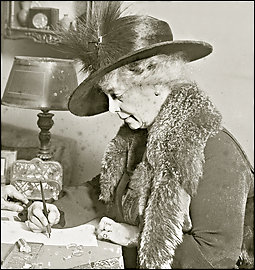
daisy calhoun loc

Daisy Calhoun. Courtesy Library of Congress

She raised funds from wealthy donors, in 1921 purchased 10 acres of prime land at Connecticut and Florida avenues NW for $80,000. Known as the Dean estate, the property included a mansion that became the foundation’s headquarters and was the setting for a hectic schedule of civics lessons, socials and inspirational pageants.

Daisy Calhoun, however, discovered that women had a less praiseworthy trait – jealous, sniping harpies. She wrote in her memoir, The Autobiography of a Chameleon:

Many women are so constituted that they cannot bear to see one of their sisters, who has been on a par with them, suddenly elevated to a position of authority over them.

Calhoun’s daughter, Margaret, eloped when she was about 18. Her secret suitor was a wealthy young Washingtonian named Arthur Drury, whom Calhoun described as “feckless and not suited to business.” The marriage didn’t last long, and Margaret later married Charles Waring, a Charleston lawyer. Margaret had children by both men.

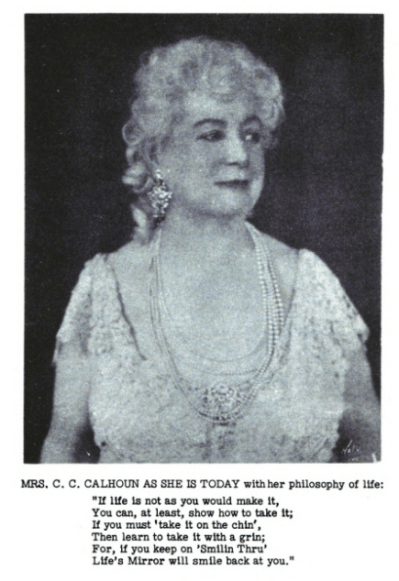
daisy - recipes, philiosphy

Clarence Calhoun died in 1938 and Daisy Calhoun promised to publish a second memoir that recounted how she had been “prey for many of the scoundrels and racketeers that infest Washington.” She never did, though her cookbook, Favorite Recipes of a Famous Hostess, became popular.

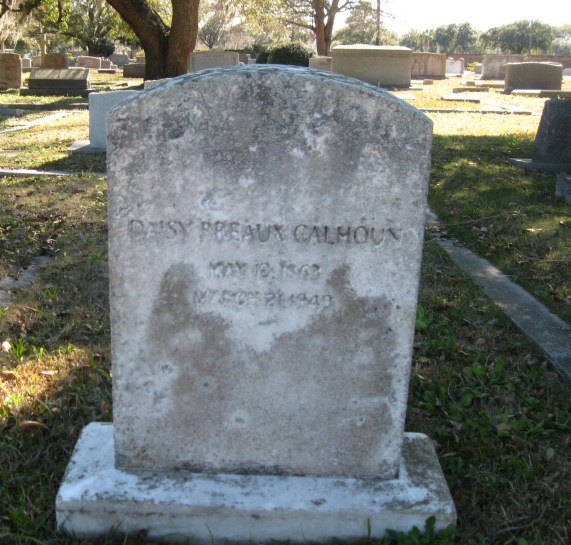
She moved back to Charleston in 1948 and died there the following year at age 85. She was buried at Magnolia Cemetery in Charleston. 

Such was the life of Margaret Rose Anthony Julia Josephine Catherine Cornelia Donovan O’Donovan Breaux Simonds Gummere Calhoun.

magnolia, daisy breaux

Daisy’s headstone in Magnolia Cemetery, Charleston. Photo by Mark R. Jones


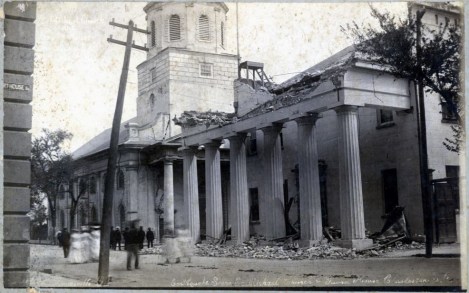
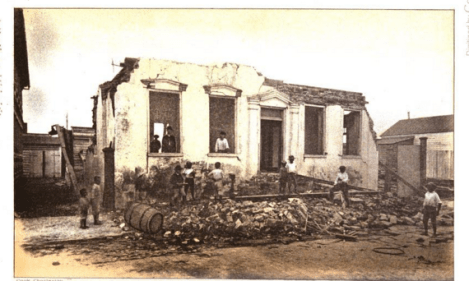
Some 1886 Charleston Earthquake History

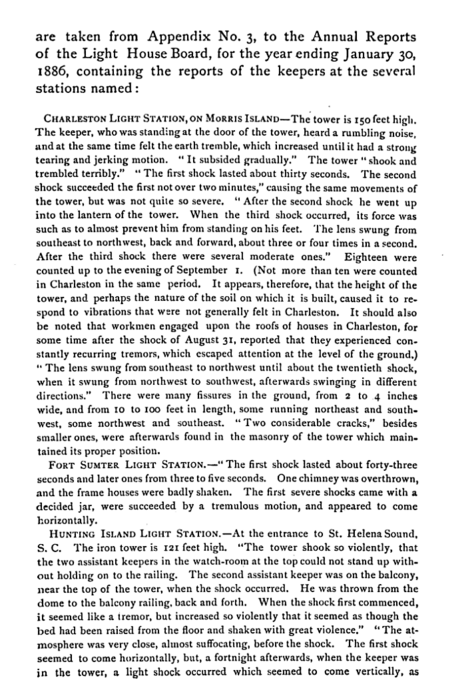
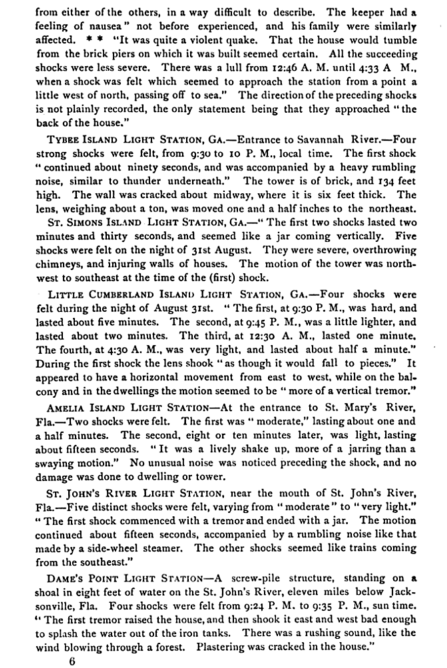
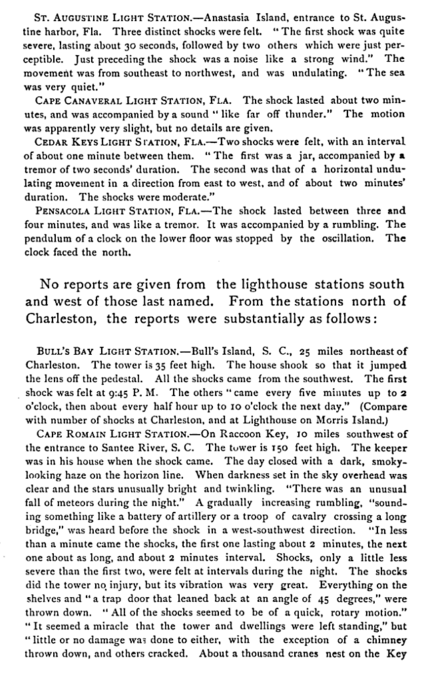
eq - book coverThe following pages are taken from A Descriptive Narrative of the Earthquake of August 31, 1886 by Carl McKinley for the Charleston City Year Book 1887. 
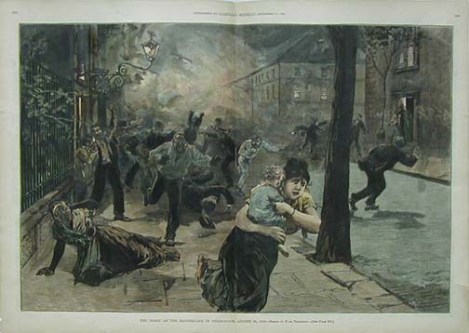
Specifically, these pages report the effects of the earthquake around the state of south Carolina. The epicenter was 20 miles north of Charleston, but the quake was felt across the east coast north to Chicago and south to Miami.

eq - street fleeing

People fleeing the earthquake’s destruction on the night of Aug. 31, 1886. Image from Harper’s Week

eq - damage

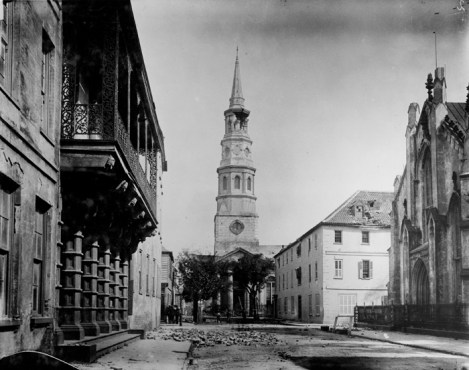
eq - church st

Church Street damage: Dock Street Theater (left); St. Philip’s Church (center); French Huguenot Church (right)

eq - damage2eq - damage3eq - damage4

eq - 27broadstreet

Broad Street … 27 Broad Street with crumbled facade

eq - damage5eq - damage6eq - fissureeq - damage7

eq-hayne street

Hayne Street (looking east from Meeting Street)

eq - damage8eq - damage9eq - damage10

eq - st. mikes and guard house

St. Michael’s Church and City Guard House

eq - harpers illustrations - food lines

Food lines, from Harper’s Weekly

eq - unidentified house

eq - washington park

Washington Square became a refugee camp for hundreds of residents whose home were destroyed. 


Today In Charleston History: March 22

 1765 – American Revolution –The Stamp Act.

stamp actIn a another attempt to pay the debt run up during the French and Indian War, British Parliament passed the Stamp Act,  which required that most printed materials in the colonies be produced on “stamped paper” (an embossed revenue mark)  from London. The printed materials included newspapers, legal documents, playing cards and magazines. There was quick and passionate opposition to the Stamp Act in Boston, Philadelphia and Charlestown.

South Carolina’s London agent Charles Garth wrote to John Rutledge informing him of the proposed Stamp Act being argued in Parliament. In Garth’s opinion the Act could not be successfully opposed by the colonies.

The Stamp Act was viewed as a threat by most Charles Town’s men. Just a year before they had managed to secure the upper hand over Governor Boone who had challenged the Assembly’s right to determine the validity of elections. 

1794 – Execution

Thomas Walsh “was assisted in his devotions by the Rev. Dr. Keating, pastor of the Roman Catholic church” before he was hanged for counterfeiting in Charleston. He then

politely waved his hand to the crowd and said, ‘Good day, gentlemen’ before he pulled the cap over his face” and was immediately launched into eternity.

1888

Charles Dickens, Jr. appeared at the Academy of Music, reading excerpts from his father’s famous works.

1924
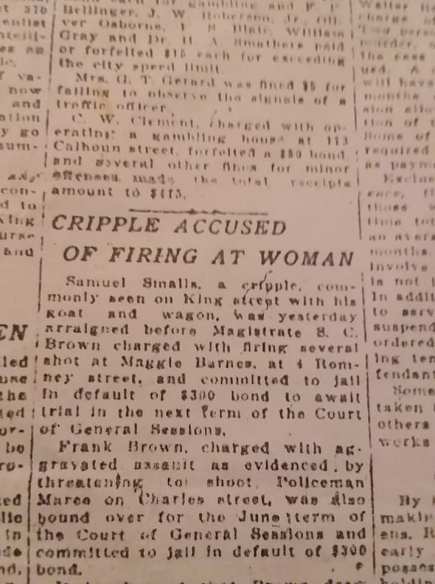
Samuel Smalls, a disabled black Charleston street peddler, often seen on his goat cart, was arrested for shooting at his girlfriend Maggie Barnes at 4 Romney Street. DuBose Heyward, wrote the novel Porgy, based on Smalls’ arrest and the fight with his girlfriend. George Gershwin read and collaborate with Heyward on “Porgy and Bess.”

sammy smalls arrest

Today In Charleston History: March 21

1917 – Music

From the Musical News, London: 

A song, “How Sweet Is Life” by a student, Mr. Edmund T. Jenkins, showed the composer to be possessed of a vein of melody, not original as yet, and of a style which needs unifying, but his effort was full of promise, especially in the matter of orchestration. The song was well rendered by Miss Marjorie Perkins.

Edmund Thorton Jenkins

Edmund Thorton Jenkins

Edmund Jenkins (who was called “Jenks”) was the son of Rev. Daniel Jenkins, founder of the Jenkins Orphanage in Charleston. He grew up playing with the Jenkins Orphanage Band, but longed to play “serious music.” He took piano lessons in Charleston and attended Morehouse College in Atlanta.

In 1914 the Jenkins Band was invited to perform at the Anglo-American Expo in London and Jenks performed with the band until the outbreak of World War I closed down the Expo. Jenks was admitted to the Royal Academy of Music in London where he studied composition.     

1921 – Music

Ethel Waters had her first recording session for the Pace & Handy Music Company. She recorded two songs –  “Down Home Blues” and “At The Jump Steady Ball.” The songs were composed by her Charleston friend, Tom Delaney, formerly a member of the Jenkins Orphanage Band. Also, two other former members of the Jenkins Band, brothers Bud (trombone) and Gus Aiken (trumpet), were part of the recording.  A twenty-three-year-old former chemistry student named Fletcher Henderson played the piano for the session.

“Down Home Blues” became a hit so Pace & Handy paired Waters and Delaney together and sent them out on tour, Waters on vocals and Delaney on piano.   

To learn more about Charleston’s role in American music … read Doin’ the Charleston. 

doin' the charleston

Today in Charleston History: March 18

1758

A report about British quartering (housing of troops) was presented to the Assembly. Prepared by Peter Manigault, Christopher Gadsden, Charles Pinckney, Henry Laurens and Rawlins Lowndes, the report stated:

Officers and Soldiers cannot, legally or constitutionally, be quarter’d in private Houses, without the special Consent of the Owners or Possessors of such Houses. 

1782 – Births.
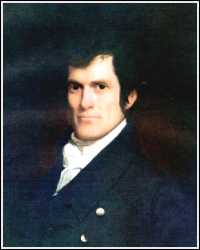
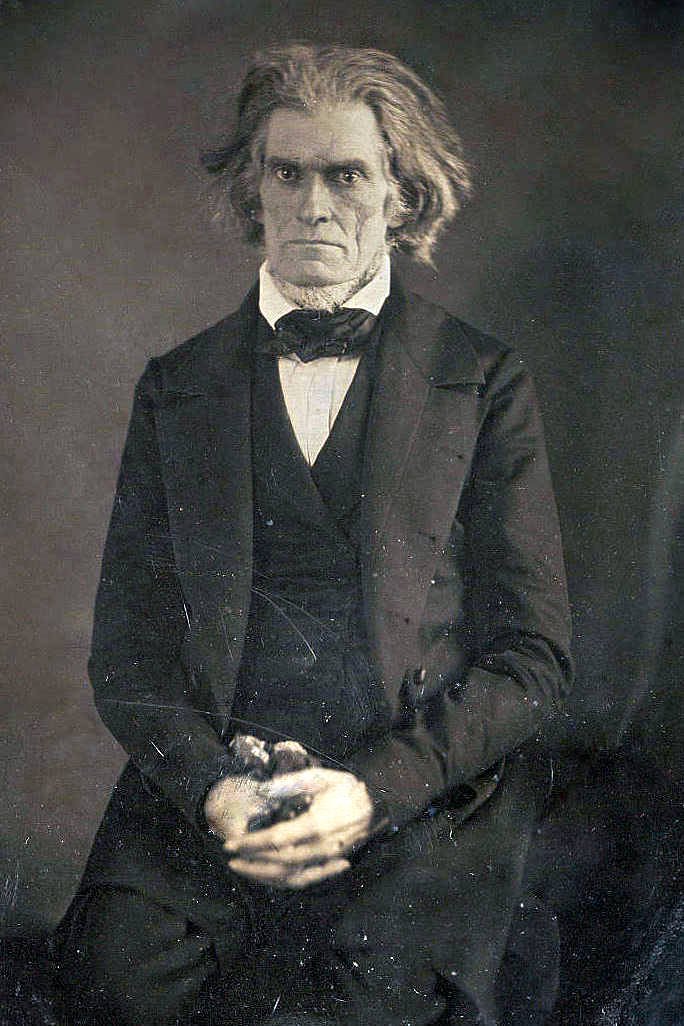
Calhoun as a young man

Calhoun as a young man

John Caldwell Calhoun was born in Abbeville, in the South Carolina backcountry. His mother was described as being “full of intelligence and energy … strong will and temper” – attributes her son would most definitely inherit.

During his life Calhoun became one of the most influential politicians of the 19th century. He was educated at Yale served in South Carolina’s legislature and was elected to the United States House of Representatives serving three terms. In 1812, Calhoun and Henry Clay, two famous “warhawks”, who preferred war to the “putrescent pool of ignominous peace”, convinced the House to declare war on Great Britain.

Calhoun was secretary of war under President James Monroe from 1817 to 1825 and ran for president in the 1824 election along with four others, John Q. Adams, Henry Clay, Crawford, and Andrew Jackson. However, Calhoun withdrew from the race, due to Jackson’s support, and ran for vice president unopposed. Calhoun was vice president of the United States in 1824 under John Quincy Adams and was re-elected in 1828 under Andrew Jackson.

Jackson was for the Tariff of 1828 (Tariff of Abominations) and caused Calhoun to be opposed to Jackson, which led to Calhoun’s resignation in 1832. Because he could not do anything about Jackson’s views toward tariffs, which benifitted only industrial North and hurt slaveholding South, John C. Calhoun became the first vice president to resign.

Calhoun as an elder statesman

Calhoun as an elder statesman

Calhoun wrote an essay about this conflict, “The South Carolina Exposition and Protest”, in which he asserted nullification of federal laws, and in 1832 the South Carolina legislature did just that. This gave Calhoun the nickname “the Great Nullifier.” 

The next year in the Senate Calhoun and Daniel Webster opposed each other over slavery and states’ rights in a famous debate. In 1844 President John Tyler appointed Calhoun secretary of state. In later years he was reelected to the Senate, where he supported the Texas Annexation and defeated the Wilmot Proviso.

John Caldwell Calhoun died in Washington, D.C. on March 31, 1850 and was buried in St. Phillips Churchyard in Charleston. In 1957, United States Senators honored Calhoun as one of the five greatest senators of all time.


Calhoun's tomb in St. Philip's cemetery

Calhoun’s tomb in St. Philip’s cemetery

Today In Charleston History: March 9

1686-Arrivals.  

Jean Boyd, a well-educated Huguenot merchant, arrived in Charles Towne and penned a lengthy letter to his sister back in London. He described various aspects of life and culture, and sketched a map of the town.

Here we are at last landed in this much longed-for country. In truth, I had imagined that I would find the town of Charlestown built differently and much larger than it is … The temperature of the air is here the same as in the southern provinces of France.  The English, in truth, who are not accustomed to hearing large claps of thunder in England exclaim in surprise at those in Carolina, but they would never scare a French person.

boyd map - 1687

Jean Boyd’s map of Charles Towne

The head of the rivers & principally the creeks are full of crocodiles so monstrous that we saw some that were 22 feet long. They do not hurt anyone and people fear them so little that several people who were bathing went swimming after them.

When one sells something here one must specify if it will be paid for in silver; otherwise they will pay you in silver of the country, which means in corn or animals & there is a great difference, least 25% for cattle to silver. Sometimes when silver is plentiful, that is to say when the buccaneers have come, livestock is worth a lot.

Aside from game one sees many wild beasts but a  little higher up in the  country, like wolves, wildcats, leopards,  tigers, bears, foxes, raccoons,  badgers, otters, beavers & a type of black and white cat which for its only  defense (urinates)  on people who pursue it, but its urine is so foul that it is  capable  of making one feel sick. The stench does not go away for two or three months even though one washes.

1738 – Slavery.

A writer in the Gazette addressed his concerns about the issue of Negro population:

I cannot avoid observing that altho’h a few Negroes annually imported into the province might be of advantage to most People, yet such a large importation of 2600 or 2800 every year is not only a loss to many, but in the end may prove the Ruin of the Province, as it most certainly does that of many industrious Planters who unwarily engage in buying more than they have occasion or able to pay for.

1779

Andrew Groundwater and William Tweed were hanged for treason. Both men had refused to take the oath of fidelity to the Patriot cause, and were arrested for carrying a message from a British prisoner of war to Colonel Archibald Campbell. According to Charles Pinckney:

some interest was made for Groundwater … he had been captain of a small vessel, and had been of service in the bringing in to us stores and many necessary articles which we were in want of … [but also] strongly suspected of being concerned with Tweed in setting fire to the town on Trott’s point … the inhabitants were so incensed against him, that he suffered, to appease the people.

Today In Charleston History: March 8

1770 – American Revolution – Foundations

In the Gazette, Peter Timothy reported that British merchants had lost £300,000 sterling just in the loss of slave trading, an unreasonable sacrifice in an attempt to raise £13,000 sterling. 

1773

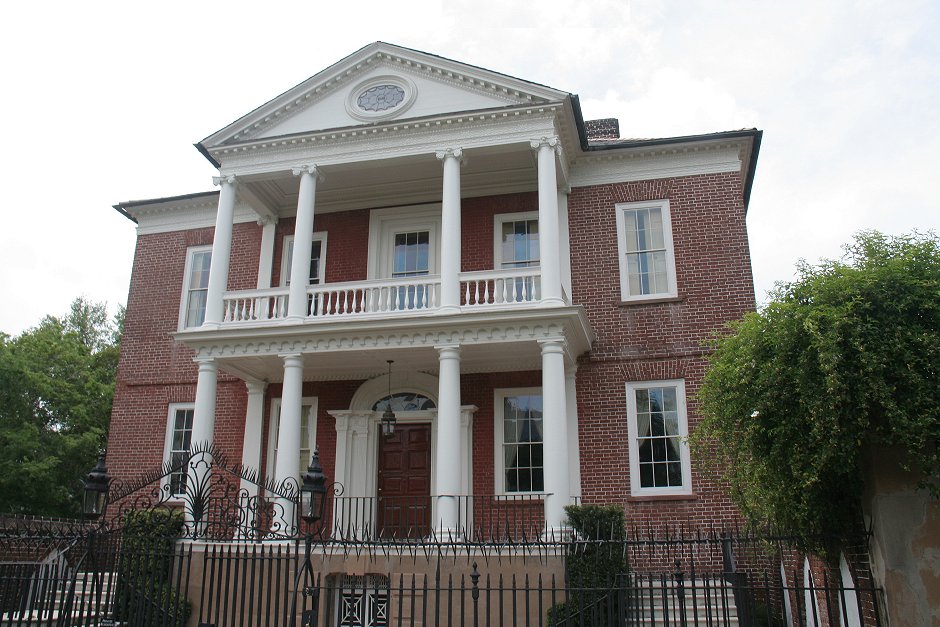
During his visit to Charleston, Josiah Quincy wrote in his diary of his evening at the Miles Brewton House, 27 King Street:

Dined with a large company at Miles Brewton’s, Esq. a gentleman of a very large fortune – a most superb house, said to have cost him £8000 sterling. The grandest hall I ever beheld, azure blue satin window curtains, rich blue paper with gilt … most elegant pictures … a most elegant table, three courses, jellies, preserves, sweet meats, etc … After dinner, two sorts of nuts, almonds, raisins, three sorts of olives, apples, oranges … by odds the richest wines I ever tasted.

Miles Brewton House

Miles Brewton House

Today In Charleston History: March 7

1737 – Slavery

A curfew act was enacted for blacks in Charlestown. Any black that appeared on the street after sundown without a lantern and written permission from their master could be apprehended by any white and taken to the Watch house overnight. They would be whipped in the morning and their owners could claim them after paying a fine.

1773 – Culture
Josiah Quincy

Josiah Quincy

Josiah Quincy visited Charleston in 1773. He was was an American lawyer and patriot from Boston. He was the principal spokesman for the Sons of Liberty prior to the Revolution and was John Adams’ co-counsel during the trials of Captain Thomas Preston and the soldiers involved in the Boston Massacre.

He kept a journal of his visit in the South and recorded his impressions of Charleston. He was not impressed with the church service at St. Philips. The small number in attendance shocked his Boston-Puritan ethic. In addition he noted the minister was:

A young scarcely-bearded boy … preached and prayed as to try an affect a gay air about the service. The sermon was only seventeen and a half minutes, a solemn mockery … … few women or men stood to sing … most people freely conversed with one another during the service.

1780 – Revolutionary War

British engineers constructed a bridge over the Wappoo Cut as preparations of their siege of Charlestown. 

Today In Charleston History: March 6

1724 – Births.
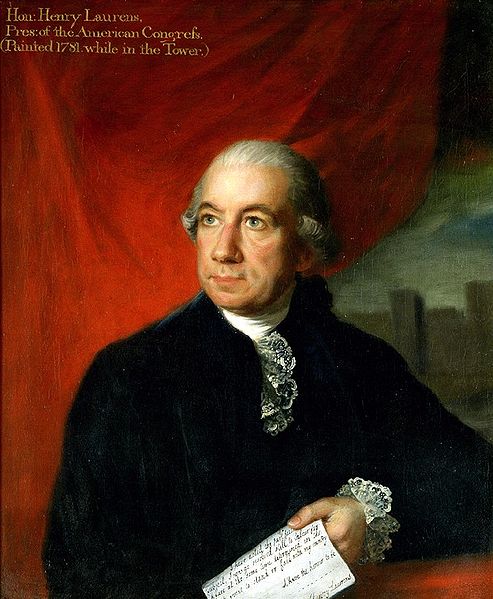
Henry Laurens

Henry Laurens

Henry Laurens was born in Charlestown, son of John Laurens a French Huguenot. The young Henry became friends with Christopher Gadsden during childhood, creating an alliance between two powerful men during the Revolution. Lauren’s son-in-law, Dr. David Ramsay wrote that they were:

…. Attached in their early youth to each other by the strongest ties of ardent friendship. They made a common cause to support and encourage each other in every virtuous pursuit, to shun every path of vice and folly, to leave company whenever it tended to licentiousness … and acquired an energy of character which fitted them for acting a distinguished part in the trying scenes of a revolution …

1837

Senate confirmed the appointment of Joel R. Poinsett as Secretary of War by President Martin Van Buren, and presided over the continuing removal of Indians west of the Mississippi and over the Seminole War.

To read more about Poinsett’s life … click here.