Today In Charleston History: March 5

1773 – Commerce

Using slave labor, Christopher Gadsden finally completed his 840-foot long wharf at the north end of town on the Cooper River (at the foot of present-day Calhoun Street). It was described as “one of the most extensive of the kind ever undertaken in America.”

Gadsden Wharf on the Cooper River

Gadsden Wharf on the Cooper River

In the late 1760s, Gadsden began the construction of a large wharf on today’s Concord Street between Calhoun and Laurens Street. In January 1767 Gadsden advertised in the South Carolina Gazette for, “Pine logs 16 to18 feet long and from 10 to 12 inches thick.” Work progressed so that in nine months Gadsden announced that he had framed the wharf and had space for two ships that could be loaded and unloaded simultaneously. Gadsden also announced that planters could store their rice at his wharf for a week without charge provided that he was the factor selling the rice. Over the next seven years Gadsden continued expanding the wharf.

 In March 7, 1774 the South Carolina Gazette reported that the,
“Stupendous work was nearly completed and was believe to be the most extensive of its kind ever undertaken by any one man in America.”
In May Gadsden wrote his friend Samuel Adams describing his
“seven years of hard labor to build the wharf, extending 840 feet that included warehouses that could hold 10,000 barrels of rice.”
1778 – American Revolution

The new Constitution of South Carolina was given a third reading and approved. It deprived the President of the state of his veto. It also stated that only Protestants could be legislators or governor. The Anglican Church, was disestablished, but retained all its property.

President John Rutledge resigned his office because he felt this document surrendered all hope of reunion with Britain. Arthur Middleton was elected to succeed Rutledge but he declined. Rawlins Lowndes was then elected and served until Rutledge replaced him in January 1779. Christopher Gadsden was chosen as Vice-President. 

Today In Charleston History: March 4

1788 – City Market

old market stalls - postcardPlans for a “City Market” began to take shape when six prominent citizens donated land to the city to build the new street. Much of the property was a canal created by building up the banks of a tidal creek that ran from the Cooper River to Meeting Street. The donors gave the city four years to fill the canal property from Meeting to Church Street and six additional years to fill it from Church to East Bay. The donors were:

  • Charles Cotesworth Pinckney
  • John Deas
  • Thomas Jones
  • Sims White
  • John Wyatt
  • Mary Lingard

The canal was to be filled to make the street 33 feet wide and divided into what is now North and South Market Streets, with spaces along each side of the canal about 33 feet wide as well.

1825 – Presidential election

John Quincy Adams took the oath of office as President of the United States. John C. Calhoun was sworn in as Vice President of the United States.

1829 –  Presidential election

Andrew Jackson took the oath of office as President of the United States and John C. Calhoun was sworn in as Vice-President. Calhoun was only one of two men to serve two consecutive terms as VP for two different presidents. Two times a bridesmaid, never a bride. The other was George Clinton who served as V-P for Thomas Jefferson and then a term for James Madison. 

Vice President John C. Calhoun

Vice President John C. Calhoun

Today In Charleston History: March 3

1763

Peter Timothy announced he was suspending publication of the South Carolina Gazette because he was unable to procure a printing assistant, his paper stock was depleted and he had been too busy to collect bills due to him. 

1781 – British Occupation

The South Carolina Gazette resumed publication as the Royal Gazette.  The Tory publisher John Wells made sure the paper reflected the British perspective.

1853

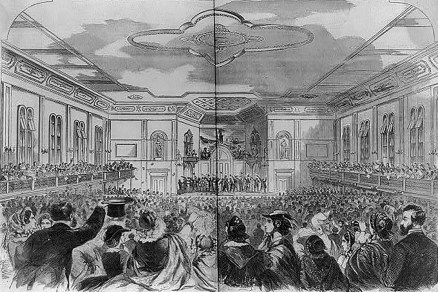
Construction of South Carolina Institute Hall began – for the purpose of hosting agricultural and industrial fairs. In 1860 it was the site of two events which changed American history: the Democrat National Convention, and the signing of the Ordinance of Secession. 

South Carolina Institute Hall on Meeting Street. Harper's Weekly illustration

South Carolina Institute Hall on Meeting Street. Harper’s Weekly illustration

circular church - teetotal

Photo of Meeting Street with 1806 version of Circular Church steeple and portico and SC Institute Hall, c 1860.

secession

Inside South Carolina Institute (Secession) Hall. From Frank Leslie’s Newspaper. Courtesy of the Library of Congress

Today In Charleston History: March 2

1696 – Fortifications.

The Assembly passed a second act appropriating money for the construction of a brick wall along Charles Town’s eastern edge. It became known as the “wharf wall,” or the “curtain line upon the Bay.” The legislature also considered plans for building a brick “fort” at the east end of Broad Street.

1779 – Births.

Joel Roberts Poinsett, future American statesman and botanist, was born in Charleston. As the American minister to Mexico in 1828 Poinsett discovered a beautiful shrub which the locals called “Flor de Noche Buena” (Christmas Eve flower). Poinsett sent samples of the plant home to his plantations in Charleston and Greenville.  

Most botanists dismissed the plant as nothing more that a weed, but Poinsett shared the plant with friends and other horticulturists whose enthusiasm for its beauty led to it being called the “Mexican fire plant.” In 1836 the plant was officially renamed the “poinsettia”, following the 19th century convention of naming things after their “discoverers.” It is now the #1 selling potted plant in the world. 

greenhouse full of bright red poinsettia

Poinsettias in a warehouse.

1833 – Nullification Crisis

The Force Bill was passed by Congress at the urging of President Andrew Jackson. It consisted of eight sections expanding presidential power and was designed to compel the state of South Carolina’s compliance with a series of federal tariffs, opposed by John C. Calhoun and other leading South Carolinians. Among other things, the legislation stipulated that the president could, if he deemed it necessary, deploy the U.S. Army to force South Carolina to comply with the law.

Today In Charleston History: March 1

1711 – Religion
St. Philips Church, 1723

St. Philips Church, 1723

At the urging of Rev. Gideon Johnston, a law was passed for “Erecting a New Brick Church,” a new St. Philip’s on “the east side of Church-street, a few poles north of Queen-street.”  The Assembly realized the true entrance of the city was not by road (Broad Street) but by ship, so it was determined to build the new church closer to the harbor.

1755

The new State House at Broad and Meeting streets opened. It was the largest and grandest building in South Carolina described as a

“two-story, large, commodious Brick Building … of about 120 by 40 feet … decorated with four … columns.”

1771 – Slavery

Edmund Jones and Joseph Jordan were hanged for “aiding runaway slaves.” Jones, the master of the schooner Two Josephs, and Jordan, a sailor, allegedly had stolen the schooner, taking with them several slaves. Several slaves who had run away on the Two Josephs, were hanged together with Jordan and Jones.

1774
Edward Rutledge

Edward Rutledge

Edward Rutledge married Henrietta Middleton, daughter of Henry Middleton, one of the wealthiest and most influential men in South Carolina with 50,000 acres and 800 slaves. This marriage solidified many alliances with other prominent South Carolina families that would play important roles in the coming Revolution. 

Today In Charleston History: February 28

1752 – Births
William Washington

William Washington

William Washington was born in Stafford County, Virginia. He was second cousin to George Washington and would later play an important role during the Revolution in South Carolina.  

Washington was elected a captain of Stafford County Minutemen on September 12, 1775, and became part of the 3rd Virginia Regiment, Continental Line on February 25, 1776, commanding its 7th Company. His lieutenant and second-in-command was future President of the United States James Monroe. 

On November 19, 1779, was transferred to the Southern theatre of war, and marched to join the army of Major General Benjamin Lincoln in Charleston, South Carolina. On March 26, Washington had his first skirmish with the British Legion, under command of Lieutenant Colonel Banastre Tarleton, which resulted in a minor victory near Rantowle’s Bridge on the Stono River in South Carolina. Later that same day, during the fight at Rutledge’s Plantation Lt. Col. Washington again bested a detachment of Tarleton’s dragoons and infantry.

Washington and Tarleton at the Battle of Cowpens

Washington and Tarleton at the Battle of Cowpens

During the Battle of Cowpens, January 17, 1781, Washington’s cavalry was attacked by Tarleton’s forces again. Washington managed to survive this assault and in the process wound Tarleton’s right hand with a sabre blow, while Tarleton creased Washington’s knee with a pistol shot that also wounded his horse. For his valor at Cowpens, Washington received a silver medal awarded by the Continental Congress executed under the direction of Thomas Jefferson.

September 8, 1781, the Battle of Eutaw Springs was the last major battle in the Carolinas, and Washington’s final action. Midway through the battle,  Washington charged a portion of the British line positioned in a blackjack thicket along Eutaw Creek. The thicket proved impenetrable and British fire repulsed the mounted charges. During the last charge, Washington’s mount was shot out from under him, and he was pinned beneath his horse. He was bayoneted and taken prisoner, and held under house arrest in the Charleston area for the remainder of the war.

The British commander in the South, Lord Cornwallis, would later comment that “there could be no more formidable antagonist in a charge, at the head of his cavalry, than Colonel William Washington.”

After the war Washington married Jane Elliott of Charleston and for the remainder of his life lived at 8 South Battery and on the Elliott family plantation at Rantowles.

William Washington House, 8 South Battery, Charleston

William Washington House, 8 South Battery, Charleston

1758

A “New Barracks” of pine-timber was constructed for British soldiers on what is now the site of the College of Charleston. Lt. Col. Bouquet again demanded that the Assembly pay the officers’ rents in private homes. The legislature refused, claiming that the traditional right of Englishmen to be free of quartering soldiers was being violated. 

1774

The South Carolina Gazette reported of “a most infamous and dangerous Set of Villains, of whom the Public had entertained very little Suspicion.” Two slaves were arrested as “Principals” in “several of the Burglaries and Robberies, which had been so frequent of late.” After questioning the slaves, authorities also arrested “John Thomson, an Umbrella-maker and Shop-keeper, Richard Thomson, who kept a Livery Stable, and George Vargent, a Coachman.”

The two slaves received a death sentence and were hanged a few days later. The three white men were sentenced to sit twice in the pillory where they were “most severely pelted,” given a whipping of thirty-nine lashes each, and fine from 25 to 500 pounds.

Today In Charleston History: February 27

1719

The Assembly passed an act providing funds to pay the debts incurred by Gov. Johnson and Col. Rhett in their actions against the pirates.

1785-Religion.
asbury

Francis Asbury

Methodist Bishop Francis Asbury and Rev. Jeese Lee held the first service of Methodists in Charleston at the deserted Baptist Meeting House. During the Revolution, the Meeting House had been used by the British army for the storage of provisions.

Due to their rigid morality and their passionate evangelism, Methodists infuriated many people. They were quick to point out to sinners their fiery fate unless they repented. The services continued every evening for fourteen days.

Today In Charleston History: February 26

1670 – Carolina Expedition

The expedition took on several new passengers in Bermuda, including 79-year old William Sayle, the newly appointed Governor of Carolina. They left Bermuda with a plan to settle at Port Royal (current location of Hilton Head, SC.)

1687

Arnold Bruneau, Esq., Paul Bruneau, Esq. and Josias Marviland, Esq. formed a partnership for the construction of a mill (wind or water) to saw timber.

windmills carolina

Illustration of Dutch-designed windmills used in the Carolinas.


Today In Charleston History: February 25

1746 – Births

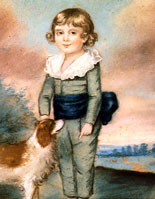
Charles Cotesworth Pinckney, a Future signer of the U.S. Constitution, was born in Charles Town. He was the eldest son of Charles and Eliza Pinckney. Seven years later, he accompanied his father, who had been appointed colonial agent for South Carolina, to England. As a result, Cotesworth enjoyed a European education.

SC-C117key

Charles Cotesworth Pinckney, age 6

He received tutoring in London, attended several preparatory schools, and went on to Christ Church College, Oxford, and graduated in 1764. Pinckney next pursued legal training at London’s Middle Temple. He was accepted for admission into the English bar in 1769. He then spent part of a year touring Europe and studying chemistry, military science, and botany under leading authorities.

In late 1769 Pinckney sailed home. He entered private practice in South Carolina and was elected to the provincial assembly. In 1773 he acted as attorney general in the colony. In 1775 he was a supporter of the patriot cause and was elected to the provincial congress. The next year he was elected to the local committee of safety and made chairman of a committee that drew up a plan for the interim government of South Carolina.

When hostilities broke out, Pinckney, who had been a royal militia officer since 1769, pursued a full-time military calling and joined the First South Carolina Regiment as a captain. He rose to the rank of colonel and fought in the South in defense of Charleston and at the Battles of Brandywine, PA, and Germantown, PA. He commanded a regiment in the campaign against the British in the Floridas in 1778 and at the siege of Savannah. When Charleston fell in 1780, he was taken prisoner and held until 1782. The following year, he was discharged as a brevet brigadier general.

19065-004-E8F2454A

Pinckney, military officer for Continental Army

After the war, Pinckney resumed his legal practice and the management of estates in the Charleston area but found time to continue his public service, which during the war had included tours in the lower house of the state legislature (1778 and 1782) and the senate (1779).

Pinckney was one of the leaders at the Constitutional Convention. He was present at all the sessions, and strongly advocated for a powerful national government. He proposed that senators should serve without pay, but that idea was not adopted, but he exerted influence in such matters as the power of the Senate to ratify treaties and the compromise that was reached concerning abolition of the international slave trade. 

Pinckney became a devoted Federalist. Between 1789 and 1795, he declined presidential offers to command the U.S. Army, to serve on the Supreme Court and as Secretary of War and Secretary of State. In 1796, he accepted the post of Minister to France, but the revolutionary regime refused to receive him and he was forced to proceed to the Netherlands. The next year, however, he returned to France when he was appointed to a special mission to restore relations with that country. During the ensuing XYZ affair, refusing to pay a bribe suggested by a French agent to facilitate negotiations, he was said to have replied “No! No! Not a sixpence!”

When Pinckney arrived back in the United States in 1798, he found the country preparing for war with France. That year, he was appointed as a major general in command of American forces in the South and served in that capacity until 1800, when the threat of war ended. That year, he represented the Federalists as Vice-Presidential candidate, and in 1804 and 1808 as the Presidential nominee, but was defeated on all three occasions.

pinckney_1_lg

An elderly Cotesworth Pinckney

For the rest of his life, Pinckney engaged in legal practice, served in the legislature, and was active in many philanthropic activities. He was:

  • a charter member of the board of trustees of South Carolina College (later the University of South Carolina)
  • first president of the Charleston Bible Society
  • chief executive of the Charleston Library Society

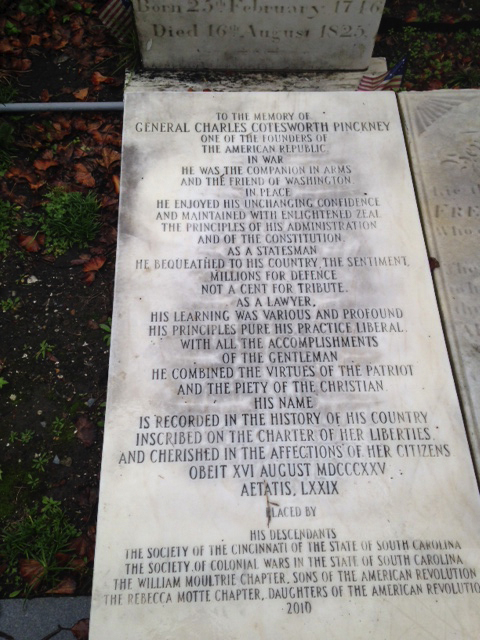
During the later period of his life, Pinckney enjoyed his Belmont estate and Charleston high society. He was twice married; first to Sarah Middleton in 1773 and after her death to Mary Stead in 1786. He died in Charleston in 1825 at the age of 79 and was interred there in the cemetery at St. Michael’s Episcopal Church.
Charles-Cotesworth-Pinckney-Grave-Charleston-SC

Grave of Charles Cotesworth Pinckney, St. Michael’s Church

1807

George Alfred Trenholm  was born in Charleston, South Carolina. Due to his father’s death, George left school at age 16 to work for a major cotton broker, John Fraser and Company in Charleston. By 1853 he was head of the company, and by 1860 he was one of the wealthiest men in the United States with financial interests in steamships, hotels, cotton, plantations, and slaves. His fortune including owning real estate worth $90,000 and personal property (including slaves) valued at about $35,000.  About 39 enslaved persons lived with Trenholm’s family as domestic staff in Charleston.

GATrenholm

George Trenholm

When the War broke out, Trenholm immediately moved his company’s head office from New York to the Bahamas, Bermuda and Liverpool. He was appointed to South Carolina’s State Marine Battery Commission, where he oversaw construction of the Confederate ironclad Chicora. Trenholm also personally financed construction of a twelve-vessel flotilla for Charleston’s defense. During the War, his company – now called Fraser, Trenholm and Company – became the Confederate government’s overseas banker. From their Liverpool office, they arranged cotton sales and financed its own fleet of blockade runners, profiting more than $9 million.

Confederate Secretary of the Treasury, Christopher Memminger, used Trenholm as an unofficial adviser. When Memminger resigned, Trenholm was appointed to that post on July 18, 1864.

When Richmond fell to Federal troops, Trenholm fled with the rest of the government in April 1865 and reached Fort Mill, South Carolina. Due to illness he asked President Jefferson Davis to accept his resignation, which Davis accepted with his thanks on April 27, 1865. Trenholm was later briefly imprisoned at Fort Pulaski near Savannah, Georgia. He was pardoned by President Andrew Johnson and ordered released on October 11, 1865. 

E. Lee Spence wrote a book in 1995, Treasures of the Confederate Coast: The ‘Real Rhett Butler’ & Other Revelations, which effectively argued the case that Trenholm was the inspiration for the character of Rhett Butler in Margaret Mitchell’s Gone with the Wind.

1910

The South Carolina Military Academy officially changed its name name to “The Citadel, The Military College of South Carolina.” The word “Academy” had become synonymous with secondary schools and the public had the misconception that the South Carolina Military Academy was a preparatory school.

1920px-The_Citadel_at_the_start_of_the_Civil_War._Image_on_display_at_Fort_Sumter_National_Monument

The South Carolina Military Academy, c. 1861. 

Today In Charleston History: February 24

1698 – Disaster

A devastating fire destroyed about one-third of Charles Town, burning the “dwellings, stores and outhouses of at least fifty families … the value of £30,000 sterling.”

1819

President James Monroe visited the Charleston Orphan House and in the evening attended the Charleston Theater.

orphan house postcard

Charleston Orphan House

1828 – Charleston & Hamburg Rail Road

Charles Parker and Robert K. Payne, at the direction of William Aiken, left Charleston by carriage to examine a potential route for the C&HRR. They

“arrived at the Six Mile House at one o’clock, where Mr. Arnot, the keeper, was requested to provide dinner as soon as possible.”

They paid $1.62 for the meals. Later that afternoon they crossed the Ashley Ferry (later known as Bee’s Ferry).

Over the next several weeks, they traveled west toward Hamburg, South Carolina, using Ashley River Road (passing Drayton Hall, Mangolia Planation, Runnymede, Millbrook and Middleton Place) to Bacon’s Bridge. They crossed the Edisto River at Givhan’s Ferry.

1946

The Nicaugra Victory slammed into the Cooper River Bridge. Five people were killed, the Elmer Lawson family, when their car plunged into the chilly waters of the Cooper River.

1954

Dr. Sarah Allan Campbell dies. First women to receive a medical degree in South Carolina.

Sarah Campbell Allan born in Charleston and led an attempt to have women accepted at the all-male College of Charleston. At age 29, she applied for admission to the all-male Medical College of South Carolina. She graduated from the Women’s Medical College of the New York Infirmary for Women and Children in 1894. Scored highest grade on the examination given by the South Carolina Medical Board and granted license #40 in October 1894.