Good Money Gone: A Review

Having read Acevedo’s Felix Gomez vampire PI novels, I knew what I was going to get … a fast-paced, no-nonsense story, told with economy and grit. This is a slight departure only in the subject matter. Instead of vampires, werewolves and nymphos, we get a giant Ponzi scheme evidently based on a true story which Acevedo was hired to co-write with one of the people involved, Richard Killborn. 

good money gonePanama: a tropical paradise with an anything-goes attitude. Bring your wish list. It’s a place to start. Or to start over. Where the best of intentions are dazzled by the glitter of easy money. Steven McKay chases the quick bucks in offshore finance, playing fast and loose with his scruples until he discovers he’s merely one cog in a vast Ponzi scheme. Even as his paranoid boss puts the screws to everyone inside the conspiracy, McKay races to save his clients-and his skin-before the rotten machine grinds to a halt under the weight of sleaze, greed, and criminal investigations. He realizes too late that his dream for wealth and fortune was nothing but Good Money Gone.

This is a fascinating character study on greed and having it all, well-written and a page turner. Finished it in 3 sittings.

4 palmettos

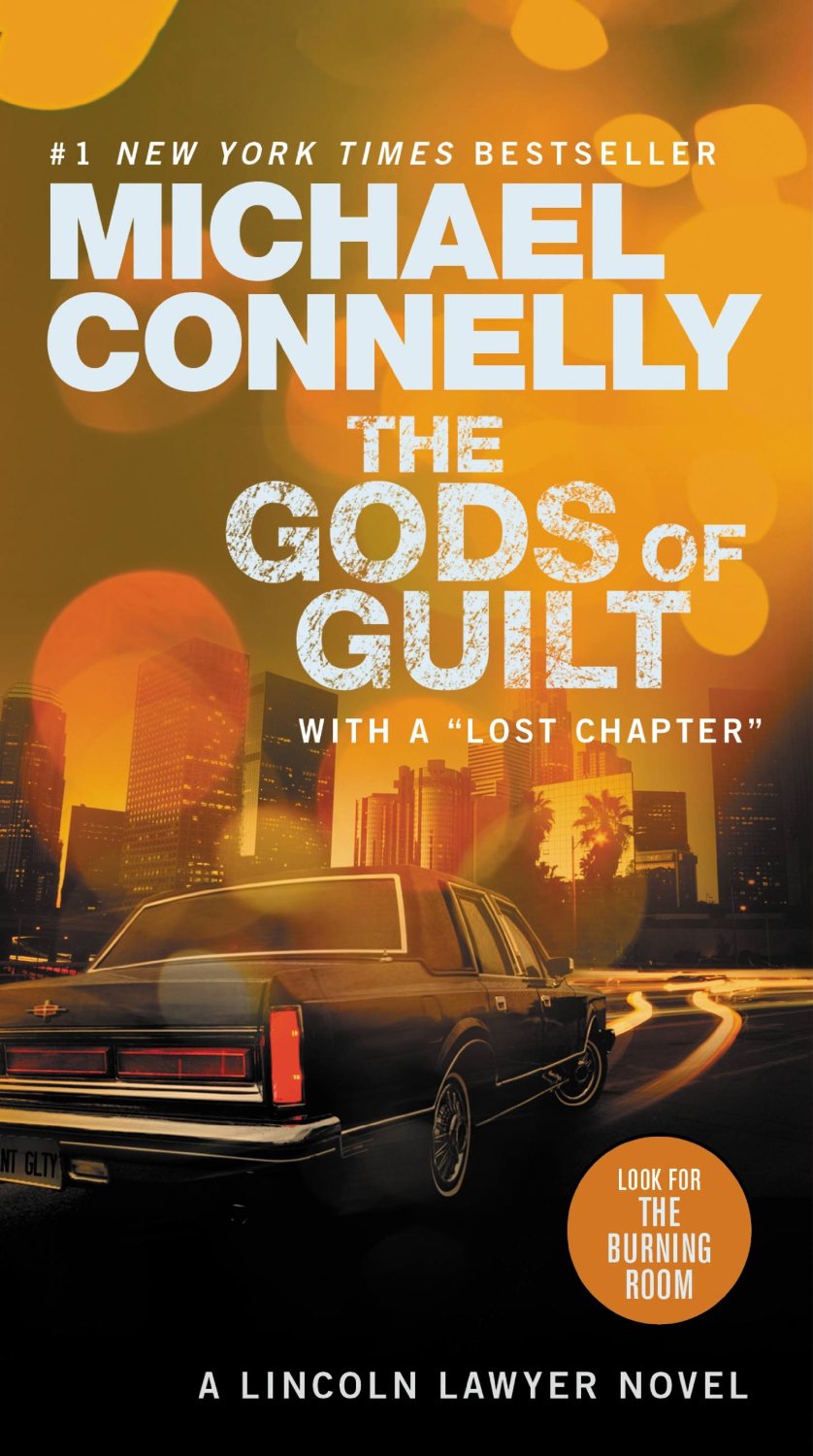
The Gods of Guilt: A Review

gods of guiltSeems like it’s impossible for Mr. Connelly to write a bad book. “The Gods of Guilt” is one of his best. Once again, ethically-suspect Mickey Haller (The Lincoln Lawyer) is back at work with an impossible case, a new love (?) and personal problems up the wazoo … not to mention someone is trying kill him.

Mickey Haller gets a text, “Call me ASAP – 187,” and the California penal code for murder immediately gets his attention. Murder cases have the highest stakes and the biggest paydays, and they always mean Haller has to be at the top of his game.

When Mickey learns that the victim was his own former client, a prostitute he thought he had rescued and put on the straight and narrow path, he knows he is on the hook for this one. He soon finds out that she was back in LA and back in the life. Far from saving her, Mickey may have been the one who put her in danger. Haunted by the ghosts of his past, Mickey must work tirelessly and bring all his skill to bear on a case that could mean his ultimate redemption or proof of his ultimate guilt.

One of the joy of Connelly’s books are the full fledged secondary characters that pop up and weave in and out his stories. Another part of his brilliance, even though his books have continuing characters, who overlap into different series, you can pick up any one of his books, and feel right at home.

Highly recommended!

4 palmettos

Advent: A Review

S-l-o-w.

ADVadventENT, the first of a projected trilogy, suffers from the same flaw that made Jonathan Strange & Mr Norrell so tough to read – long meandering pages of description and character musings. The story is more atmospheric than intriguing or compelling. My advice to novelists … Charles Dickens and Jane Austen are dead, stop trying to write like them!

The main character, Gavin, wallows in his own self pity for about two thirds of the book – no one understands him, how alone he is, how he keeps seeing Mrs. Grey everywhere – blah! blah! blah! Johann is just as bad … stuck in a narrative time loop telling the same story over and over and over again. 

I can’t imagine reading the rest of this trilogy.

2 palmettos

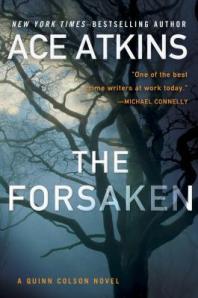
THE FORSAKEN: A Review

Thirty-six years ago, a nameless black man wandered into Jericho, Mississippi, with nothing but the clothes forsakenon his back and a pair of paratrooper boots. Less than two days later, he was accused of rape and murder, hunted down by a self-appointed posse, and lynched.

Now evidence has surfaced of his innocence, and county sheriff Quinn Colson sets out not only to identify the stranger’s remains, but to charge those responsible for the lynching. As he starts to uncover old lies and dirty secrets, though, he runs up against fierce opposition from those with the most to lose—and they can play dirty themselves.

Even though this is the 4th book in the Colson series, this is the first one I have read and most likely the last.  I found it more than a little cliqued … another Southern redemption story about past wrongs … ALWAYS racial. Plowing the same ground that Greg Ilies is tilling in his most recent novels.  Found the characters little more than stage dressing … Colson the white knight, stoic ex-military sheriff; his tough, lesbian (of course) deputy; a local strip club owner who is a misunderstood businessman and politician, etc … etc …

Pretty tiring . 

2 palmettos

The Gold Coast & The Gate House: A Review

Okay, so I know how much other critics love these two books. I am also a Demille fan. The
Charm School, Word of Honor, The General’s Daughter
and Plum Island are all good books. Exciting thrillers and well written. So I know Demille is capable of writing good books. 

I read The Gold Coast when it was first published in 1990, and remember not being impressed at all. FAST FORWARD to 2009 – with great hype, Demille’s sequel to Gold Coast was published  and I was v-e-r-y  disinterested.

However, recently, I decided to give the books a second chance and re-read the first book before I read the new one. Halfway through Gold Coast for the second time I found myself very impatient. One question kept popping up in my head: Who the f*@k cares? I found nothing about any of the three main characters sympathetic.

In fact, by page 350 I was hoping everyone would die. Alas, only the so-called “bad guy” Frank Bellarosa gets it in the end. Frank’s crime was being an Italian and daring to move into the cloistered white-bread preppy culture of snobs and shallow people along the Gold Coast – and tempting his ultra uptight neighbors John and Susan Sutter. According to the book’s description, John’s narrative voice is “sardonic – often hilarious.” Someone at the publishers has a different definition of hilarious than most of us.

I was thankful when it was finished, and pissed that John and Susan were still breathing valuble oxygen. So it was with trepidation that moved on to The Gate House. Ten years after his wife Susan killed Mob boss Frank Bellarosa, John Sutter returns to the cloistered life on the Gold Coast. John spends pages and pages ruminating about how terrible life is at the country club, on his yacht and in his mansion. Most of his problems are due to the fact that he is too much of a wienie to actually say “screw it” and leave the so-called good life behind. His annoying wife Susan is still annoying. She has a six-figure income from a family trust fund and is a spoiled bratty bitch. What John sees in her – other than her money and taste for kinky sex – is beyond me. So, if you enjoy reading about spoiled, self-important people clinging to an out-dated lifestyle I can recommend several books about Charleston in the 1860s. Stay away from this piece of boring crap.

HINT: next time have the editor actually EDIT and cut out the boring $h!t -75% of these books.

2 palmettos

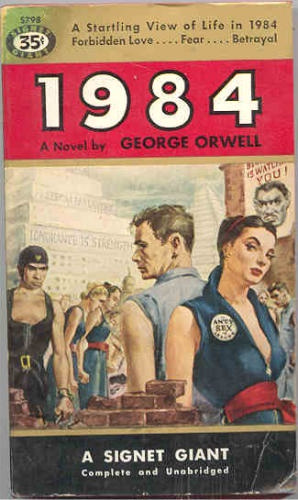
Nineteen Eighty-Four to 2014: A Brave New World (Essentials)

Sixty-five years ago one of the most famous and influential novels was published, Nineteen Eighty-Four. George Orwell’s dystopian novel introduced terms and concepts that have entered everyday use: Big Brother, doubl1984ethink, thoughtcrime, Newspeak and memory hole.

I first read the novel in 1977 in Mrs. Mazursky’s Advanced Composition class at Barnwell High School (S.C.) And here we are in 2014, living in the world Orwell warned us about. For those of you who have never read 1984 a quick summary:

The Oceanian province of Airstrip One is a world of perpetual war, omnipresent government surveillance, and public mind control, dictated by a political system euphemistically named English Socialism (Ingsoc) under the control of a privileged Inner Party elite that persecutes all individualism and independent thinking as thoughtcrimes. Their tyranny is headed by Big Brother, the quasi-divine Party leader who enjoys an intense cult of personality, but who may not even exist. Big Brother and the Party justify their rule in the name of a supposed greater good.

Winston Smith is a low-ranking member of the Outer Party who works for the Ministry of Truth (Minitrue), which is responsible for propaganda and historical revisionism. Smith’s job is to re-write past newspaper articles so that the historical record always supports the current party line. Smith is a diligent and skillful worker, but he secretly hates the Party and dreams of rebellion against Big Brother.

Everywhere Winston goes, even his home, the Party watches him through telescreens; everywhere he looks he sees the face of the Party’s seemingly omniscient leader, Big Brother. The Party controls everything in Oceania, even the people’s history and language. Currently, the Party is forcing the implementation of an invented language called Newspeak, which attempts to prevent political rebellion by eliminating all words related to it. Even thinking rebellious thoughts is illegal. Such thoughtcrime is, in fact, the worst of all crimes.

If you have a pulse and are reasonably aware of the world around you, everything in the previous paragraph should sound familiar. A few comparisons between the novel 1984 and our world should make it clear:

1984: Newspeak. NOW: Politically Correct speech

1984: Telescreens in every room. Programming runs 24 hours a day. Proles have no way to turn off their screens. NOW: Telescreens in almost every room. In everyone’s hands. Programming runs 24 hours a day. Proles rarely turn off their screens.

1984: Telescreens in all public and private places, so the populace can be watched to prevent thoughtcrime. NOW: Surveillance cameras in most buildings and public streets to prevent crime. People carrying tracking devices called cell phones. 

1984: Helicopters silently watch over the masses to keep people from creating thoughtcrime, reinforcing the fear that you are “always being watched.” NOW: Helicopters and drones silently watch over the masses to keep people from breaking traffic laws, reinforcing the fear that you are “always being watched.”

1984: Lotteries with very few winners. Held to collect income for the state, and to give hope to the masses. NOW: Lotteries with very few winners. Held to collect income for the state, and to give hope to the masses.

1984: History is rewritten to conform with modern beliefs. All references to oldthink are removed. NOW: History is rewritten to conform with modern beliefs. Example: In the 2013 history textbooks, the 9/11 attacks are described as being committed by “terrorists.” No description of their Islamic extremism and hatred for Western beliefs. However, in the same book, Timothy McVeigh is described as a “radical right-wing terrorist.” There are too many examples to list here. You’ve probably already come up with 3 or 4 in your head. 

1984: People are steered away from consuming goods such as chocolate, steak, sugar, coffee, cigarettes and alcohol by rationing. NOW: People are steered away from consuming certain foods by warnings that these items are bad for your health. Cigarette smokers are portrayed as a criminal class. In New York City, Mayor Bloomberg did his best Big Brother imitation by banning sugary drinks more than 16 ounces. Other states and cities have levied heavy taxes on food items that the state has deemed “not good for the public.” 

1984: There is always a war, always an enemy always a crisis. If peace is made with one country, war is started somewhere else. When one “crises” is solved, another is discovered. NOW: There is always a war, always an enemy always a crisis. If peace is made with one country, war is started somewhere else. When one “crises” is solved, another is discovered. “War on Poverty.” War on Drugs.” Etc … 

1984: Songs are created by machines. No one can write a song not in line with Big Brother. No creativity is needed. NOW: Songs are created by synthesizers and digital samples.The creativity of past musicians are “sampled” by “artists” and re-mixed into a collage of mechanized sound.

1984: Telescreen is full of confessions of “Thought criminals.” They confess their crimes and perversions. NOW: Daytime talk shows are filled with people who enjoy sharing the low-rent, thuggish lifestyles with the rest of the world.

Over the past two years we have learned that the U.S. government directed the IRS to target conservative Tea Party groups merely because of their opposition to the expansion of federal government programs. We also learned that the government has been listening to the private conversations of EVERY Verizon cell phone customer since 2007. Through a program called PRISM, the government has also had access to the date of everyone on the internet who has logged on to FaceBook, Yahoo, Google, YouTube, Apple and Skype. The government’s response to all of this is: “We have done nothing wrong. We have done nothing illegal.” Various criminal operations and counties are hacking into digital date of corportations, political groups etc … 

So, if you have never read 1984, it would make a great (yet uncomfortable) summer read to discover what Mr. Orwell warned us about sixty-five years ago. And for the government bureaucrat whose job is to read this column, I hope you enjoyed it. I encourage you to purchase my books and read them also!

A TOWN LIKE ALICE: A Review (Essentials)

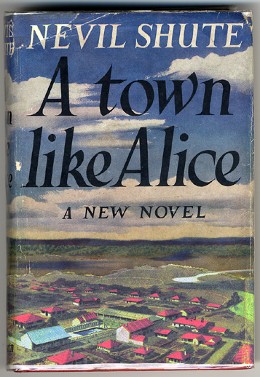
This is one of the best books of the 20th century. In 1998, Modern Library voted A Town Like Alice #17 on the list of 100 Greatest English-language Novels of 20th Century. It is also known as The Legacy. It is an unbashedly romantic tale that I have read more than a dozen times. aliceNevil Shute was the author of 30+ novels and can best be described as “old fashioned.” His books are literate, with a distinctly British view, but also very worldly. He often explored unusual themes like reincarnation, utopian visions (In The Wet is a very entertaining variation of Brave New World.) 

Shute was a trained engineer and science plays a huge role in many of his books. Many of his characters are aviators, engineers, and geologists. During his lifetime Shute was one of the most popular writers in the world and his most famous book, On The Beach, while justly famous as the only close-ended novel ever written (no one in the book survives after the final page) is one of his lesser efforts. It is a shame that dozens of Shute’s novels do not sit on the shelves of modern bookstores.

In 1981 the book was turned into a world wide award winning mini-series for Australian television starring Helen Morse and Bryan Brown, it is superb! 

SUMMARY

After World War II, a young English woman named Jean Paget learns that she has inherited a legacy from her great uncle. She is now a rich young woman with no need to work ever again. When the Scottish lawyer, Noel Strachan, whose firm manages the legacy asks what she’d like to do with the money, she replies, “I’d like to build a well.”

Jean and her family had lived in Malaysa for most of her childhood until her fathered died. Now, Jean was alone living in London. Her mother was dead and her brother died in a Japanese POW camp. Jean and her family had lived in Malaysa for most of her childhood until her father died.

TownLikeAliceJean tells Strachan her story:During the war she was working in Malaya when the Japanese invaded and she ended up as one of a party of English women and children who are marched around Malaya by the Japanese, since no camp will take them in and the Japanese army does not want to take responsibility for them. Many of them die on the march, and the rest survive only on the charity of the local villagers. Jean’s knowledge of Malay language and culture proves invaluable to the group’s survival.

The women meet Joe Harman, an Australian soldier who is also a prisoner. He drives a truck for the Japanese across Malaya carrying supplies. He steals food and medicines to help the women and Jean and Joe become friends. Jean always carries a small boy, orphaned after his mother died, and which leads Harman to the mistaken belief that she is married; to avoid giving Joe any temptation, Jean does not correct this misperception. The thefts are investigated and Harman takes the blame to save Jean and the rest of the group. He is beaten, crucified, and left to die by the Japanese soldiers. The women are marched away leaving Joe for dead.

To survive, the women become part of a native village where they grow rice and work as part of the village. This saves their lives, and they live there for three years, until the war ends. This village is where Jean wants to build the well so that the local women will not have to walk so far to collect water: “A gift by women, for women”.

With her legacy, Jean travels to Malaya, where she goes back to the village and persuades the headman to allow her to build the well. While it is being built she discovers that by a strange chance Joe Harman survived his punishment and returned to Australia. She decides to travel on to Australia to find him. 

In her travels, she visits the town of Alice Springs, where Joe lived before the war, and is much impressed with the quality of life there. She then travels to the (fictional) primitive town of Willstown in Queensland where Joe has become manager of a cattle station. She soon discovers that the quality of life in Alice is an anomaly, and life for a woman in the outback is elsewhere very rugged. While staying in the local hotel in Willstown she finds that the local hunters shoot crocodiles and prepare their skins for export, at prices much lower than they are sold in England. To show the locals what their exports are used for, she makes a pair of crocodile-skin shoes in her bedroom, by hand.

In the meantime, Joe has learned both that Jean survived the war and is unmarried. He takes the money he won in the state lottery in order to travel to Britain in search of her. In London, he meets lawyer Strachan, who must decide on his client’s behalf how to handle this situation. On Strachan’s advice, Harman returns to Queensland, and Jean and Joe two finally meet again in one of the most emotionally charged and poignant love scenes ever written.

At this point, you are about halfway through the book, and I would deserve to be crucified myself if I revealed any more of the plot. Read it NOW.

5 palmettos


Companion Read: 
No Highway by Nevil Shute

FADE: A Review

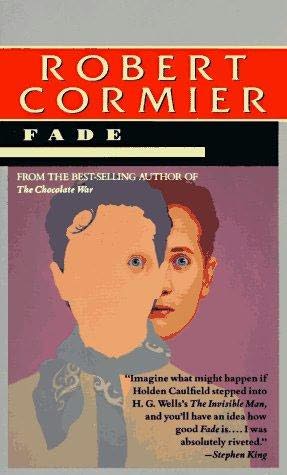
Why is Robert Cormier marketed to Young Adult audiences? His books explore disturbing subjects, dark themes, and create a generally bleak tone. Thomas Hardy has nothing on Cormier for tragic conclusions. And, not withstanding the constant presence of The Chocolate War, on must-read lists for Young Adults, Fade may be Cormier’s best book.

Fade_Robert_Cormier_novel_coverSUMMARY: At the age of thirteen, Paul Moreaux discovers that he can turn invisible. Paul, a sensitive and thoughtful working-class boy, doesn’t even realize it when he first gets The Fade. On a dare, he spies on a meeting of the Ku Klux Klan. (This is the 1930s, and anti-Catholic/anti-immigrant sentiments are running high against Paul and the other citizens of Frenchtown.) When the meeting is ambushed, a crazed Klansman discovers Paul and tries to kill him– but inexplicably, he somehow loses sight of his intended victim.

What Paul doesn’t realize is that he has inherited the ability to turn invisible. Sometimes it’s useful, as when escaping from Klansmen and bullies; more often it’s horrible, as when spying upon people who reveal secrets Paul never wanted to know. One male in his family has inherited this “gift” for several generations. Paul at least has guidance from an uncle, also a Fader. 
The invisible teenaged Paul slowly discovers that his “gift” only helps him learn quickly the tragedy of human existence; he is doomed to lead a life marked by violence, madness, and despair, with relief coming only when health complications from the invisibility cause him to die, lonely and young and unmourned.

A generation later, Paul’s own nephew Ozzie has no such counseling, because Paul doesn’t know he exists; the child had been secretly given up for adoption. Unfortunately Ozzie was raised by a physically abusive father, and when Ozzie discovers his Fading powers, after years of beatings and neglect, the results are terrible, with “terrible” meaning “like Stephen King’s Carrie on prom night.”

Thoughtful, horrific and suspenseful. Highly recommended!

Companion Read: Jumper by Steven Gould. (Note: do not let the bad movie based on Jumper keep you from reading it.)

 4 palmettos

CHANGELESS: A Review

Remember the first time you heard the 1976 LP, Boston? It blew you away. Swirling twin guitars, a sound that mixed Led Zep with Yes and The Beatles, hard rockin’ songs with a melody, high harmonies, soulful singing by Brad Delp, and one mean ass rock and roll organ.

PrintRemember the anticipation as you waited (and waited and waited and waited) for Boston’s second LP? And then, it finally arrived! Don’t Look Back. So you tossed it on your turntable (for those of you under 30, Google it) and you listened to the LP. And about halfway through Side Two you started to get a sour feeling in your belly. The album was good … but was not great. It was … the same, but not better. After two years, this is what you got? So, you listened to it again. For the next few days you walked around thinking: “Oh man, this sucks.”

Welcome to CHANGELESS, the literary equivalent of Boston’s Don’t Look Back.

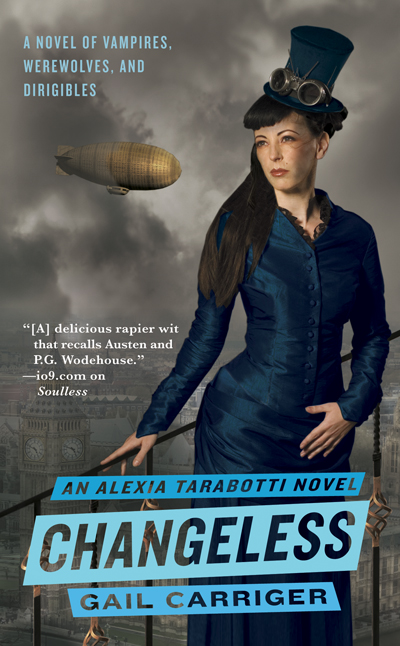
CHANGELESS is the sequel to SOULLESS.(Read the Soulless review) It was Bram Stoker mixed with the sensibility of Jane Austen set in Charles Dickens’ London. It was a world in which vampires, werewolves and ghosts were accepted in English society. Author Gail Carriger deftly pulled off a screwball comedy of manners.

So what’s wrong with CHANGELESS? Nothing really, except the disarming freshness has worn off. The wackiness of an English woman without a soul who can disarm vampires and werewolves with a thrust of her silver-coated parasol and sitting in council with Queen Victoria discussing the “vampire problem” is no longer new. Carriger has done little to move the story (and her world) into something else. We are stuck in a world that we already know, in a story that seems stale and mundane. Maybe that’s my own fault, since I found Soulless so delightful I am guilty of creating false expectations. I have an sneaking suspicion that two years from now, I will rate this book higher than I do right now. 

Like Don’t Look Back, it’s more of the same thing … more than just a mere shadow, but it serves to remind you how brilliant the initial offering is.

4 palmettos

ONE SECOND AFTER: A Review (ESSENTIALS)

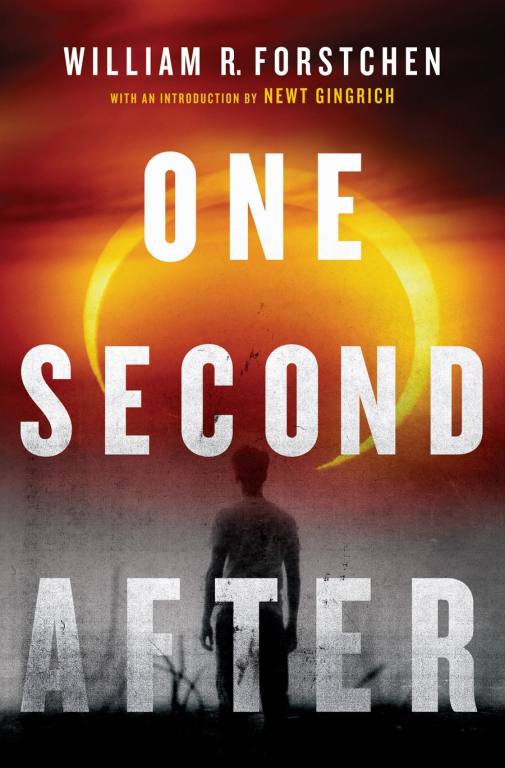
one secnd afterElectromagnetic pulses can result from natural phenomena and, in much greater strength, from nuclear blasts. The result of an EMPs is the destruction of unprotected electronic circuitry, about 95% of it in the United States. A nuclear bomb set off at a high altitude would cause electronics over a large swathe of the planet to fail and almost nothing has been done to protect the US from this threat.

This frightening novel depicts what life might be like in the case of an EMP attack. With no electronics -vehicles won’t run; no phones, computers, radios, or televisions; no electricity. America descends into the Middle Ages. In One Second After, a lack of food and medicine leads to mass death. Society crumbles quickly. Cities turn against the countryside; friends and neighbors turn against each other in a desperate struggle to survive. Criminals take advantage.

Forstchen humanizes it by giving a detailed look at how events unfold around the idyllic small town of Montreat College in North Carolina.The weeks pass, and society deteriorates quickly – food runs out, people die due to lack of treatment and medicine, tyrants try to take advantage of the weak and confused, and criminals run rampant.

One Second After is a masterpiece of dystopian literature that ranks with 1984 and Brave New World, but is even more horrific. IT IS A PAGETURNER! You will have restless nights while you are reading this, and several nights after. Particularly when you realize that our government has done nothing to prepare this country for this serious threat.  

5 palmettos