Today In Charleston History: November 14

1851

Report of the Board of Fire Masters from the Charleston Courier, pg 4:  

There are thirty one (31) large Fire Wells, which are designated by a white post [illegible] feet out of ground, with red ball on the top, lettered Fire Well, and the nearest Gas Lamp to each well has a red star painted on the upper glass. Located [on street corners] as follows: Beaufain and Archdale, Liberty and St. Philip, Clifford and King, Queen and Friend, King and Tradd, [etc.]

1860 – Fire

Sparks from the rice polishing machine ignited a fire at the West Point Rice Mill. “Brilliantly illuminating” the west side of Charleston, flames destroyed the mill machinery, ancillary buildings, and 23,306 bushels of rice. The company was insured, and immediately began rebuilding new mill. Although hampered by the Union blockade, the mill was capable of full operation in late 1863. When Charleston was occupied by the Union Army in 1865, the mill was used as a food distribution center.

After the Civil War, the mill resumed operations and its production increased. In 1886, it suffered damage from the 1886 Charleston earthquake. Brickwork was damaged and the gables were brought down. At some point before the 1920s, the entire roof was replaced except for the kingposts and trusses.
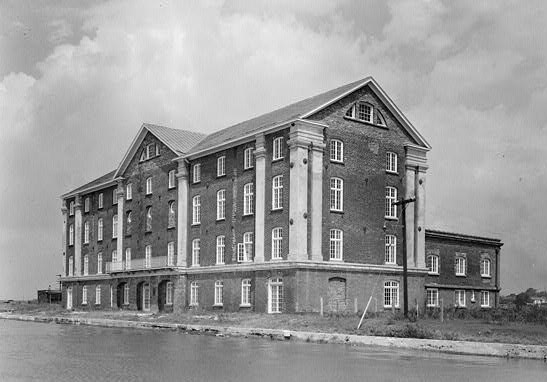
West_Point_Rice_Mill,_Ashley_River,

In 1890, three Charleston mills produced over 97,000 barrels of rice. Competition from western rice growers and a number of hurricanes caused rice production in South Carolina to fall. West Point Mill was closed in 1920, and the company began to sell its assets. Around 1925, the mill’s steam engine was sold to the Henry Ford Museum. The mill’s property was sold to the City of Charleston in 1926.

In the late 1930’s, the old mill ponds were dredged for a municipal yacht basin. Through the years the building has been used for Chamber of Commerce headquarters, a restaurant and city marina offices. It was listed on the National Register in 1995. 
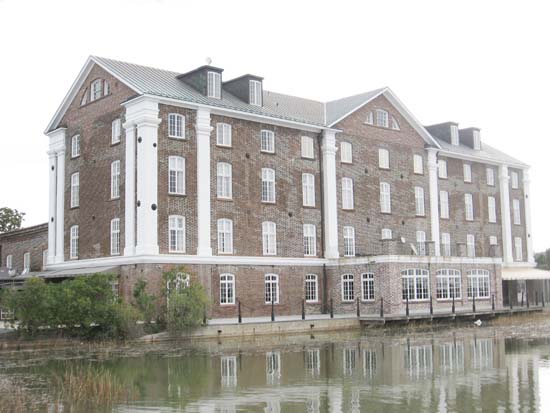
west point


Today In Charleston History: November 13

1773. American Revolution – Foundations.

Peter Timothy announced in the South Carolina Gazette that “300 chests of tea were on their way to Charles Town.” He urged the citizens to “band together to take the necessary steps to prevent the landing” of the cargo.

Earlier in the year, Parliament had passed the Tea Act, which allowed the East India Company to export tax-free tea into the American colonies in an effort to help the company recover from near bankruptcy. It was also an attempt to undercut the price of illegal tea smuggled into the North American colonies. The Act was supposed to convince the colonists to purchase Company tea on which the Townshend duties were paid, thus implicitly agreeing to accept Parliament’s right of taxation. Most of the American colonies disagreed.


gazette masthead


Today In Charleston History: November 12

1718 – Piracy
Bonnet

Stede Bonnet

Judge Nicholas Trott sentenced Bonnet to death. Trott’s long harangue during sentencing – quoting scripture and lecturing Bonnet on morality – probably felt like a death sentence to the pirate. Trott stated that Bonnet faced “not just physical death, but everlasting burning … in fire and brimstone.”

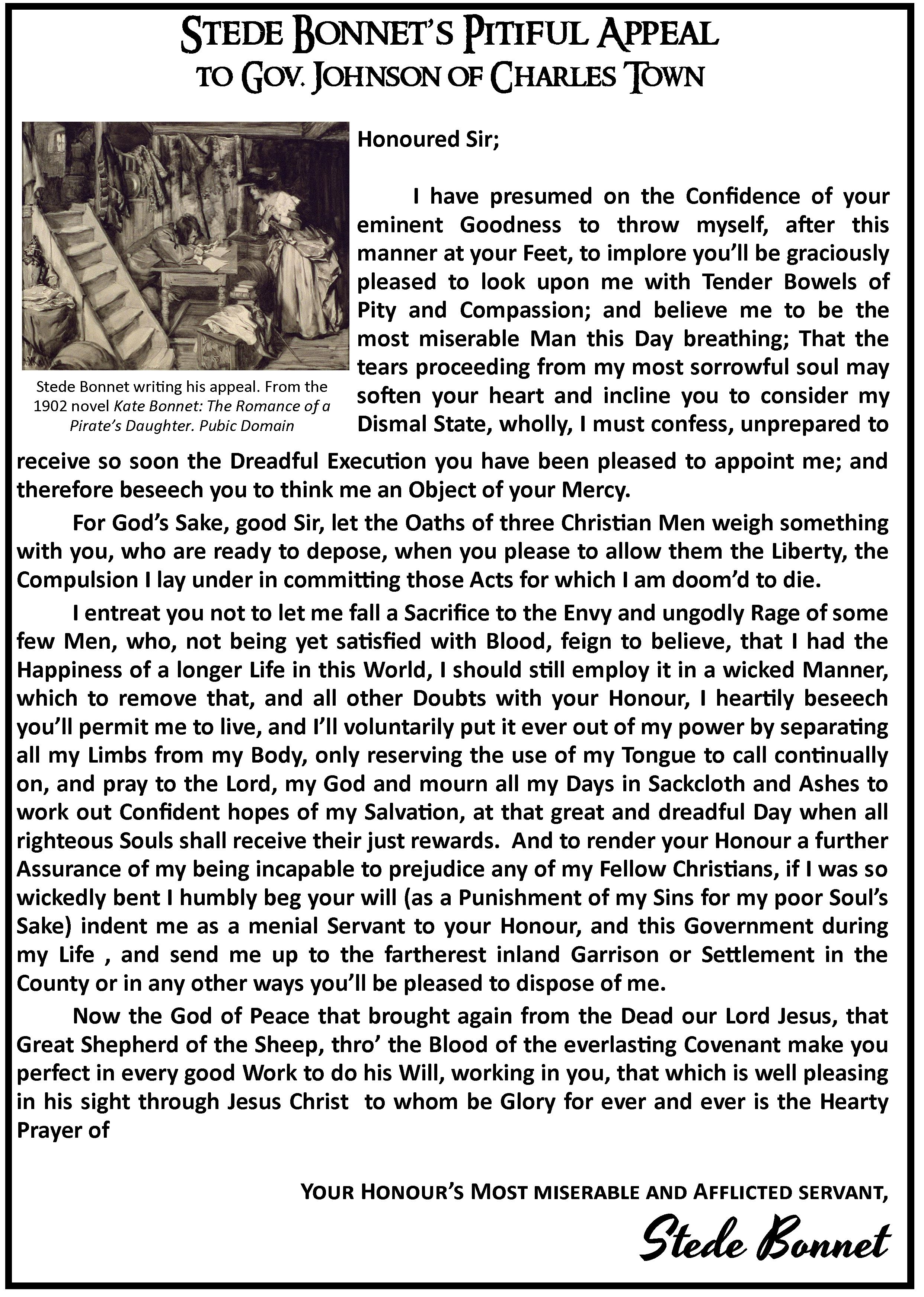
Bonnet was allowed an appeal, which he wrote to Governor Johnson.

Also, late that day, twenty-four pirates, Richard Worley’s crew, were put on trial. Five of the crew were acquitted, probably because they agreed to testify for the Crown. The other nineteen were found guilty, sentenced to death and hanged. 

stede bonnet - letter


Today In Charleston History: November 11

  1775 – American Revolution

hog islandSouth Carolina’s first Revolutionary War naval skirmish took place. William Henry Drayton., president of the Second Provisional Congress of South Carolina,  was on board the newly-commissioned South Carolina schooner Defence, supervising the sinking of the hulks in the Hog Island channel. Captain Edward Thornbrough ordered six shots fired from the HMS Tamar and HMS Cherokee. Drayton replied with his nine-pounders. Over the next several hours the British fired 130 ineffective shots, which rallied public opinion to the side of the Revolutionaries. Lord William Campbell was aboard the Cherokee during the battle.

1815

Charles Pinckney, deeply in debt, signed an agreement with his creditors for a group of trustees to sell his property, which included:

  • 500 acres on the Black and Pee Dee Rivers near Georgetown
  • 1200 acres on the Lynches River
  • 815 acres at Snee Farm
  • Shell Hall, his house at Haddrell’s Point
  • His mansion on Meeting Street
  • Two tracts of land from his father-in-law, Henry Laurens – one in Savannah and one called Mount Tacitus on the Santee River which included a lumber mill and Pinckney’s Ferry
  • 240 slaves

Today In Charleston History: November 10

1742

Peter Boez was fined £2 for “knocking down Mr. Pinckney, a Negro.” Mr. Tributed was fined 10s (shillings) for “retailing Rum on Sunday.”

1763

The Treaty of Augusta was signed by the governors of Georgia, South Carolina, North Carolina and Virginia, and the chiefs of the Cherokees, Creeks, Chickaswas, Choctaws and Catawbas. John Stuart, Superintendent of Indian Affairs presided.

1860 – Road to Secession

The South Carolina delegation to Congress resigned and left Washington, D.C. South Carolina legislature was conducting an emergency secession conference in reaction to the election of  Republican Abraham Lincoln. They were meeting at the First Baptist Church due to the construction of the new State House.

James Petigru was in Columbia, SC for business, was stopped on the street and asked by a stranger for directions to the state insane asylum. Petigru replied, “The building, my friend, stands upon the outskirts of the town, but I think you will find the inmates yonder,” he pointed to the First Baptist Church.

first baptist columbia

First Baptist, Columbia

Today In Charleston History: November 9

1799 – Slavery

The Charleston City Gazette announced that the “Thirteenth Day’s Drawing” of the East Bay Lottery was ticket #1884. The top prize was $1500. The holder of the wining ticket was a slave named Denmark Vesey, who presented the ticket to his master, Capt. Joseph Vesey. Capt. Vesey agreed to allow Denmark to purchase his freedom for $600.

vesey statue copy

Today In Charleston History: November 8  

1691
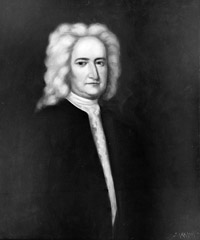
Gov_P_Ludwell

Philip Ludwell

Sir Nathaniel Johnson led the “Goose Creek men” in opposition against Governor Sothell, forcing his retirement.  The Lords Proprietors appointed Philip Ludwell “Governor and Comander in Cheif [sic] of Carolina” with the authority “to apoint [sic] a Deputy Governor of North Carolina.” 

Colonel Ludwell lived at Middle Plantation (which later became Williamsburg) in the Colony of Virginia. In 1676, he supported Virginia Governor William Berkeley during Bacon’s Rebellion. Later, Ludwell married Berkeley’s widow, Frances Culpeper Berkeley of Green Spring Plantation. After serving in Carolina, Ludwell returned to Virginia, where he served as Speaker of the House of Burgesses in 1695–96. Around 1700 he moved to England, where he died.

1718 – Piracy

 Stede Bonnet’s crew was found guilty by Judge Trott. The twenty-nine men from his crew were hanged that day. Their bodies were dumped in the marsh beyond the low-water mark.

1781 – American Revolution

Gen. Green established the Continental Army at Round O, about 45 miles west of Charleston.

1786 – Theater

Because of a sore foot, Mr. Godwin of the Harmony Hall theater could not perform his popular comic dance “The Drunken Peasant.” The audience hurled bottles on stage, which Godwin tossed back and charged the audience with a drawn sword.  After the death of his leading lady, Godwin was forced to close his theater.

1827
Poe in uniform

Poe in uniform

Private Edgar Perry (Edgar Allan Poe) arrived on Ft. Moultrie on Sullivan’s Island an articifer – an enlisted tradesman who prepared shells for artillery.

1864 – Bombardment of Charleston

During the overnight Federal bombardment, a shell crashed through the roof of the house of John and Mary Mullane, killing them in their sleep.

1870  

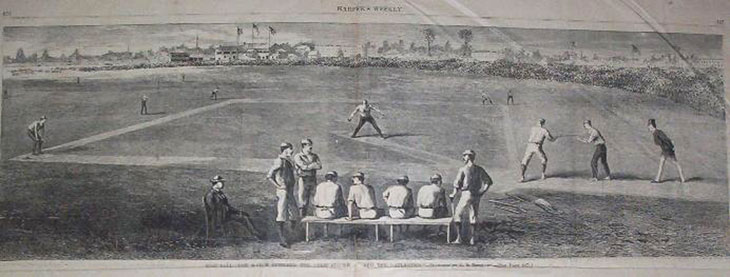
To celebrate the conclusion of the South Carolina Institute Fair, a three inning baseball game was played with the Palmettos beating the Schachte team 27-16.

1870 baseball - Atlantics vs. Red Stockings. Harper's Weekly

1870 baseball – Atlantics vs. Red Stockings. Harper’s Weekly

Today In American History – The Republican Elephant

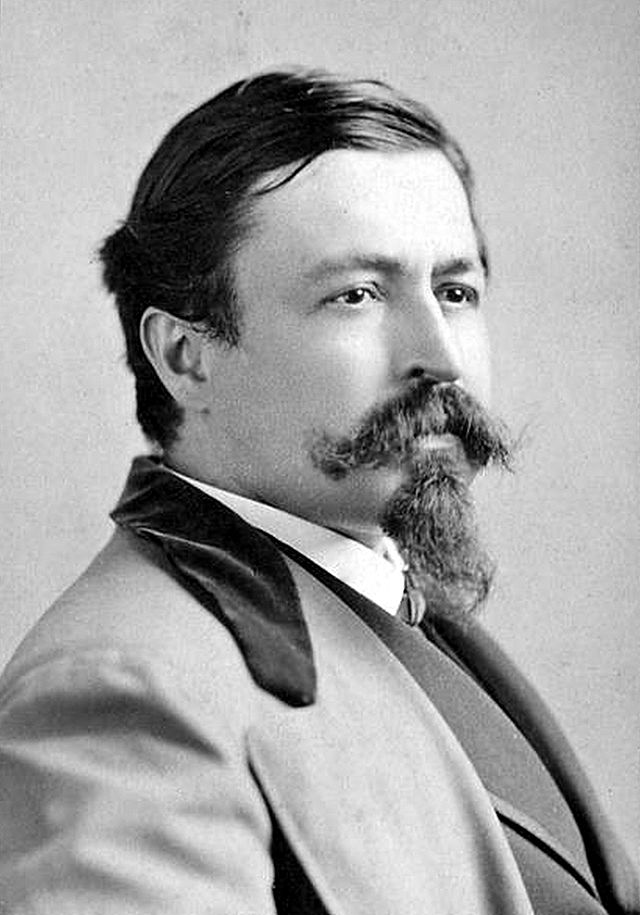
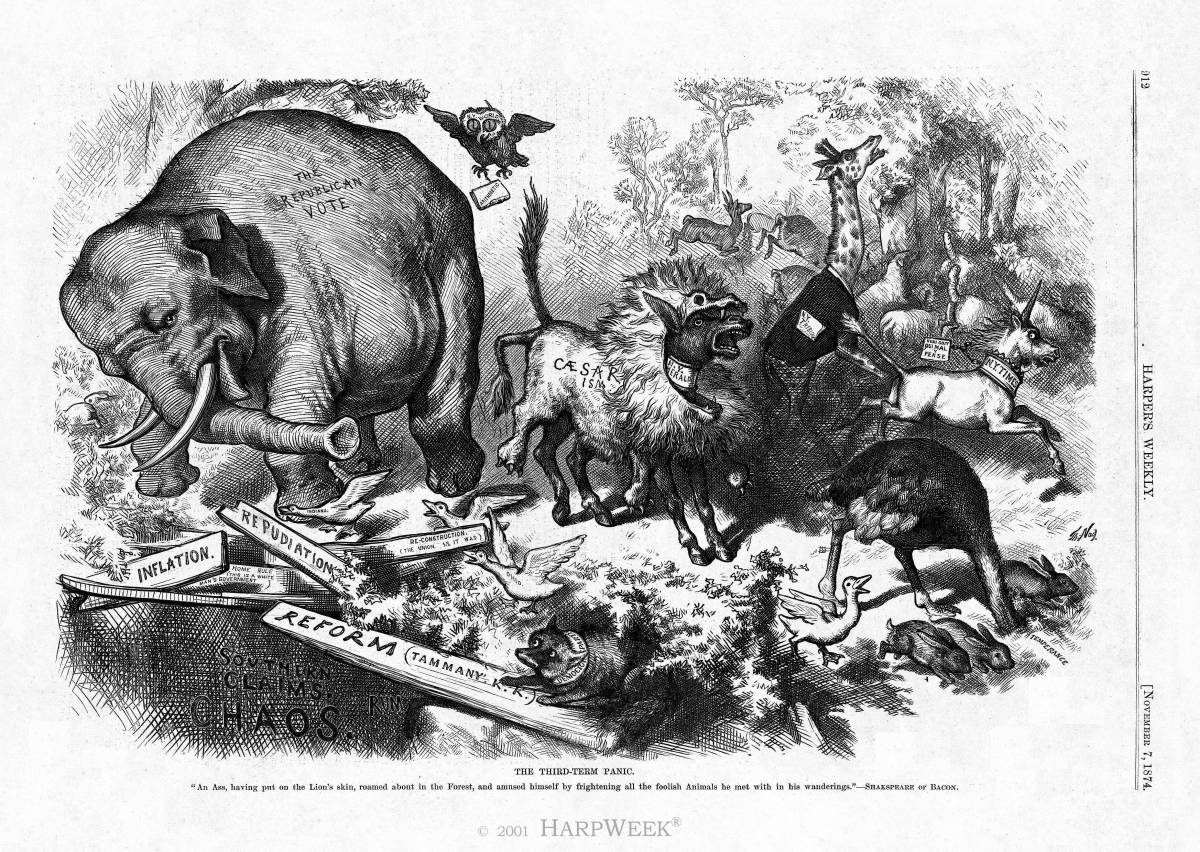
The symbol of the Republican Party was created by cartoonist Thomas Nast and first appeared in Harper’s Weekly on Nov. 7, 1874. 

Thomas_H_Nast

Thomas H. Nast

The New York Herald perpetuated a circulation-builder  hoax in 1874 … called the Central Park Menagerie Scare of 1874. They ran a story, totally untrue, that the animals in the zoo had broken loose and were roaming the wilds of New York’s Central Park in search of prey.

Cartoonist Thomas Nast took the two examples of the Herald hoax and put them together in a cartoon for Harper’s Weekly. He showed an ass (symbolizing the Herald) wearing a lion’s skin (the scary prospect of Caesarism for a third term for Pres. Grant) frightening away the animals in the forest (Central Park). 

One of the foolish animals in the cartoon was an elephant, representing the Republican vote – not the party, the Republican vote – which was being frightened away from its normal ties by the phony scare of Caesarism. In a subsequent cartoon on Nov. 21, 1874, after the election in which the Republicans did badly, Nast followed up the idea by showing the elephant in a trap, illustrating the way the Republican vote had been decoyed from its normal allegiance.

Other cartoonists picked up the symbol, and the elephant soon ceased to be the vote and became the party itself: the jackass, now referred to as the donkey, made a natural transition from representing the Herald to representing the Democratic party that had frightened the elephant.

Harper's Weekley 1874

Harper’s Weekley 1874

Caption: “An Ass, having put on the Lion’s skin, roamed about in the Forest, and amused himself by frightening all the foolish Animals he met with in his wanderings.”–


Today In Charleston History: November 7

1775 – American Revolution. Slavery

John Murray, Earl of Dunmore, and governor of Virginia, issued a proclamation that promised freedom to those slaves who joined the British in the fight against the rebellious colonists. According to reports, runaway slaves flocked to Sullivan’s Island in Charleston and Tybee Island in Savannah by the hundreds. William Moultrie estimated that about five hundred slaves had found refuge on Sullivan’s Island and Stephen Bull wrote to Henry Laurens that about two hundred slaves had settled on Tybee Island.

lowcountry slaves

sullivans-island

Today In Charleston History: November 6

1782 – Revolutionary War. 
John Laurens

John Laurens

Upon receiving the news of John Laurens’ death, John Adams wrote to Henry Laurens:

“I feel for you more than I can or ought to express. Our country has lost its most promising character, in a manner, however, that was worthy of the cause. I can say nothing more to you, but that you have much greater reasons to say, in this case, as a Duke of Ormond said of an Earl of Ossory, “I would not exchange my dead son for any living son in the world.”

 Henry Laurens replied, “Thank God, I had a son who dared to die in defence of his country.”

1860 – Road to Secession.

Abraham Lincoln became the first Republican to be elected President. Voter turnout was 81.2 %, the highest in American history at the time. Lincoln did not carry a single slave-holding state and won the Electoral College with less than 40% of the vote.


1860 PRESIDENTIAL ELECTION RESULTS

CANDIDATE / POLITICAL PARTY PERCENTAGE OF VOTE
Abraham Lincoln (Republican) 39.8%
John Breckenridge (Southern Democrat) 18.1%
John Bell (Constitution Union / Whig) 12.6%
Stephen Douglas (Northern Democrat) 29.5%

South Carolina legislature immediately called for a state secession convention. Since the new state house was under construction, the legislature held meetings at the First Baptist Church in Columbia, as it was the largest meeting place in the city.

city hall - lincoln election

Charleston City Hall – assembled crowd awaiting the result of the 1860 Presidential elections. Harper’s Weekly image.