Today In Charleston History: September 21

1820

John England was consecrated as the first Roman Catholic Bishop of South Carolina in St. Finbar’s Cathedral in Cork, Ireland.

St-Finbarre's-Cathedral

St. Fin Barre’s Cathedral, Cork, Ireland

1914

Edmund Jenkins, whose father Rev. Daniel Jenkins ran the Jenkins Orphanage, enrolled in London’s Royal Academy of Music. Ironically, the campus site had once been an orphanage. His enrollment fee was £14 ($75) which covered only his piano and composition studies. He listed his home address as 20 Franklin Street, Charleston, S.C., U.S.A.  He was enrolled to study composition under the direction of Francis Corder, one of the world’s leading experts on Wagnerian opera.
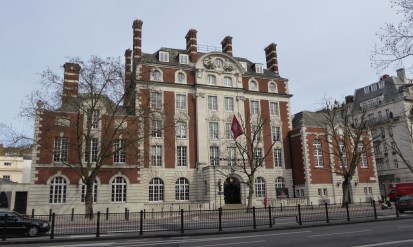
Royal-Academy-of-Music-Marylebone-Road

Royal Academy of Music, Marylebone Road, London

1989

Hurricane Hugo was a Category 4 hurricane at landfall which brought strong winds to many areas of South Carolina. Extensive property damage was reported in several counties, especially in the Lowcountry and the Grand Strand. More than 227,800 residences experienced power outages. In the Francis Marion National Forest, about 8,800 square miles of trees were downed, enough timber to build 660,000 homes.Total losses in the Lowcountry reached $1 billion.

1989hugo0422The storm surge and rough tides caused extensive damage in Charleston County. The highest storm surge observation was 20.2 feet (6.2 m) at Seewee Bay near McClellanville. Prior to the storm, residents of McClellanville took shelter in the cafeteria at Lincoln High School. However, storm surge flooded the room, with some people climbing up to the rafters for safety. A portion of the Ben Sawyer Bridge – linking Mount Pleasant to Sullivan’s Island – collapsed due to strong winds and storm surge. On Sullivan’s Island, water destroyed two or three rows of beach houses in some areas. At Isle of Palms, boats harbored at the marina were washed ashore and piled into a large heap. Losses at Sullivan’s Island and Isle of Palms reached nearly $270 million.

  • Total fatalities: 61
  • Highest winds: 162 mph
  • Lowest pressure: 918 mb

Today In Charleston History: September 20

1708

Reverend Gideon Johnston was not impressed at what he found in Charles Town. He wrote:

The people here, generally speaking, are the vilest race of men upon earth. They have neither honor, nor honesty, nor religion enough to entitle them to any tolerable character, being a perfect Medley of hotch-potch made up of bankrupt pirates, decayed libertines … who have transported themselves hither from Bermudas, Jamaica, Barbados, Montserat, Antego, Nevio, New England, Pennsylvania … Most of those that pretend to be churchmen are strongly crippled in their goings…

The population of Carolina was 9580 souls which included:

  • 2260 free men and women
  • 120 white servant males and females
  • 1700 white free children
  • 2900 Negro men and women slaves
  • 1100 Indian men and women slaves
  • 1200 Negro children slaves
  • 300 Indian children slaves

Today In Charleston History: September 19

1721

 A new election law was passed, dividing the representation of Carolina into parishes. It remained that way until the Revolutionary period.

1802

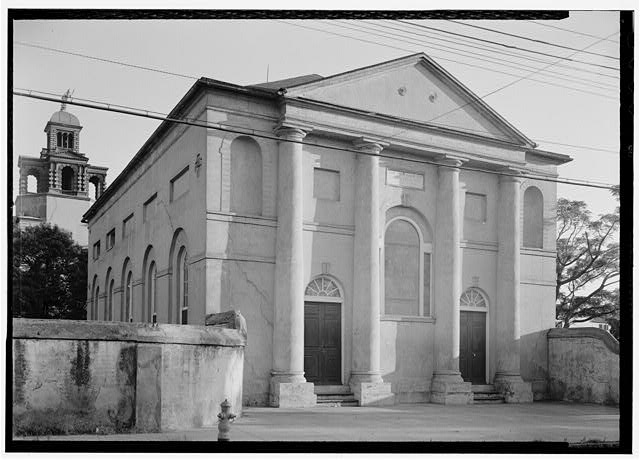
The chapel at the Charleston Orphan House opened. Designed and constructed by Gabriel Manigault, the Gentleman Architect, it was completed in less than one year. Baptist minister, Rev. Richard Furman, preached the dedication sermon.

Charleston Orphan House Chapel, 13 Vanderhorst Street

Charleston Orphan House Chapel, 13 Vanderhorst Street

1835

A letter by Angelina Grimke, decrying the mob violence against abolitionist literature, was published by William Lloyd Garrison in his paper, The Liberator.

I can hardly express to thee the deep and solemn interest with which I have viewed the violent proceedings of the last weeks. The ground upon which you stand is holy ground: never – never surrender it. If you surrender it, the hope of the slave is extinguished. If persecution is the means by which God has ordained for the accomplishment of this great end, EMANCIPATION; then … I feel as if I could say, LET IT COME, for it is my deep, solemn deliberate conviction, that this is a cause worth dying for.

Understanding that the publication of this letter had burned all her Southern bridges, Angelina later wrote in her diary:

To have the name of Grimke associated with that of the despised Garrison seemed like bringing disgrace upon my family, not myself alone … I cannot describe the anguish of my soul. Nevertheless I could not blame the publication of the letter, nor would I have recalled it if I could.

Today In Charleston History: September 18

1787

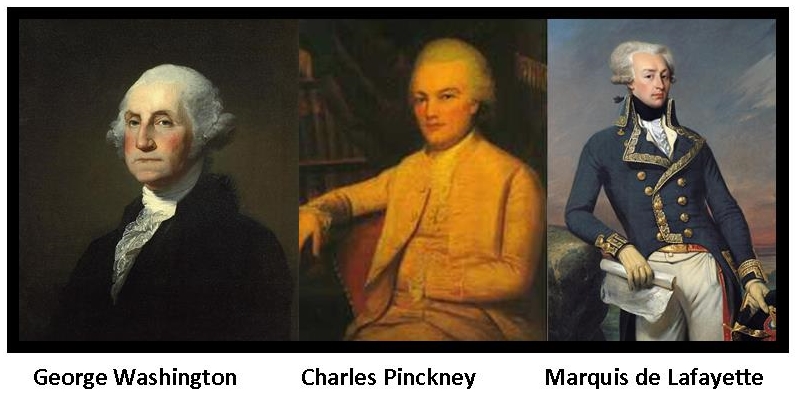
George Washington wrote a letter of introduction for Charles Pinckney for the Marquis de Lafayette. Pinckney was planning to finally fulfill his dream to travel to Europe, delayed first by the Revolution and then his father’s death. However, he delayed the trip to return to South Carolina to campaign for the ratification of the Constitution of the United States. 

washington-pinckney-lafayette

Today In Charleston History: September 17

1669

The three ships of the Carolina expedition – the Carolina, the Albermarle and the Port Royal – left Ireland for the trans-Atlantic crossing. Mr. Joseph West was appointed Governor and Commander-in-chief of the Carolina expedition until its arrival at Barbados, or until another Governor was appointed. 

1739 – Births

j. rutledgeJohn Rutledge, son of Dr. John and Sarah Rutledge was born. He would become the most prominent lawyer in Charles Town, the first governor of South Carolina and a signer of the U.S. Constitution.  

1787 -Constitutional Convention.

South Carolina delegates John Rutledge, Charles Cotesworth Pinckney, Charles Pinckney and Pierce Butler signed the new Constitution of the United States.

Scene_at_the_Signing_of_the_Constitution_of_the_United_States

Howard Christy’s “Scene at the Signing of the Constitution of the United States.” The South Carolina delegation is pictured in the lower left hand corner.

Today In Charleston History: September 16

1706 – Queen Anne’s War.

A joint French and Spanish attack upon Charles Town during Queen Anne’s War was repulsed when Colonial forces capture a French vessel and it crew. Governor Nathaniel Johnson and Lieutenant Colonel William Rhett lead the successful defense of Charles Town against a combined force of Spanish, French, and Native American combatants who sailed into Charleston harbor from St. Augustine.

1781 – Slavery. Denmark Vesey.

Capt. Joseph Vesey of Charles Town purchased 390 slaves in St. Domingue. One of the slaves he purchased was a young boy “about 14 years old” named Telemaque. Vesey also noted the boy had a “beauty, alertness and intelligence.”  Instead of keeping the boy chained below decks Vesey”adopted the boy as the “ship’s pet and plaything.” Vesey gave the boy a new set of clothes and used him as his cabin boy.

vesey statue copyWhen the ship arrived at Cap Francois, Haiti, Vesey decided he “had no use of the boy” and turned him over to the slave agents Lory, Plomard and Compagnie. Little did he know that young boy would become a constant feature of his life for the next 30 years, and ultimately … for the next 200 years. 


Today In Charleston History: September 15

1707

Judge Trott wrote in defense of the Church Act: “The reason why we passed the Act to exclude them (Dissenters) from being chosen was because they never did any good there nor never do any.”

1718 – Piracy

Col. William Rhett’s expedition left searching for Charles Vane. Information indicated that the pirates had sailed up the Edisto River. However, the search was in vain. Rhett found no trace of the pirates and sailed north to Cape Fear to continue his patrol.

1767

The Commissioners of Fortification reported they had “viewed the fortifications on White Point and find the whole in ruinous condition and some parts broke through by the sea …”

1775 – American Revolution. Charleston First
WilliamCampbell

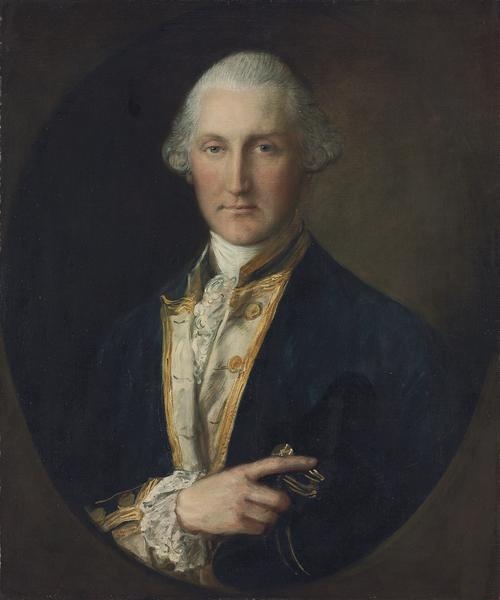
Lord William Campbell was injured on June 28, 1776 during the battle of Sullivan’s Island on board the HMS Bristol. He later died of his wounds.

Lord William Campbell discovered that Patriot leaders learned of his coordinating with back country Loyalists. Fearing attack from Revolutionaries in Charlestown, Campbell fled his house on Meeting Street in the early morning hours to HMS Tamar. This effectively ended British rule in South Carolina.

Almost immediately, Colonel William Moultrie led a local militia unit with Captain Francis Marion, seized Fort Johnson and its twenty-one guns, with no resistance from the British. Lord William Campbell, on board the Tamar, considered this action an overt act of war. The fact that this was done in plain view of two British warships, practically under Campbell’s nose, made it particularly insulting.

Moultrie was then directed by the Council of Safety to devise a flag. He chose the blue of the 1st and 2nd Regiments and the silver crescent which adorned their hats. This flag was raised over Ft. Johnson – the first American flag to replace the Union Jack. 

1832 – Nullification Crisis

 The Union and Nullifier Parties signed a formal agreement to prohibit late night meetings and abolish free liquor to all supporters. They set a 10:00 p.m. curfew for all meetings to end. This was an attempt to limit the number of drunken brawls and shootings that had plagued the city during the run-up to the election.

1857
Wreck_of_the_Central_America

Wreck of the Central America

The S.S. Central America sank in a hurricane off the Charleston coast. It was a 278-foot steamer sailing from Panama to New York City carrying 30,000 pounds of California Gold Rush-era coins and ingots – giving rise to the name Ship of Gold. Four hundred and twenty-five passengers and crew were lost. At the time of its sinking, Central America carried gold then valued at approximately $2 million. The loss shook public confidence in the economy, and contributed to the Panic of 1857.

On September 11, 1988. The ship was located by the use a remotely operated vehicle (ROV). The total value of the recovered gold was estimated at $100–150 million. A recovered gold ingot weighing 80 lb sold for a record $8 million and was recognized as the most valuable piece of currency in the world at that time. Currently only “5 per cent of the ship has been excavated. 

Read an August 2014 story from Newsweek about the excavation.

Today In Charleston History: September 14

1769 – American Revolution – Foundations

The Gazette reported that, excluding Royal officials, only thirty-one inhabitants of had refused to sign the pledge and join the “Association.” The names of the thirty-one were published in the paper and they quickly discovered themselves unable to sell merchandise.

The “Association” was a group of Charles Town men who pledged to support non-importation of any products of Great Britain, and denounced anyone who did not sign within a month. Many of the aristocratic leaders were upset by the surge of the mechanics (carpenters, etc …) in politics, usurped by men they considered their inferior.

william henry draytonWilliam Henry Drayton condescendingly wrote in the Gazette:

No man who could boast of having received a liberal education would consult on public affairs with men who never were in any way to study, or to advise upon any points, but rules how to cut up a beast in the market … cobble on old shoe … or to build a necessary house.

Christopher Gadsden pointed out that Drayton was exempted from labor to make a living due to his “marriage to a rich heiress rather than from any merit of his own.”

The rally cry of the “Association” became “Sign or die!” Over the next several weeks Drayton and Gadsden published dueling letters in the Gazette, with the attacks becoming more personal rather than an exchange of ideas.

Jazz Me Blues – Story of an American Standard (Essentials – Music)

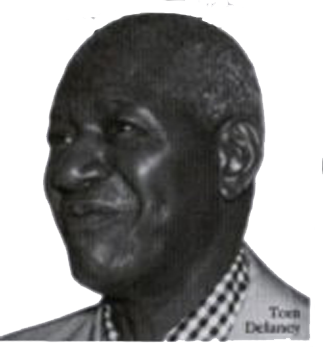
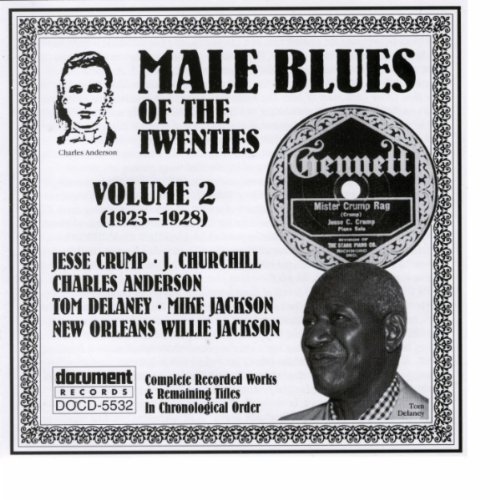
tom delaney_edited-1Tom Delaney was born in Charleston, South Carolina in 1889 and raised at the Jenkins Orphanage. Founded in 1891 by Rev. Daniel Jenkins, it became one of the most successful orphanages for black children in the South. One of the most famous features of the orphanage was the Jenkins Band, which performed military marching music on street corners and “passed-the-hat” for donations. Delaney performed with the band until 1910. At age 21 he was living in New York City and working as a “whorehouse professor,” playing piano, writing songs and singing in saloons, gin joints and whorehouses in the seedy sections of Manhattan. 

His first big break came when he was thirty-two years old, in 1921. Delaney’s song “Jazz Me Blues” attracted the attention of professional musicians and, more importantly, people who owned recording studios. They were always looking for songs to record, especially now that there was money to be made with “black” songs. “Jazz Me Blues” combined risqué lyrics about sex with a swinging ragtime feel.

The year before, 1920, Perry Bradford convinced a New York record company to record a “black blues” song. Mamie Smith recorded Bradford’s “Crazy Blues.” It sold more than a million copies in less than a year. Suddenly, “black blues” songs were hot. Delaney had written hundreds of blues songs by then, so he began to peddle them to record companies.

tom delaney - blues singers of the 20sDuring this time he met a young singer named Ethel Waters. She performed in vaudeville shows for years as a dancer billed as “Sweet Mama Stringbean.” Waters, however, preferred singing to dancing, and on March 21, 1921, she recorded two of Delaney’s songs for the Pace & Handy Music Company, “Down Home Blues” and “At The Jump Steady Ball.” A twenty-three year old former chemistry student named Fletcher Henderson played the piano for the session. “Down Home Blues” became a hit. Pace & Handy paired Waters and Delaney together and sent them out on tour, Waters on vocals and Delaney on piano.   

Two months later an act called Lillyn Brown and Her Jazz-Bo Syncopaters recorded “Jazz Me Blues.”  That was followed quickly by an instrumental version of the song by the Original Dixieland Jazz Band.  Both versions sold thousands of copies. Through the years more than 100 of Delaney’s songs were recorded by the most popular artists of the day. “Jazz Me Blues” became a standard recorded by Duke Ellington, Louis Armstrong, Sidney Bechet, Bix Beiderbecke, Count Basie, Jack Teagarden and Benny Goodman.

“Jazz Me Blues” lyrics

Down in Louisiana in that sunny clime, 
They play a class of music that is super fine, 
And it makes no difference if it’s rain or shine, 
You can hear that jazzin’ music playin’ all the time.

It sounds so peculiar ’cause it’s really queer, 
How its sweet vibrations seems to fill the air, 
Then to you the whole world seems to be in rhyme; 
You’ll want nothin’ else but jazzin’, jazzin’ all the time.

Every one that I ever came to spy, hear them loudly cry: 
Oh, jazz me! 
Come on, Professor, and jazz me! 
Jazz me! 
You know I like my dancing both day and night, 
And if I don’t get my jazzin’, I don’t feel right, 
Now if it’s ragtime, take a lick,  play it in jazz time, 
Jazz time! 
Don’t want it fast, don’t want it slow; 
Take your time, Professor, play it sweet and low! 
I got those doggone, low-down jazz-me jazz-me blues!

Jazz me! 
Come on, Professor, and jazz me! 
Jazz me! 
You know I like my dancing both day and night, 
And if I don’t get my jazzin’, I don’t feel right, 
Now if it’s ragtime, take a lick, play it in jazz time, 
Jazz time! 
Don’t want it fast, don’t want it slow; 
Take your time, Professor, play it sweet and low! 
I got those doggone, low-down jazz-me, jazz-me blues! 

To read the entire story of “Jazz Me Blues” and the beginning of American popular music read Mark’s book, Doin’ The Charleston: Black Roots of American Popular Music & the Jenkins Orpahange Legacy.

doin' the charleston

Today In Charleston History: September 13

1752 – Disaster.
CharlestowneWharf1700s1

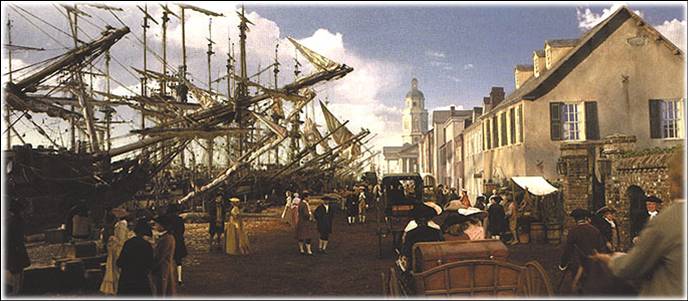
Still from the movie, The Patriot, showing Tradd Street (on the right) with some Hollywood CGI magic thrown in.

A hurricane hit Charlestown, with a flood level of ten feet above the previous recorded high water mark. More than 100 died, with twice as many injuries. The South Carolina Gazette reported:

All the wharves and bridges were ruined, and every house, store, & upon them, beaten down, and carried way (with all the goods, & therein), as were also many houses in the town; and abundance of roofs, chimneys, & almost all the tiled or slated houses in the town … The town was likewise overflowed, the tide of sea having rose upwards of Ten feet above the high-water mark at spring tides …

All but one of the ships in the harbor were driven ashore and most of the smaller vessels soon became one with the debris. Sloops and schooners were thrown against the houses of Bay street and the wharves along East Bay street destroyed. A brigantine beat down several houses and wound up on the east side of Church street. Eight or ten small schooners, owned by Charlestonians, and three or four pilot boats were driven into the woods, corn fields and marshes of surrounding areas

David Ramsay, in his History of South Carolina, reported:

Colonel Pinckney, who lived in the large white house at the corner of Ellery street and French alley, abandoned it after there were several feet of water in it. He took his family from thence to… corner of Guignard and Charles streets, in a ship’s yawl. All South Bay was in ruins, many wooden houses were wrecked to pieces and washed away, and brick houses reduced to a heap of rubbish … A brick house where Mr. Bedon lived, on Church street .. Mr. Bedon and family unfortunately remained too long in the house, for the whole family, consisting of twelve souls, perished in the water, except himself and a negro wench. The bodies of Mrs. Bedon, of one of her children, and of a Dutch boy, were found in the parsonage pasture…

1763

During a special election for the Assembly, Christopher Gadsden was elected, but discovered that the election return from St. Paul’s parish was blank. The church wardens had also not taken the oath required by the Election Act. Gov. Boone, citing the irregularities, refused to administer the oath of office to Gadsden, and called for a new Election Act to be written.