A TOWN LIKE ALICE: A Review (Essentials)

This is one of the best books of the 20th century. In 1998, Modern Library voted A Town Like Alice #17 on the list of 100 Greatest English-language Novels of 20th Century. It is also known as The Legacy. It is an unbashedly romantic tale that I have read more than a dozen times. aliceNevil Shute was the author of 30+ novels and can best be described as “old fashioned.” His books are literate, with a distinctly British view, but also very worldly. He often explored unusual themes like reincarnation, utopian visions (In The Wet is a very entertaining variation of Brave New World.) 
Shute was a trained engineer and science plays a huge role in many of his books. Many of his characters are aviators, engineers, and geologists. During his lifetime Shute was one of the most popular writers in the world and his most famous book, On The Beach, while justly famous as the only close-ended novel ever written (no one in the book survives after the final page) is one of his lesser efforts. It is a shame that dozens of Shute’s novels do not sit on the shelves of modern bookstores.

In 1981 the book was turned into a world wide award winning mini-series for Australian television starring Helen Morse and Bryan Brown, it is superb! 

SUMMARY

After World War II, a young English woman named Jean Paget learns that she has inherited a legacy from her great uncle. She is now a rich young woman with no need to work ever again. When the Scottish lawyer, Noel Strachan, whose firm manages the legacy asks what she’d like to do with the money, she replies, “I’d like to build a well.”

Jean and her family had lived in Malaysa for most of her childhood until her fathered died. Now, Jean was alone living in London. Her mother was dead and her brother died in a Japanese POW camp. Jean and her family had lived in Malaysa for most of her childhood until her father died.
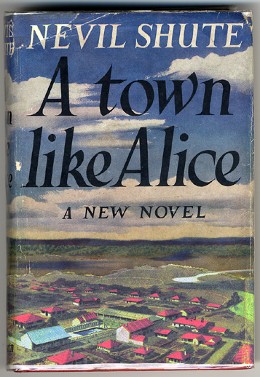
TownLikeAliceJean tells Strachan her story:During the war she was working in Malaya when the Japanese invaded and she ended up as one of a party of English women and children who are marched around Malaya by the Japanese, since no camp will take them in and the Japanese army does not want to take responsibility for them. Many of them die on the march, and the rest survive only on the charity of the local villagers. Jean’s knowledge of Malay language and culture proves invaluable to the group’s survival.

The women meet Joe Harman, an Australian soldier who is also a prisoner. He drives a truck for the Japanese across Malaya carrying supplies. He steals food and medicines to help the women and Jean and Joe become friends. Jean always carries a small boy, orphaned after his mother died, and which leads Harman to the mistaken belief that she is married; to avoid giving Joe any temptation, Jean does not correct this misperception. The thefts are investigated and Harman takes the blame to save Jean and the rest of the group. He is beaten, crucified, and left to die by the Japanese soldiers. The women are marched away leaving Joe for dead.

To survive, the women become part of a native village where they grow rice and work as part of the village. This saves their lives, and they live there for three years, until the war ends. This village is where Jean wants to build the well so that the local women will not have to walk so far to collect water: “A gift by women, for women”.

With her legacy, Jean travels to Malaya, where she goes back to the village and persuades the headman to allow her to build the well. While it is being built she discovers that by a strange chance Joe Harman survived his punishment and returned to Australia. She decides to travel on to Australia to find him. 

In her travels, she visits the town of Alice Springs, where Joe lived before the war, and is much impressed with the quality of life there. She then travels to the (fictional) primitive town of Willstown in Queensland where Joe has become manager of a cattle station. She soon discovers that the quality of life in Alice is an anomaly, and life for a woman in the outback is elsewhere very rugged. While staying in the local hotel in Willstown she finds that the local hunters shoot crocodiles and prepare their skins for export, at prices much lower than they are sold in England. To show the locals what their exports are used for, she makes a pair of crocodile-skin shoes in her bedroom, by hand.

In the meantime, Joe has learned both that Jean survived the war and is unmarried. He takes the money he won in the state lottery in order to travel to Britain in search of her. In London, he meets lawyer Strachan, who must decide on his client’s behalf how to handle this situation. On Strachan’s advice, Harman returns to Queensland, and Jean and Joe two finally meet again in one of the most emotionally charged and poignant love scenes ever written.

At this point, you are about halfway through the book, and I would deserve to be crucified myself if I revealed any more of the plot. Read it NOW.

5 palmettos


Companion Read: 
No Highway by Nevil Shute

Dylan Goes Electric at Newport Folk Festival, 1965.

The Newport Folk Festival was founded in 1959 by George Wein, founder of the already-well-established Newport Jazz Festival. Members of the supporting board included Theodore Bikel, Oscar Brand, Pete Seeger and Albert Grossman.

The festival introduced a number of performers who went on to become major stars, most notably Joan Baez in 1959, and Bob Dylan at the 1963 festival. It also featured many country-blues artists like Johnny Cash, Muddy Waters and Howlin’ Wolf.  However, the 1965 festival became famous as one of the watershed events in modern American music.

On Saturday, July 24, 1965, Bob Dylan performed three solo acoustic numbers, “All I Really Want to Do”, “If You Gotta Go, Go Now”, and “Love Minus Zero/No Limit” at a Newport workshop. Dylan was irritated by what he considered condescending remarks about the Paul Butterfield Blues Band made by Newport Folk Festival organizer Alan Lomax. Dylan made a spontaneous decision that day that he would challenge the Festival by performing with a fully amplified band.

dylan, newport2

Dylan performs an acoustic set at Newport.

On the night of Sunday, July 25, Dylan’s appearance was sandwiched between Cousin Emmy and the Sea Island Singers, two very traditional folk acts. The band that went on stage with Dylan included two musicians who had played on his recently released single, “Like a Rolling Stone”: Mike Bloomfield on lead guitar and Al Kooper on organ.

Master of Ceremonies Peter Yarrow of Peter, Paul & Mary, introduced Dylan with, “Ladies and gentlemen, the person that’s going to come up now has a limited amount of time … His name is Bob Dylan.” The band took the stage, plugged in their electric guitars and launched into a blistering version of “Maggie’s Farm.” Within a few bars of the song, the boos began from the audience and continued throughout the three song set. After playing “Like a Rolling Stone.” Dylan closed with an early version of “It Takes a Lot to Laugh, It Takes a Train to Cry” titled “Phantom Engineer.” As the band left the stage there was a mixture of booing and clapping from the audience. Peter Yarrow returned to the microphone and begged Dylan to continue performing., Dylan returned to the stage and performed two songs on acoustic guitar for the audience: “Mr. Tambourine Man”, and then, as his farewell to Newport, “It’s All Over Now, Baby Blue”. 

Bob-Dylan-at-Newport-1965

It has been argued for years that the boos were from outraged folk fans, who disliked Dylan playing an electric guitar. Al Kooper, and others present at Newport, have disagreed with this interpretation, and argued that the audience was upset by poor sound quality, and the boos were brought on by Dylan’s short set, not the fact that Dylan had gone electric. Kooper said: “The reason they booed is because he only played for fifteen minutes, when everybody else played for forty-five minutes or an hour. They were feeling ripped off. Wouldn’t you? They didn’t give a shit about us being electric. They just wanted more.”

Poor sound quality was the reason Pete Seeger gave for disliking the performance. He was watching the performance backstage and says he told the audio technicians, “Get that distortion out of his voice … It’s terrible. If I had an axe, I’d chop the microphone cable right now.” Seeger has also said, however, that he only wanted to cut the cables because he wanted the audience to hear Dylan’s lyrics properly, because he thought they were important.

Joe Boyd, responsible for the sound mixing at the 1965 Newport Folk Festival, said, “I think there were a lot of people who were upset about the rock band, but I think it was pretty split. I think probably more people liked it than didn’t.”

In an interview in Mojo magazine, Murray Lerner, director the documentary The Other Side of the Mirror: Bob Dylan Live at the Newport Folk Festival 1963-1965 said,

“I think they were definitely booing Dylan and a little bit Pete Yarrow because he was so flustered. He was not expecting that audience’s reaction and he was concerned about Bob’s image, since they were part of the same family of artists through Al Grossman. But I absolutely think that they were booing Dylan going electric.”

Three months before Dylan’s performance, the rock band, The Byrds, released an electric version of Dylan’s “Mr. Tambourine Man.” The Byrds’ version featured traditional folk harmonies soaring over Roger McGuinn’s jangly 12-string Rickenbacker guitar and a driving beat, which hit #1 in late June 1965, three weeks before Dylan’s performance. The combination of those two events unleashed the folk-rock explosion in popular music. The Beatles’ George Harrison introduced his 12-string guitar and the Fab Four created a Byrds-like sound on their Rubber Soul and Revolver LPs.  This opened the floodgates for artists like The Searchers, The Lovin’ Spoonful, The Mamas and the Papas, Donovan, the Turtles, Sonny & Cher and Simon & Garfunkel. 

If Bob Dylan had faded into obscurity during the 1970s, he would still be considered as one of the most important artists of the 20th century based on his output of dozens of classic songs and his electric performance at the 1965 Newport Folk Festival.

Born Today: August 7

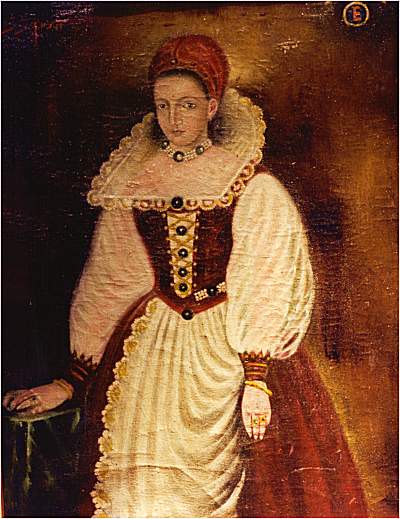
1560 – Elizabeth Báthory, Nyírbátor, Hungarian countess and serial killer.

During the Christmas season in 1609 (or 1610), King Mathias II of Hungary�sent a party of men to the massive Castle Csejthe. He had heard rumors that several young women from the area were being held in the castle against their will, if not actually killed. In haste, he sent the team to investigate. what they discovered was beyond their imagination. 

Bathory was already infamous in the area for her torture and murder of servants and peasants, but her title and high-ranking relatives had made her untouchable. 

One of her uncles instructed her in Satanism, while her aunt taught her all about sadomasochism. At the age of 15, Bathory was married to Count Nadady, and the couple settled into Csejthe Castle. To please his wife, her husband built a torture chamber to her specifications.

Elisabeth Bathory, the Bloody Countess

Elisabeth Bathory, the Bloody Countess

Bathory’s torture included jamming pins and needles under the fingernails of her servant girls, and tying them down, smearing them with honey, and leaving them to be attacked by bees and ants. Although the count participated in his wife’s cruelties, he may have also restrained her impulses; when he died in the early 1600s, she became much worse. With the help of her former nurse, Ilona Joo, and local witch Dorotta Szentes, Bathory began abducting peasant girls to torture and kill. She often bit chunks of flesh from her victims, and one unfortunate girl was even forced to cook and eat her own flesh. Bathory reportedly believed that human blood would keep her looking young and healthy.


1950 – Rodney Crowell, Houston Texas, singer/songwriter.

rodney-crowell-456-012811One of the best songwriters of the past forty years, Crowell has had a long career, starting in the 1970s as part of Emmylou Harris’s Hot Band. He then began to record his own solo LPs, and became the hottest songwriter / producer in Nashville. His marriage to Rosanne Cash made them one of the royal couples of country music during the 70s and 80s. Between them, they wrote and recorded together dozens of Top Ten country songs and won several Grammy Awards. In 1988 Crowell managed to have five #1 songs off his LP Diamonds and Dirt. 

During the 21st century Crowell has retreated from mainstream country music and has released a series of brilliant CDs and has become the elder statesman for the Americana music genre. 

Today In Charleston History: August 7

1753 – Religion.

A petition was made to the Royal Governor for a parcel of land upon which to build a Lutheran church.

1767 – Backcountry.

In more complaints about the dangerous conditions in the backcountry, The South Carolina and American General Gazette reported that:

If we save a little for to bring to Town Wherewith to purchase Slaves – Should it be known our Houses are beset, and Robbers plunder Us, even of our Cloaths. If we buy Liquor for to Retail, or for hospitality, they will break into our dwellings and consume it … Should be raise fat Cattle, or Prime Horses for the Market, they are constantly carried off, tho’ well guarded.  


Today In Charleston History: August 5

1749 – Births.
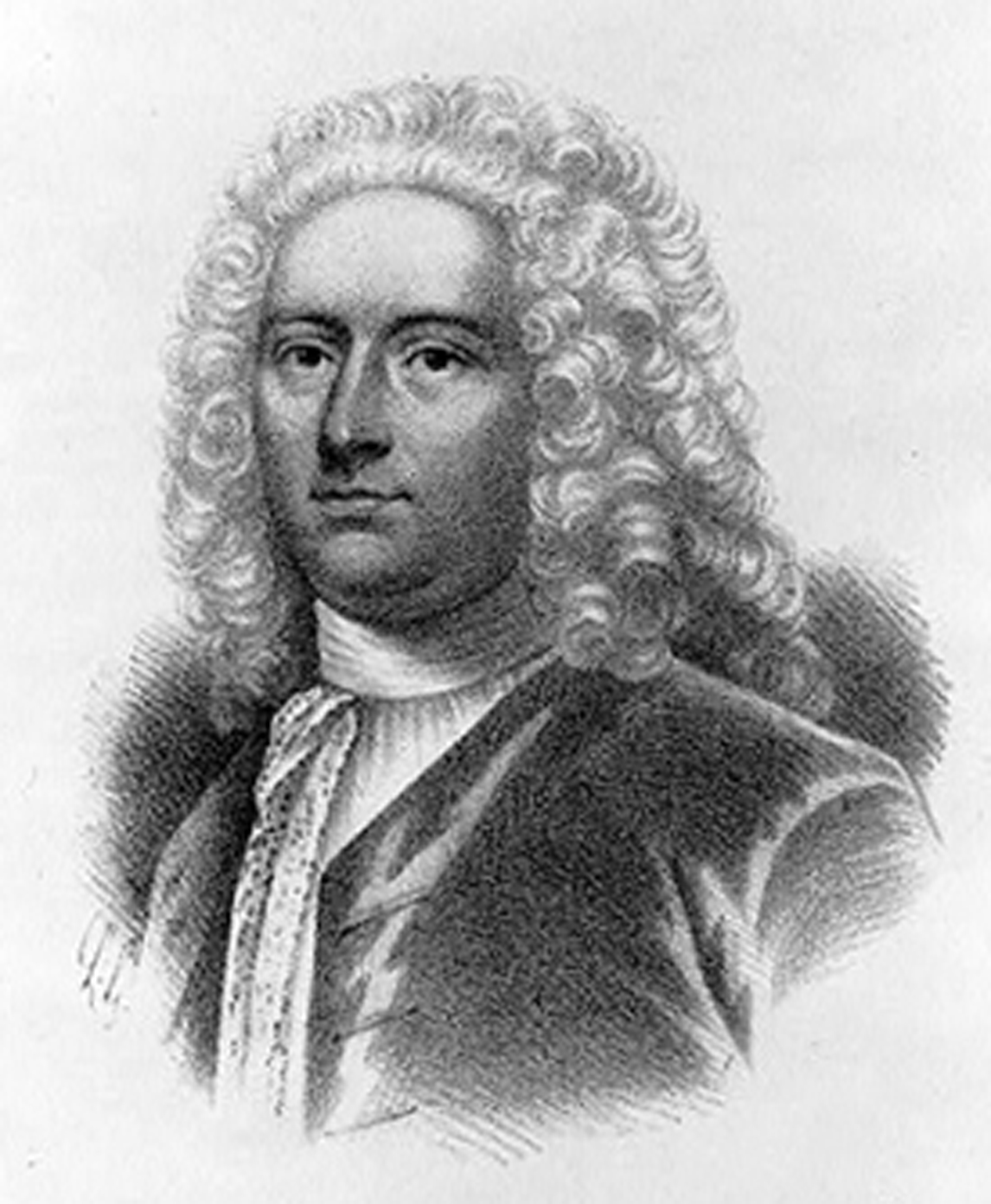
Thomas Lynch, Jr.

Thomas Lynch, Jr.

Thomas Lynch, Jr.  was born in Georgetown. He would later sign the Declaration of Independence for South Carolina.

1776 – American Revolution.

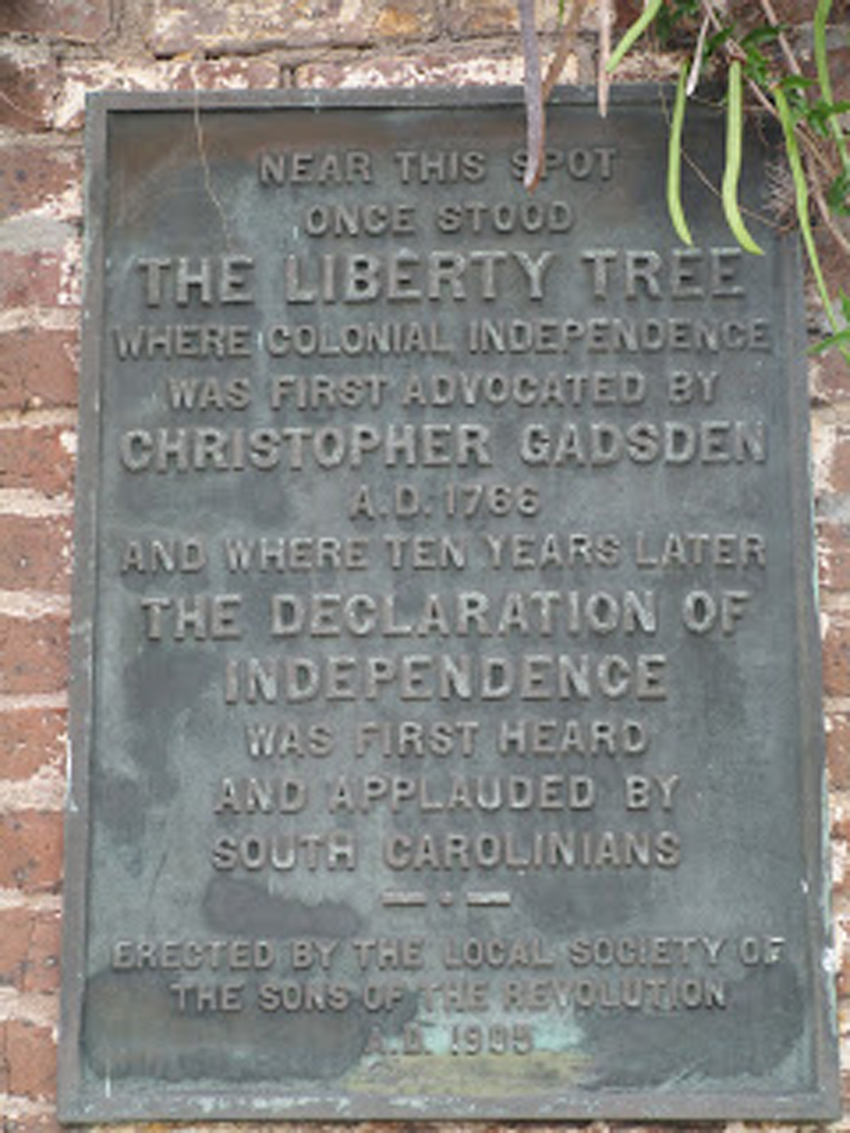
The Declaration of Independence arrived in Charleston. Maj. Barnard Elliot read it to a large, enthusiastic crowd under the Liberty Tree.

Liberty Tree marker on Alexander Street

Liberty Tree marker on Alexander Street

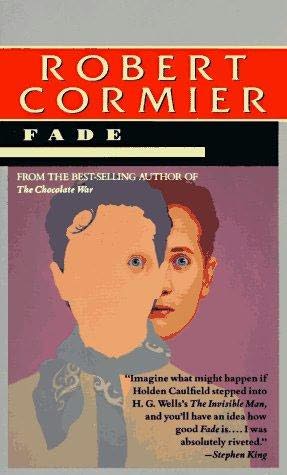
FADE: A Review

Why is Robert Cormier marketed to Young Adult audiences? His books explore disturbing subjects, dark themes, and create a generally bleak tone. Thomas Hardy has nothing on Cormier for tragic conclusions. And, not withstanding the constant presence of The Chocolate War, on must-read lists for Young Adults, Fade may be Cormier’s best book.

Fade_Robert_Cormier_novel_coverSUMMARY: At the age of thirteen, Paul Moreaux discovers that he can turn invisible. Paul, a sensitive and thoughtful working-class boy, doesn’t even realize it when he first gets The Fade. On a dare, he spies on a meeting of the Ku Klux Klan. (This is the 1930s, and anti-Catholic/anti-immigrant sentiments are running high against Paul and the other citizens of Frenchtown.) When the meeting is ambushed, a crazed Klansman discovers Paul and tries to kill him– but inexplicably, he somehow loses sight of his intended victim.

What Paul doesn’t realize is that he has inherited the ability to turn invisible. Sometimes it’s useful, as when escaping from Klansmen and bullies; more often it’s horrible, as when spying upon people who reveal secrets Paul never wanted to know. One male in his family has inherited this “gift” for several generations. Paul at least has guidance from an uncle, also a Fader. 
The invisible teenaged Paul slowly discovers that his “gift” only helps him learn quickly the tragedy of human existence; he is doomed to lead a life marked by violence, madness, and despair, with relief coming only when health complications from the invisibility cause him to die, lonely and young and unmourned.

A generation later, Paul’s own nephew Ozzie has no such counseling, because Paul doesn’t know he exists; the child had been secretly given up for adoption. Unfortunately Ozzie was raised by a physically abusive father, and when Ozzie discovers his Fading powers, after years of beatings and neglect, the results are terrible, with “terrible” meaning “like Stephen King’s Carrie on prom night.”

Thoughtful, horrific and suspenseful. Highly recommended!

Companion Read: Jumper by Steven Gould. (Note: do not let the bad movie based on Jumper keep you from reading it.)

 4 palmettos

Today In Charleston History: August 4

 1781 – British Occupation.

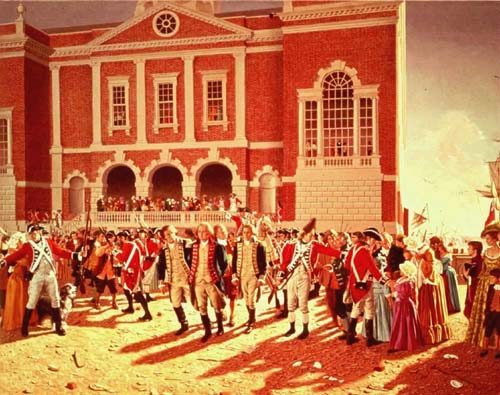
At 5:00 p.m. Col. Issac Hayne “was escorted by a party of soldiers to a gallows erected within the lines of the town with his hands tied behind, and there hung up till he was dead.” David Ramsay reported:

The military escort consisted of three hundred men. The place of execution was just without the city-lines, near Radcliffe’s Garden, nearly in front, and within a stone’s throw of the present Orphan House building. The troops formed a hollow square around the scaffold, the British troops occupying the front and rear, the Hessians on the right and left.

During the march through the city “the streets were crowded with thousands of anxious spectators.” Someone in the crowd called to Hayne “Exhibit the example of how an American can die!” Hayne replied, “I will endeavor to do so.”

gs_hayne

Issac Hayne marched from the Exchange Building to his execution.

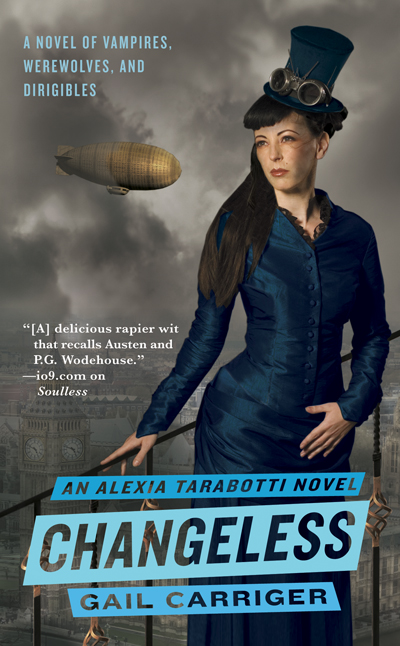
CHANGELESS: A Review

Remember the first time you heard the 1976 LP, Boston? It blew you away. Swirling twin guitars, a sound that mixed Led Zep with Yes and The Beatles, hard rockin’ songs with a melody, high harmonies, soulful singing by Brad Delp, and one mean ass rock and roll organ.

PrintRemember the anticipation as you waited (and waited and waited and waited) for Boston’s second LP? And then, it finally arrived! Don’t Look Back. So you tossed it on your turntable (for those of you under 30, Google it) and you listened to the LP. And about halfway through Side Two you started to get a sour feeling in your belly. The album was good … but was not great. It was … the same, but not better. After two years, this is what you got? So, you listened to it again. For the next few days you walked around thinking: “Oh man, this sucks.”

Welcome to CHANGELESS, the literary equivalent of Boston’s Don’t Look Back.

CHANGELESS is the sequel to SOULLESS.(Read the Soulless review) It was Bram Stoker mixed with the sensibility of Jane Austen set in Charles Dickens’ London. It was a world in which vampires, werewolves and ghosts were accepted in English society. Author Gail Carriger deftly pulled off a screwball comedy of manners.

So what’s wrong with CHANGELESS? Nothing really, except the disarming freshness has worn off. The wackiness of an English woman without a soul who can disarm vampires and werewolves with a thrust of her silver-coated parasol and sitting in council with Queen Victoria discussing the “vampire problem” is no longer new. Carriger has done little to move the story (and her world) into something else. We are stuck in a world that we already know, in a story that seems stale and mundane. Maybe that’s my own fault, since I found Soulless so delightful I am guilty of creating false expectations. I have an sneaking suspicion that two years from now, I will rate this book higher than I do right now. 

Like Don’t Look Back, it’s more of the same thing … more than just a mere shadow, but it serves to remind you how brilliant the initial offering is.

4 palmettos

Today In Charleston History: August 3

 1674 – Deaths.

Sir John Yeamans

Sir John Yeamans

Sir John Yeamans died in Carolina.  He was one of original landgraves of the Carolina colonial and became governor. In 1674 Yeamans was removed from office, and at once sailed for Barbados, where he soon afterward died. Robert Weir wrote: 

Yeamans epitomized the enterprising Barbadians who played a large part in settling South Carolina. That some, like him, resembled pirates ashore probably both promoted and retarded development of the colony; it certainly contributed to political factionalism endemic during the early years.

1769 – American Revolution – Foundations.

William Henry Drayton was a twenty-seven year old planter who refused to join the Association. Educated in England, Drayton had expensive tastes and his fondness for gambling left him deeply in debt. He was described as “a rather frivolous young lightweight, unable to get his life in order.”

When Drayton discovered there was no market for his plantation goods, he attacked the Association in the Gazette. The publication of his name was “an infringement of individual rights” and “only the legislature could brand a man an enemy of his country.” He contemptuously called Gadsden: “either traitor or madman who looks upon himself as a monarch … the ruler of the people …[who should be] locked in an insane asylum until the change of the moon.”

1776American Revolution – Continental Congress.  

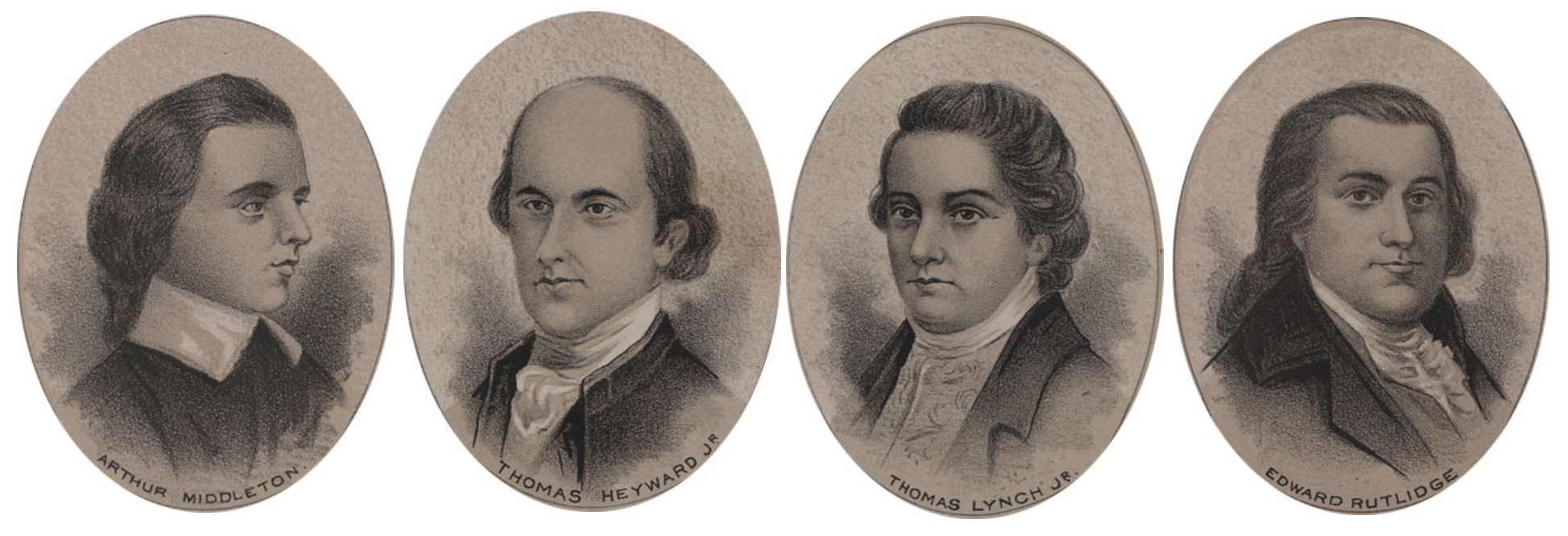
Most of the members of the Continental Congress officially signed the Declaration of Independence on this day. They then turned their attention to creating a union of the thirteen colonies. South Carolina signers were: Edward Rutledge, Arthur Middleton, Thomas Heyward, Jr. and Thomas Lynch, Jr. 

South Carolina signers of the Declaration of Independence

South Carolina signers of the Declaration of Independence.

1781 – British Occupation.

A group of citizens meet Lord Rawdon at the Miles Brewton House to plead for Issac Hayne’s life. Col Hayne’s son, William Hayne wrote:

I recollect also going with my brother Issac & sister Sarah in Company of my Aunt Peronneau to Lieut. Col. Balfour … and on our knees presenting a petition to him in favor of my father but without effect. 

1807

The trial of Aaron Burr began before a packed house. His daughter,Theodosia Burr Alston, sat in the courtroom next to her Charleston husband, Joseph Alston, during the trial. It was written about her:

There is nothing in human history that is more touching than her devotion during this ordeal. Beautiful, intelligent far beyond the average woman of her time, she was the center of admiration throughout the trial.

1836 – Religion.
Angelina Grimke Weld

Angelina Grimke Weld

Angelina Grimke was moved to speak at a silent prayer at the Orange Street Quaker Meeting in Philadelphia. She was interrupted by Jonathon Edwards, suggesting that she stop speaking. This convinced Angelina that she could no longer live in Philadelphia, since the Quakers were not supportive of her abolitionist views.  She wrote, “The incident has proved the means of releasing me from those bonds which almost destroyed my mind.”

     She became a full-fledged public abolitionist.

1864 – Bombardment of Charleston.

In the North Channel just outside the Charleston harbor during the morning, Union officers were exchanged for an equal number of Confederate officers.  

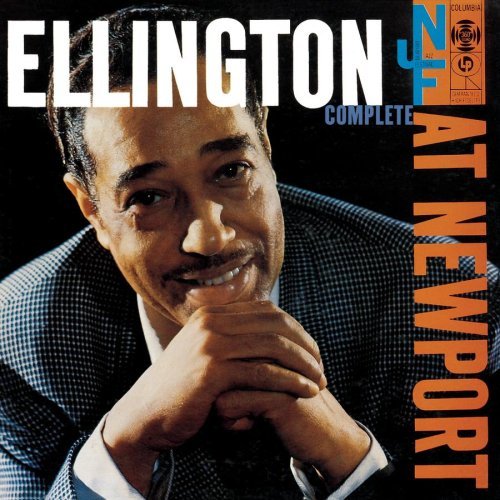
ESSENTIALS: Ellington At Newport 1956

albumcoverEllingtonAtNewportBy the mid-1950s many of the big bands had folded. Jazz music had been brought to its knees by the explosion of rock ‘n roll – Bill Haley, Buddy Holly, Chuck Berry and Elvis.  In addition, jazz was going through a radical change. The traditional swing big bands were being usurped by the harder-edged Be Bop and smooth West Coast Cool schools of music.

Duke Ellington had managed to financially keep his band together through the royalties of his popular compositions in the 1920s and 40s. They occasionally played shows at ice-skating rinks. In 1956 Ellington did not even have a recording contract.

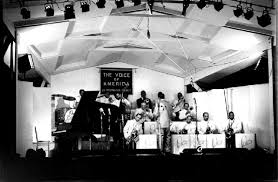
On the night of July 7, 1956 at the Newport Jazz Festival, after a series of thunderstorms had dampened the collective spirits of the Eastern Seaboard patrons, The Duke Ellington Orchestra took the stage. Ellington paid for the performance to be recorded out of his own pocket.

Ellington at Newport 1956 was to become Ellington’s biggest selling recording, although only about 40% of the original recording was actually live. The remainder was recorded in the studio to provide “patches” and filler for the less than perfect live portions.

Ellington Orchestra on the Newport stage

Ellington Orchestra on the Newport stage

During the concert the Duke announced that they were pulling out “some of our 1938 vintage.” It was a pair of blues, “Diminuendo in Blue” and “Crescendo in Blue.” The two songs were to be joined by an improvised interval played by tenor saxophonist Paul Gonsalves. Ellington had been experimenting and reworking the songs for several years before the Newport performance. The night of the show, Ellington told Gonsalves to “blow as long as you feel like blowing.”

As performed at Newport, the new version kick-started Ellington’s waning career and secured the band financially for the rest of Ellington’s life. Gonsalves played a 27-chorus solo backed only by bassist Jimmy Woode, drummer Sam Woodyard, and Ellington himself punctuating piano chords. Through-out the song there are several audible comments from the band members. The Duke himself is often heard urging the saxophonist, shouting “Come on, Paul — dig in! Dig in!” About five minutes into Gonsalves’ solo, the sedate wine-and-cheese crowd realized they were witnessing a magical moment. They started dancing in the aisles and can be heard cheering and shouting at the band.

The usually sedate wine-and-cheese crowd at Newport dancing to Gonsalves' solo

The usually sedate wine-and-cheese crowd at Newport dancing to Gonsalves’ solo

When the solo ended Gonsalves collapsed in exhaustion, and the full band returned for the “Crescendo in Blue” portion. The real crescendo of “Crescendo in Blue” however starts at the 13:15 minute mark, as trumpet player Cat Anderson (of Charleston, SC) stands up and begins to play several octaves above the Orchestra for the final minute of the song. In a moment worthy of any classic rock concert, the already excited crowd is brought to the edge of hysteria by Anderson’s screaming trumpet. When the song ends, pandemonium ensues for several moments as the Duke tries to quiet the crowd.

Truly one of the most classic recorded moments in jazz history.

“Diminuendo And Crescendo In Blue”

Remastered 1999 CD: Ellington at Newport (Complete)

Disc one

  1. “The Star Spangled Banner” – 1:10
  2. Father Norman O’Connor Introduces Duke & the Orchestra / Duke Introduces Tune & Anderson, Jackson & Procope – 3:36
  3. Black and Tan Fantasy” – 6:21
  4. Duke Introduces Cook & Tune – 0:26
  5. “Tea for Two” – 3:34
  6. Duke & Band Leave Stage / Father Norman Talks About The Festival – 2:30
  7. Take the ‘A’ Train” – 4:27
  8. Duke Announces Strayhorn’s A Train & Nance / Duke Introduces Festival Suite, Part I & Hamilton – 0:41
  9. “Part I – Festival Junction” – 8:10
  10. Duke Announces Soloists; Introduces Part II – 0:38
  11. “Part II – Blues to Be There” – 7:09
  12. Duke Announces Nace & Procope; Introduces Part III – 0:19
  13. “Part III – Newport Up” – 5:33
  14. Duke Announces Hamilton, Gonsalves & Terry / Duke Introduces Carney & Tune – 0:25
  15. Sophisticated Lady” – 3:52
  16. Duke Announces Grissom & Tune – 0:17
  17. Day In, Day Out” – 3:50
  18. Duke Introduces Tune(s) and Paul Gonsalves Interludes – 0:23
  19. “Diminuendo In Blue and Crescendo In Blue” – 14:20
  20. Announcements, Pandemonium – 0:44
  21. Pause Track – 0:06

Disc two

  1. Duke Introduces Johnny Hodges – 0:18
  2. “I Got It Bad (and That Ain’t Good)” – 3:38
  3. “Jeep’s Blues” – 4:36
  4. Duke Calms Crowd; Introduces Nance & Tune – 0:42
  5. “Tulip or Turnip” – 2:49
  6. Riot Prevention – 1:08
  7. “Skin Deep” – 9:13
  8. Mood Indigo” – 1:30
  9. Studio Concert (Excerpts) – 4:01
  10. Father Norman O’Connor Introduces Duke Ellington / Duke Introduces New Work, Part I & Hamilton – 1:02
  11. “Part I – Festival Junction” – 8:46
  12. Duke Announces Soloists; Introduces Part II – 0:32
  13. “Part II – Blues To Be There” – 7:48
  14. Duke Announces Nance & Procope; Introduces Part III” – 0:16
  15. “Part III – Newport Up” – 5:20
  16. Duke Announces Hamilton, Gonsalves & Terry / Pause / Duke Introduces Johnny Hodges – 0:41
  17. “I Got It Bad (And That Ain’t Good)” – 3:47
  18. “Jeep’s Blues” – 4:31
  19. Pause Track – 0:09

THE BAND

  • Piano: Duke Ellington
  • Bass: James Woode
  • Drums: Sam Woodyard
  • Trumpet: Cat Anderson, Clark Terry, John Willie Cook, Ray Nance
  • Trombone: John Sanders, Britt Woodman, Quentin Jackson
  • Alto Sax: Johnny Hodges, Russell Procope
  • Baritone Sax: Harry Carney
  • Tenor Sax: Paul Gonsalves
  • Clarinet: Jimmy Hamilton
  • Voice: Jimmy Grissom