The horrific mass murder of nine people at Emmanuel A.M.E. in Charleston, SC, on June 17, 2015, has brought international attention to my hometown, and the resulting swarm of media attention. TV talking heads and news writers have been referencing a name from Charleston’s past in their news coverage, Denmark Vesey. As a student of history, I have cringed as these “journalists” have name-dropped Vesey by mentioning his role as a founder of the A.M.E. church in Charleston and the resulting slave rebellion that carries his name to this day. Like most media, they only tell the bare basic facts of the story, and (often) facts that are wrong.
For many of the millions of people who are following the story of the Charleston mass murder, this is most likely the first time they have ever heard of Denmark Vesey and his plot against Charleston. So, here is the story, from my 2005 book, Wicked Charleston: The Dark Side of the Holy City.
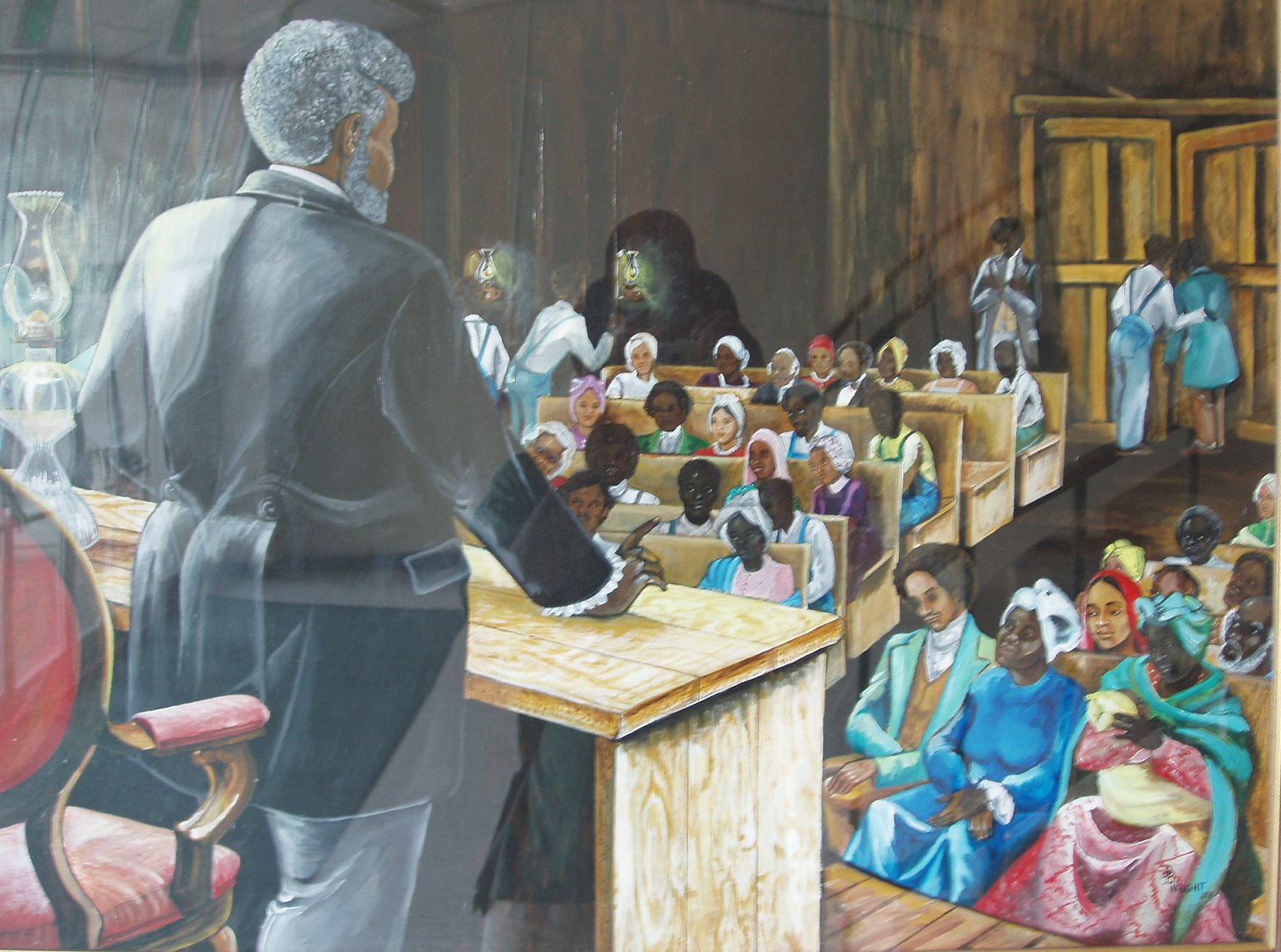
In 1976, 154 years after his execution, the city of Charleston commissioned a portrait of Denmark Vesey to be placed in the new municipal auditorium. The problem was, no one knew what Vesey looked like. There were no previous portraits, drawings or any physical description of the man. The artist solved that problem by painting Vesey with his back to picture, addressing a group of followers who are facing forward.
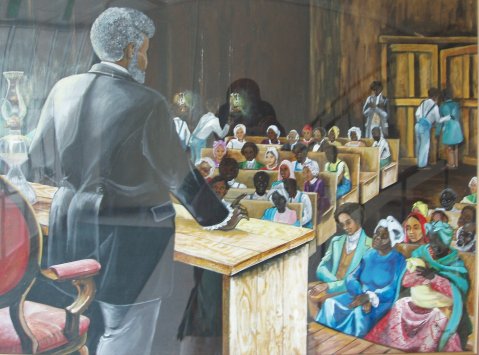
Vesey painting
But there were other problems. In a letter to editor of the News and Courier, a white citizen wrote that “we should also hang portraits of Hitler, Attila the Hun and Herod the murderer of babies.” The Courier had commented on the portrait by writing,
“If black leaders in Charleston had searched for a thousand years they could not have found a local black whose portrait would have been more offensive to many white people.”
What did Denmark Vesey do to warrant such passions after 154 years? He planned, organized and nearly executed what would have been the largest, most violent slave rebellion in the American colonies. If not for a series of lucky opportunities, more than a thousand whites would have been slaughtered in 1822.
Charleston Conditions
“Is it possible that any of my slaves could go to heaven, and must I see them there?” This was the attitude of a female parishioner in Charlestown in 1706, as recorded by the Reverend Francis Le Jau. The reverend later commented that he could not prevail upon the people to “make a difference between Slaves and free Indians, and Beasts.”
Charleston possessed the most concentrated population of Africans in the United States. It was the fourth largest city in America, exceeded only by New York, Boston and Philadelphia. According to the 1790 census Charleston was home to 15,402 whites and 51,585 blacks. Less than ten per cent of the white population controlled most of the wealth and political power. Charleston had a larger African population than New York, Boston and Philadelphia combined, and that condition demanded that the city be run as a quasi police state.
- Slaves were forbidden to appear in daylight wearing fine clothes, smoking, playing an instrument or carrying a walking stick.
- Every evening at dusk a drum was beaten for several minutes at the Guard House (current site of the U.S. Post Office at 83 Broad Street). The drum was the signal for all blacks within the city limits to disappear from the public streets until sunrise.
- Any black caught on the streets at night without a written pass from his master would be sent to the Work House until the following morning. During the night he would be whipped and kept in small cramped cells, chained to the walls until his master came to retrieve him by paying a small fine.
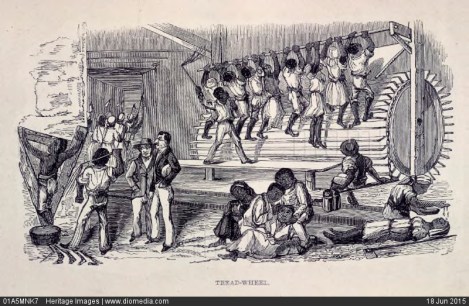
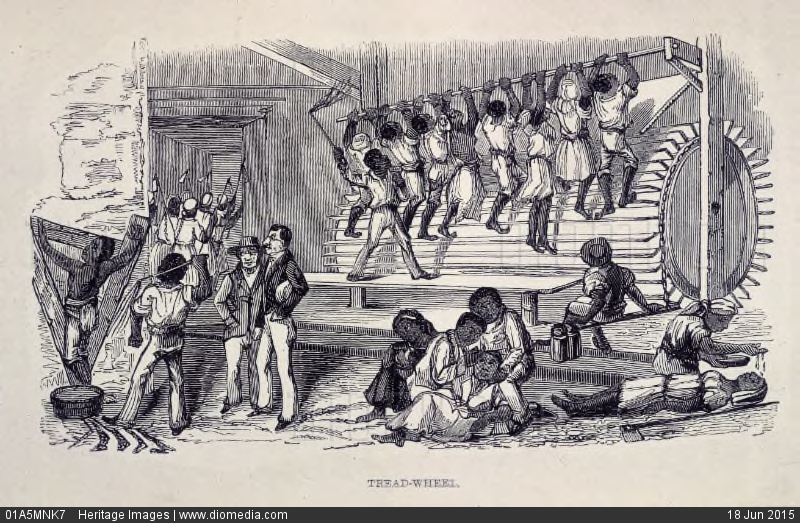
Slaves on a treadmill, 1843. Artist: Unknown
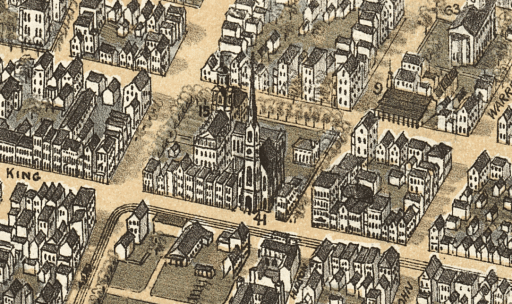
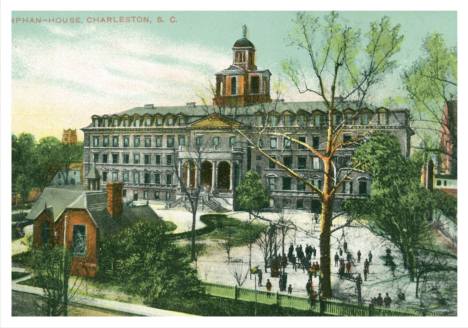
As early as 1739.there was a Work House at 15 Magazine Street. The first Work House was a former sugar warehouse which led to an odd euphemism; a white master would threaten his slave that he would be sent “for a little sugar” if his bad behavior continued. “Getting sugar” meant flogging and walking the treadmill. Slaves walked on the treadmill in shifts, providing power for grinding corn. If an exhausted slave tripped and fell on the ever-moving treadmill, he often would lose a foot or leg between the rollers. Overseers used rawhide whips to maintain order. Rawhide was preferred because it flayed the skin and bruised the muscle tissue beneath the skin. In 1769 two slaves, Dolly and Liverpoole, were burned to death on the Work House green for poisoning a white infant in their care. A new Gothic Revival Work House was built in 1850 but was so damaged by the 1886 earthquake it was taken down soon after.
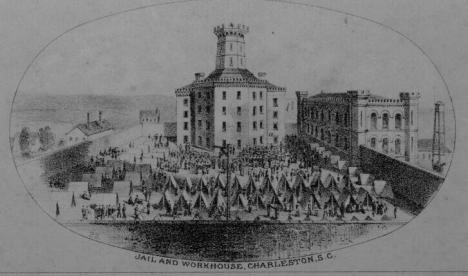
Charleston jail, workhouse and marine hospital, 1857
On August 20, 1791, there was a slave rebellion on the French colony of St. Domingue. During the next two months 180 sugar plantations and 900 coffee and cotton settlements were burned as slaves revolted, dragging their white masters from their homes and slaughtering them like livestock. Refugees poured into American cities. Five hundred arrived in Charleston in 1792, bringing with them their personal house slaves. A letter in a Charleston newspaper complained that the slaves from the French colony would spread the word of the successful revolt to other slaves, putting an idea in their heads. The letter complained about lack of the city’s military preparation, but if anyone took the advice to heart, nothing was done.
A Boy Named Telemaque
Captain Joseph Vesey, slaver trader, arrived in Haiti in 1781 with a cargo of 390 slaves from the Danish Virgin Islands. One of the slaves on board was an intelligent and handsome fourteen-year-old boy called Telemaque. The crew treated the boy like a pet, allowing him out of the hell of the cargo hold to roam above decks and perform chores for the crew. However, in Haiti, Telemaque was sold and began to chop sugarcane for twelve hours a day. Three months later, when Captain Vesey returned to the island and he was accosted by an angry plantation owner who complained that Telemaque was unfit for work. Evidently, the boy suffered epileptic fits and the owner demanded a refund. Vesey returned the money and collected the boy whom he renamed Denmark and for the next two years, the boy served as the captain’s personal assistant on the slave ship.
Denmark was an unusual slave. He had a position of authority above decks on Vesey’s ship. Denmark spoke several languages – Dutch, French and English fluently, and also was able to speak Gullah and Creole. He was invaluable to his master during his slave buying trips up and down the west coast of Africa. But, not matter how favored Denmark was, life on a slave ship was brutal, even for the crew and captain.
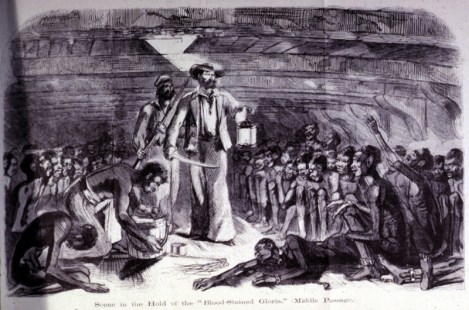
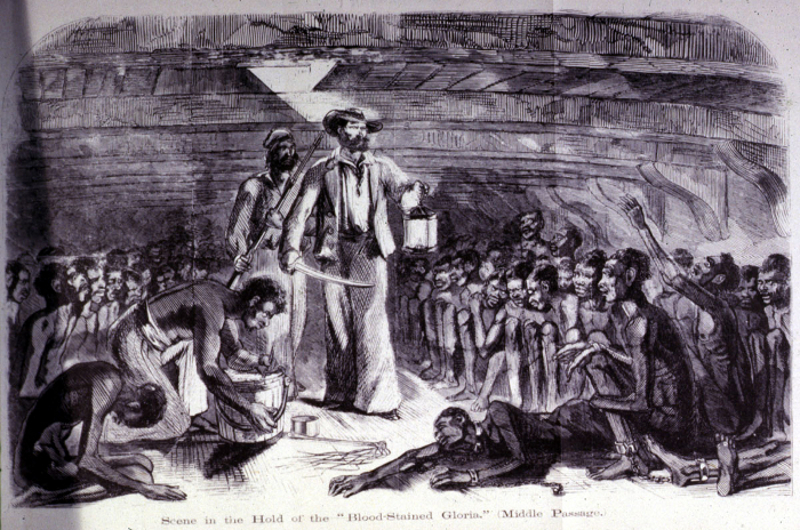
Africans in the hold of a slave ship, during the Middle Passage
During the eighteenth century, sailors claimed that on a calm sea they could smell a slave ship five miles away. Many white sailors refused to ship out on a vessel that had used as a slaver, for reasons of hygiene and superstition. Some slave captains would dispose of any cargo that was not healthy enough to survive the voyage, dumping weak and diseased living Africans into the Atlantic Ocean. Charleston newspapers complained about the litter of black corpses along the local beaches. What other horrors and brutality the teenaged Denmark witnessed during his years working and living on a slave trader can only be imagined. It could not have heightened his opinion of whites, or of slavery.
By 1790, Captain Vesey had sold his ships and purchased property in Charleston. He set up business as a moderately successful merchant at 27¼ Bay Street. He was listed in the 1790 census as head of a household which included eight slaves, including Denmark. For the next seventeen Denmark was a slave in the city, often being hired out by his master to construct ships and buildings and evidently Vesey let Denmark keep some of the money earned, or the clever slave managed to withhold some of the sums for himself.
In 1793 Joseph Vesey was one of the men contracted to oversee the construction of the new City Market and it is almost certain that his skilled slave Denmark would be involved in the market construction. The Market sits on what used to be Daniel’s Creek. The area was owned by the Pinckney family and in 1788 the land was conveyed to the city by Revolutionary War general (and signer of the U.S. Constitution) Charles Cotesworth Pinckney. The purpose of the gift was
“to lay out a street from the channel of the Cooper River to Meeting Street 100 feet broad, and in said street to establish a public market or markets for the purpose of vending all sorts of butcher meats, poultry, game, fish vegetables and provisions.”
The Market quickly became the almost exclusive domain of blacks. It was such a nasty place, filled with half-rotted meats, fish and vegetables, that few whites ventured into the area. They preferred to allow the blacks free rein in the Market, operating the food distribution of the city almost carte blanche. Large groups of blacks congregating in the pungent, muddy streets along the Market became commonplace. For that reason, thirty years later, Denmark would choose the Market as a gathering place for one of his armed companies on the night of the 1822 rebellion.
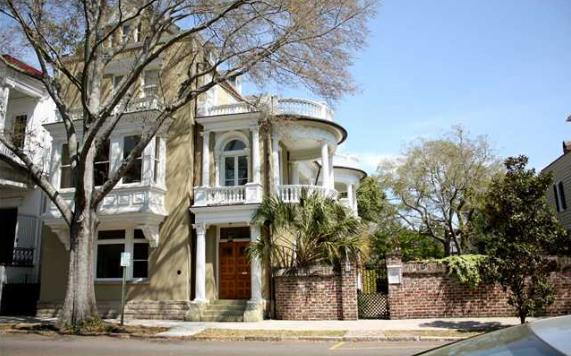
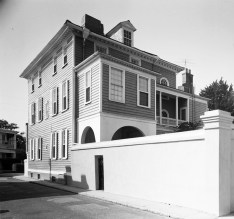
In early December 1799 Denmark used some of his “hired out” funds to purchase a ticket in the East Bay Street lottery. He bet on the numbers 1-8-8-4. During the last week of 1799, Denmark was informed that held the winning ticket number and he received $1500. With $600 he was able to purchase his freedom from his master and then begin a successful career as a free black artisan, a highly skilled carpenter. With the remaining $900 he was able to rent and later purchase a house at 20 Bull Street, three blocks from the private residences of both the governor of South Carolina and the mayor of Charleston.
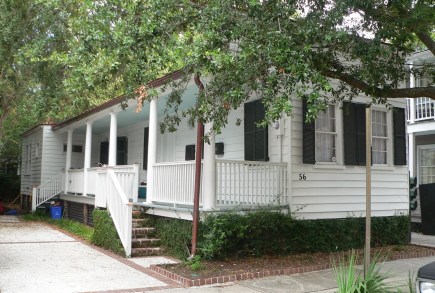
Vesey’s house … now numbered 56 Bull Street, Charleston. A National Historic Landmark
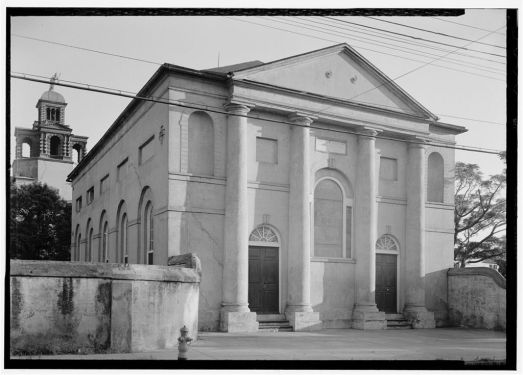
He helped established the Emmanuel African Methodist Episcopalian (A.M.E.) Church in Charleston, an exclusively black congregation. He also took on several women as his wives, one living with him and others that were slaves owned by other whites. He was reported to have as many of seven wives at one time in the Charleston area.
Denmark became one of about 1400 free blacks living within the city, the majority of whom were mulattoes, usually the illegitimate offspring of white masters and female slaves who had been given their freedom. Denmark cut his ties with the free mulatto society who more often tried to emulate white behavior by copying their lifestyle and owning slaves. Indeed, one of Denmark’s neighbors, a free mulatto named Robert Smyth, owned six slaves. Since pre-Revolutionary days there had been a Charleston tradition in which Negro and mulatto women would invite white gentlemen to a ball. Most of the mulattoes felt a closer kinship with the whites than with blacks. They even avoided the exclusively black A.M.E. church and worshiped at the traditional Anglican churches, St. Philip’s and St. Michael’s.
Denmark became a leader of the A.M.E. church in Charleston. At a time when most blacks (free or slave) could not read or write, Denmark was well read and fluent in several languages. During his time as a church leader he began to teach passages from the Bible which he claimed showed a moral imperative for freedom, much as the leaders of the 1960s civil rights did 140 years later. Denmark conducted Bible lessons at church, in his home, and in slave’s quarters throughout the Charleston area. When someone objected to Denmark’s vision of a violent revolution he would state, “The Lord has commanded it.” The passages that he seemed to emphasize the most were:
- Colossians 4:1: Masters, give unto your servant that which is just and equal; knowing that ye also have a Master in heaven.
- Exodus 2: 23-24: . . . and the children of Israel sighed by reason of the bondage, and they cried, and their cry came up onto the God by reason of the bondage.
- Joshua 6:21: “Ánd they utterly destroyed all that were in the city, both man and woman, both young and old . . .”
- Zachariah 14:1-2: “Behold, the day of the Lord cometh, and thy spoil shall be divided in the midst of thee. For I shall gather all nations against Jerusalem to battle; and the city taken, and the houses rifled, and the women ravished. . .”
The Plot
By 1817, Denmark had found an ally, Jack Prichard, or as he was known more familiarly, Gullah Jack. He was owned by Paul Pritchard and lived at 6 Hasell Street. Gullah Jack was a native of Angola, and a familiar, comical sight on the Charleston streets. He was a short man with bushy side-whiskers who acted the fool for the whites. Gullah Jack had perfected the “shuck-and-jive” persona. He was a member of the A.M.E. church, but also practiced another religion – root, or voodoo. Considered harmless and a fool among the whites, Gullah Jack was known to the blacks as “the little man who can’t be killed.” A root doctor who was skilled in the uses of herbs for medicine or poison, could project his mind into other’s bodies, and could create powerful amulets to protect one against the evils of the world. Gullah Jack was instrumental in spreading the message of Denmark’s plan for violent revolution out of the city and into the sea island plantations where he traveled frequently. Thus, Denmark could bring two different groups into the fold, the Christian, city-dwelling blacks who worked at artisans and household servants, and the Gullah island people, all organized with the same plan in mind – freedom or death.
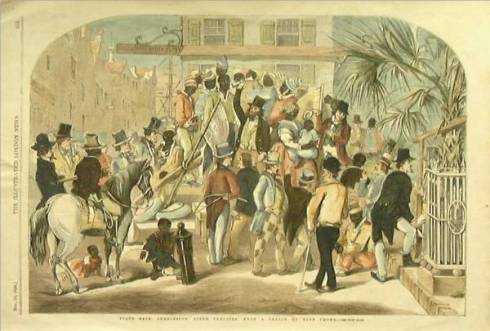
Charleston slave sale
White suspicion of black worships services escalated. Even though they did not discover Denmark’s plan for revolution of recruiting soldiers from churches, they were worried about the gathering of such large groups of blacks. Traditional Anglican worship was quiet, subdued and reverential but black worship practices frightened whites. As reported in the Charleston Times 1816:
Almost every night there is a meeting of these noisy, frantic worshippers . . . Midnight! That the meeting of numerous black people to hear the scriptures expounded by an ignorant and (too frequently) vicious person of their own color can be of no benefit either to themselves or the community is certain.
On December 3, 1817, the city guard (police) raided the A. M. E. Church and arrested 469 blacks, charging them with disorderly conduct. But the congregation persevered and on June 9, 1818, the city once again raided the church. One hundred and forth free blacks and slaves, including twelve ministers and one Bishop, were arrested and brought to the Guard House. Five of the ministers and the Bishop were sentenced to banishment from the state. The other eight ministers were sentenced to receive ten lashes or pay a fine of five dollars each.
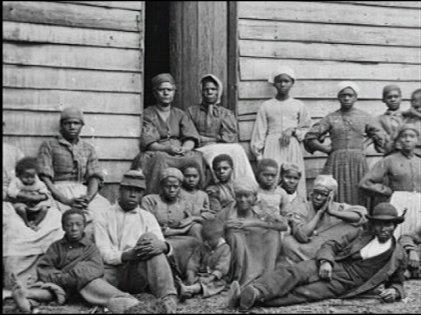
These raids galvanized the commitment among many blacks. Worship was about the only avenue of self-expression among the oppressed, and that right had been ripped away from them by Charleston guard. When the word of these raids reached the slaves living on the sea islands, Gullah Jack remarked that “the Gullah people were ready” to enlist with Vesey’s vision of violent rebellion. For the next four years Vesey traveled the low country area, taking carpenter jobs in remote places recruiting members of his army and counseling patience. He convinced many of the slaves that the Haitian government would certainly send a black army to aid the Carolina slaves in their revolt. If not that, then after killing their white masters and looting Charleston, the slaves could flee to Haiti. There is little evidence to indicate that Vesey had communication with the Haitian government through second parties, but he managed to convince his recruits that help would come only when the blacks rose against the whites.
Denmark was a mesmerizing figure, manipulating the nationalism, the fears, hopes and religion of the slaves. He preached from the Old Testament and constantly reminded them of the successful Haitian slave rebellion. He also convinced many slaves that there was too large a population of blacks in the area and the white masters had decided the most efficient way to eliminate the surplus was to kill the non-productive – the weak, old and infirm. God approved of their plan, Denmark argued. For those who were not Christians, Vesey preached of the sorcerer’s skills of Gullah Jack – a man they believed could not be killed and whose charms would keep them from harm.
As 1822 approached, Denmark was almost 60 years old and his attitude changed. Where he had always tried to live quietly and not attract attention, living as a respectable freed black. He started to refuse to bow to whites that he passed on the sidewalks. He began to castigate black who did bow, telling them that he “would never cringe to the whites” and that “all men were born equal.” When some of the blacks told him “We are slaves,” Denmark responded, “You deserve to remain slaves.”
By early 1822 Denmark had several chief lieutenants, each of whom had hundreds, if not thousands of followers who were willing to be led in a violent rebellion. All of Denmark’s leaders were slaves, and there were no mulattoes in their ranks. Other than Gullah Jack they were:
- Ned Bennett: A trusted and loved slave in the household of Governor Thomas Bennett who lived at 19 Lynch Street (now Ashley Avenue), less than three blocks from Denmark’s home. On the night of the revolt, Ned’s job was to seize the State Arsenal and distribute the weapons, which included more than 200 muskets, bayonets and swords.
- Rolla Bennett: Also a slave in service of Governor Bennett. Although Rolla admitted that governor treated him like a son, he volunteered to murder his master and his family on the night of the rebellion.
- Batteau Bennett: Yet another trusted slave in the house of the governor. Batteau claimed he would rather murder his master or die violently resisting than continue his life as a privileged slave.
- Monday Gell: Monday’s master, John Gell, owned a livery stable at 127 Church Street and regarded his slave as intelligent and dependable. Monday was an excellent harness maker and his master hired him out to a shop on Meeting street, letting his slave keep a portion of the earnings for himself.
- Bacchus Hammett: An early and eager convert to Denmark’s vision. He stole a keg of gunpowder which was hidden for weeks at Denmark’s house.
- Peter Poyas: A ship’s carpenter who “wrote in a good hand” and owned by James Poyas who Poyas lived at 49 King Street and operated a shipyard on Bay Street. Peter had his own weapons and agreed with Denmark that “we are obliged to revolt.” Poyas may have been more eager than Denmark for the rebellion to take place. He often urged Denmark that “we cannot go on like this.”
By April 1822 word had been spread to the country slaves that the date for the rebellion had been chosen, Sunday, July 14, the anniversary of the storming of the Bastille. Choosing Sunday for the day of rebellion was a brilliant strategic stroke since that was the only day blacks were allowed to congregate in the Market and attend church services. Also, by mid-July, many white militia officers had left town for their summer vacation to Newport, Rhode Island. Thus, there would be less experienced military men in town. Dozens of Denmark’s trusted aides were collecting weapons, hiding them in strategic locations throughout the city. Blades were being manufactured by slave blacksmiths and hidden in locations around the city. Musket balls were also being made and hidden in bags throughout the city. Gullah Jack reported that the Sea Island slaves were preparing their boats and weapons for the journey to Charleston. Denmark’s army was estimated to number almost 10,000. All around the daily lives of white Charlestonians, preparations were being made for their massacre.
In May 1822, a group of a dozen men gathered for a meeting at Denmark’s house on Bull Street to plan the destruction of white Charleston. All met agreed that “nothing could be done without fire.” Monday Gell agreed to hide in his harness shop the keg of gunpowder that Bacchus Hammett had stolen. They agreed to set the city on fire at several places, and as Denmark reminded his conspirators that “every servant in the yards to be ready with axes, knives, and clubs, to kill every [white] man as he came out when the [fire] bells rang.” Vesey ordered that they were spare no one, women or children, nor ministers. “Leave no white skin alive,” he commanded. And then, quoting Luke 11:23 he said, “He that is not with me, is against me.”
While the panic and chaos of the fires kept most of the whites distracted, the stores of weapons in the city were to be attacked by groups of armed slaves arriving from the south, north and east. Peter Poyas was to lead a group of 4000 coastal blacks from the south up Meeting Street “to seize the City Arsenal and the Guard House opposite St. Michael’s Church.” At the same time, Gullah Jack was to lead a group from the North and loot the private weapon shops where more than 1000 muskets and bayonets were stored. That group would then join forces with Rolla Bennett’s group. The weapons would be distributed and the joined force was to work its way into the city, killing all whites in their way. Groups of slaves from east of the Cooper River were to arrive by boat near the Market, and proceed to the Guard House killing “every person they might meet, and prevent them from assembling, or extending an alarm.” Ned Bennett was given the task of murdering his master and as many members of the family as he could; he was then walk one block and murder the mayor and his family in their home.
Gullah Jack had instructed his faithful to only eat parched corn and ground nuts on the day of the attack. Jack gave them crab claws they were to hold in their mouths as they attacked, to keep them from being wounded.
However, on Saturday, May 25, Peter Priloeau, a house slave of Col. John Prioleau, was running an errand for his master near the city wharves when he was approached by another black man, a stranger. This other slave asked Peter if he had heard that “something serious was about to take place.” Peter replied no, and the stranger, later identified as William Paul replied,
“Why, we are determined to shake off our bondage . . . Many have joined and if you go with me, I will show you the man, who has the list of names, who will take yours down.”
Peter broke off the conversation and returned home, but a few days later, he told his master of the conversation. Colonel Prioleau asked for description of the slave. Prioleau recognized the description of William Paul and on May 31, Paul was arrested at Denmark Vesey’s house on Bull Street and placed in the “black hole”- the solitary confinement of the Work House.
Initially Paul claimed ignorance of any plot but by the next day, he began to confess. The method of coercion can be easily imagined. Torture by whipping and being kept in the “Crane of Pain”. The crane was similar to the rack. The victim’s feet would be anchored to the floor, while his wrists were bound to ropes attached to a pulley on the ceiling. The tension of the ropes was incrementally tightened until the victim’s arms were pulled from their sockets and left hanging in that position for hours.
Paul was also kept in the “Black Hole” and questioned for over a week. He named Peter Poyas, Mingo Harth and Ned Bennett as the chief conspirators. He also knew there was another man involved who was a sorcerer and “carried about him a charm which rendered him invulnerable.” Poyas and Harth were arrested and questioned at the Work House but both were released. Incredibly, even though Paul was arrested at Vesey’s house, Denmark was not arrested nor was he suspected by the authorities until later.

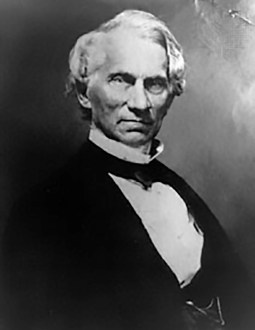
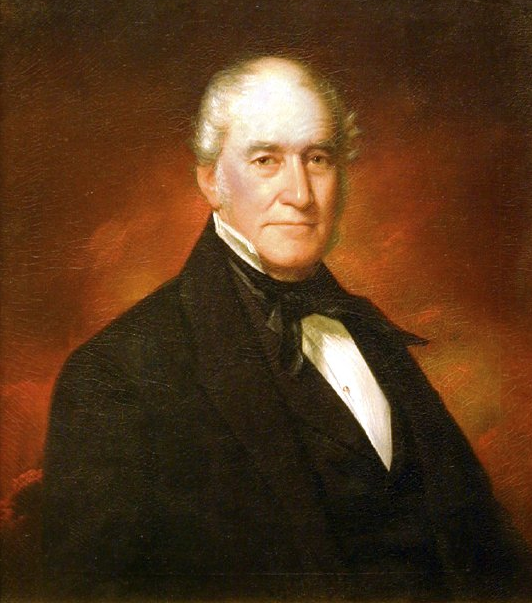
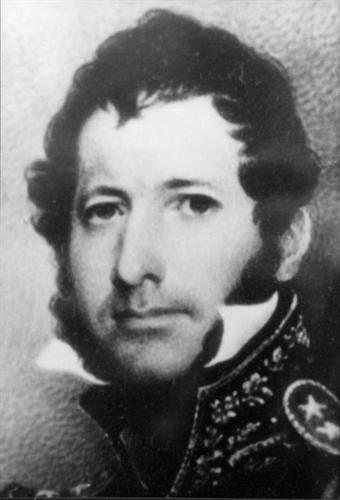
Gov. Thomas Bennett
Governor Bennett did not believe any of the suspected conspiracy. In his opinion the black population attitude toward their masters was loving and loyal. Bennett told the mayor that the entire rebellion idea was “nonsense”. Indeed, on June 12, his slave, Ned Bennett, voluntarily turned himself in at the Work House. Ned told the wardens that he had heard his name had been mentioned in the investigation of a planned rebellion and he wished to clear his reputation. Ned was questioned for several house and released. When Ned Bennett was released from the Work House, he walked five blocks to Denmark’s house to attend a meeting to advance the date of the rebellion before any more investigation could uncover their plot.
The authorities concluded that the allegations of rebellion by Paul had “no confirmation.” However, Major John Wilson was not convinced. The Major had political ambitions to succeed Bennett as governor. He thought the governor was foolish to be so trustful of the city’s slave population. Major Wilson instructed his slave, George Wilson, to inquire among the blacks in Charleston if there was any talk of insurrection. George was a blacksmith who could read and write. George reported to his master on June 14
“that the fact was really so, that a public disturbance was contemplated by the black and that not a moment should be lost in informing the authorities, as the succeeding Sunday, the 16th, at twelve o’clock at night, was the period fixed for the rising.”
Major Wilson informed Mayor James Hamilton of his findings. Hamilton informed Bennett who gave permission for the captains of the state militia to be summoned. Merely two blocks from Denmark’s house, the mayor and the governor were mustering their resources to protect the city. By Sunday night 400 of the state militia, including horsemen armed with sabers and pistols were patrolling the streets. The city guard, usually only armed with truncheons, were issued firearms. During the night, most of the white population stayed awake. William Hasell Wilson, son of Major John Wilson, was ten years old in 1822. He wrote in 1902:
“I shall never forget the feeling of alarm and anxiety that pervaded the whole community . . . no one, not even the children ventured to retire.”
On Monday June 17 the City Council convened to consider how to best safeguard the city. They appointed a committee “for the exploring the causes and character of the existing disturbance, and bringing to light and punishment the suspected and guilty.”
Peter Poyas, Ned Bennett, Rolla, Batteau Bennett were arrested the next day as well as six others, but not Denmark. Vesey knew that his conspirators would sooner or later reveal his name to the authorities, so he burned all written records of the conspiracy, left his Bull Street house and went into hiding in the house of one of his wives, He was hoping to stow away on a ship leaving Charleston. By Saturday June 22, the authorities were actively seeking Denmark Vesey. Peter Poyas was chained to a pole in the Work House with another of the conspirators. For several hours the blacks were promised, cajoled and then threatened, and tortured, but neither man revealed anything.
Someone broke down however, for several days later, Captain Dove of the City Guard broke into the house of Vesey’s wife and arrested him. He was taken to the Work House to await trail.
The Trial
Justice for blacks was different than justice for whites in Charleston in 1822. There was no trial by jury; instead, blacks were tried before a group of judges, and the verdict did not have to be unanimous. There was no requirement that counsel be present. The Duke de la Rochefoucauld-Liancourt commented on South Carolina slave justice:
No defender is allowed to the poor wretched accused; and his judges have the power to condemn him to whatever mode of death they think proper. Simple theft by a Negro is punished with death
. . . For the murder of a Negro . . . a white man pays a fine of three thousand six hundred and eighty dollars. If he had only beaten the Negro . . . the fine is but one thousand five hundred dollars. He who maims a Negro, puts out his eyes, cuts off his tongue, or castrates him, pays only a fine of four hundred and twenty-eight dollars. A Negro slaying a white man . . . wound a white man . . . he will eventually be put to death.
On June 19 court opened and the trials began. Over the next seven days, a total of 131 blacks were arrested; fifteen were acquitted and thirty-eight others were discharged after serving a prison sentence and whippings at the Work House. Forty-three others were “transported” (moved to other states as slaves at their owner’s expense) and five slaves who testified against the other conspirators were allowed to live. The other thirty-four were hanged within a month.
The first group of six were ordered to be hanged on July 2, between the hours of six and eight in the morning. On the appointed morning the City Gazette published a notice of the execution. A huge crowd of blacks and whites gathered near the gallows, located on Blake’s Land (present location of where the I-26 overpass crosses over the northern end of Meeting Street). The prisoners were marched to their death chained at their legs and wrists.
July 2, 1822 Executions
- Batteau Bennett: One of three slaves who was owned by South Carolina governor Thomas Bennett.
- Ned Bennett: The judges commented that “from his looks it was impossible to discover or conjecture what were his feelings.”
- Rolla Bennett: Reportedly “laughed aloud” when taken from his cell on the morning of execution.
- Jesse Blackwood: Visited by a white minister on the morning on his execution Blackwood stated his “mind was placid and calm” and “he was prepared to meet his God.”
- Peter Poyas: Also reportedly laughed aloud when taken from his cell to execution. When once asked how firm his commitment was to the rebellion, Peter struck his hand against an oak tree and claimed “firm as this.”
- Denmark Vesey: He reportedly called out to his fellow prisoners in the Guard House to “Die like a Man!”
July 12, 1822 Executions
- John Horry: A coachman for a prominent family. During the trial John testified that he had a sword. When asked by his owner Elias Horry what he intended to do with it John replied, “to rip open your belly.”
- Gullah Jack Pritchard: Gullah Jack was accused of not only planning to massacre white Charleston, but also to have “endeavored to enlist on your behalf all the powers of darkness.”
At his trial Gullah Jack played the fool so much that some of the judges could not believe he was part of the rebellion. However, as the trial progressed and six witnessed testified against him, Jack’s demeanor changed. He scowled and gave his accusers hard looks. He made motions and designs with his fingers until the judges admonished him for trying to bewitch the witnesses.
Gullah Jack and John Horry met their fate just north of “The Lines” (present day Line Street).
July 26, 1822 Executions
- Smart Anderson: Smart was a drayman who stole two muskets, hiding them on his cart to be used when the occasion arose. He claimed he was in the rebellion “as much as possible.”
- Charles Billings: Worked in a commercial stables and planned to steal horses on the night of the rebellion. Claimed that he was “ready and willing” to do what needed to be done.
- Jemmy Clement: Member of the A. M. E. Church
- Jerry Cohen: One of the last arrested but claimed that if everyone involved was killed, he was “still willing to go on.”
- Polydore Faber: Good friend of Gullah Jack. Faber was convicted of hiding at least twenty pike poles which were to be fitted with blades and used as weapons on the night of rebellion.
- Julius Forrest: Claimed to have been “charmed” by Gullah Jack into joining the rebellion.
- Lot Forrester: One of the most active of Denmark’s recruits. Worked at the State Arsenal and was able to steal a slow fuse to be used in setting fires throughout the city.
- Jack Glenn: Although he was lame in both feet, he told Vesey he would serve as a horseman on the night of rebellion. He collected money about town to finance the plot.
- Bacchus Hammett: Stole a keg of black powder, a sword and pistol for the rebellion. On his way to gallows he shocked the white crowd by laughing and shouting good-byes to his acquaintance. Upon his execution, the mechanism failed, and he did not drop. According to a witness, Bacchus “threw himself forward, and as he swung back he lifted his feet, so that his knees might not touch the Board.” Because he was taking so long to die dangling from the gallows, he was shot with a pistol by Captain Dove.
- Mingo Harth: He was a skilled laborer and worked at a lumberyard. Mingo hosted Bible study classes in his quarters in order to discuss the rebellion.
- Joe Jore: Considered an invalid, Joe pledged to take a sword and fight on the night of rebellion.
- Dean Mitchell: Assisted in collecting money to make spears and pikes.
- Jack Purcell: One of Denmark’s first recruits. However, on the gallows he stated that “if it had not been for the cunning of that old villain, Vesey, I should not now be in my present situation.”
- Adam Robertson: Participated in the ceremony where a chicken was eaten bloody by all present as a sign of their commitment to the rebellion.
- John Robertson: Also participated in the chicken ceremony.
- Robert Robertson: Helped conceal pikes and spears. Also, stole a pistol from his master.
- Tom Russell: A blacksmith who forged pikeheads and spears as long as the group took up a collection to pay for the materials. Russell was also trained by Gullah Jack to be a sorcerer.
- Dick Simms: Property of the family William Gilmore Simms, famous novelist of the time. Dick stole a pistol from his master for use during the rebellion.
- Pharo Thompson: Pharo possessed a sword fashioned out of a scythe.
- Adam Yates: Adam had the responsibility of leading the rural blacks into the city on the night of rebellion.
- Bellisle Yates: Responsible for hiding some of the plantation blacks in the city during the night of rebellion.
- Naphur Yates: Yates took an oath and swore that his “heart was in this business.” He claimed that his name had ordained him to be part of the rebellion since the word naphur is defined in the Bible as “purification fire”.
July 26, 1822 turned out to be one the largest days of executions in Charleston history. The twenty-two were hanged just north of “The Lines”. The entire city turned out for the Friday morning spectacle. There was such a large crowd and so much excitement that a small black boy was trampled to death. The bodies of the convicted were given to the Medical College of South Carolina for dissection.
July 30, 1822 Executions
- Jack McNeil: One of the youngest killed, perhaps still in his teens.
- Tom Scott: A member of the A.M. E. Church.
- Caesar Smith: He possessed a sword and was a member of the A.M. E. Church.
- Jacob Stagg: A housepainter, Stagg claimed “he was tired of paying wages” to his master. He also claimed to have fashioned a sword out of a scythe.
August 9, 1822, Executions
- William Garner: The last to be executed. He was to lead a group of horsemen into the city on the night of rebellion. Garner escaped to Columbia when the first group was arrested, but later arrested after the governor had offered a $200 reward for his capture.
| City Council. Negro Plot: An Account of the Late Intended Insurrection Among A Portion of the Blacks of the City of Charleston, South Carolina. Boston: Jospeh W. Ingaham, 1822 Published by the Authority of the Corporation of Charleston.
Lofton, John. Denmark Vesey’s Revolt: The Slave Plot That Lit a Fuse to Fort Sumter. Kent, Ohio: The Kent State University Press, 1983.
Pearson, Edward A. Designs Against Charleston: The Trial Record of the Denmark Vesey Conspiracy of 1822. Chapel Hill, N.C.: University of North Carolina Press, 1999.
Poole, Jason. “On Borrowed Ground: Free African-American life in Charleston, South Carolina 1810-61”. Essays in History, volume 36. Charlottesville, Va.: Corcoran Department of History at the University of Virginia, 1994.
Robertson, David. Denmark Vesey: TheBuried History of America’s Largest Slave Rebellion and the Man Who Led It. New York: Alfred A. Knopf, Inc., 1999. |












 MarkJonesBooks