Today in Charleston History: August 18

AUGUST 18

1772 

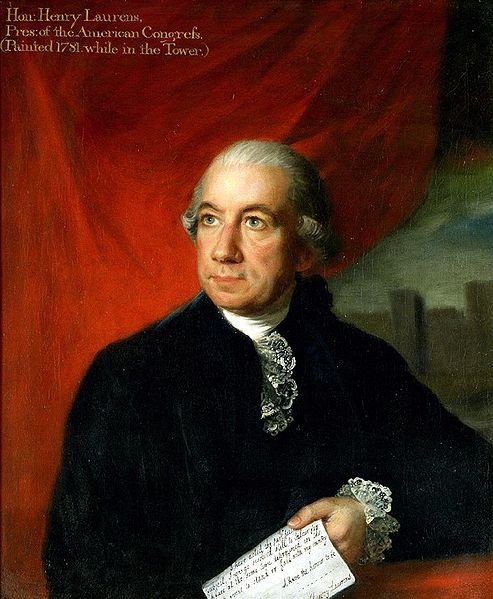
Henry_laurensHenry Laurens wrote his daughter, Martha, from Philadelphia, as he was preparing to leave for England.

My dearest Patsy, remember my precepts; be dutiful, kind and good to your Aunt … let all your reading, your study, and your practice tend to make you a wise and virtuous woman, rather than a fine lady; the former character always comprehends the latter, but the modern fine lady … is too often found to be deficient both in wisdom and in virtue.

 1775 – American Revolution – Slavery.

Thomas Jeremy, a free black man, was hanged at the workhouse green on Magazine Street, next to the Jail. Known as “Jerry the pilot” he was convicted of conspiring to foment a slave insurrection. His body was taken down and burned.

Jeremy, worth £1000 sterling and a slave owner himself, had supposedly claimed that if British warships came, he would pilot them across the Charlestown bar himself. Lord William Campbell, Carolina Royal Governor, became convinced that Jeremy was innocent. He believed that the swirling emotions of rebellion, fueled by the massacre at Lexington and Concord, created an atmosphere in which Jeremy was an unwitting victim. The day after Jeremy’s execution Campbell wrote, “I could not save him My Lord!”

Today In Charleston History: August 17

August 17

1682 – A fourth version of the Fundamental Constitutions was drawn up by the Lords Proprietors. It was never ratified.

1696 – Arrivals.  

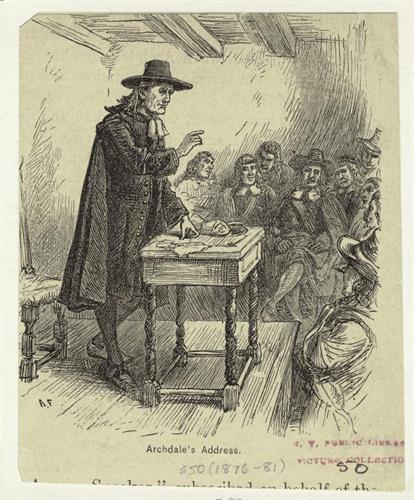
John Archdale, a Quaker from London, who owned a Proprietary share in Charles Town, arrived as Governor of Carolina, sent at the behest of the Proprietors. He retained Joseph Blake as Deputy Governor.  He wrote to the Proprietors that:

When I arriv’d I found all matters in great confusion and every faction apply’d themselves to me in hopes of relief; I appeased them with kind and gentle words and so soon as possible call’d an assembly.

Archdales address (NY public library)Archdale moderated restrictions against the Indians and was acknowledged for his more humane settlements of conflicts. He also reinforced the liquor act – prohibiting the sale, except by license, of any “beer, cider, wine, brandy, rum, punch or any strong drink whatsoever under the quantity of one gallon.”

He also passed an act stating that “laws passed by the Commons House of Assembly … could not be repealed by London without the consent of the assembly.”

1863 – Bombardment of Charleston.

Under the direction of Union General Quincy Gilmore, Colonel Edward Serrel of the Volunteer Engineers supervised the mounting of a 16,500 pound eight-inch Parrot gun, called the “Swamp Angel.” It was located five miles (8000 yards) south of Charleston, in a muddy stretch of land between Morris Island and James Island.

SwampAngelDrawingThe Swamp Angel was a rifled gun, which changed artillery forever. No longer did cannons have to merely shoot round balls, the “rifling” inside the cannon barrel (a series of grooves cast into the gun’s tube) enabled them to shoot a long, slender projectile bullet more accurately, and over greater distances.

Today In Charleston History: August 16

1736- Religion

Charles Wesley sailed back to England. John Wesley returned to Savannah to continue his ministry.

1763-College of Charleston

The Assembly established a committee to make plans for a public college for the young men of the province. It would be seven years before any action was taken and the College of Charleston would be established.

1771 – Dueling 

In a duel that took place in the long room of a tavern, Dr. John Haley, a Charlestown Whig physician, killed Mr. Delancy, a Tory from New York and brother of Mrs. Ralph Izard. Since the duel took place without the presence of seconds, Dr. Haley was charged with murder. At his trial he was defended by Thomas Heyward, Jr. and acquitted which “was considered a great triumph by the Whigs.”

1780 – American Revolution – The Battle of Camden.  
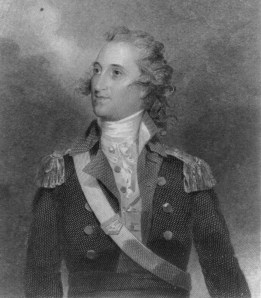
Thomas Pinckney

Thomas Pinckney

This was another major defeat for the Americans. A new Southern Army, commanded by Major General Horatio Gates, was roundly defeated by Cornwallis. With more than 1000 casualties it was the worst American battlefield defeat of the entire Revolution. Thomas Pinckney of Charleston an aide-de-camp to General Gates, and was captured on the battlefield.

1825-DEATHS

Charles Cotesworth Pinckney, eldest son of a politically prominent planter and Eliza Lucas Pinckney, died today.

At age 7, Charles accompanied his father, who had been appointed colonial agent for South Carolina, to England. Pinckney received tutoring in London, attended several preparatory schools, and went on to Christ Church College, Oxford, and graduated in 1764. Pinckney next pursued legal training at London’s Middle Temple and was accepted for admission into the English bar in 1769. He then spent part of a year touring Europe and studying chemistry, military science, and botany under leading authorities.
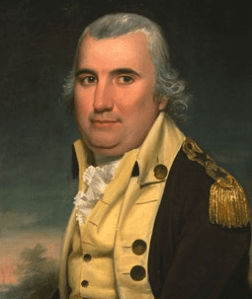
Charles Cotesworth Pinckney

Charles Cotesworth Pinckney

Late in 1769, Pinckney sailed home and the next year entered practice in South Carolina. In 1773 he acted as attorney general for several towns in the colony. By 1775 he had identified with the patriot cause and that year sat in the provincial congress.

When hostilities broke out, Pinckney, pursued a full-time military calling. When South Carolina organized its forces in 1775, he joined the First South Carolina Regiment as a captain. He soon rose to the rank of colonel and fought in the South in defense of Charleston and in the North at the Battles of Brandywine, PA, and Germantown, PA. He commanded a regiment in the campaign against the British in the Floridas in 1778 and at the siege of Savannah. When Charleston fell in 1780, he was taken prisoner and held until 1782. The following year, he was discharged as a brevet brigadier general.

Pinckney was one of the leaders at the Constitutional Convention. Present at all the sessions, he strongly advocated a powerful national government. His proposal that senators should serve without pay was not adopted, but he exerted influence in such matters as the power of the Senate to ratify treaties and the compromise that was reached concerning abolition of the international slave trade. After the convention, he defended the Constitution in South Carolina.

Under the new government, Pinckney became a devoted Federalist. Between 1789 and 1795 he declined presidential offers to command the U.S. Army and to serve on the Supreme Court and as Secretary of War and Secretary of State. In 1796, however, he accepted the post of Minister to France, but the revolutionary regime there refused to receive him and he was forced to proceed to the Netherlands. The next year, though, he returned to France when he was appointed to a special mission to restore relations with that country. During the ensuing XYZ affair, refusing to pay a bribe suggested by a French agent to facilitate negotiations, he was said to have replied “No! No! Not a sixpence!”

When Pinckney arrived back in the United States in 1798, he found the country preparing for war with France. That year, he was appointed as a major general in command of American forces in the South and served in that capacity until 1800, when represented the Federalists as Vice-Presidential candidate, and in 1804 and 1808 as the Presidential nominee but was defeated on all three occasions.

He was a charter member of the board of trustees of South Carolina College (later the University of South Carolina), first president of the Charleston Bible Society, and chief executive of the Charleston Library Society. .Survived by three daughters, he died in Charleston at the age of 79 and interred  in the cemetery at St. Michael’s Episcopal Church.

Today In Charleston History: August 15

1739

The Security Act was passed by the Assembly in response to white fears about the majority Negro population. The Act required that all white men carry firearms to church on Sunday. Anyone not in compliance of the law by September 29 would be subjected to a fine.

1779 – Births.
Joseph Alston

Joseph Alston

Joseph Alston was born in Charleston. He was a future governor of South Carolina and inherited one of the state’s largest fortunes. He would later marry Theodosia Burr, daughter of vice-president Aaron Burr.  

Today In Charleston History: August 14

1743-Slavery. Executions

 A Mr. Snowden was set on fire by a Negro man, who was convicted and publicly burned to death.

clergy banished1774

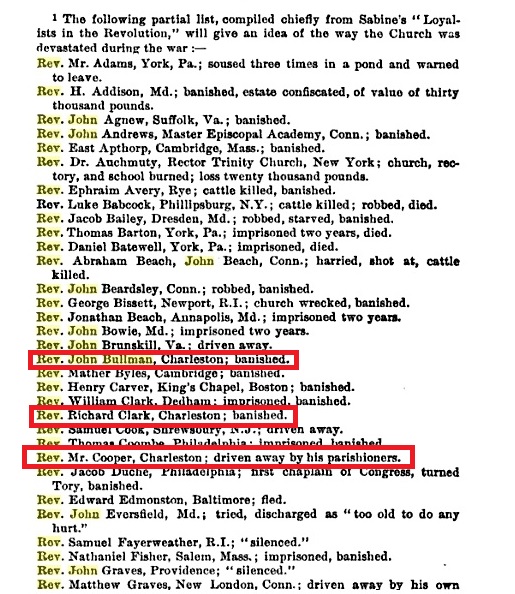
 The Sunday morning departure of Christopher Gadsden and Thomas Lynch to Philadelphia to attend the Continental Congress created a stir in Charlestown. Most of the clergy were on the side of the Revolutionaries. However, Rev. John Bullman, assistant minister at St. Michael’s Church, boldly preached a sermon titled “The Christian Duty of Peaceableness.” In a thinly veiled reference to the Boston Tea Party, he stated it was not the place of “a silly clown or illiterate mechanic (Sam Adams) to meddle in the affairs of princes and governors.” He called Gadsden and Lynch both “traitors.” Unfortunately for Bullman, many Charlestonians were sympathetic to the Boston resistance. The vestry voted 42-33 and dismissed him from the pulpit.

1863 

The Commission for the Removal of Non-Combatants submitted a list of “Camp-Grounds” prepared to receive refugees around South Carolina, which included: Summerville, Ridgeville, Branchville and St. Matthews.

ttd16-31901

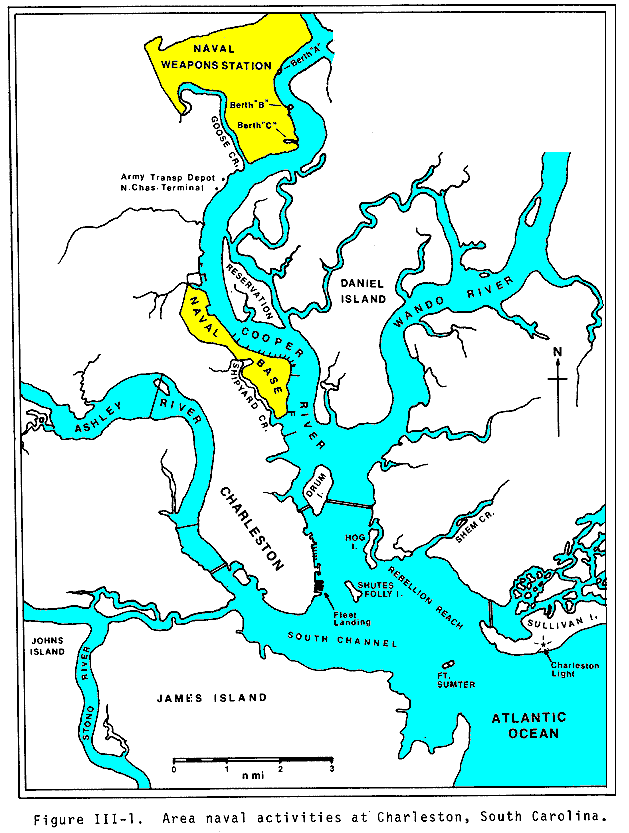
 Charleston sold 170 acres of land along the Cooper River to the United States for $200 per acre for the construction of a naval facility.

Today In Charleston History: August 13

1783-City Incorporated

 Edward Rutledge, Thomas Heyward and Thomas Bee, proposed a bill of incorporation for Charlestown. An elected intendant (mayor) and thirteen wardens would have the power to govern the city, whose name was changed to Charleston.


1864 – Civil War
Clubhouse of the race course where Federal officers were imprisoned.

Clubhouse of the race course where Federal officers were imprisoned.

By this time there were 6000 Federal prisoners within the city limits. Many of them were housed in the City Jail at the corner of Franklin and Magazine Streets. Others were housed around the corner in Roper Hospital at the corner of Queen and Logan Streets. The majority were held at the Charleston racecourse. Most of the Federal prisoners considered their imprisonment in Charleston to be a life-saving change, away from the hellish conditions of Andersonville. Lt. Benjamin Calef wrote:

We reached Charleston on the morning of August 13, and were kept waiting a long time in the Street, when I procured some fresh figs, bread and milk, and seated on the curb-stone, made an excellent breakfast … I should not omit to speak of the long piazza at the front [of Roper Hospital], on which I have spent so many hours with my pipe for my companion.

charleston-prison

Charleston Jail and prison.

Today In Charleston History: August 11

1735 – SLAVERY.

Abraham, a Negro man owned by Mr. Samuel Jones, was baptized by Rev. Nathan Bassett of the Independent Church.

1847 – BORN TODAY

Ben Tillman was born near Trenton, South Carolina. Tillman rose to power as a representative of poor white residents of the state. He was elected governor of South Carolina in 1890 and began instituting populist reforms, including Jim Crow laws. He was elected to the United States Senate in 1894, serving until his death.

He was forced to leave school at the age of 16 in order to join the Confederate Army. He was stricken with a bacterial infection in his left eye before he could enlist. The eye was subsequently removed. He joined a paramilitary effort to overthrow Republican rule in South Carolina, taking part in the “Hamburg Massacre” of 1876, in which armed citizens overwhelmed the federal militia. Tillman’s leadership in this event established him as a leading white supremacist and launched his political career.

tillmanTillman was elected governor of South Carolina in 1890, serving for a single term. During this time, he established an agricultural school that would become Clemson University.

As governor he tirelessly promoted a culture of race-based discrimination and violence. Tillman’s supporters dubbed him the “Champion of White Men’s Rule and Woman’s Virtue” for his support of lynching as a punishment for alleged sexual misconduct by African Americans. The decade of the 1890s saw a spike in mob violence, particularly lynching, that was tolerated and even encouraged by Tillman and his allies.

Tillman was elected to the United States Senate in 1894. He held the office until his death in 1918. In Washington, Tillman developed a reputation as a hot-head. He threatened to stab President Cleveland with a pitchfork, earning the nickname “Pitchfork Ben,” received a formal censure for assaulting another senator and was barred from entering the White House.

Tillman died on July 3, 1918, in Washington, D.C. A statue of Tillman was erected outside the South Carolina State House in 1940 and stands to this day.

Today In Charleston History: August 10

1664 

Capt. William Hilton sailed from Barbados to find a location in Carolina for settlement. He sailed into Port Royal Sound and claimed the island that protected the mouth of the harbor in his name – Hilton Head..

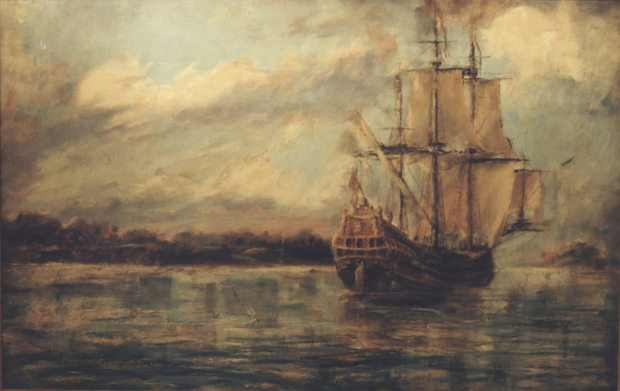
adventure

The Adventure, Captain William Hilton’s merchant ship, painted in 1963 by long time Hilton Head Island resident Walter Greer – is currently on display at Coastal Discovery Museum at Honey Horn.

In 1662 at the request of a group of merchants in Boston, Captain William Hilton set sail from Charlestown, Massachusetts aboard the ship Adventure to explore the Carolina coast. After investigating the area around Cape Fear (North Carolina), Hilton returned to Massachusetts with enough information to have a detailed map made of the area.

The next year a group of businessmen from New England, London and Barbados commissioned Hilton for a second voyage to explore the Carolina coast. Hilton, once again commanding Adventure, set sail, from Barbados on August 10, 1663. During this voyage he explored the entrance to Port Royal Sound and noted, just inside the entrance to the sound, the existence of a headland —a high point of land used as a reference point by mariners. Later this headland would be called Hilton’s Head and soon the island on which it was located would be called Hilton Head Island.

Today In Charleston History: August 8

AUGUST 8

1781 – The Royal Gazette [Charlestown] wrote: 

Mr. Issac Hayne, who since the capitulation of Charlestown, had taken protection, and acknowledged himself a subject of his Majesty’s Government, having notwithstanding been taken in arms, and at the head of a Rebel Regiment of Militia, was therefore on Saturday morning last, executed as a Traitor.

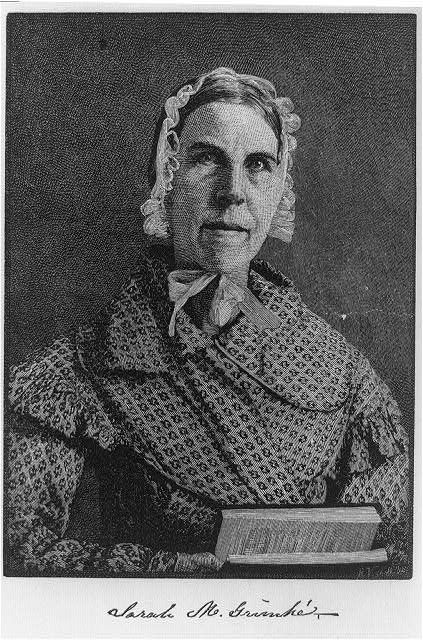
1819 – Judge John Grimke died. Judge John Grimke fell seriously ill in March. His Charleston doctors advised him to seek treatment with the foremost surgeon in American, Dr. Phillip Synge Physick of Philadelphia. Sarah Grimke accompanied her father. Physick, a Quaker, found lodgings for Sarah in a Quaker boardinghouse.

grimke, sarahFor the first time, Sarah  was surrounded by people who were NOT southern and held social views that were more in line with Sarah. It was the beginning of a life-altering change for Sarah, and ultimately, her younger sister, Angelina. The sisters became two of the most famous abolitionists within 20 years.  


Today In Charleston History: August 7

1753 – Religion.

A petition was made to the Royal Governor for a parcel of land upon which to build a Lutheran church.

1767 – Backcountry.

In more complaints about the dangerous conditions in the backcountry, The South Carolina and American General Gazette reported that:

If we save a little for to bring to Town Wherewith to purchase Slaves – Should it be known our Houses are beset, and Robbers plunder Us, even of our Cloaths. If we buy Liquor for to Retail, or for hospitality, they will break into our dwellings and consume it … Should be raise fat Cattle, or Prime Horses for the Market, they are constantly carried off, tho’ well guarded.