Secretary Dalton wrote that the number of colonists transported to Carolina by this date was 337 men, 71 women and 62 children – 470. Sixty-four had died, leaving a population of 406.
1733
James Oglethorpe and Col. William Bull explored the territory around the Savannah River together, scouting for a good location for a permanent settlement. They decide on Yamacraw Bluff on the river, where Savannah sits today.
1807
Joel Roberts Poinsett, dined with Czar Alexander at the Palace in Russia. During the meal Alexander attempted to entice Poinsett into the Russian civil or military service. Poinsett was hesitant, which prompted Alexander to advise him to “see the Empire, acquire the language, study the people,” and then decide. Poinsett spent the next several months traveling across Russia.
1837
Angelina and Sarah Grimke began a six-week series of successful lectures about slavery in a New York City Baptist Church.
Four sailors allegedly “attacked a gentleman on the Bay, supposed with the intent to rob him.” The victim retreated to his store, “where he not only…defended himself, but…at length beat them off.” No comment 😉
1814
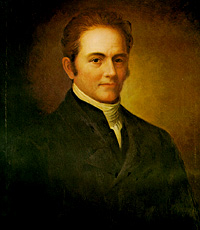
Langdon Cheves was elected speaker of the U.S. House of Representatives, replacing Henry Clay.
Langdon Cheves
Cheves was born at Bull Town Fort, on the Rocky River in South Carolina. At the age of ten he went to Charleston to earn a living, and at sixteen had become confidential clerk in a large mercantile house. In 1797 he was admitted to the bar to practice law. In 1808 his yearly income exceeded $20,000, making him wealthy for his time. He also became Attorney General of South Carolina, serving until 1810.
In 1806 he married Mary Elizabeth Dulles, of Charleston and was elected to the U.S. House in 1808.. Cheves soon distinguished himself as the best orators in Washington. His speech on the merchants’ bonds in 1811 was so eloquent Washington Irving, who was present, said for the first time it gave him an idea of the manner in which the great Greek and Roman orators must have spoken.
Cheves became the ninth Speaker of the House on January 19, 1814, and served until March 4, 1815, when his Congressional term ended.
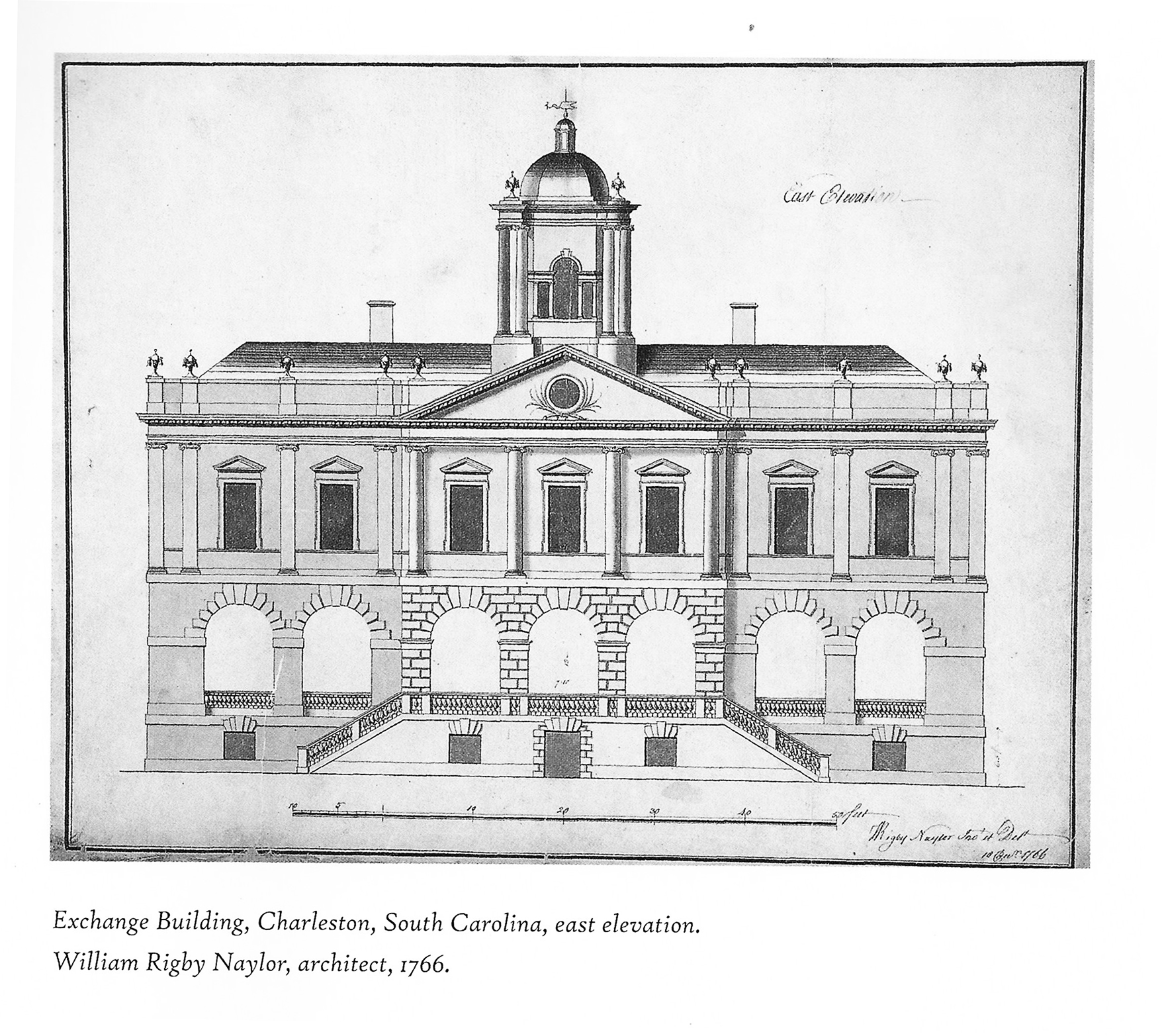
The Assembly, at the urging of John Rutledge, Cotesworth Pinckney and Charles Pinckney, agreed on a holding a ratifying convention for the Constitution. It was scheduled for May 12 at the Exchange Building.
1865 – Civil War
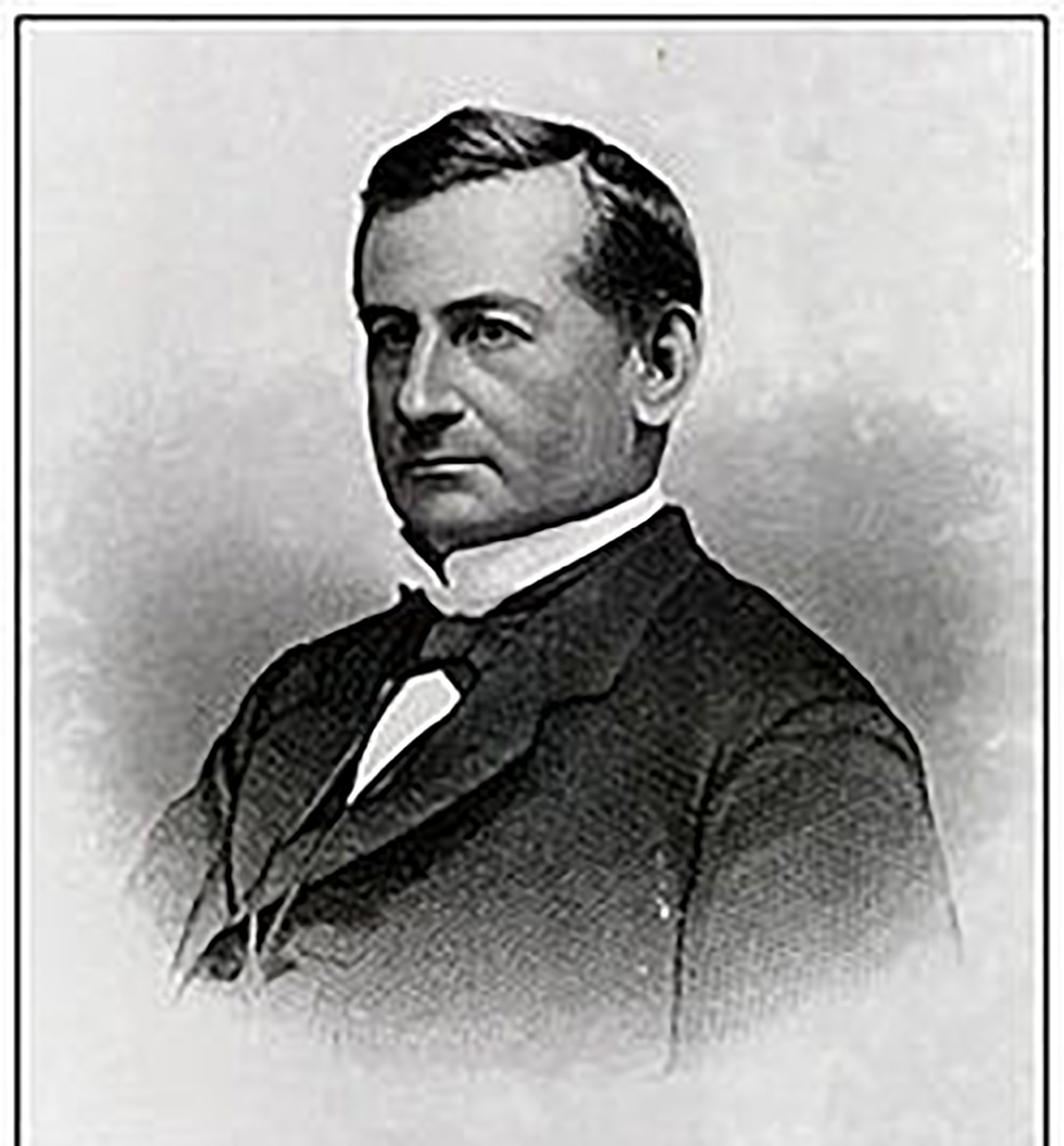
Andrew Gordon MacGrath
South Carolina governor, Andrew Magrath, pleaded with Confederate President Jefferson Davis to protect Charleston. There was great and reasonable fear that Sherman’s troops, breaking their Christmas camp in Savannah, were next heading for Charleston.
Magrath is most famous for resigning his judgeship when Abraham Lincoln was elected president in 1860. In U.S. District court on the day after Lincoln’s election, November 7, 1860, Magrath rose from the bench and said:
In the political history of the United States, an event has happened of ominous import to fifteen slaveholding States. The State of which we are citizens has been always understood to have deliberately fixed its purpose whenever that event should happen … So far as I am concerned, the Temple of Justice, raised under the Constitution of the United States, is now closed. If it shall be never again opened, I thank God that its doors have been closed before its altar has been desecrated with sacrifices to tyranny.
Magrath was active during the Secession Convention and served as Secretary of State for South Carolina. As the War was coming to a conclusion, Magrath was appointed governor by the S.C. Legislature in December 1864. He served for less than a year as governor, was arrested by the Union Army on May 25, 1865 and sent to Fort Pulaski for imprisonment. Magrath was released in December and resumed the practice of law in Charleston. He died on April 9, 1893, and was buried at Magnolia Cemetery.
1908 – Murder!
One chain gang inmate was hanged in Charleston for the murder Captain Herman Stello. The captain was killed when his throat was slit by the inmates during an escape attempt from the Seven Mile Stockade at Ashley Junction.
The inmates feigned illness in order to remain at the stockade while the other prisoners worked on the chain gang for the Drainage and Sanitary Commission. One of the inmates asked Captain Stello for water and when he opened the door to deliver it he was attacked. He was struck over the head with the bucket before one of the inmates cut his throat with a knife.
Captain Stello was placed into their cell along with two other inmates who refused to participate in the escape. Then the three subjects fled the camp. The man who cut Captain Stello’s throat was arrested a short time later. He was convicted of Captain Stello’s murder, sentenced to death, and subsequently executed by hanging on January 18th, 1908.
The town of Beaufort was chartered on the Port Royal Sound, making it the second oldest town in South Carolina. It was named after Henry Somerset, the 2nd Duke of Beaufort and a Lord Proprietor from 1700-14. The Beaufort settlement made the Yemassee Indians unhappy, as it usurped a large part of their territory. It was one of the factors that led to the Yemassee War, 1715-17.
1781 – British Occupation
The Knights Terrible Society was organized at Mr. Holliday’s Tavern, for the purpose of drinking once a week during the British occupation. They disbanded after the British evacuated the city.
1782 – American Revolution
Gov. John Rutledge and the South Carolina House convened in Jacksonboro, thirty miles from Charleston, near the site of the Stono Slave Rebellion on the Edisto River. Only persons loyal to South Carolina were allowed to vote. Christopher Gadsden was elected governor, but declined due to his health, which had suffered during his imprisonment in St. Augustine. John Mathews was chosen as governor, “a younger and more even-tempered individual.”
Laws were quickly passed for raising Continental troops and for punishing “conspicuous Tories.” Called the “Act for Disposing of Certain Estates and Banishing Certain Persons” it banished Loyalists and provided for the confiscation and sale of their estates. The list of confiscation contained more than 700 individuals.
Several members of Beth Elohim “withdrew from the congregation, and joining a larger number who were not members, establishing a new place of worship.” They called themselves the Reformed Society of Israelites. They met at Selye’s Masonic Hall on 209 Meeting Street. This was the first Reformed Jewish Society in America.
1825 – Slavery.
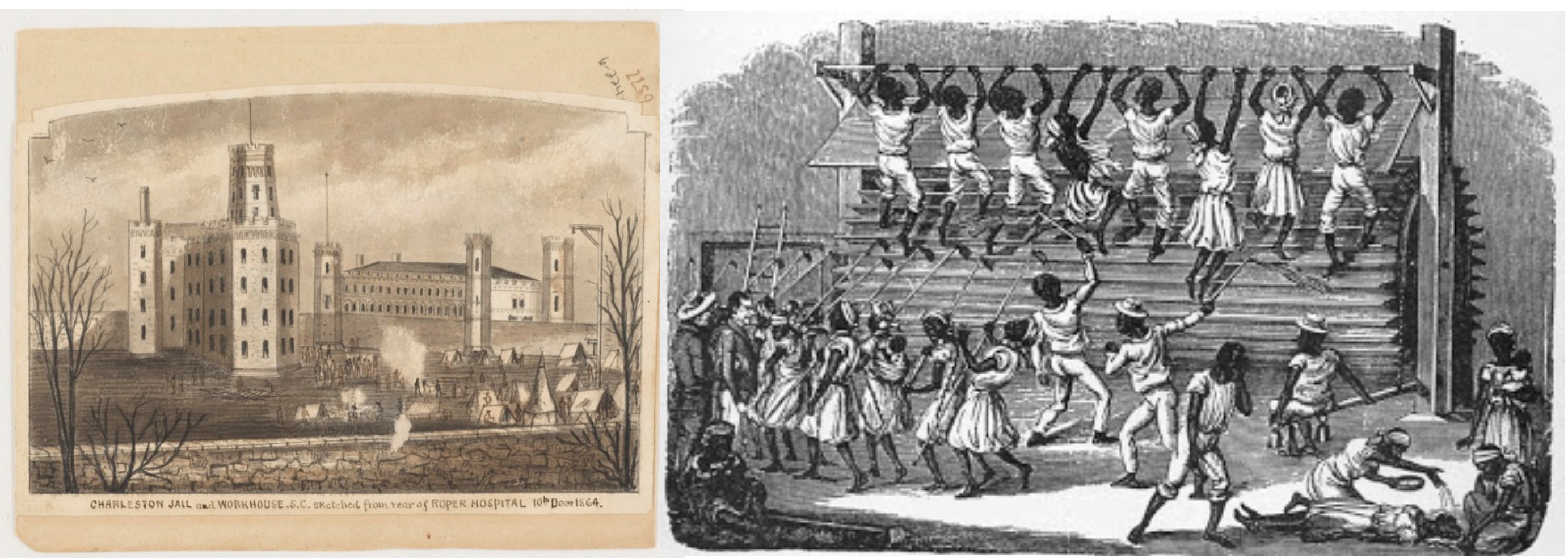
Charleston erected a treadmill in the city workhouse for the punishment of slaves, relieving white masters from the distasteful practice of whipping their slaves. For a fee, the master could send the slaves to the workhouse for punishment administered by city authorities. The slaves would walk on the treadmill in shifts, providing power for the grinding of corn. Overseers with rawhide whips maintained order.
LEFT: Jail & Workhouse, rear view, looking north from Roper Hospital on Queen Street. RIGHT: Traditional work treadmill.
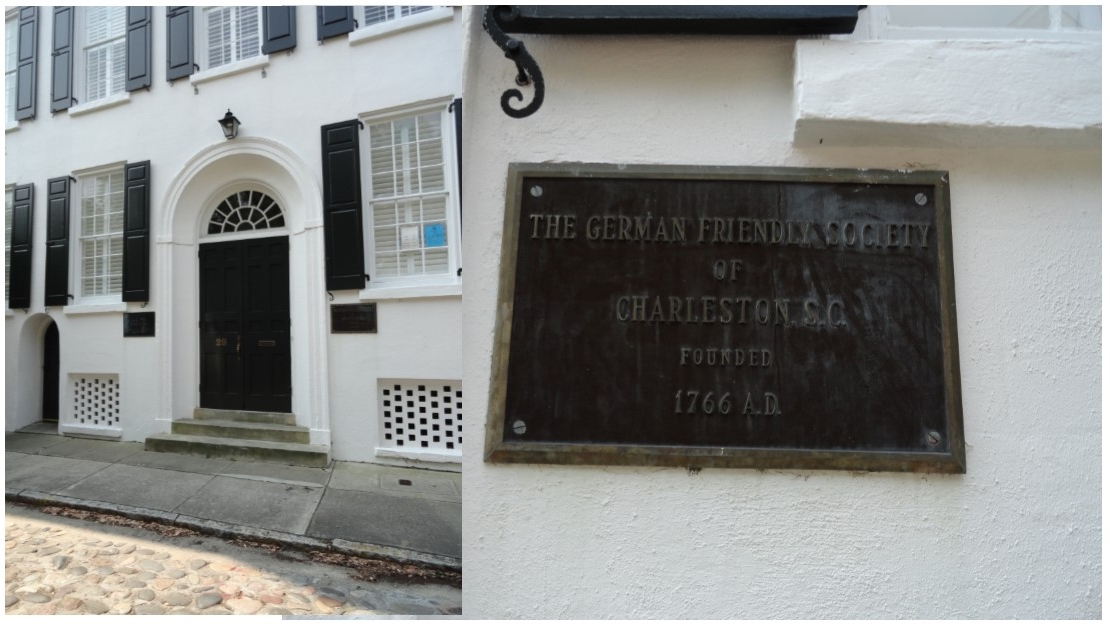
The German Friendly Society was organized in the home of Michael Kalteisen. The rules decreed that either German or English had to be spoken at the meetings. They still hold weekly meetings.
German Friendly Society, Chalmers Street. close-up of marker on building. Photos byMark R. Jones
1778 – Disasters
A major fire started at the corner of Queen and Union (now State) Street. Aided by a blustery wind it burned across Charleston for seventeen hours, destroying hundreds of buildings, including most of the holdings of the Charleston Library Society, Peter Timothy’s printing shop, and Charles Pinckney, Junior’s house on Queen Street. The city was “smoking ruins, and the constant falling walls and chimneys.”
1821
Charleston Councilman, John J. Lafar warned Rev. Morris Brown that the city would not tolerate “instructional school for slaves” as “education of such persons forbidden by law.”
Rev. Morris Brown
Morris Brown was born a free black in Charleston in 1770. In 1813 he traveled to Philadelphia with another free black, Henry Drayton, to collaborate with the Rev. Richard Allen in the founding of the country’s first African Methodist Episcopal Church (AME). Brown was a prosperous shoemaker by trade and charismatic religious leader in Charleston’s black community. Brown and Drayton were ordained as pastors by Allen and returned to Charleston with the goal of establishing an AME congregation locally.
They discovered their church, Bethel Methodist, was embroiled in a controversy. White church trustees had voted to construct a hearse house (a carriage house / garage for storing hearses) on top of the black cemetery. Brown and Drayton led an exodus of 4300 free blacks and slaves from the church and began construction of an independent African Methodist Church at the corner of Anson and Boundary (now Calhoun) Streets.
White Charlestonians regarded the black church as “dangerous bastions of slave autonomy” and routinely disrupted the services and threatened to close the churches. Their fear was that a “latter-day Moses” would emerge from the congregation, so every Sunday service was attended by “white authorities routinely … in the back pews.”
Councilman Lafar’s warning to Rev. Brown was a not-so-subtle reminder that the city white authorities were watching their activities.
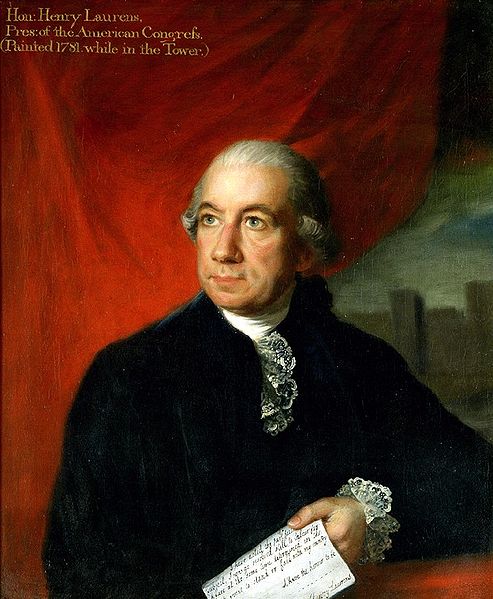
Congress ratifies the Treaty of Paris, officially ending the American Revolutionary War. The treaty was negotiated in 1783 by Benjamin Franklin, John Jay, John Adams and Charleston’s own Henry Laurens, who had been imprisoned in the Tower of London as a traitor to the King. The secretary for the American delegation was Lauren’s teenage daughter, Martha Laurens (later Ramsay).
1785
Henry Laurens
Henry Laurens returned to Charleston. He had been absent for more than five years as a prisoner of the British.
In 1780, the Continental Congress appointed Laurens as American minister to the Netherlands, in order to procure financial support for the Revolution. Laurens was captured by the British on the open sea, declared a traitor and imprisoned in the Tower of London for 16 months, where his health steadily deteriorated.
After his release, Laurens spent the next two years recuperating in Europe. Upon his return to South Carolina, he wrote that he had “become a stranger in my native land.” He estimated that damage to his property exceeded £40,000.
1864 – Bombardment of Charleston
Gen. Beauregard wired the Confederate government in Richmond, Va.:
Fire of enemy on city for last two days has been almost continuous … Although averaging over 100 shots a day, only one person wounded … enemy threw yesterday 273 shells at city; over one fourth fell short; some ranged nearly five miles. Two fires occurred; not much damage; nobody hurt.
1868
South Carolina Constitutional Convention meets with a black majority for the first time in history. It included 76 Blacks and 48 whites, and all but four were Republicans.
The Convention met in Charleston for fifty-three days at the Charleston Club House on Meeting Street (current location of the Waties Waring Judicial Center), completing their work on March 17, 1868. A few of the most important changed in the new constitution were:
(1) Confirmed South Carolina’s membership in the Union. (2) Prohibited discrimination based on race or color. (3) Gave women the right to control their own wealth, and to get divorced. (4) Declared public schools to be available to ALL citizens. As Nic Butler declared, it was “the most democratic and equitable of the seven constitutions in the history of this state.”
On March 16, 2018, a historical marker on the site of the former Charleston Club, was erected commemorating the 1868 South Carolina Constitutional Convention was unveiled. To read the proceedings of the Convention, CLICK HERE.
Charleston Club, c 1887. Severely damaged by the 1886 earthquake. From Robert Stockton, “The Great Shake.”
Four acres of land were granted to Anglican minister, Rev. Atkin Williamson, by Originall Jackson who wrote he was:
excited with a pious zeal for the propagation of the true religion which we profess … the divine service according to the form and liturgy now established to be duly and solemnly performed by Atkin Williamson.
One year later, Rev. Williamson was dismissed from the pulpit “for baptizing a bear while drunk.” Whether it was the bear or the reverend that was drunk was never specified.
1733 – Arrivals
James Oglethorpe
James Oglethorpe and the first settlers for Georgia arrive in Charlestown on the Anne. The merchants of Charlestown were excited and supportive of the new Georgia colony. An English settlement between St. Augustine and Charlestown to them it meant greater security against the Spanish.
The Assembly voted £2000 for the assistance of the Georgia effort and Colonel William Bull accompanied the expedition several days later when they sailed to Beaufort.
1865
Preparations for Sherman’s expected attack on Charleston were under way. Charleston’s military officials had reports that both the Union Seventeenth and Fifteenth corps were moving up the coast from Savannah.
Col. William Rhett died of apoplexy in Charlestown. He was described as “greedy, violent, vulgar, lawless, brave, impulsive, generous … greedily violating law and propriety for bigger profits, insulting the noble and courteous Gov. Craven.”He was also one of the most important citizens of early Charles Town. Rhett served as colonel of the Provincial Militia, receiver general of the Lords Proprietors of Carolina, surveyor and comptroller of customs for Carolina and the Bahama Islands.
In 1706 Rhett commanded a flotilla that fought off a Franco-Spanish attack on Charles Town.Ten years later, he outfitted two ships as pirate hunters – the Henry and the Sea Nymph, each with eight guns and a crew of between 60 and 70 men. Rhett assumed the position of captain of this small flotilla and led it to victory in the 1718 Battle of Cape Fear River, capturing the infamous Stede Bonnet, the so-called “gentleman pirate.”
1760 – Epidemics
One of the most severe small pox outbreaks in colonial America started, most likely brought to the city by returning soldiers from the Cherokee Indian expedition. More than 6000 people contracted the disease, resulting in 380 deaths among whites and about 350 blacks. This led to the first mass inoculation of the Charlestown population, with more than 2000 people taking the shot within a few weeks, more than 600 in one day according to Dr. Alexander Garden.
Three month old Martha Ramsay was pronounced dead of smallpox. Her body was laid out in preparation for a funeral and placed next to an open window. Dr. John Moultrie arrived and pronounced her still alive, speculating she had been revived by the fresh breeze.
Eliza Pinckney wrote: “Many poor wretches … died for want of proper nursing … smallpox rages the city so that it almost puts a stop to all business.”
1773 – Charleston First
Charleston Museum was established – 1st natural history museum in America.
The Charleston Library Society provided the core collection of natural history artifacts for the founding of the Charleston Museum (the first in America) in 1773. Residents were encouraged to donate objects for the new museum on Chalmers Street. Some of initial acquisitions included “a drawing of the head of a bird, an Indian hatchet, a Hawaiian woven helmet, and a Cassava basket from Surinam.”
The museum also acquired “a Rittenhouse orrery, a Manigault telescope, a Camera obscura, a hydrostatic balance, and a pair of elegant globes.”
A camera obscura box with mirror, with an upright projected image at the top
Carolina’s First Provincial Congress convened at the Old Exchange. Charles Pinckney, was chosen as President and Peter Timothy (editor of the South Carolina Gazette) as Secretary. Populated with former members of the Assembly, it declared itself the government of South Carolina independent from British authority.
The General Meeting was to discuss the recommendations of the Continental Congress, which included:
a compact among the colonies to boycott British goods
to provide for a Second Continental Congress to meet on May 10, 1775
This meeting was the most democratic assembly in South Carolina’s history, consisting of 184 delegates from every part of the colony, including the backcountry.
1777 – American Revolution. Religion
Rev. William Tennant of the Independent Church, and also a member of the Legislature, introduced legislation to disestablish the Church of England in South Carolina. He argued that a State Church discouraged freedom, that goal of the Revolution.






 MarkJonesBooks