Today In Charleston History: March 23

1738

Sarah Chamberlain was found guilty of “the Murder of her Bastard Child.” She was sentenced to death.

1740 –Religion.

 While in Charlestown Rev. George Whitefield conducted public services – open air preaching –  that disregarded the Book of Common Prayer, an offense against the Church of England, of which he was a licensed minister. Rev. Alexander Garden called on him to explain his offense. Whitefield warned that God had been:

Contending with the people of South Carolina … for two years –  with disease, the Stono Rebellion … God has a quarrel with you, for your abuse of and cruelty to the poor negroes.

Rev. George Whitefield - open air preaching

Rev. George Whitefield – open air preaching

Today In Charleston History: March 22

 1765 – American Revolution –The Stamp Act.

stamp actIn a another attempt to pay the debt run up during the French and Indian War, British Parliament passed the Stamp Act,  which required that most printed materials in the colonies be produced on “stamped paper” (an embossed revenue mark)  from London. The printed materials included newspapers, legal documents, playing cards and magazines. There was quick and passionate opposition to the Stamp Act in Boston, Philadelphia and Charlestown.

South Carolina’s London agent Charles Garth wrote to John Rutledge informing him of the proposed Stamp Act being argued in Parliament. In Garth’s opinion the Act could not be successfully opposed by the colonies.

The Stamp Act was viewed as a threat by most Charles Town’s men. Just a year before they had managed to secure the upper hand over Governor Boone who had challenged the Assembly’s right to determine the validity of elections. 

1794 – Execution

Thomas Walsh “was assisted in his devotions by the Rev. Dr. Keating, pastor of the Roman Catholic church” before he was hanged for counterfeiting in Charleston. He then

politely waved his hand to the crowd and said, ‘Good day, gentlemen’ before he pulled the cap over his face” and was immediately launched into eternity.

1888

Charles Dickens, Jr. appeared at the Academy of Music, reading excerpts from his father’s famous works.

1924
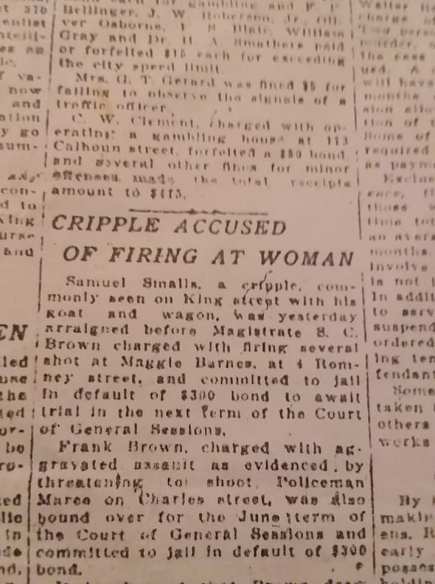
Samuel Smalls, a disabled black Charleston street peddler, often seen on his goat cart, was arrested for shooting at his girlfriend Maggie Barnes at 4 Romney Street. DuBose Heyward, wrote the novel Porgy, based on Smalls’ arrest and the fight with his girlfriend. George Gershwin read and collaborate with Heyward on “Porgy and Bess.”

sammy smalls arrest

Today In Charleston History: March 21

1917 – Music

From the Musical News, London: 

A song, “How Sweet Is Life” by a student, Mr. Edmund T. Jenkins, showed the composer to be possessed of a vein of melody, not original as yet, and of a style which needs unifying, but his effort was full of promise, especially in the matter of orchestration. The song was well rendered by Miss Marjorie Perkins.

Edmund Thorton Jenkins

Edmund Thorton Jenkins

Edmund Jenkins (who was called “Jenks”) was the son of Rev. Daniel Jenkins, founder of the Jenkins Orphanage in Charleston. He grew up playing with the Jenkins Orphanage Band, but longed to play “serious music.” He took piano lessons in Charleston and attended Morehouse College in Atlanta.

In 1914 the Jenkins Band was invited to perform at the Anglo-American Expo in London and Jenks performed with the band until the outbreak of World War I closed down the Expo. Jenks was admitted to the Royal Academy of Music in London where he studied composition.     

1921 – Music

Ethel Waters had her first recording session for the Pace & Handy Music Company. She recorded two songs –  “Down Home Blues” and “At The Jump Steady Ball.” The songs were composed by her Charleston friend, Tom Delaney, formerly a member of the Jenkins Orphanage Band. Also, two other former members of the Jenkins Band, brothers Bud (trombone) and Gus Aiken (trumpet), were part of the recording.  A twenty-three-year-old former chemistry student named Fletcher Henderson played the piano for the session.

“Down Home Blues” became a hit so Pace & Handy paired Waters and Delaney together and sent them out on tour, Waters on vocals and Delaney on piano.   

To learn more about Charleston’s role in American music … read Doin’ the Charleston. 

doin' the charleston

Today In Charleston History: March 20

1706   

Judge Nicholas Trott convicted a woman (not named) of witchcraft. Reverend Dr. Francis Le Jau wrote:

A notorious Maelfactor evidently guilty of Witchcraft & who had kill’d several persons by the Devils help was lately return’d by the Grand Jury. The last Sedition begun while the Judge was examining Evidence relating to the accused Witch that is still in our prisons … that she has many powerful friends here.

Judge Trott also convicted Sarah Dickenson of murder and sentenced her to “be drawn upon a Hurdle, to the place of Execution and there shall be burned to Death.”

1719 – Bloodless Revolution

The Lords of Admiralty in London consented to send “a frigate as soon as possible.” South Carolina Governor Johnson had written a letter illustrating the Proprietors’ inability to defend their territory and subsequently, their charter.

The man-of-war Flambourg, under Captain Hildesly, arrived on duty in the harbor, while the Phoenix under Captain Pierce patrolled the coast for freebooters. Better late than never, the citizens felt.

1830

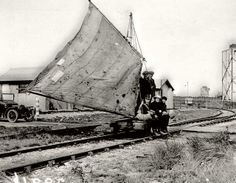
The Charleston & Hamburg Rail Road completed one mile of track in the Charleston Neck. Chief engineer Horatio Allen tested the track with a small two-axle wagon with a single mast supporting a sail – 5×9 feet in size – a “sail wagon.”  Thirteen passengers and three tons of freight were propelled at fifteen miles per hour along the rail.

A

A “sail wagon” from England, 1922, similar in concept to the larger one used in Charleston.

Today In Charleston History: March 19

1778 – Politics
Rawlins_Lowndes

Rawllins Lowndes

South Carolina President Rawlings Lowndes approved changes to the state constitution that changed the title of South Carolina’s chief executive’s office from president to governor, although he was called “president” until the end of his term. It also disestablished the Church of England in South Carolina.

1785 – Education

The Legislature granted a charter for College of Charleston to “encourage and institute youth in the several branches of liberal education.” The founders of the College include three signers of the Declaration of Independence (Edward Rutledge, Arthur Middleton and Thomas Heyward, Jr.) and three future signers of the United States Constitution (John Rutledge, Charles Pinckney and Charles Cotesworth Pinckney).

The Act also granted the college almost 9 acres of land bounded by present-day Calhoun, St. Philip, Coming and George streets; three-fourths of the land was soon sold to pay debts,  In 1837 CofC became America’s first municipal college in the country.

Randolph Hall, College of Charleston main campus

Randolph Hall, College of Charleston main campus

Today in Charleston History: March 18

1758

A report about British quartering (housing of troops) was presented to the Assembly. Prepared by Peter Manigault, Christopher Gadsden, Charles Pinckney, Henry Laurens and Rawlins Lowndes, the report stated:

Officers and Soldiers cannot, legally or constitutionally, be quarter’d in private Houses, without the special Consent of the Owners or Possessors of such Houses. 

1782 – Births.
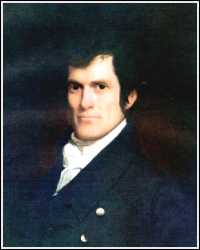
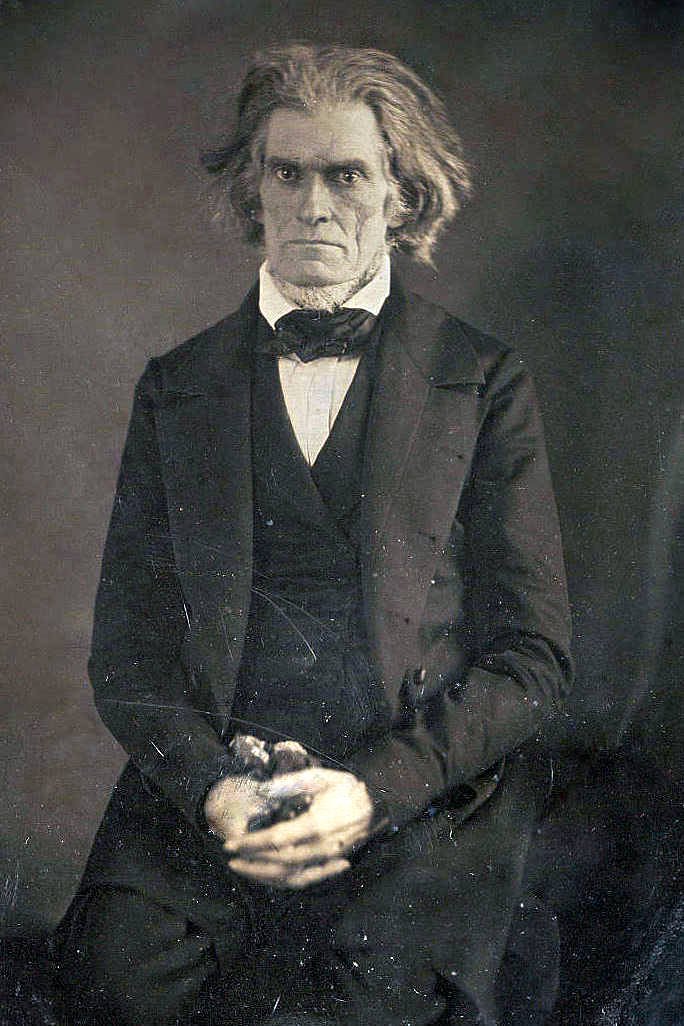
Calhoun as a young man

Calhoun as a young man

John Caldwell Calhoun was born in Abbeville, in the South Carolina backcountry. His mother was described as being “full of intelligence and energy … strong will and temper” – attributes her son would most definitely inherit.

During his life Calhoun became one of the most influential politicians of the 19th century. He was educated at Yale served in South Carolina’s legislature and was elected to the United States House of Representatives serving three terms. In 1812, Calhoun and Henry Clay, two famous “warhawks”, who preferred war to the “putrescent pool of ignominous peace”, convinced the House to declare war on Great Britain.

Calhoun was secretary of war under President James Monroe from 1817 to 1825 and ran for president in the 1824 election along with four others, John Q. Adams, Henry Clay, Crawford, and Andrew Jackson. However, Calhoun withdrew from the race, due to Jackson’s support, and ran for vice president unopposed. Calhoun was vice president of the United States in 1824 under John Quincy Adams and was re-elected in 1828 under Andrew Jackson.

Jackson was for the Tariff of 1828 (Tariff of Abominations) and caused Calhoun to be opposed to Jackson, which led to Calhoun’s resignation in 1832. Because he could not do anything about Jackson’s views toward tariffs, which benifitted only industrial North and hurt slaveholding South, John C. Calhoun became the first vice president to resign.

Calhoun as an elder statesman

Calhoun as an elder statesman

Calhoun wrote an essay about this conflict, “The South Carolina Exposition and Protest”, in which he asserted nullification of federal laws, and in 1832 the South Carolina legislature did just that. This gave Calhoun the nickname “the Great Nullifier.” 

The next year in the Senate Calhoun and Daniel Webster opposed each other over slavery and states’ rights in a famous debate. In 1844 President John Tyler appointed Calhoun secretary of state. In later years he was reelected to the Senate, where he supported the Texas Annexation and defeated the Wilmot Proviso.

John Caldwell Calhoun died in Washington, D.C. on March 31, 1850 and was buried in St. Phillips Churchyard in Charleston. In 1957, United States Senators honored Calhoun as one of the five greatest senators of all time.


Calhoun's tomb in St. Philip's cemetery

Calhoun’s tomb in St. Philip’s cemetery

Today In Charleston History: March 16

1699 – Piracy

Collector of Customs, Edward Randolph, arrived in Charles Town and announced that the royal government was tightening its grip on all the colonies and was considering voiding all Proprietary charters. Randolph also made it clear that the Royal Admiralty Courts believed the Proprietors allowed:

illicit trade … and sought to establish a sort of independence of the King … traded with the Dutch, welcomed pirates as free spenders and have no regard to the acts of trade.

Randolph also discovered that Governor Blake was “a notorious offender against the act.” He also accused Blake and his brother-in-law, Judge Joseph Morton, Jr. of:

fraudulently condemning vessels as contraband and then colluding to purchase, at auction, ships and cargoes at bargain prices … took bribes to ignore smuggling and traded with pirates and the Spanish in Florida.

1735_CHARLESTON

Charlestown, 1735

1773

Josiah Quincy, visiting Charlestown from Boston, wrote about race week:

spent this day in viewing horses, riding over the town … am now going to the famous races … well performed … Filmnap beat Little David (who had won the last sixteen races) out and out. The first four –mile heat was performed in eight minutes and seventeen seconds. I saw a fine collection of excellent, though very high-priced horses … Two thousand pounds were won and lost at this race and Filmnap sold at public vendue … for £300 sterling.

Today In Charleston History: March 15

1670 

The Carolina expedition arrived at Bull’s Island, 100 miles north of Port Royal (just north of present day Charleston). They were greeted onshore by the Cassique (chief / leader) of the Kiawah Tribe speaking bad Spanish, “Bony Conraro Angles!” (Good English comrades!) The Kiawah were a small tribe, approximately 160 members
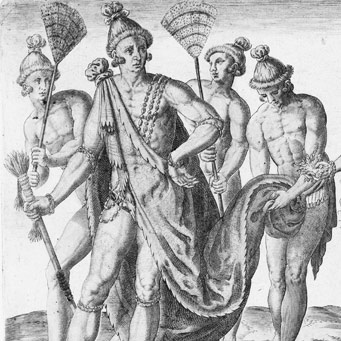
Cassique of the Kiawah tribe

Cassique of the Kiawah tribe – 1670

The Cassique was a young man (nephew of the Cassique at Port Royal) who had traveled to England four years before with Captain Sanford during the expedition to explore the coast. He informed Sayle that a tribe called Westoes had destroyed everything from St. Helena (Port Royal) north to the Kiawha River (Ashley River). 

He tried to convince Sayle they should settle in the Bull’s Island/Kiawha (Ashley) River area. Sayle, however, was determined to go south. The young Indian agreed to join the expedition and guide them to Port Royal. Having spent several years in England, he was a firm friend of the English and during the journey he continued to encourage them away from Port Royal, which was closer to Spanish Florida. Most native tribes of the Carolina coast had been attacked and enslaved by the Spanish for over one hundred years. The Cassique believed the English would be better neighbors and partners.

During their short stay at Port Royal, Governor Sayle summoned the passengers and they elected five men “to be of the council” – Paul Smith, Robert Donne, Ralph Marshall, Samuel West and Joseph Dalton. This was the first election in South Carolina. The council voted to return to the Kiawha area to settle. 

1813. Privateering.

 The Defiance, under Jean Pierre Chazal, battled with the British brig, Nimrod. When Defiance’s main boom was damaged, Chazal was unable to run a full speed. During the battle five of his crew were killed, and ten more wounded. Defiance was captured and taken to Port Royal, Jamaica. Chazal and two of his officers were exchanged.

1813

An advertisement in the City Gazette read:

AT THE AMPHITHEATRE:

Mr. Langley has the honor to inform the Ladies and Gentlemen of Charleston and its vicinity that his Benefit is fixed for THIS EVENING, when every exertion on the part of the Managers, himself, and the whole Company will be made to give general satisfaction. He hopes to meet the approbation of a generous audience. To commence by the Grand Entry and Military Manoeuvres.

Master Charles will perform a variety of Feats of Activity, will jump his whip, etc. Mr. Langley will perform, on one Horse, several Steps and Attitudes – he will also dance a HORNPIPE, his horses in full speed.

Mr. Codet will exert himself to please the spectators by performing numerous Feats of Agility, &c. Master Parfee will exert his utmost endeavors to please. Mr. Langley will also execute the laughable scene of the METAMORPHOSE, or the SAILOR’S VOYAGE, A FOX HUNTING. 

ACT II: GROUND AND LOFTY TUMBLING, By the Company, in which Mr. Laenia will throw a row of FLIP FLAPS across the Circus, and conclude by a lofty back Somerset. Mr. Langley, on two Horses, will execute the feat of Apples, Forks, Bottle, &c, also, the difficult feat of the Hoop, and Leap over the Ribbands.

Mr. Pepin will perform a variety of feats of Horsemanship, in which he will execute the Leap over four Ribbands and over four Illuminated Galleries.

STILL VAULTING by the Company, in which Mr. Langley will perform that unparalleled feat of balancing his body, extending in the air, on one hand.

Mr. Cayetano will perform the admired scene of the INTOXICATED OFFICER.

The whole of this brilliant representation to conclude with the pleasing scene of BILLY BUTTON, or the TAYLOR’S JOURNEY TO BRENTFORD.

Doors to be open at 6, and performance to commence precisely at 7 o’clock. For sale, a full blooded Spanish Stud HORSE.

1825

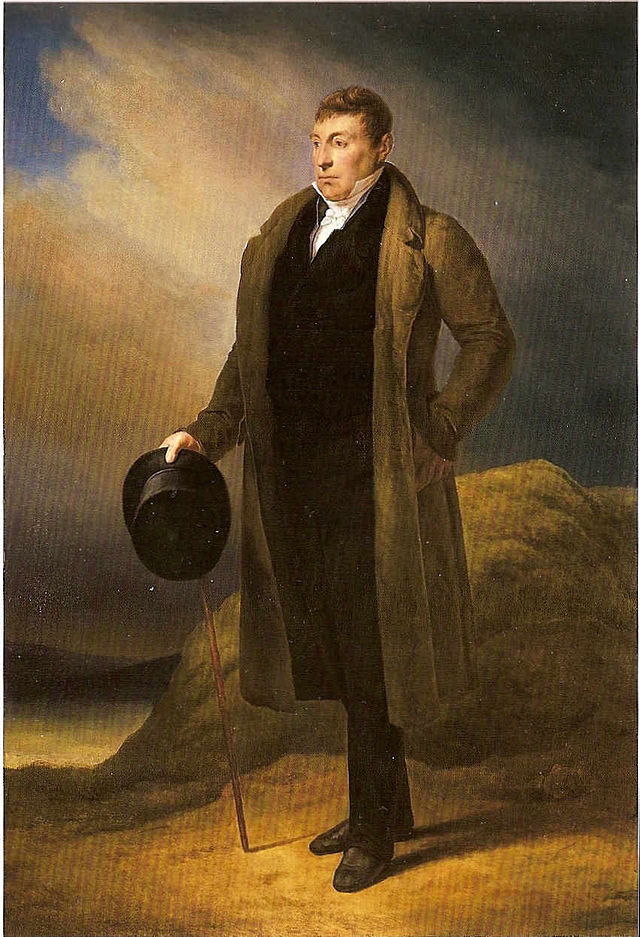
Marquis de Lafayette, arrived in Charleston and enjoyed three days of balls and reunions while here.
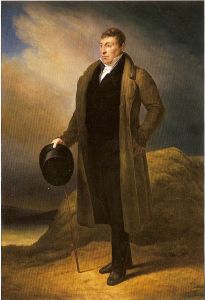
Lafayette portrait, 1824, which hangs in the U.S. House of Representatives

1824 Lafayette portrait, which hangs in the U.S. House of Representatives

William Seabrook, an Edisto plantation owner and planter, invited him to be his guest on Edisto. Lafayette accepted his invitation. William Seabrook met the steamboat that brought Lafayette from the city at the mouth of the creek leading to his plantation. He carried him the rest of the way in his personal smaller steamboat. The slaves rolled out a red carpet for Lafayette to walk ashore upon his arrival at the dock.

That evening they had a lavish dinner. While waiting in the ballroom for other guests to arrive William Seabrook placed his infant daughter in the arms of Lafayette and requested that he name her. Lafayette said that he would call her “Carolina” for the state, and said he would consider it an honor to add Lafayette for himself. The reverend in attendance christened the baby “Carolina Lafayette.”

Today In Charleston History: March 14  

1699

Peter Girad wrote that there were 195 French Protestants in Charles Town.

1740 – Religion
George Whitefield

George Whitefield

Rev. George Whitefield warned that God had been:

Contending with the people of South Carolina … for two years with disease, the Stono Rebellion … God has quarreled with you, for your abuse of and cruelty to the poor negroes.

While in Charlestown he conducted public services that disregarded the Book of Common Prayer, an offense against the church of which he was a licensed minister. Rev. Alexander Garden called on him to explain his offense.

1767

Daniel Moore, new customs collector, was determined to use the position to increase his personal wealth. He increased collection fees, strictly enforced the coastal trade regulations and colluded with customs searcher, George Roupell, to “set a new standard for rapaciousness.” This angered many of the local merchants, including Henry Laurens who organized the merchants in an attempt to isolate the Royal officials.

Today In Charleston History: March 13

1826

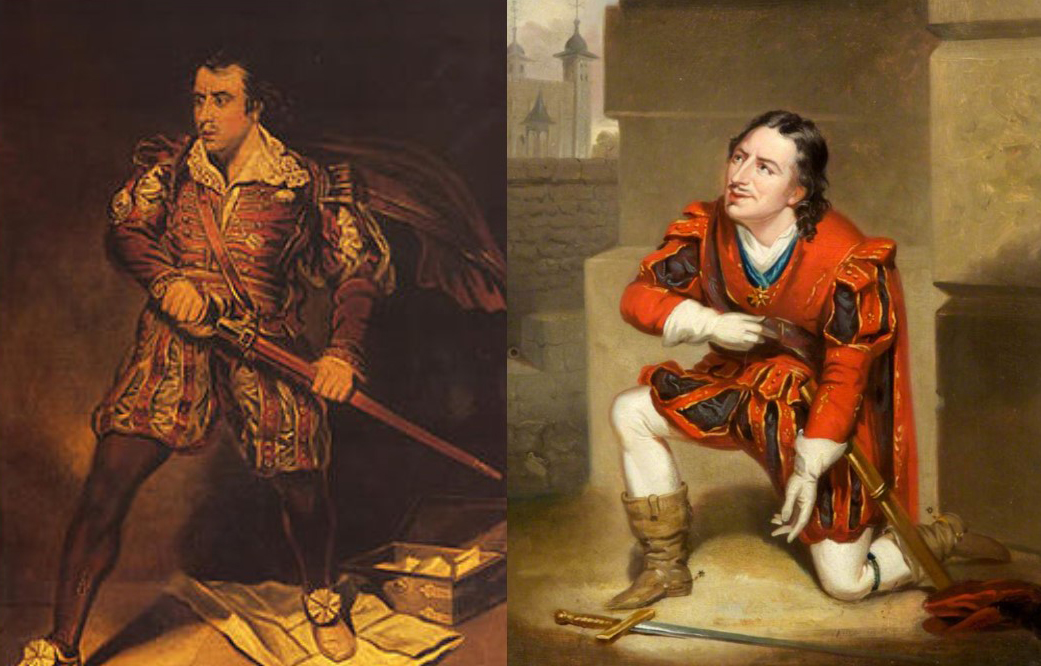
Edmund Kean, Junius Booth’s great rival in the Shakespearian world, played King Lear, Othello, and Richard III in Charleston. He was touring America due to his scandalous affair with the wife of a London city councilman which resulted in Kean’s wife leaving him. That created such a furor that he was forced to leave England for America to allow the scandal to cool down.

Edmund Kean

Edmund Kean

1834   

Charleston City Council approved the line of the Charleston & Hamburg Rail Road to be extended into the city, with a new depot built at Mary Street, between Meeting and King Streets.