Today In Charleston History: October 31

1769 – Slavery

 The Sally brought slaves to Charlestown. Henry Laurens wrote:

A third poor pining creature hanged herself with a piece of small vine which shows her carcass was not very weighty … who that views the above Picture can love the African trade?

Laurens rationalized his role as a slave trader using what was to become a tried and true Charleston excuse – tradition.

These Negroes were first enslaved by the English … I was born in a Country where Slavery had been established  by the British Kings & Parliaments … I found the Christian Religion & Slavery growing under the same authority … I am not the Man who enslaved them, they are indebted to English men for that …

African American History Slave Ships


Today In Charleston History: October 30

1629

Sir_Robert_Heath_(State_2)Charles I granted the American territory between the thirty-one- and thirty-six-degrees north latitude to Sir Robert Heath. This land included everything from Florida to the present Cape Fear River and included the Bahamas. The charter was never used. Heath was impeached by Parliament for high treason in 1644. He fled England and died in Calais.

1765, October 30. Stamp Act.  

Attorney Richard Hutson complained that many locals were indifferent, yet they praised the “laudable example of the northern provinces in endeavoring to repel the manifest encroachments on their liberty.”

1935, October 30.

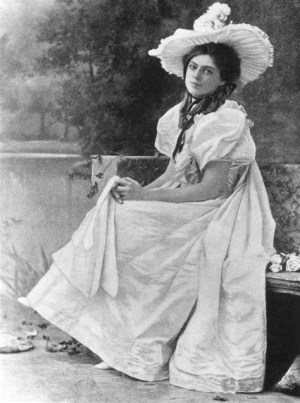
Ethel Barrymore appeared at the Academy of Music in Somerset Maughn’s The Constant Wife.

ethel barrymore

Ethel Barrymore

Today In History: October 29

1717 -Bloodless Revolution

Governor Robert Johnson met with the Assembly for the first time. As the representative of the Proprietors, he was not warmly received. The lack of assistance the Proprietors offered during the Yemassee War had soured the people’s opinion. Judge Nicholas Trott and Col. William Rhett, Speaker of the Assembly, were the two most powerful men in colony, more respected than the Proprietors.  Johnson, however, knew that former Governor Craven was in London seeking a path to make South Carolina a Royal Colony. During his address to the Assembly Johnson said:

I am obliged for your sakes to give you my opinion touching the disrespectful behavior that has of late been shown to the Lords Proprietors … very unjustifiable and impolitic. If it be supposed their character is a bar to your relief, it is a mistake. His Majesty and his Parliament are too just to divest their Lordships of their properties without a valuable consideration.

1824 – Deaths

Charles Pinckney

Charles Pinckney died. In his will, Pinckney stated that his body be laid out until decomposition began – a common practice to avoid the possibility of being buried alive. However, against his wishes, the funeral was held the next day and he was buried at St. Philip’s graveyard.

His will also freed eight slaves, Primus, Cate, Betty, and Dinah, as well as Dinah’s children –Anthony, John, Peneta and Carlos. He directed that the four children be “suitably maintained and bound out for trades.” Dinah was a “washerwoman” who seemed special to Pinckney. It was openly speculated that the freed children were Pinckney’s own with Dinah. Particularly in the light of Pinckney’s service in Spain and two of the children having Spanish names, including one named Carlos, the Spanish version of Charles, that speculation seems likely. 

1924 – The “Charleston” Debuts on Broadway

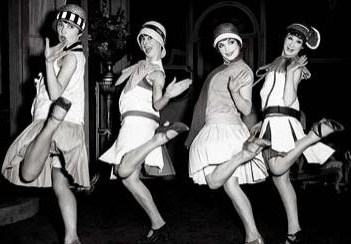
16. charleston (runnin' wild)_edited-1Flournoy Miller and Aubrey Lyles introduced their second Broadway show Runnin’ Wild with songs by James P. Johnson and Cecil Mack. The choreographer, Elida Webb, later falsely claimed to have invented the “Charleston” dance. Yet, the first act of Runnin’ Wild ended with the “Charleston” performed by Elizabeth Welsh, backed by a group of chorus boys called the “Dancing Redcaps.”

James Weldon Johnson wrote when the dance was introduced in Runnin’ Wild:

They did not wholly depend upon the orchestra – an extraordinary jazz band – but had the major part of the chorus supplement it with hand and foot patting. The effect was electrical and contagious. It was the best demonstrating of beating out complex rhythms I have ever witnessed; and, I do not believe New York ever before witnessed anything of just its sort.

Roger Pryor Dodge, in his book Hot Jazz and Jazz Dance says:

The famous single-step, the Charleston, suggests the rhythm 4/4 but does not explicitly state it. The Charleston rhythm … pervades all music, and for our purposes is predominant in ragtime. Nevertheless the Charleston rhythm had not, up to the time of James P. Johnson’s composition “Charleston” become unmistakably identified. While ragtime sheet music and piano rolls are records of the past, the elusive elements of the dance are lost. Whether the dancers actually used a Charleston rhythm before James P.’s piece I do not know. Since that time and with the help of a music strongly accenting this rhythm, the dancers still do not actually follow it, but give the impression that they do only because we associate the step with a music having this rhythm. Maybe James P. made point of constantly holding to this rhythm because of the impression he got from the dancers, or very likely with the music in a slower tempo some dancers did more than just give an impression of the rhythm and did accent it. Certainly the dance was not evolved to fit James P.’s composition; rather, James P. derived his music from his impression of the dancers, with the possibility that some of them actually may have followed the musical rhythm. Thus our visual impression of the step is influenced by the Charleston rhythm in the music so that whatever the dancer is doing we assume he is still following the musical rhythm.

The Charleston dance step may have a longer history than most think. The Branle of 1520 is presumed by most dance scholars to be similar to the Charleston. Dance historians speculate the Ashanti People of Africa were the originators since some of their tribal dances incorporated what could be viewed as Charleston-style steps and movements.

But Willie “the Lion” Smith in his autobiography mentions a black Charleston dancer named Russell Brown:

His dance was a Geechie step like those I had seen in “The Jungles” [a name often used in the 1910s for the San Juan Hill District of New York]. He was given a nickname by the people of Harlem . . . they would holler at him, “Hey Charleston, do your Geechie dance!” Some folks say that is how the dance known as the Charleston got its name. I’m a tough man for facts, and I say the Geechie dance had been around New York for many years before Brown showed up. The kids from the Jenkins Orphanage Band of Charleston used to do Geechie steps when they were in New York on their yearly tour.

It can safely be accepted that the origins of “the Charleston” are most likely a combination of all of the above, particularly the line that runs from the Ashanti African tribal dances directly to the southern plantations of the 18th and 19th centuries. What cannot be denied is that by the end of 1923, everybody in the country was doin’ the Charleston.

Nothing else epitomizes the spirit and joyous exuberance of one the most tumultuous decades in American history as the Charleston dance. Other dance crazes have had their fifteen minutes of fame: the Waltz, Tango, Hokey-pokey, Twist, Hustle, Macarena, and Breakdancing. None of them, however, managed to influence and infect an entire generation so thoroughly the way the Charleston did. Almost 100 years later, the image of the Jazz Age is always a Flapper doing the Charleston. No other American decade can be so neatly summed up in one simple image.

blogue-charleston - Copy

From the book Doin’ the Charleston: Black Roots of American Popular Music & the Jenkins Orphanage Legacy

doin' the charleston

Today In Charleston History: October 28

 1736

First Masonic Lodge in Charlestown was organized under a warrant issued by Lord Weymouth of England, Grand Master of the Ancient and Honorable Society of Free and Accepted Masons. An announcement in the Gazette said:

Last night a Lodge of the Ancient and Honorable Society of Free and Accepted Masons, was held, for the first time, at Mr. Charles Shepheard’s, in Broad Street, when John Hammerton, Esq., Secretary and Receiver General for this Province was unanimously chosen Master, who was pleased to appoint Mr. Thomas Denne, Senior Warden, Mr. Tho. Harbin, Junior Warden, and Mr. James Gordon, Secretary.

sheapheard's tavern2

Shepheard’s Tavern (corner of Broad & Church Streets), circa 1740s; In the distance on the left hand corner can be seen St. Philip’s Church

1752

Gov. Glen proposed a plan for repairing and improving the city’s fortifications. He claimed the defenses were “piece-meal” and suggested the hiring of a “regular Engineer.” Without consulting the Assembly, Glen hired German-born engineer William De Brahm.

1765 – Stamp Act

Due to political pressure and threats of violence, George Saxby and Caleb Lloyd, stamp officer and stamp distributor, publically promised not to perform their duties.

Lt. Gov. Bull called the Gazette the “Conduit Pipe of northern propaganda … poisoning the minds … against the Stamp Act.” In an effort not “to directly support and engage in the most violent Opposition” Peter Timothy temporarily suspended the publication of the South Carolina Gazette.

1790   

Charleston City Council passed an ordinance that established the Charleston Orphan House. Until a structure could be built Mrs. Elizabeth Pinckney provided a building on Market Street, close to the Sailors’ Homes, for children too young to be bound out.

Today In Charleston History: October 27

1775

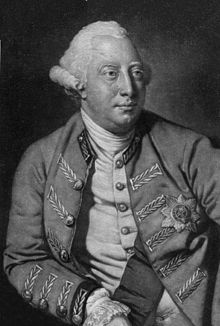
King George III declares the American colonies to be in open rebellion, due to traitorous behavior. He stated:

Many of these unhappy people may still remain their loyalty, and may be too wise not to see the fatal consequence of this usurpation, and wish to resist it, yet the torrent of violence has been strong enough to compel their acquiescence, till a sufficient force shall appear to support them.

220px-George_III_Zoffany

Today In Charleston History: October 26

1759 – French and Indian War.

Governor Lyttleton left Charlestown, marching for Fort Prince George (present-day Pickens County, South Carolina) with 1500 troops (including Christopher Gadsden) to put down the Cherokee rebellion.

Fort Prince George

Fort Prince George


1765 – Stamp Act.

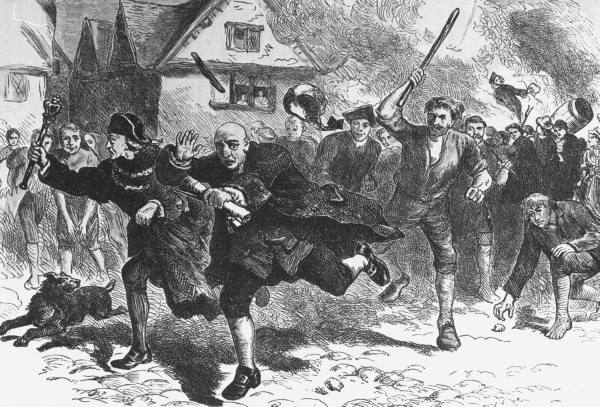
A mob of citizens marched the streets threatening to kill the two stamp agents, George Saxby and Caleb Lloyd, unless they resign.

Stamp Act Rioting

Stamp Act Rioting

Today In Charleston History: October 25

1718 –Piracy  
col rhett and bonnet

Col. Rhett and Stede Bonnet

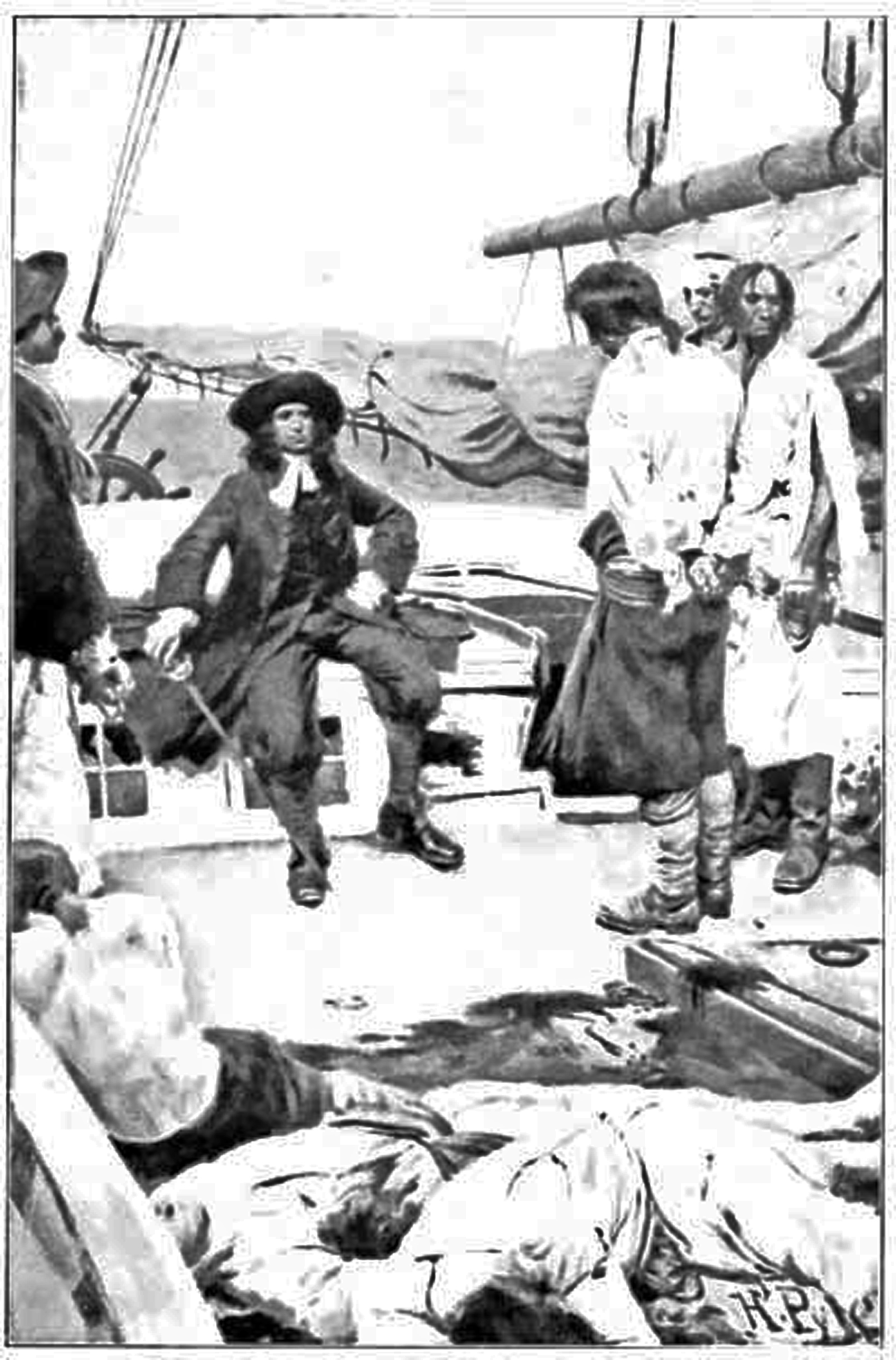
Some local merchants were nervous about the recently captured pirate, Stede Bonnet. They were afraid his testimony at his trial may link them to the buccaneer’s trade. Due to the lax security (and most likely a bribery of gold by merchant Richard Tookerman) at Capt. Partridge’s home, Stede Bonnet and David Herriot escaped. Bonnet disguised himself as a woman to escape undetected.

Accompanied by a slave and an Indian, they stole a small boat and planned to leave the harbor under cover of night and rendezvous with Moody’s ship, Cape Fear.  However, foul winds and lack of supplies forced the four of them onto Sullivan’s Island., where they cowered. Gov. Johnson at once placed a £700 bounty on Bonnet’s head and dispatched search teams to track him down, led by Col. William Rhett.


1757-Births

Charles Pinckney, son of Charles Pinckney, Junior and Francis Brewton Pickney, and cousin to Charles Cotesworth Pinckney, was born in Charlestown. He would later sign the U.S. Constitution with his cousin.

Charles Pinckney

Charles Pinckney

Today In Charleston History: October 24

1671

 The Grand Council appointed a group of citizens to “examine the banks of the Ashley and the Wando, or Cooper River, and to make a return of what places might be most convenient to situate towns upon.” It was an order to begin the surveying of Oyster Point.

1808

The cornerstone of the Charleston Homespun Company was laid at the west end of Wentworth Street – the first manufacturing company incorporated in Charleston. 

1824 – Births

 Susan Dupont Petigru was born, the youngest of four children. She was raised in her family’s Broad Street house, at the center of Charleston’s elite business and social district. Sue attended school first at Madame Talvande’s French School for Young Ladies in Charleston, along with classmate Mary Boykin Chesnut, and later at Madame Binsse’s in Philadelphia. At Talvande’s, in particular, she received a heavy dosage of French, the required language for both instructional and social dialogues, but she also studied chemistry, botany, astronomy, literature, rhetoric, German, art, dancing, and music. 

Her marriage to Henry King was unhappy and in 1861 the couple was separated. Due to laws at the time, divorce was not an option. When Henry was killed in 1862 at the Battle of Secessionville, Sue donned “widow’s weeds”  but her cousin Carey North said that Sue had to “act considerably in doing so.”

She became a fiction writer and novelist. Her work, which included Busy Moments of an Idle Woman (1853), Lily: A Novel (1855), Sylvia’s World: Crimes Which the Law Does Not Reach (1859), and Gerald Gray’s Wife (1864), focused on subversive portrayals of South Carolina aristocracy, in which men toyed with women’s affections, women plotted against one another’s best interests, and mothers forced daughters to choose wealth over romance.

In December 1863 Sue moved to Columbia, S.C. where she was determined “to make herself notorious during the sitting of the Legislature,” at which she succeeded.Sue dressed in lavish outfits of bright coloring, equipped with the finest accouterments her meager estate could provide. Her flirty behavior attracted the attention of a number of young soldiers and married officers from the Confederate army. Later in 1865, Sue was seen cavorting with victorious Yankees in Charleston, to which one gentleman responded: “There goes Mrs K driven by a Yankee thief in my uncle’s Stolen Buggy.”

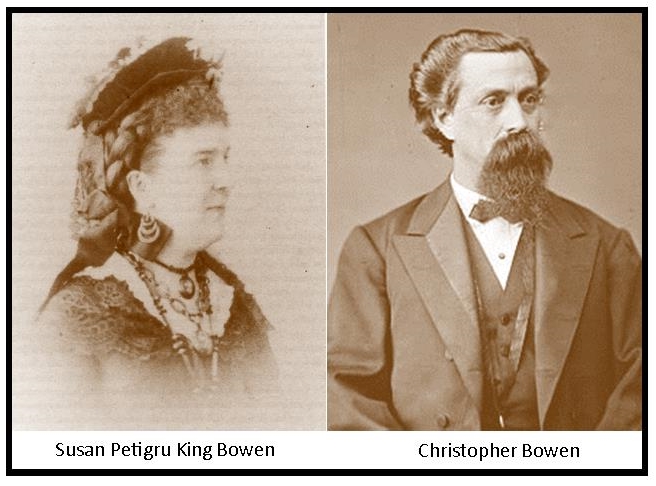
However, it was in 1870, while working as a foreign-language clerk in Washington’s Post Office Department, that Sue committed her most scandalous and damning public affair – her marriage to Radical Republican and carpetbagger Christopher Columbus Bowen. Eight years her junior, Bowen was even more notorious than Sue.  Born in Rhode Island, Bowen eventually moved to Georgia, where he volunteered for the Confederate cavalry, after being threatened with conscription. He was court-martialed and dishonorably discharged for forging a commanding officer’s signature on a furlough pass to gamble in Charleston and Savannah, Bowen hired a fellow soldier to murder the officer, for which he was arrested and imprisoned in Charleston. While Bowen was awaiting trial, the city of Charleston was successfully invaded by Union forces and Bowen, among other prisoners, was released. He then began working for the Freedmen’s Bureau, which he was fired from shortly thereafter for “irregularities in his accounts.” Afterwards, he began acting as a pro-bono lawyer for newly freed slaves, and the connections he developed allowed him to become first a Republican delegate to South Carolina’s 1868 constitutional convention, and later the elected representative of its first congressional district.
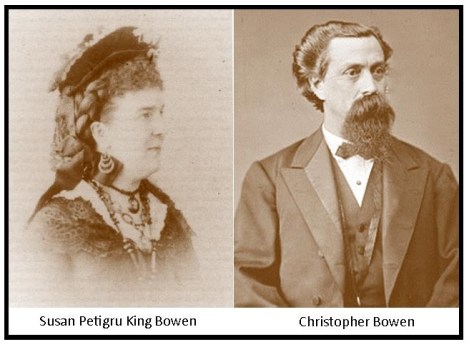
sue king

In 1871, after marrying Sue, Bowen was arrested and tried on charges of bigamy brought by two former wives, one of which owned several brothels and was later convicted as a serial killer. Sue deftly and adamantly defended her husband both in court and in public, writing to one Washington newspaper that she knew:

“that he had been an orphan boy, without relations or friends; had drifted into the company of gamblers and prostitutes, and had lived their life until it had pleased the good god to lift him from the mire.”

Bowen received a two-year prison sentence and a $250 fine, but Sue appealed to President Ulysses S. Grant, who eventually offered Bowen a full pardon. Bowen was reelected to Congress in 1872, but an investigation by the House of Representatives deemed both his and his opponent’s campaigns too corrupt to be officially recognized. Yet Bowen had also been elected as sheriff of Charleston County, a position he would hold until Sue’s death in 1875.

Today In Charleston History: October 23

1704 – Religion

 Francis Simonds, a widow, donated a plot of land for the construction of a dissenting church building, the White Meeting House – the site of the current Circular Church on Meeting Street.

1754 – Births

t. pinckneyThomas Pinckney born in Charleston, second son of Charles and Eliza Pinckney.

1764 – Stamp Act

 A masked and armed mob (probably members of the Sons of Liberty) of “about 60 to 80” marched on Henry Laurens’ house at midnight, suspecting that he held the stamps. Lauren’s coolness toward the Patriot cause made him suspicious in the eyes of the public. The mob held “a brace of cutlasses across my breast” and for the next hour the house was searched.  Laurens was amazed by the lack of damage to his house:

Is it not amazing that such a number of Men many of them heated with Liquor & all armed with Cutlasses & Clubbs did not do one penny damage to my Garden not even not even to walk over a Bed & not damage to my Fence, gate or House?

1830

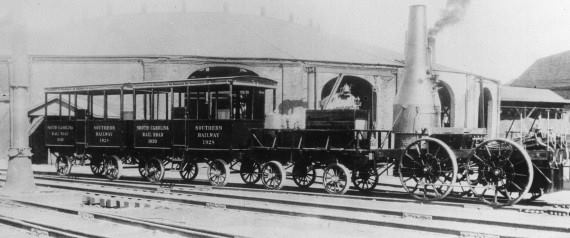
 The Best Friend arrived in Charleston on the freighter Niagra, in parts, and was taken to the shop of Thomas Dotterer where it was reassembled.

best friend

The Best Friend

Today In Charleston History: October 22

1774

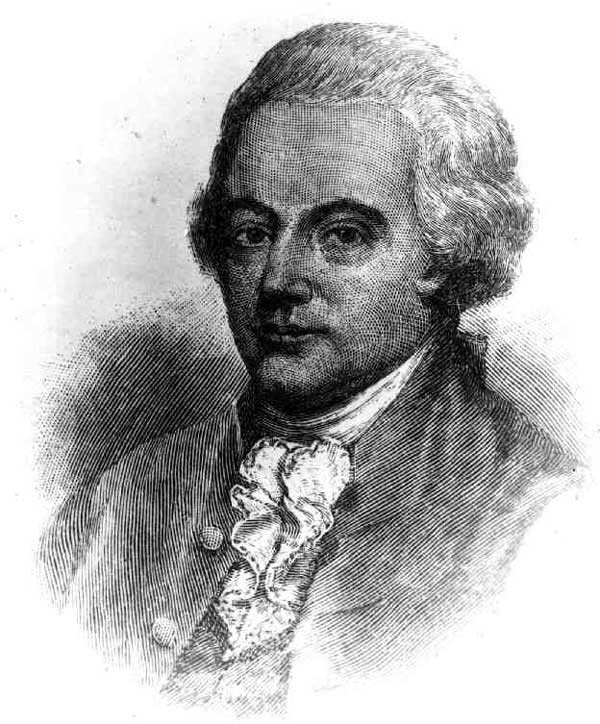
Henry Middleton served as second president of the Continental Congress.

1862 – Civil War

Gus Smythe enlisted in the Signal Corps in Charleston and reported to Capt. Joseph Manigault. He wrote to his Aunt Janey:

I have not yet been assigned to any station, but trust to be kept at the Bathing House [South Battery] … As to accommodations, they are MUCH better than in camp, as we (in town) all stay in houses …


View of Charleston from Ft. Wagner

View of Charleston from Ft. Wagner

1925 – Doin’ the Charleston

One of the clubs that challenged the Cotton Club in popularity was Small’s Paradise. Ed Smalls was born in Charleston and moved to New York as a young man. Charleston legend claims that he was kin to the legendary Robert Smalls, an African slave who, during the Civil War, stole a steamer in Charleston harbor and delivered it to the Union navy. Untrue.

Another legend states that Ed Smalls was also related to the notorious Sammy Smalls, “Goat Cart Sam,” a crippled beggar who was often seen drunk on the streets of Charleston being pulled around in a goat cart. Sam usually frequented gambling saloons and whorehouses. “Goat Cart Sam” was about to become a legendary and universal character known as Porgy, the title character of Dubose Heyward’s lyrical novel of black life in Charleston. Also untrue.

Ed Smalls opened Small’s Paradise on October 22, 1925. It was housed in a large basement at 2294½ Seventh Avenue at 135th Street and could accommodate 1500 patrons. It offered extravagant floor shows and the Charlie Johnson Orchestra played the hottest jazz music in Harlem. The Paradise also featured a slew of flamboyant, Charleston-dancing gay waiters who served Chinese food and bootleg liquor to the small tables. During those early years, the Charlie Johnson Orchestra featured two former Jenkins Orphanage trumpet players: Gus Aiken and Jabbo Smith, who had just recently “escaped” from the orphanage.

smalls

Smalls Paradise, New York City. Author’s Collection