Today In Charleston History: September 6

1876 – Race Riots

During the evening six black Democrats who were supporting Gen. Wade Hampton’s campaign for South Carolina governor held a political rally in Archer’s Hall at the corner of King and George streets. They publicly called Republicans “thieves” for robbing the state of South Carolina. 

Marion Square, c. 1870

Marion Square, c. 1870

After the meeting a group of black Republicans attacked the Democrats and their white companions near the Citadel green (Marion Square). Several gun shots were fired, drawing more people to the park … during the night and the next day, a riot escalated until more than 1000 people were roaming the streets in mobs. The New York Times reported that

Blacks roamed upper King Street from midnight to sunrise, breaking windows, robbing stores, and attacking and beating indiscriminately every white man who showed his face.

More than 100 people were hurt – one white man was shot and killed, and a black man died of his injuries. 


Today In Charleston History: September 5

1713 – Disasters.

A hurricane hit Charles Town.  Rev. William Livingston, pastor of the White Meeting House, survived the storm from his house on White Point. He wrote that the storm “beat off the weatherboards of the house, carried away the book that contained the church records and the furniture of the rooms on the lower floor.”

Thomas Lamboll recorded:

On September 5 came on the great hurricane which was attended with such an Inundation from the sea and to such an unknown height that a great many lives were lost; all the vessels in Charleston harbor, except one, were drove ashore. The new Look-out on Sullivan’s Island, of wood, built eight square and eighty feet high, blown down; all the front wall and mud parapet before Charlestowne underminded and washed away.

1774

The Continental Congress opened in Philadelphia. John Adams wrote some observations about the South Carolina delegates in his diary:

  • John Rutledge: “No keenness in his Eye. No depth in his Countenance. Nothing of the profound, sagaciousness, brilliant or sparkling.”
  • Edward Rutledge: “a perfect Bob o’ Lincoln, a Swallow, a Sparrow, a Peacock, excessively vain, excessively weak.”
  • Christopher Gadsden: “Is violent against allowing Parliament any Power of regulating Trade, or allowing that they have any Thing to do with Us.”
1836
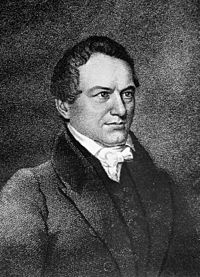
Robert_Y_Hayne

Robert Hayne, 1st mayor of Charleston

Robert Y. Hayne elected the first mayor of Charleston … previously, the office was called “the Intendent.”

THE GHOST: A Review

Almost every other review of this book makes reference to it’s roman a clef nature – the main character Adam Lang is a thinly veiled portrait of former British Prime Minster, Tony Blair. They go on and on about the clever plot and dialogue and point out all the parallel political tidbits. But, I don’t give a damn about the political nature of the story. No one ever points out the major glaring error which forced me to literally THROW THIS BOOK ACROSS THE ROOM and say “Screw you, Mr. Harris, be a better writer.”Ghost_cover_scan_

A quick summary: Former British prime minister Adam Lang (modeled on Tony Blair) is up against a firm deadline to submit his memoirs to his publisher, and the project is dangerously derailed when his aide and collaborator, Michael McAra, perishes in a ferry accident off the coast of Martha’s Vineyard. To salvage the book, a professional ghostwriter is hired to whip the manuscript into shape, but the writer, who is never named, soon finds that separating truth from fiction in Lang’s recollections a challenge. The stakes rise when Lang is accused of war crimes for authorizing the abduction of suspected al-Qaeda terrorists in Pakistan, who then ended up in the CIA’s merciless hands. As the new writer probes deeper, he uncovers evidence that his predecessor’s death may have been a homicide and begins to fear for his own life.

Okay, sounds fine. The book opens with the ghostwriter meeting with the publishers and taking on the job of finishing the Prime Minister’s memoirs. He has one month to take the unreadable manuscript and turn it into something salable. It will be his largest pay day ever – $200,000 for four weeks of work. The writer has made a decent living churning autobiographies of rock stars, celebrities and sports figures, but this assignment is the opportunity of a lifetime.

He also has to sign a confidentiality clause and is under strict guidelines as how and where he can work on the manuscript. He can only work on the manuscript at the palatial house on Martha’s Vineyard where the PM and wife are living. He cannot discuss the manuscript with anyone. He cannot make copies. His laptop on which he is writing and editing the book, cannot leave the mansion. The writer has no problem with that … hey, he’s making $200,000 to basically re-write a completed manuscript.

So what does this idiot do? On page 98, after an interview session with the PM, the writer e-mails a copy of the manuscript to himself so he can work on the book at night while he’s in his hotel room. That was the moment when I tossed this book. The only reason for this idiotic action was to give the novel its plot. Who cares if it goes against everything we have learned about the character? It’s the plot that counts.

And another thing: if it was so important for the manuscript to stay secret until publication why in the hell is the writer staying at a deserted hotel in off season Martha’s Vineyard? Why wasn’t the writer sequestered in the mansion with the PM and wife and staff and secret service? Why? Because then, there is no plot.

“Screw you, Mr. Harris. Be a better writer.”

1 palmetto

SMOKE SCREEN; A Review

I live in Charleston, and try to read as many novels that use my hometown as a setting. Unfortunately, as Charleston has become the #1 tourist destination over the last 5 years, more authors are using us in their fiction. Usually with bad results.

smoke screenThis book is awful. One of the clues that you’re reading a poorly written (re: poorly designed plot) is when all the characters spend A LOT of time at the end explaining the story. It’s the writer’s job to get that information to the reader without the clunky conclusion of endless explanations. We are no longer living in the age of Agatha Christie.

Brown seems to have studied Charleston via Google maps for her location descriptions. And, by the way … seems like she was reaching for a little bit of Carl Hiaasen feel at the beginning by creating an eccentric and wacky hermit (Delno Pickens) living in the marsh, but for no reason except local color. Pickens has NOTHING to do with the story. 

That being said: the plot is something about a fire and city corruption blah … blah … blah. Pretty sure that producers of the CBS show “Reckless” (also based in Charleston) must have read this novel for research.

1 palmetto


Today In Charleston History: September 4

1666

William Rhett was born in London, during the Great Fire.  Thirty-two years later he would move to Carolina and become one it’s most prominent citizens.

1700 – Hurricane!

A fierce hurricane hit Charles Town causing extensive damage to the waterfront fortifications being constructed and destroying the Rising Sun, killing its 200+ crew and passengers. Stobo viewed the event as God’s judgment. He wrote that “the ship’s crew were so filled with wickedness that they could hold no more; they were ripe, they must be cut down with the sickle of His wrath.”

Edward Hyme, a newly arrived immigrant, described the catastrophe to his wife in England:

On Tuesday September 3 here happened a most terrible Storm of Wind or Hurricane with continual Rain; which has done great Damage to ye Country. Thousands of Trees have been torn up by ye Roots, many Houses blown down & more damnified; much Rice Corn & c spoiled; but ye greatest Mischief fell amongst ye Shipping of which about a Dozen Sail (of all sorts) were riding at Anchor before ye Town, some of which were driven on Shoar & broke all in Pieces, some were carryed a great Way up into ye Two Rivers into Ashley River, in her way breaking down a Pair of Gallows (from which 8 Pirats at once were hanged since my coming here) some were turn’d Bottom upwards & lost. but ye greatest and most deplorable loss of all was that to a great Scotch Ship called ye Rising-Sun, which having lost all her Masts in a Huricane in ye Gulf of Florida was riding at Anchor with out our Bar, wth Designe to come in here & refit; but being a Ship of 800 tons & 60 guns she durst not venture in with out lightening to which Purpose One Sloop has already been on board her, but waiting for another, ye Storm rise & she foundred at Anchor, ye Captain (Gibson) & all ye souls on board (being about 100) misearbly perishing…

Rev. Stobo settled in Charles Town and became renowned for his oratory skills, with sermons lasting more than four hours. Church officials asked that he divide his sermons into two sessions so that members could break for dinner. Stobo refused, claiming that Charleston’s spiritual reservoir needed filling. The next Sunday, Solomon Legare left the service at the two hour mark. Rev. Stobo called out, “Aye, aye, a little petcher (pitcher) is soon full!” Legare called back, “You’ve said enough to fill all the cisterns in Charlestown.”

1766 – Stamp Act.

Thomas Lynch, Christopher Gadsden and John Rutledge sailed for New York on the Carolina Packet to attend the Stamp Act Congress. At age twenty-six, Rutledge was the youngest delegate in attendance.

1786 – Births. Slavery
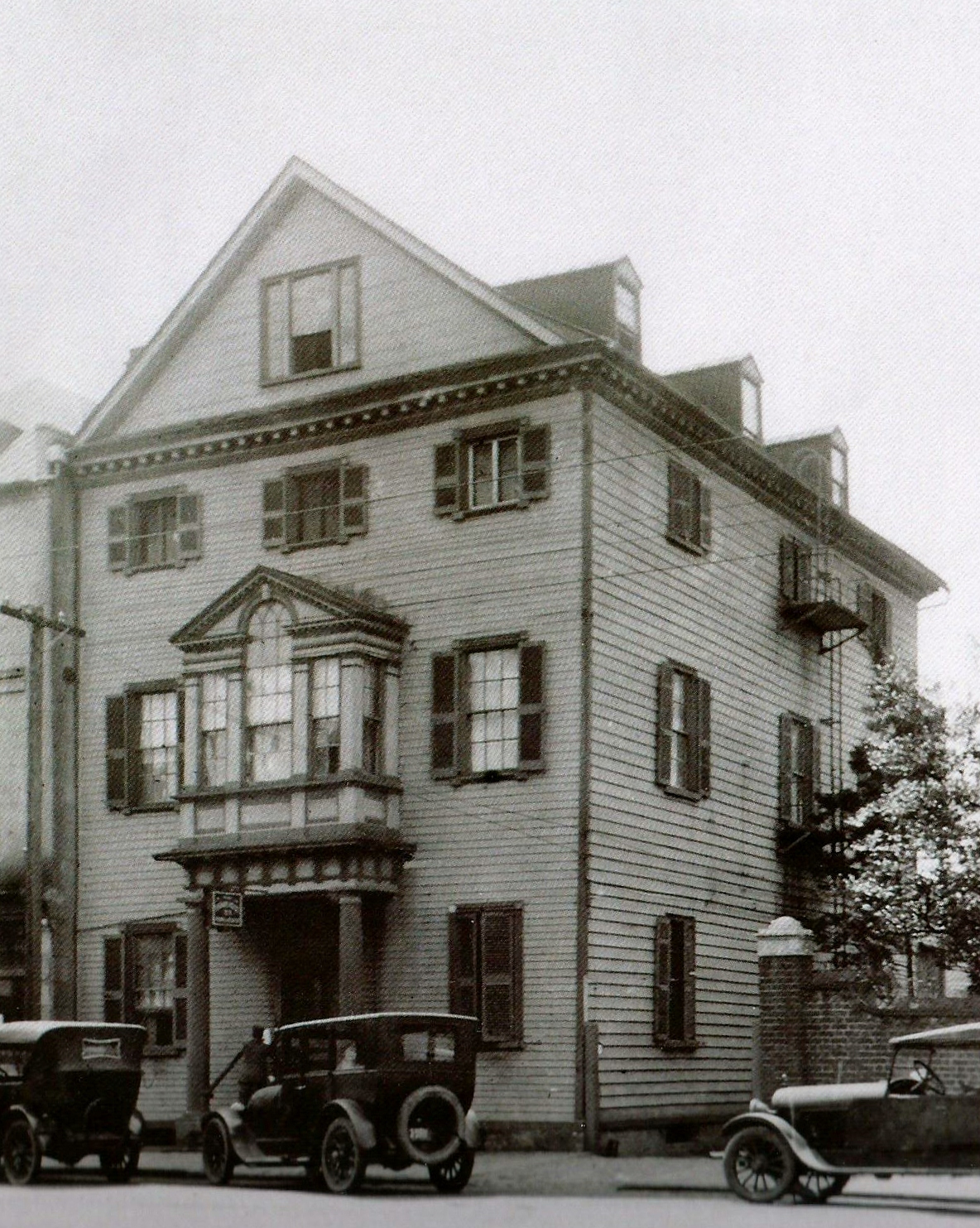
IMG_0077

The building that once housed Jehu Jones’s hotel on Broad Street.

Jehu Jones, Jr., a mulatto, was born in Charleston as a slave. He would later become a successful tailor and gain his freedom in 1798. He operated a successful hotel on Broad Street (next to St. Michael’s church) for many years. 

1886

In one of the stranger events, a shower of warm stones fell from the sky on the offices of the News and Courier – twice! The shower of stones occurred at 7:30 a.m. and the second shower at 1:30 p.m. Coming four days after the devasting earthquake, this event increased the unease of a shocked population. 


Today In Charleston History: September 3

1700 – Religion.

The Rising Sun arrived from Scotland, with several hundred Presbyterians, led by Rev. Archibald Stobo. Members of the White Meeting House met Rev. Stobo and invited him ashore to preach the next day. Stobo, his family and twelve other passengers disembarked.

1749 – Religion.
KK BETH ELOHIM, 1812 John Reubens Smith

Kahal Kadosh Beth Elohim, c. 1812 by John Reubens Smith. Note: This building was destroyed by the 1838 fire but the smaller building pictured in the drawing survived and stands today on Hassel Street.

The first Jewish meeting in Charlestown took place. According to Jewish practice there must be a minyan, or ten males over the age of thirteen, for services to take place. They adopted the name Kahal Kadosh Beth Elohim – holy Congregation of the House of God. They used a small wooden house on Union Street (now State) for their worship services until 1750, when the purchased land on Hasell Street. 

1780 – Laurens Captured

During Henry Laurens’ return voyage from the Netherlands, the British frigate Vestal intercepted his ship, the continental packet Mercury, off the banks of Newfoundland. Laurens tossed his dispatches overboard, but they were retrieved by the British, who discovered the draft of a possible U.S.-Dutch treaty, prompting Britain to declare war on the Netherlands. The British charged Laurens with treason and transported him to England for trial.

1783 – Treaty of Paris

Treaty of Paris was signed by Benjamin Franklin, John Jay and John Adams. Henry Laurens of Charleston, who had participated in the negotiations for the Americans, left Paris before the signing ceremony. In a letter to his wife Abagail, John Adams stated:

I have the Satisfaction to inform you that the definitive Treaties were all Signed yesterday, and the Preliminaries with Holland were Signed the day before. Dr. Franklin has fallen down again with the Gout and Gravel … Mr. Laurens , has a Brother declining, so that he will go to the south of France, untill he knows his Brother’s Fates.

1820 – New Intendent

James Hamilton was elected Intendent (mayor) of Charleston.

Today In Charleston History: September 2

1706 – Queen Anne’s War

A joint French and Spanish attack upon Charles Town  is repulsed when English Colonial forces capture a French vessel. Governor Nathaniel Johnson and Lieutenant Colonel William Rhett lead the successful defense of Charles Town against a combined force of Spanish, French, and Native American combatants who sailed into Charleston harbor from St. Augustine..

1863 – Bombardment of Charleston

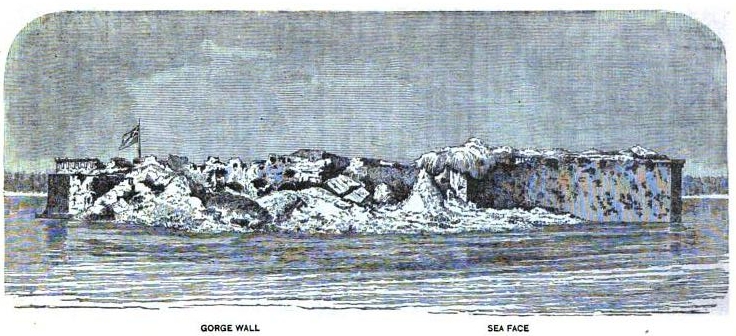
Ft. Sumter was demolished. John Johnson, a Confederate engineer, wrote:

The fort had now lost all offensive character, but it had been firmly decided by the [Confederate] general commanding to hold it in a defensive way to the last extremity.

aug24sumter21

Ft. Sumter

aug24sumter23

Ft. Sumter


Today In Charleston History: September 1

1734 

Jean Pierre Purry, wrote about South Carolina:

The Trade of Carolina is now so considerable that of late years there has sail’d from thence Annually above 200 ships … besides 3 ships of war … which had above 100 Men on Board. It appears from March 1730 to March 1731 that there sail’d rom Charles Town 207 ships … which carried … 41,957 barrels of rice about 500 Pounds Weight per barrel … besides a vast quantity of Indian corn, Pease, Beans, Beef, Pork and other salted Flesh … There were between 5(00) to 600 houses in Charles Town … most of which were very costly.

1737 – South Carolina Society
28elliott

Poinsett’s Tavern, 28 Elliott St.

The South Carolina Society was established.

Originally called the “Two-Bitt Club,” it was organized by French Huguenot artisans and forbade the use of English in the beginning. Their goal was to support indigent and widows and orphans. The met at Jacob Woolford’s Broad Street Tavern or at Poinsett’s Tavern on Elliott Street, opposite Bedon’s Alley.

The Society was incorporated by the Provincial General Assembly as the French Society on May 1, 1751, and King George II confirmed it at the Court of St. James on December 20, 1752. Soon afterward, the name was changed to the South Carolina Society and began including non-French members.

The Society purchased a block of land between George and Wentworth streets, cut a new street through it (the present Society Street), and built a school for orphan boys. 

182881_l

Society Hall, 72 Meeting St.

In 1804, the Society built the South Carolina Society Hall at 72 Meeting Street as a school for female orphans and indigents, and as a meeting place. The first floor was used to school orphans and indigents, while the second floor was a ballroom for social purposes.


1881 – Jenkins Orphanage

 Daniel Dickinson, a freed slave from Barnwell County (SC), chose the surname Jenkins to illustrate his freedom. He later moved to Charleston and established an orphanage house for “Black lambs.” 

Today In Charleston History: August 31

1706 – Queen Anne’s War

Colonel William Rhett and a fleet of six small vessels drove the French / Spanish invaders from the harbor. The English fleet was:

  • Flagship: Crown Galley
  • Galleys: Mermaid -12 guns; Richard -16 guns; William
  • Sloop: Flying Horse – 8 guns; Seaflower
1886 – Earthquake

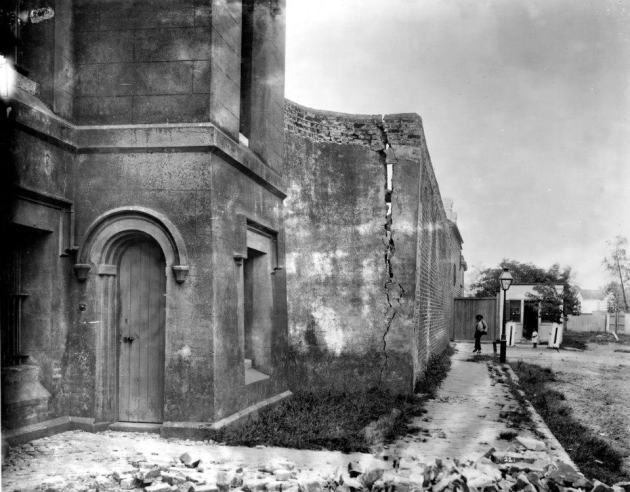
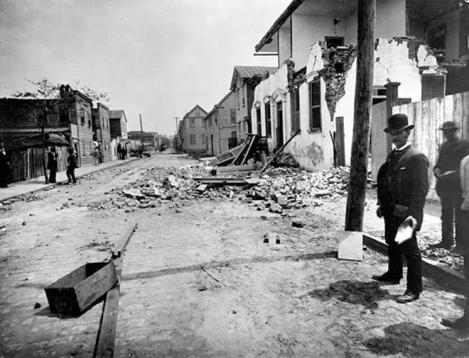
The most destructive earthquake ever recorded in the eastern United States occurred near Charleston at 9:51 P.M. on August 31st, 1886. It was one of the largest shocks in Eastern North America and was felt as far away as Boston, Chicago and Cuba. At least half of the buildings in Charleston were seriously damaged, with more than 14,000 chimneys destroyed.  Property damage was estimated at $5-$6 million (about $150-200 million in present-day). Structural damage was reported in central Alabama, central Ohio, eastern Kentucky, southern Virginia, and western West Virginia and was felt by two out of every three people living in the United States. The quake has been estimated at a 7.3 magnitude.

earthquekIn 1886 Charleston had a population of 60,145 – 27,605 whites and 32,540 blacks. After twenty years of economic depression after the Civil War, Charleston was becoming a modern city – streetcars, a paid fire department, gas works, running water in several households. There was no sewage system, and most people still got their water from wells and public cisterns.

It is a heavily studied example of an intraplate earthquake. It is believed to have occurred on faults formed during the break-up of Pangaea. Similar faults are found all along the east coast of North America. It is thought that such ancient faults remain active from forces exerted on them by present-day motions of the North American Plate. The exact mechanisms of intraplate earthquakes are a subject of much ongoing research.

eq - map

The quake occurred 21 years after the Civil War – the War that Charleston started … and lost. There were some people that thought the quake was divine retribution against Charleston’s role in starting a conflict which devastated America – more than 600,000 dead. 

The city was cut off from the outside world, all telegraph wires were destroyed. The next day, a courier rode to Summerville (thirty miles away) and reported the news of the disaster to the outside world. Rumors outside of Charleston were that the city had been swept away by a mighty tidal wave and that the Florida peninsula had snapped off from the continent and fallen into the Atlantic Ocean. 

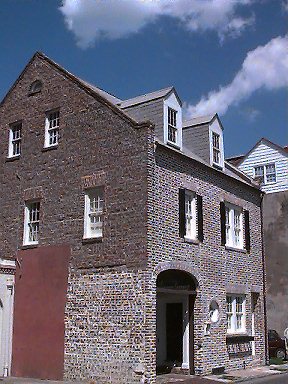
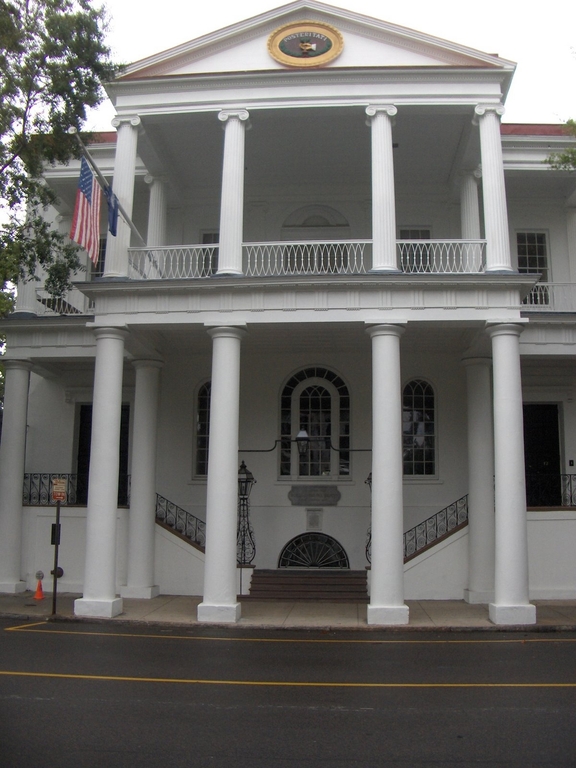
OLYMPUS DIGITAL CAMERATo repair the damaged buildings, earthquake bolts were added to existing unreinforced masonry buildings to add support to the structure without having to demolish the structure due to instability. The bolts pass through the existing masonry walls tying walls on opposite sides of the structure together for stability. One hundred and thirty years later, the buildings still stand. 

The News and Courier wrote on September 3, 1886:

“The City Hospital was badly wrecked, and it is stated that several of the inmates were killed. A number of the patients were injured. These were taken out of the building and passed the night in the open air.”

Some facts of the quake included:

  • More than 100 people were killed and almost every building in Charleston was damaged.
  • There were more than 300 aftershocks taking place over the next 3 years.
  • According to the Savannah Morning News, at least a dozen people went insane and had to be sent to lunatic asylums, including “the wives and daughters of prominent citizens.”
  • “A drugstore clerk started walking on Tuesday night and didn’t stop until he reached a town fifty miles away, where he sent a postcard to his parents saying he could not return.”
  • According to the Charleston News and Courier, three women were “frightened to death.”
  • Maine: The captain of a schooner off the coast saw “black wall” rising on the water, a mighty wave that lifted the ship to a fantastic height. The schooner was buried in a mountain of foam, its sails torn off and its mast snapped.
  • North Carolina Mountains: Flames shot from caverns, leaving behind a cloud of smoke that smelled like burning coal. Massive rocks crashed down into the valley.
  • Brooklyn, New York: A telephone operator thought he was having a heart attack when all the plugs on his switchboard popped out of their sockets.
  • Terre Haute, Indiana: At a minstrel show the galleries swayed, and one man was thrown out of the balcony; he saved himself by clinging to a railing.
  • Dubuque Iowa: The audience in the opera house stampeded, thinking the building was about to fall.

eq - city jail

eq - tradd street

eq

eq - st. mikes and guard house


To learn the entire story of the Charleston quake and it’s aftermath, read City of Heroes by Richard Cote.city of heroes

Born Today: John Locke

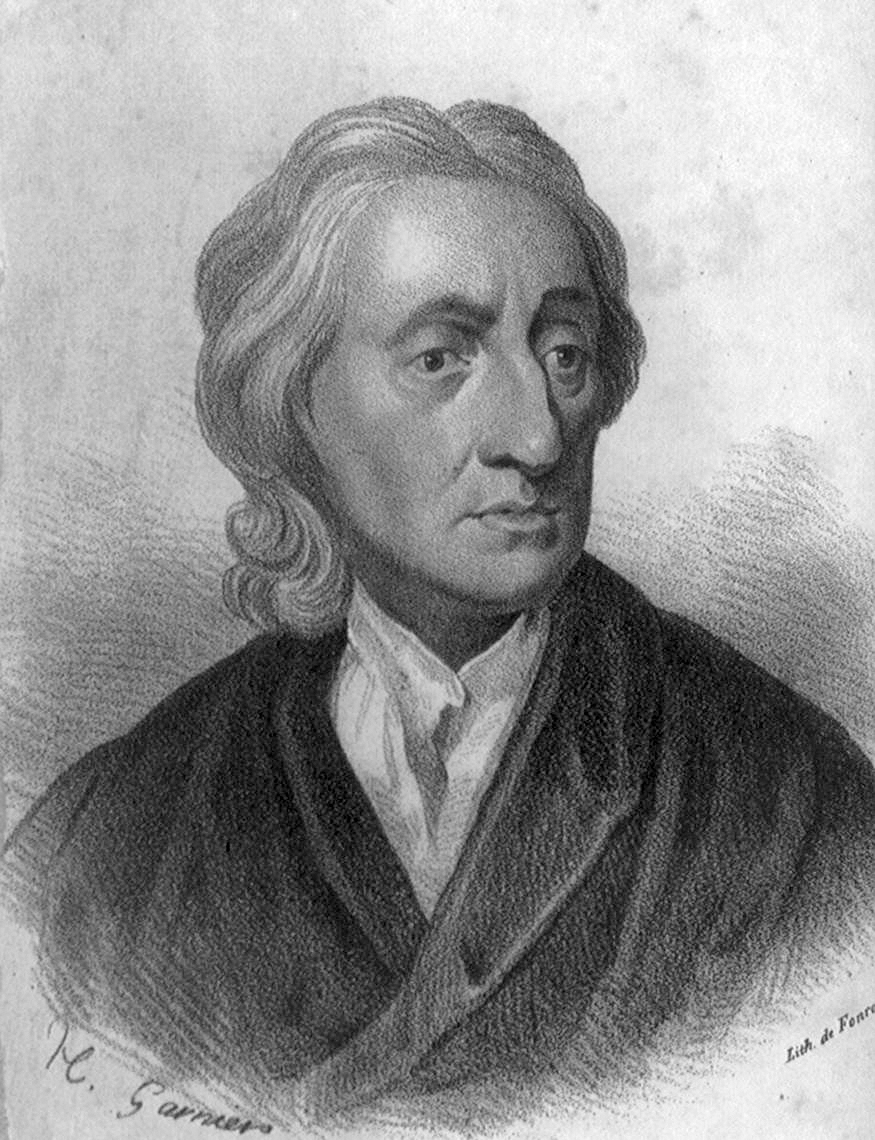
John Locke, born in Wrington, Somerset, England, He became a highly influential philosopher, writing about such topics as political philosophy, epistemology, and education. Considered one of the first of the British empiricists, his writings influenced Voltaire and Rousseau, many Enlightenment thinkers, as well as the American revolutionaries. His contributions to classical republicanism and liberal theory are reflected in the United States Declaration of Independence. Detractors note that (in 1671) he was a major investor in the English slave-trade through the Royal African Company. In addition, he participated in drafting the Fundamental Constitutions of Carolina which established a feudal aristocracy and gave a master absolute power over his slaves.

Locke-John-LOC

John Locke

Locke’s father was a country lawyer and military man who had served as a captain during the English civil war. Both his parents were Puritans and Locke was raised that way. In 1647 he enrolled at Westminster School in London, where Locke was named a King’s Scholar, a privilege that went to only select number of boys and paved the way for Locke to attend Christ Church, Oxford in 1652.

At Christ Church, Oxford’s most prestigious school, Locke immersed himself in logic and metaphysics, as well as the classical languages. After graduating in 1656, he returned to Christ Church two years later for a Master of Arts, which led in just a few short years to Locke taking on tutorial work at the college. In 1668 he was elected a fellow of the Royal Society in 1668. He graduated with a bachelor’s of medicine in 1674.

Early in his medical studies, Locke met Lord Anthony Ashley Cooper, who was to become Earl of Shaftsbury. The two grew close and Shaftsbury eventually persuaded Locke to move to London and become his personal physician. As Shaftsbury’s stature grew, so did Locke’s responsibilities. He assisted in his business and political matters, and after Shaftsbury was made chancellor, Locke became his secretary of presentations.

Shaftsbury became one of the Proprietors of the Carolina Colony and Locke assisted in writing the Fundamental Constitutions of the Carolina, an intriguing mixture of liberal and feudalistic ideas, spanning from then modern concepts of representative government and partial religious freedom to preservation of pre-Enlightenment institutions of serfdom and slavery.

Fundamental_Constitutions_of_CarolinaOne of the goals of the Fundamental Constitutions was to create an orderly society controlled by a titled, landed gentry in Carolina and ultimately by the Lords Proprietor in England. The two major ranks in the Carolina nobility would be the Landgraves, with 48,000 acres, and the caciques with 24,000 acres . The Fundamental Constitutions envisioned a society that would also include both serfs (called “leetmen”) and slaves. The unicameral parliament would be permitted to debate only those measures that had previously been approved by the Lords Proprietors, thus ensuring that the proprietors maintained control over colonial affairs.

Locke also wrote Article 97 of the Constitutions which established the most radical form of religious freedom in the 17th century – “any seven or more persons agreeing in any religion, shall constitute a church or profession, to which they shall give some name, to distinguish it from others.”

Lordashley

Lord Ashley Cooper, Earl of Shaftsbury

Shaftsbury’s influence on Locke’s professional career and his political thoughts cannot be understated. As one of the founders of the Whig party, which pushed for constitutional monarchism and stood in opposition to the dominant Tories, Shaftsbury imparted an outlook on rule and government that never left Locke. In Locke’s landmark, Two Treatises of Government, he put forth his revolutionary ideas concerning the natural rights of man and the social contract. Both concepts not only stirred waves in England, but also impacted the intellectual underpinnings that formed the later American and French revolutions.

In 1679 Shaftsbury was tried for treason and cleared, but the Earl decided to flee England anyway to escape further persecution. He fled to Holland where William and Mary ruled but had some claim to the English throne. Owing to his close association withShaftesbury, Locke also fled fled to Holland in 1683.  Locke composed “An Essay Concerning Human Understanding,” another ground breaking work of intellectual might that spanned four books and took on the task of examining the nature of human knowledge.

He returned to England in about 1688 when William and Mary were invited to retake the reign of England in what historians call the Bloodless Revolution. Eventually Locke returned to Oates in Essex where he retired. He lived there until his death in 1704.

Natural Rights

Locke wrote and developed the philosophy that there was no legitimate government under the divine right of kings theory. The Divine Right of Kings theory, as it was called, asserted that God chose some people to rule on earth in his will. Therefore, whatever the monarch decided was the will of God. When you criticized the ruler, you were in effect challenging God.

Locke disagreed. He believed the power to govern was obtained from the permission of the people and that purpose of government was to protect the natural rights of its citizens – that natural rights were life, liberty  and property, and that all people automatically earned these simply by being born. When a government did not protect those rights, the citizen had the right and maybe even the obligation of overthrowing the government.

All of these ideas were incorporated into the Declaration of Independence by Thomas Jefferson.