Today In Charleston History: November 10

1742

Peter Boez was fined £2 for “knocking down Mr. Pinckney, a Negro.” Mr. Tributed was fined 10s (shillings) for “retailing Rum on Sunday.”

1763

The Treaty of Augusta was signed by the governors of Georgia, South Carolina, North Carolina and Virginia, and the chiefs of the Cherokees, Creeks, Chickaswas, Choctaws and Catawbas. John Stuart, Superintendent of Indian Affairs presided.

1860 – Road to Secession

The South Carolina delegation to Congress resigned and left Washington, D.C. South Carolina legislature was conducting an emergency secession conference in reaction to the election of  Republican Abraham Lincoln. They were meeting at the First Baptist Church due to the construction of the new State House.

James Petigru was in Columbia, SC for business, was stopped on the street and asked by a stranger for directions to the state insane asylum. Petigru replied, “The building, my friend, stands upon the outskirts of the town, but I think you will find the inmates yonder,” he pointed to the First Baptist Church.

first baptist columbia

First Baptist, Columbia

Today In Charleston History: November 9

1799 – Slavery

The Charleston City Gazette announced that the “Thirteenth Day’s Drawing” of the East Bay Lottery was ticket #1884. The top prize was $1500. The holder of the wining ticket was a slave named Denmark Vesey, who presented the ticket to his master, Capt. Joseph Vesey. Capt. Vesey agreed to allow Denmark to purchase his freedom for $600.

vesey statue copy

Today In Charleston History: November 8  

1691
Gov_P_Ludwell

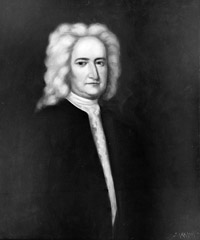
Philip Ludwell

Sir Nathaniel Johnson led the “Goose Creek men” in opposition against Governor Sothell, forcing his retirement.  The Lords Proprietors appointed Philip Ludwell “Governor and Comander in Cheif [sic] of Carolina” with the authority “to apoint [sic] a Deputy Governor of North Carolina.” 

Colonel Ludwell lived at Middle Plantation (which later became Williamsburg) in the Colony of Virginia. In 1676, he supported Virginia Governor William Berkeley during Bacon’s Rebellion. Later, Ludwell married Berkeley’s widow, Frances Culpeper Berkeley of Green Spring Plantation. After serving in Carolina, Ludwell returned to Virginia, where he served as Speaker of the House of Burgesses in 1695–96. Around 1700 he moved to England, where he died.

1718 – Piracy

 Stede Bonnet’s crew was found guilty by Judge Trott. The twenty-nine men from his crew were hanged that day. Their bodies were dumped in the marsh beyond the low-water mark.

1781 – American Revolution

Gen. Green established the Continental Army at Round O, about 45 miles west of Charleston.

1786 – Theater

Because of a sore foot, Mr. Godwin of the Harmony Hall theater could not perform his popular comic dance “The Drunken Peasant.” The audience hurled bottles on stage, which Godwin tossed back and charged the audience with a drawn sword.  After the death of his leading lady, Godwin was forced to close his theater.

1827
Poe in uniform

Poe in uniform

Private Edgar Perry (Edgar Allan Poe) arrived on Ft. Moultrie on Sullivan’s Island an articifer – an enlisted tradesman who prepared shells for artillery.

1864 – Bombardment of Charleston

During the overnight Federal bombardment, a shell crashed through the roof of the house of John and Mary Mullane, killing them in their sleep.

1870  

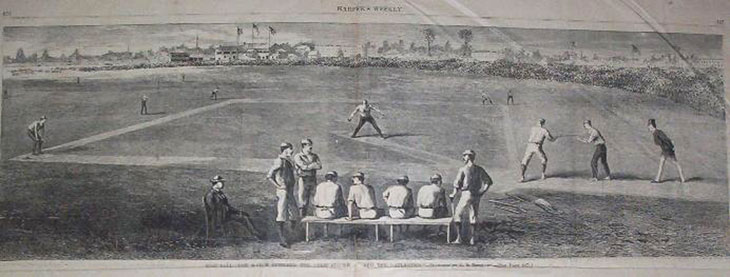
To celebrate the conclusion of the South Carolina Institute Fair, a three inning baseball game was played with the Palmettos beating the Schachte team 27-16.

1870 baseball - Atlantics vs. Red Stockings. Harper's Weekly

1870 baseball – Atlantics vs. Red Stockings. Harper’s Weekly

Today In American History – The Republican Elephant

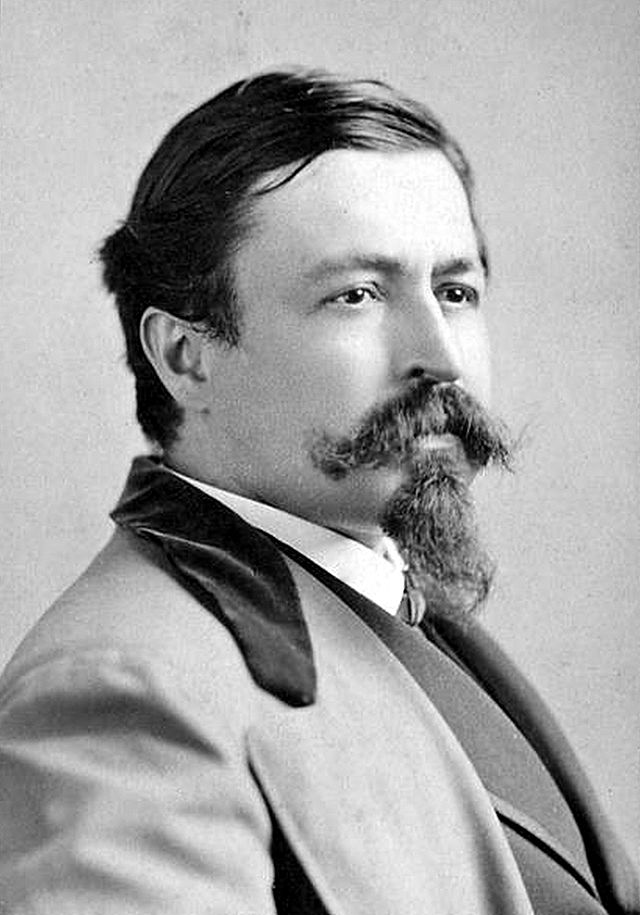
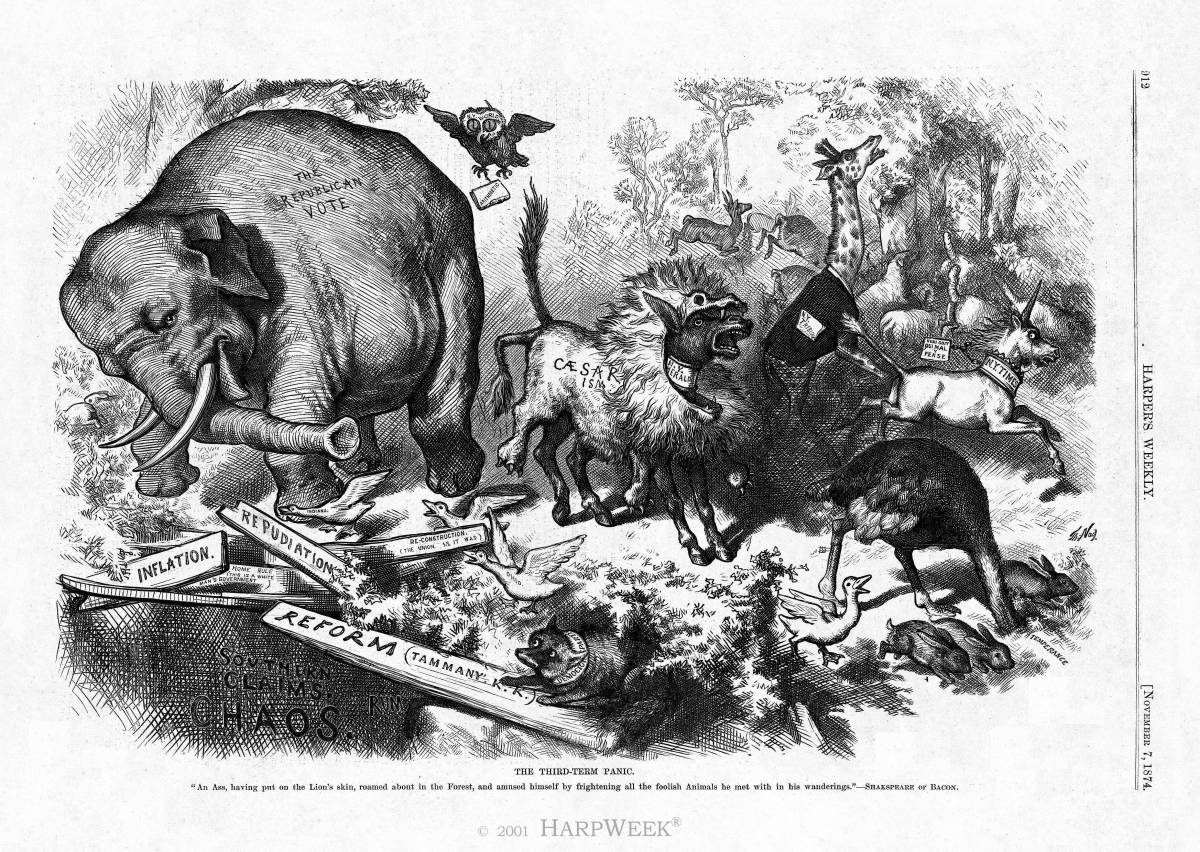
The symbol of the Republican Party was created by cartoonist Thomas Nast and first appeared in Harper’s Weekly on Nov. 7, 1874. 

Thomas_H_Nast

Thomas H. Nast

The New York Herald perpetuated a circulation-builder  hoax in 1874 … called the Central Park Menagerie Scare of 1874. They ran a story, totally untrue, that the animals in the zoo had broken loose and were roaming the wilds of New York’s Central Park in search of prey.

Cartoonist Thomas Nast took the two examples of the Herald hoax and put them together in a cartoon for Harper’s Weekly. He showed an ass (symbolizing the Herald) wearing a lion’s skin (the scary prospect of Caesarism for a third term for Pres. Grant) frightening away the animals in the forest (Central Park). 

One of the foolish animals in the cartoon was an elephant, representing the Republican vote – not the party, the Republican vote – which was being frightened away from its normal ties by the phony scare of Caesarism. In a subsequent cartoon on Nov. 21, 1874, after the election in which the Republicans did badly, Nast followed up the idea by showing the elephant in a trap, illustrating the way the Republican vote had been decoyed from its normal allegiance.

Other cartoonists picked up the symbol, and the elephant soon ceased to be the vote and became the party itself: the jackass, now referred to as the donkey, made a natural transition from representing the Herald to representing the Democratic party that had frightened the elephant.

Harper's Weekley 1874

Harper’s Weekley 1874

Caption: “An Ass, having put on the Lion’s skin, roamed about in the Forest, and amused himself by frightening all the foolish Animals he met with in his wanderings.”–


Today In Charleston History: November 7

1775 – American Revolution. Slavery

John Murray, Earl of Dunmore, and governor of Virginia, issued a proclamation that promised freedom to those slaves who joined the British in the fight against the rebellious colonists. According to reports, runaway slaves flocked to Sullivan’s Island in Charleston and Tybee Island in Savannah by the hundreds. William Moultrie estimated that about five hundred slaves had found refuge on Sullivan’s Island and Stephen Bull wrote to Henry Laurens that about two hundred slaves had settled on Tybee Island.

lowcountry slaves

sullivans-island

Today In Charleston History: November 6

1782 – Revolutionary War. 
John Laurens

John Laurens

Upon receiving the news of John Laurens’ death, John Adams wrote to Henry Laurens:

“I feel for you more than I can or ought to express. Our country has lost its most promising character, in a manner, however, that was worthy of the cause. I can say nothing more to you, but that you have much greater reasons to say, in this case, as a Duke of Ormond said of an Earl of Ossory, “I would not exchange my dead son for any living son in the world.”

 Henry Laurens replied, “Thank God, I had a son who dared to die in defence of his country.”

1860 – Road to Secession.

Abraham Lincoln became the first Republican to be elected President. Voter turnout was 81.2 %, the highest in American history at the time. Lincoln did not carry a single slave-holding state and won the Electoral College with less than 40% of the vote.


1860 PRESIDENTIAL ELECTION RESULTS

CANDIDATE / POLITICAL PARTY PERCENTAGE OF VOTE
Abraham Lincoln (Republican) 39.8%
John Breckenridge (Southern Democrat) 18.1%
John Bell (Constitution Union / Whig) 12.6%
Stephen Douglas (Northern Democrat) 29.5%

South Carolina legislature immediately called for a state secession convention. Since the new state house was under construction, the legislature held meetings at the First Baptist Church in Columbia, as it was the largest meeting place in the city.

city hall - lincoln election

Charleston City Hall – assembled crowd awaiting the result of the 1860 Presidential elections. Harper’s Weekly image.

Today In Charleston History: November 5

1718 – Piracy. 

Early this morning off the Charles Town bar, Governor Johnson’s fleet was waylaid by a sloop, the Eagle, which raised the black flag and called on the ships to surrender. Johnson raised the King’s standard, threw open his ports and delivered a broadside which swept the deck of the pirate ship. The Eagle surrendered.

Johnson discovered the ship was not that of Christopher Moody, but the captain was Richard Worley who had captured the Eagle in Virginia. Worley had been killed by the broadside, but his crew of twenty-four were arrested. The cargo included 106 convicts and covenant servants, thirty-six of whom were women, bound as settlers in Maryland.

1768 – Backcountry
woodmason

Rev. Charles Woodmason

Rev. Charles Woodmason presented a petition to the Assembly which argued that the leaders of the low country (Charlestown planters and merchants) treated the inhabitants of the back country worse than their slaves. He pointed out that the area along the coast had forty-four representatives in the Assembly, while the back country only had six – despite containing two-thirds of the white population of South Carolina.

1779 – Births

 Washington Allston was born on a rice plantation on the Waccamaw River near Georgetown, South Carolina. He would grow up to pioneer America’s Romantic movement of landscape painting. 

Washington_Allston.jpeg

Washington Allston, self portrait


Today In Charleston History: November 4

1718 – Piracy

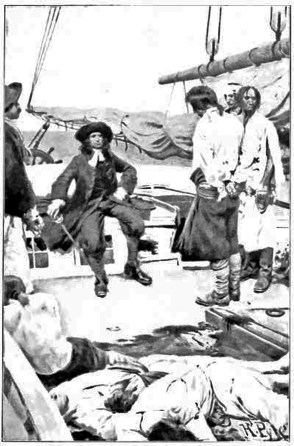
After getting reports of mysterious campfires on Sullivan’s Island Rhett searched the western end and discovered Bonnet hiding. During the subsequent battle Herriot was killed and the two slaves wounded. Bonnet surrendered and was returned to Charleston, this time imprisoned in the watch-house.

That same night, Governor Johnson’s fleet sailed out of the harbor to seek Christopher Moody.
col rhett and bonnet

Stede Bonnet stands before Col. William Rhett

1872 – Carpetbagger & Scalawag

Christopher Columbus Bowen was elected sheriff of Charleston. 

Born in Rhode Island, Bowen had worked a series of odd jobs until eventually making his way to Georgia, where he volunteered (after being threatened with conscription) in the Confederate cavalry. After forging a commanding officer’s signature on a furlough pass to gamble in Charleston, Bowen was court-martialed and dishonorably discharged. He then hired a fellow soldier to murder his commanding officer, for which he was arrested and imprisoned in Charleston. While Bowen was awaiting trial, Charleston was successfully invaded by Union forces and Bowen, among other prisoners, was released. He then began working for the Freedmen’s Bureau, which he was fired from shortly thereafter for “irregularities in his accounts.” Afterwards he began acting as a pro-bono lawyer for newly freed slaves, and the connections he developed allowed him to become first a Republican delegate to South Carolina’s 1868 constitutional convention, and later the elected representative of its first congressional district.

In 1871 Bowen married Susan Petigru King, daughter of James Louis Petigru. Sue had her own fast reputation as a woman who defied social convention and was the author of several “scandalous novels” about Charleston life. Soon after their marriage Bowen was arrested and tried on charges of bigamy.Tabitha Park, a manager of brothels, brought suit against Bowen claiming she was, in fact, his real wife. According to Park, Bowen left her three-years earlier in order that he might live in “open adultery with another woman.” Bowen offered a settlement of one thousand dollars, but Park suspected a member of the United States Congress could do better than that. A bigamy trial followed and Bowen escaped conviction because one member of the jury would not find him guilty. It was noted “a distinct likelihood” that the juror “had been well rewarded beforehand for agreeing to hang the jury.”

ChristopherCBowen

Christopher Columbus Bowen

Frances Hicks then appeared before a federal grand jury. She claimed (and had evidence) that Bowen had actually married her, in 1852. This time, the jury took only twenty minutes to reach a verdict and Representative Bowen was found guilty as charged. Susan Petigru played a more visible role in the second trial and dramatically offered up herself for sentencing, as a substitute for the person who was claiming to be her current husband. She also informed the court that she could not part with Mr. Bowen because he was “too pure” and “too good.” Bowen was sentenced to two years in the Albany penitentiary and fined two hundred and fifty dollars. 

Susan Petigru King Bowen decided to seek help directly from the White House. When President Grant declined to see her, she took it upon herself, without hesitation, to seek a letter of support from General Sherman. She then followed the Grants to their summer home in Long Branch, New Jersey. There, she managed to get the ear of Grant’s wife, Julia Dent. Less than a month after Representative Bowen’s conviction, President Grant signed a “full and unconditional pardon” for his fellow Republican.

Grant’s clemency warrant stated the Representative was “innocent of any intentional violation of the law” and “acted in good faith believing his former wife to be dead.” The warrant also gave Bowen credit – amazingly enough – for rendering “good service” to “the cause of the Union during the late rebellion and since its termination.” 

Bowen was reelected in 1872, but an investigation by the House of Representatives deemed both his and his opponent’s campaigns too corrupt to be officially recognized. he then was elected sheriff of Charleston County.


Today In Charleston History: November 3

1759 –Births.

Martha Laurens was born, daughter of Henry and Eleanor Laurens, the beginning of one of Charleston’s most extraordinary lives.

Martha Laurens (daughter of Henry and Eleanor Laurens). John Wollaston c 1767Her father, Henry, was a successful merchant. Through his London contacts, Laurens entered into the slave trade with the Grant, Oswald & Company who controlled 18th century British slave castle in the Republic of Sierra Leone, West Africa known as Bunce Castle. Laurens contracted to receive slaves from Serra Leone, catalogue and marketed the human product conducting public auctions in Charles Town. His company Austin and Laurens, in the 1750s, handled was responsible for the sales of more than eight thousand Africans.

Three month old Martha Ramsay was pronounced dead of smallpox. Her body was laid out in preparation for a funeral and placed next to an open window. Dr. John Moultrie arrived and pronounced her still alive, speculating she had been revived by the fresh breeze. This event made Martha very special to her father, Henry.

In 1780 Henry Laurens was imprisoned in the Tower of London for “suspicion of high treason” as supporting the American Revolution. After his release he moved to Vigan, France and was nursed back by Martha, where she had spent the years of the War living with her uncle. In 1787 she married Dr. David Ramsay. The two had met while Ramsay writing a History of the American Revolution and reading Henry Laurens’ papers.

1835

Mr. William Laval secured from the state of South Carolina a vague grant to 870 acres of “land” in Charleston Harbor. Acting on this odd grant, Laval made claim to the site of Fort Sumter. This also raised a question in the South Carolina legislature as to what authority the government had acted upon to begin construction. Laval wrote to the engineer in charge at Fort Johnson, Charleston Harbor:

Sirs:

You are hereby notified that I have taken out, from under the seal of the State, a grant of all those shoals opposite and below Fort Johnson, on one of which the new work called Fort Sumter, is now erecting. You will consider this as notice of my right to the same; the grant is recorded in the office of the secretary of state of this State, and can be seen by reference to the records of that office.

Laval’s claim was presented to Robert Lebly, superintendent in charge of the building of fortifications at Charleston Harbor. Lebly forwarded the claim to Brigadier General Charles Gratiot the next day.

Today In Charleston History: November 2

1669 – Carolina Expedition

The ships of the Carolina expedition made port in Barbados a day before a hurricane hit the island. The sloop Albemarle was destroyed and the other two ships were so severely damaged that repairs took more than a month. Food was so short that Sir John Colleton took “more than 20 servants” to his plantation. 

1786 – Duel

Dr. Joseph Brown Ladd died as a result of wounds sustained in a duel with Ralph Issacs on Philadelphia Alley.

1828 – Deaths.

Thomas Pinckney died.

t. pinckneyPinckney was the son of Eliza Lucas Pinckney and younger brother of Charles Cotesworth, who signed the Constitution of the United States. Thomas served during the American Revolution as captain of the 1st South Carolina Regiment of the Continental Army. In 1781 he fought in Virginia with Lafayette. He served as the 36th governor of South Carolina from 1787-89. In 1792, Pinckney replaced John Adams as Minister to Great Britain for four years.  He also served as Envoy Extraordinary to Spain and arranged the Treaty of San Lorenzo, also known as Pinckney’s Treaty, with Spain in 1795.