Today In Charleston History: June 1

1734 – Culture

A billiard table was advertised for sale at Ashley Ferry in the Gazette.

1738 – Treatment for Pox

The Gazette published Dr. Pitcarn’s treatment for small pox to help stop its spread. It consisted of bloodletting and the use of a syrup of white poppies. By the end of the summer 2112 people had come down with the disease, killing more than 400.  It was reported that there were not:

sufficient number of persons in health to attend the sick, and many persons perished from neglect and want. There was scarcely a house in which there had not been one of more deaths. Inoculation was at this time first attempted with some success and the disease soon after abated. 

1756-Arrivals

William Henry Lyttelton arrived in Charlestown as the Governor on the HMS Winchelsea. Crowds of citizens gathered to toast the new governor but Lyttelton’s term would be riddled with controversies. 

1775-American Revolution – Foundations.

 The Secret Committee of Five ordered the tarring and feathering of James Dealy and Laughlin Martin for rejoicing (supposedly) that Catholics, Negroes and Indians were going to be armed in an uprising against the people.  The two men were carted about the streets and banished from town.

1776-American Revolution
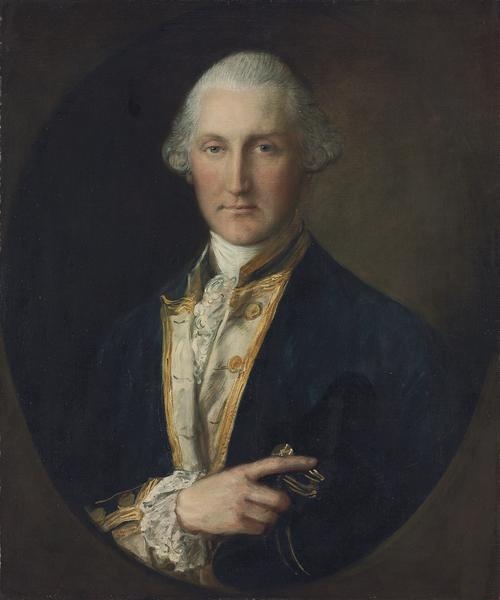
Lord William Campbell

Lord William Campbell

Lord William Campbell, who, several months before, had left Charleston in the middle of the night in fear of being attacked, had been urging a major expedition against South Carolina to crush the rebellion in the South. On June 1, the British fleet, commanded by Sir Peter Parker and Sir Henry Clinton, appeared and “displayed about fifty sail before the town, on the outside of the bar.”

Col.  Moultrie described their effect on Charlestonians:

The sight of these vessels alarmed us very much, all was hurry and confusion, the president with his council busy in sending expresses to every part of the country, to hasten down the militia; men running about the town looking for horses, carriages and boats to send their families into the country; and as they were going out through the town gates to go into the country, they met the militia from the country marching into town…

1782 – Culture

Hamilton Stevenson advertised his services as a “painter of miniatures or a hair sylist.”

1822-Denmark Vesey Rebellion

Mingo Harth and Peter Poyas were interrogated by city officials. Another Slave, William Paul, had named them as part of a “conspiracy” against the whites.  Poyas laughed and called William Paul a young fool. Intendent (mayor)Hamilton was impressed that “these fellows behaved with so much composure and coolness.”

1825 – Politics

Joel Roberts Poinsett was appointed the first United States minister to Mexico.

1832 – Death
Statue of Gen. Sumter on the courthouse lawn, Sumter S.C.

Statue of Gen. Sumter on the courthouse lawn, Sumter S.C.

Thomas Sumter died, the last surviving Revolutionary War generals.

In February 1776, Sumter was elected lieutenant colonel of the Second Regiment of the South Carolina Line. He subsequently was appointed brigadier general, a post he held until the end of the war. Perhaps his greatest military achievement was his partisan campaigning, which contributed to Lord Cornwallis’ decision to leave the Carolinas for Virginia.

Sumter acquired the nickname, “Carolina Gamecock,” during the American Revolution for his fierce fighting tactics. After the Battle of Blackstock’s Farm, British General Banastre Tarleton commented that Sumter “fought like a gamecock”, and Cornwallis paid him the finest tribute when he described the Gamecock as his greatest plague.

1865 –  Reconstruction

By this time, more than 30,000 cartloads of material and debris had been removed out of the city under the U.S. Army’s supervision, using more than 200 laborers and 50 teams of animals. The debris was dumped in the marshes as landfill.

One visitor described the city as:

The splendid houses are all deserted, the glass in the windows broken, the walls dilapidated, the columns toppled over … arches demolished, mantels shattered, while fragments, great and small, of every description strew the floors … but where are the owners of these estates – where are they?

Charleston, after the War and fire destruction. Looking  west at St. John's Lutheran and Unitarian Churches

Charleston, after the War and fire destruction.

1882 – Politics 

The “Eight Box Law, written by Charlestonian Edward McCrady, Jr. and passed by the state assembly went into effect. The law got its name from the requirement that, on Election Day, there were to be eight separate ballot boxes for different offices. A voter had to be able to read in order to know where to place his ballot. At this time illiteracy rate among blacks was five times greater than whites. Another provision of the law was that every voter must re-register before June 1, 1882, or be forever banned from voting.

Within four years, tens of thousands of black voters in South Carolina were disenfranchised. Voting districts were redrawn, leaving only one majority black district. The state’s last 19th century black congressman was defeated for re-election in 1896
Today In Charleston History: May 30

1721

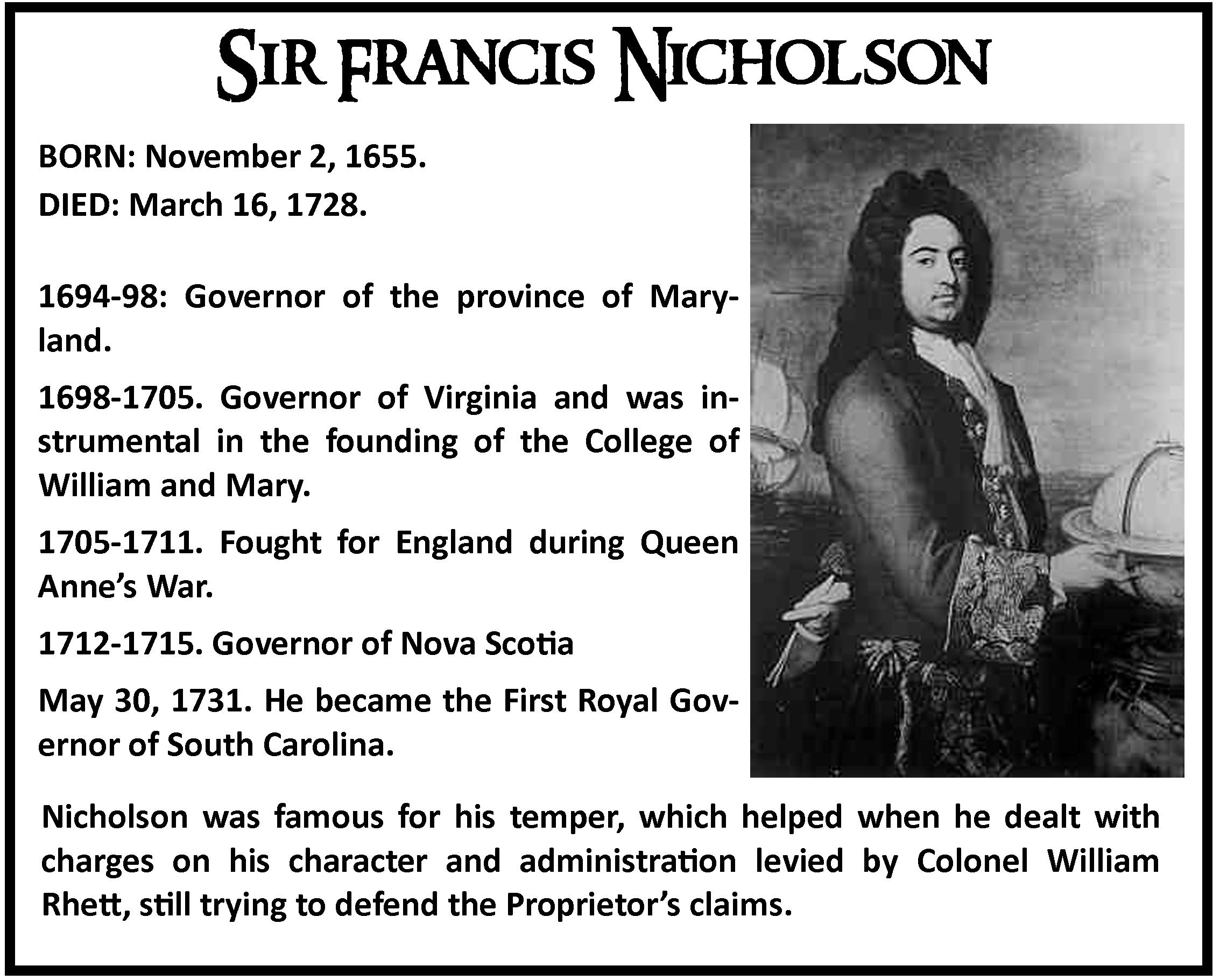
General Sir Francis Nicholson became the 1st Royal Governor of South Carolina. He had served as governors of Maryland, Virginia and Nova Scotia. He helped found the College of William and Mary and was a passionate supporter of the Anglican Church, making many of the Dissenters nervous. He was also instrumental in positive negotiations with the Cherokee nation but duplicitous in his dealing with the Creek nation. In a treaty he promised the English settlements would not extend west of the Savannah River.  

Nicholson was notorious for his temper. He was “subject to fits of passion.” In one story, an Indian said of Nicholson, “The general is drunk.” When informed that Nicholson did not partake of strong drink, the Indian replied, “I do not mean that he is drunk with rum, he was born drunk.”

nicholson profile

1822-Denmark Vesey Rebellion
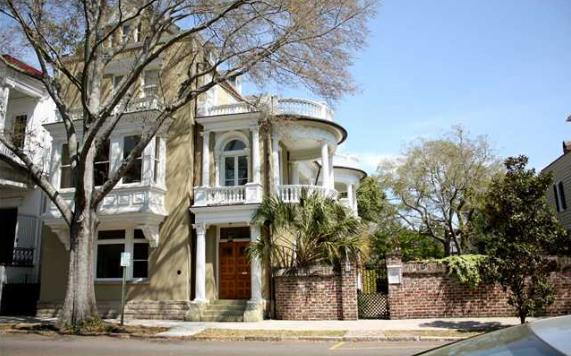
John Prioleau House, 68 Meeting Street, Charleston

John Prioleau House, 68 Meeting Street, Charleston

John Prioleau returned home from a business trip and was told about his slave Peter’s incident on the Charleston wharf with William Paul eight days previously. Alarmed that slaves were openly discussing the Haitian Revolution, Prioleau wrote a note and ordered Peter to deliver it immediately to Indendent (mayor) James Hamilton. Prioleau then marched to John Paul’s grocery story and ordered all the male slaves working at the store arrested and taken to the Guard-House.

Hamilton wrote his own note and sent it to the governor of South Carolina, Thomas Bennett, Jr. who lived a few doors down.

 1830
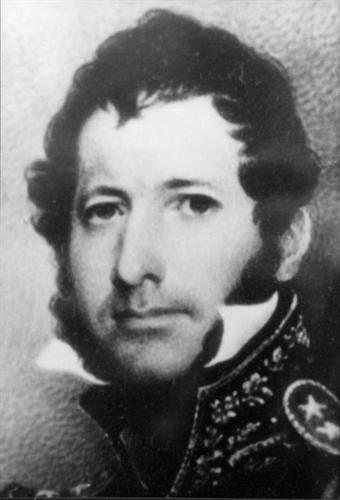
James Hamilton

James Hamilton

Political parties organized for the City Council elections in September. Leading the Union Party was Daniel Huger and James Petigru. Leading the Nullification Party was Robert Hayne and James Hamilton, Petigru’s former business partner, and former Charleston mayor.

Today In Charleston History: May 22

 
1718 – Blackbeard Blockades Charles Town 

Blackbeard and Stede Bonnet’s six ship fleet blockaded the Charles Town bar and quickly pillaged nine vessels, including the Crowley, which was headed for London with several prominent citizens hostage, including Samuel Wragg, a member of the Governor’s Council and his four-year old son, William. With these hostages at his mercy, Blackbeard effectively held the city of Charles Town in his control for several days.

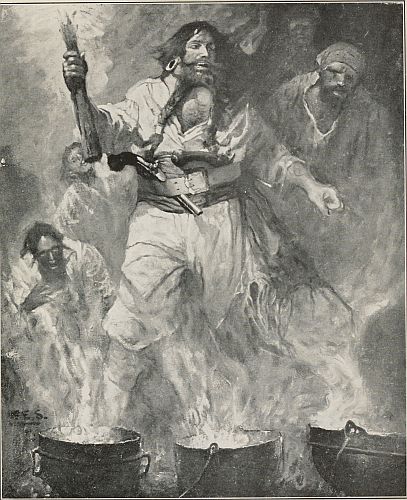
blackbeard-brimstoneBlackbeard directed his ship’s surgeon to compile a list of needed medicines for the fleet. He sent an armed boat commanded by a Mr. Richards into the city, along with a Mr. Marks, one of the captured citizens. Blackbeard demanded that within two days, Marks would convince Governor Johnson to meet the demand or the citizens would be hanged one by one from the bowsprit of the Crowley.
The deadline passed and Blackbeard sailed eight of his ships into the harbor, creating a panic among the citizens. Finally, in exchange for rations, money and medical supplies gathered from among the leading merchants, Governor Johnson was able to buy the release of the hostages. Blackbeard sailed unmolested out of the harbor with more than £1500 of gold and silver and made a beeline to his hideout on Ocracoke Island for Teach’s Hole.

Stede Bonnet and David Herriot sailed to North Carolina and received a pardon from Governor Charles Eden. Bonnet then renamed the Revenge the Royal James and called himself Captain Thomas. They sailed to Delaware and plundered several vessels.

1770 – Death

Henry Laurens’ wife, Eleanor, died in childbirth. Laurens fought a losing battle over his sorrow for several years. He wrote:

If I go here or there I find something or other to refresh my Sorrow and feel that some thing which constituted my Happiness is gone from me … I look round upon my Children, I lament for their Loss. I weep for my own.

 He never married again.

1777 – State Seal

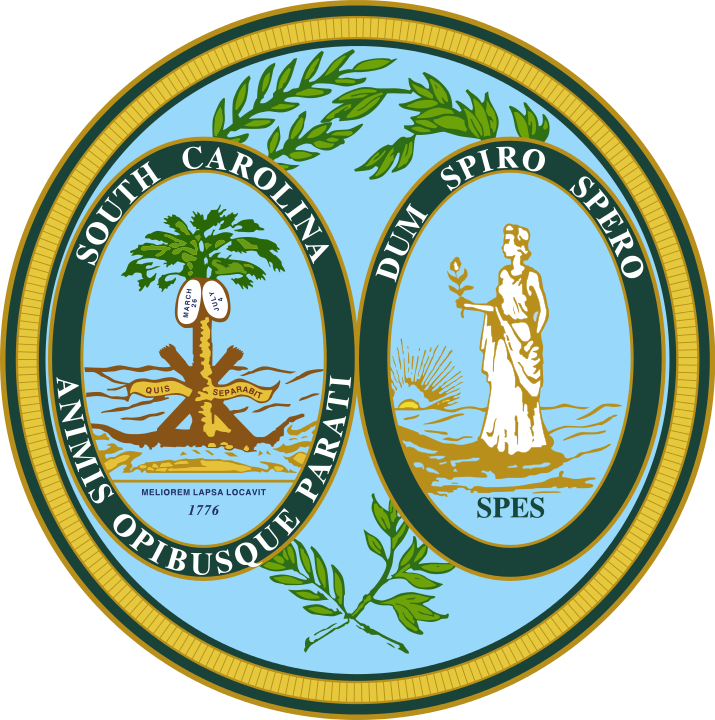
The state seal was used for the first time by President John Rutledge. The seal was made up of two elliptical areas, linked by branches of the palmetto tree. The image on the left was a tall palmetto tree and an oak tree, fallen and broken, which represents the battle fought on June 28, 1776, between defenders of the unfinished fort on Sullivan’s Island, and the British Fleet. The standing palmetto represents the victorious defenders, and the fallen oak is the British Fleet. Banded together on the palmetto with the motto “Quis separabit?” (Who Will Separate [Us]?), are 12 spears that represent the first 12 states of the Union. At the bottom is the phrase “Animis Opibusque Parati,” or “Prepared in Mind and Resources.”

Seal of South Carolina

Seal of South Carolina

The other image on the seal depicts a woman walking along a shore littered with weapons. The woman, symbolizing Hope, grasps a branch of laurel as the sun rises behind her. Below her image is the word “Spes,” (Hope) and over the image is the motto “Dum Spiro Spero,” (While I Breathe I Hope.)

1802 – Birth

Theodosia Burr Alston gave birth to a son, Aaron Burr Alston at the Miles Brewton House at 27 King Street, the home of her father-in-law. It was a difficult birth and Theodosia suffered a prolapsed uterus, which rendered her incapable of having further children, and made marital relations with her husband impossible.  For the rest of her life she would endure spasms of intense pain.

1822-Denmark Vesey Rebellion

A slave named Peter, sitting on the Charleston wharves, noticed a ship named Sally recently arrived from St. Domingue. The ship was flying a flag with the number “96.” Puzzled, he asked another black man, William Paul, about the flag. Paul, who worked in a grocery store owned by John Paul, told him it was a reference to the 1796 Haitian slave insurrection. Paul then began to talk about the horrific conditions of the slaves in South Carolina. Peter became frightened and fled from Paul.

Peter reported the conversation with Paul to a friend, a prosperous free black man named William Penceel and member of the Brown Fellowship Society. Penceel advised Peter to tell his master. Peter’s master, John Prioleau, lived at 50 Meeting Street. Prioleau was a factor and was out of town inspecting plantations  so Peter told Prioleau’s wife and young son about the conversation with Paul. They did nothing.

1856- Road to Secession
Preston Brooks

Preston Brooks

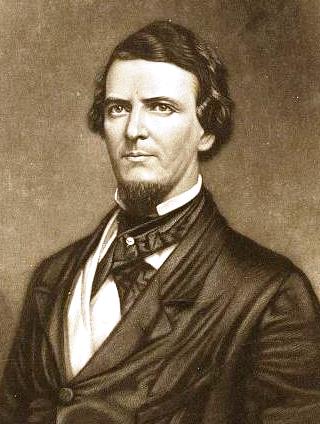
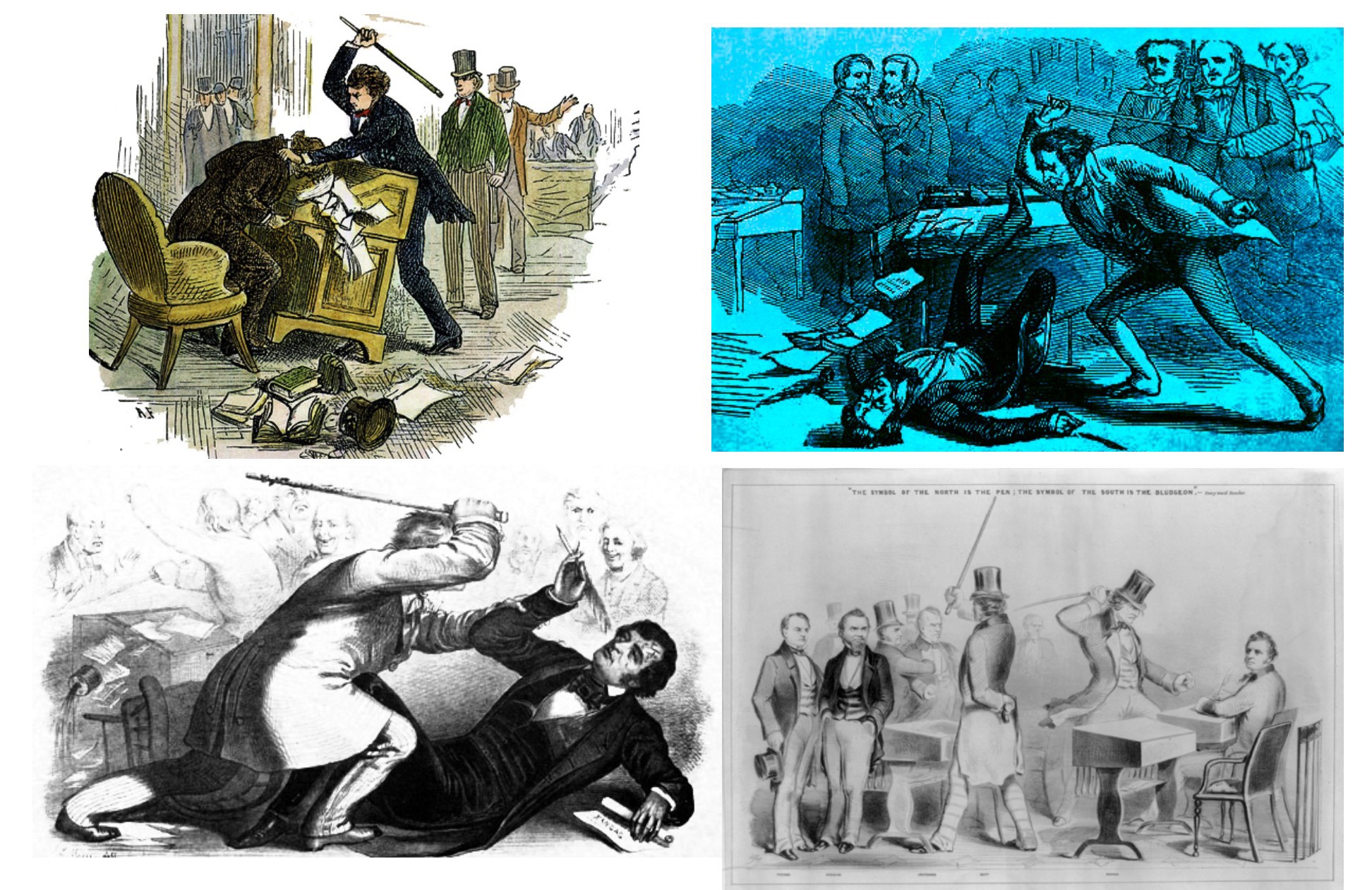
Congressman Preston Brooks (D-SC) beat the hell out of Charles Sumner on the floor of the U.S. Senate in retaliation of Sumner’s verbal attack on Brooks’ uncle, Sen. Andrew Butler. See May 19th entry.

Brooks, Butler’s nephew and Democratic representative from South Carolina, discussed challenging Sumner to a duel. He was told by fellow SC Congressman, Lawrence Keitt, that “dueling is for gentlemen of equal statue. Sumner is lower than a drunkard. Dueling with him would only be an insult to yourself.”

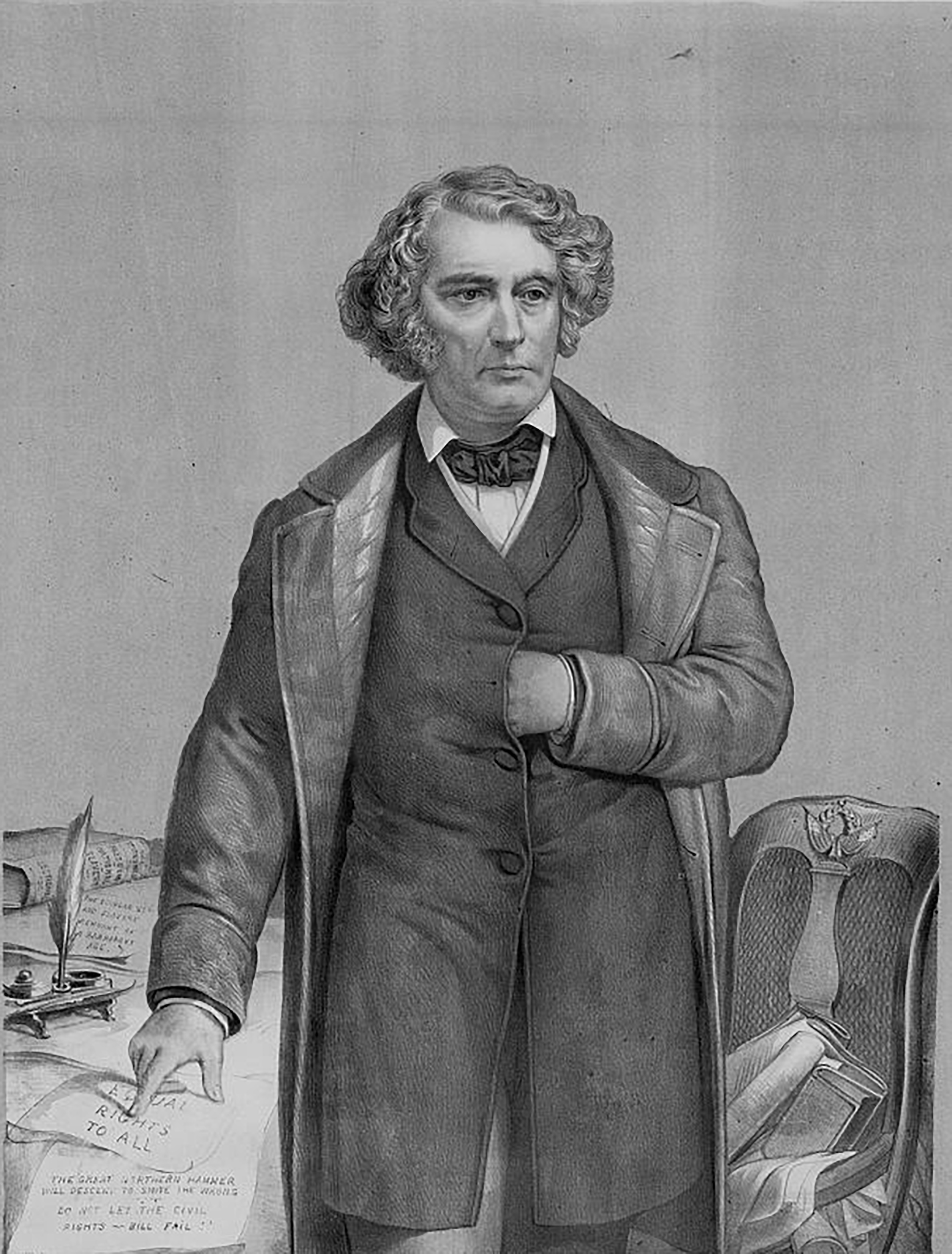
Sen. Charles Sumner

Sen. Charles Sumner

Two days later Brooks strode into the Senate chamber approached Sumner sitting at his desk. As Lawrence Keitt held other senators at bay, Brook said: “Mr. Sumner, I have read your speech twice over carefully. It is a libel on South Carolina, and Mr. Butler, who is a relative of mine.” He then struck him repeatedly with a cane until it broke into five pieces before several men rushed past Keitt and overpowered Brooks. 

Brooks became an instant hero in the South, and the fragments of his weapon were “begged as sacred relics.” A new cane, presented to Brooks by the city of Charleston, bore the inscription “Hit him again.”

Various editorial illustrations of the Preston Brooks’ attack on Sen. Charles Sumner