George Washington Visit – Day 8
May 8, 1791
President Washington spent the Sunday in Charleston attending “crowded churches” in the morning (St. Michael’s) and evening (St. Philip’s).
His evening meal was with Gen. William Moultrie.
Home » Uncategorized (Page 2)
George Washington Visit – Day 7
Saturday, May 7, 1791
Before breakfast, Washington visited the Orphan House at which there were 107 boys and girls, and he was impressed with the management of the house.After touring the house and gardens, the President had breakfast with the children.
(Note: The Orphan House was being operated out of a building off Market Street at this time. The famous Orphan House building on Calhoun street opened in 1794.)
Washington wrote in his diary:
I also viewed the City from the balcony (the portico above the clock) of [St. Michael’s] Church from whence the whole is seen in one view and to advantage, the Gardens & green trees which are interspersed adding much to the beauty of the prospect. Charleston stands on a Pininsula [sic] between the Ashley & Cooper Rivers and contains about 1600 dwelling houses and nearly 16.000 Souls of which about 8000 are white—It lies low with unpaved streets (except the footways) of sand. —There are a number of very good houses of Brick & wood but most of the latter—The Inhabitants are wealthy, —Gay—& hospitable; appear happy and satisfied w’ith the Genl. Government.

St. Michael’s Church, built in 1762.
May 6, 1791
Washington toured the town on horseback for most of the day, riding up and down most of the principal streets. Sometime during the day Washington stopped to observe the work on rebuilding of the State House and talk with the supervising architect, James Hoban.

Charleston County Courthouse, formerly the State House.
Washington had recently been given the duty by Congress to build “the President’s House” (later called the White House) in D.C. Hoban was given the job by Washington to design and supervise the construction of the White House.
The evening meal was at Sen. Pierce Butler’s home and then a party at Gov. Pinckney’s home.
May 5, 1791
Washington visited Fort Johnson (James Island) and Fort Moultrie (Sullivan’s Island). For the evening Washington was once again entertained at the Exchange at a dinner hosted by Gov. Pinckney and other principal gentlemen of the city.
The dinner must have been as spectacular as the previous evening for Washington wrote in his diary “there were at least 400 ladies – the Number & appearance of which exceeded anything of the kind I had ever seen.”

Gov. Charles Pinckney
Wednesday, May, 1791
Before breakfast Washington visited and examined the lines of Attack and Defense of the city and proclaimed them adequate.
For the noon meal Washington dined with the Members of Cincinnati in the long room of McCrady’s Tavern on East Bay Street. A choir of singers entertained the diners throughout the meal.
In the evening Washington attended “an elegant dancing Assembly at the Exchange – At which were 256 elegantly dressed & handsome ladies.” According to newspaper reports the ladies were “all superbly dressed and most of them wore ribbons with different inscriptions … such as “long live the President.”

Exchange Building, Charleston
Tuesday, May 3, 1791
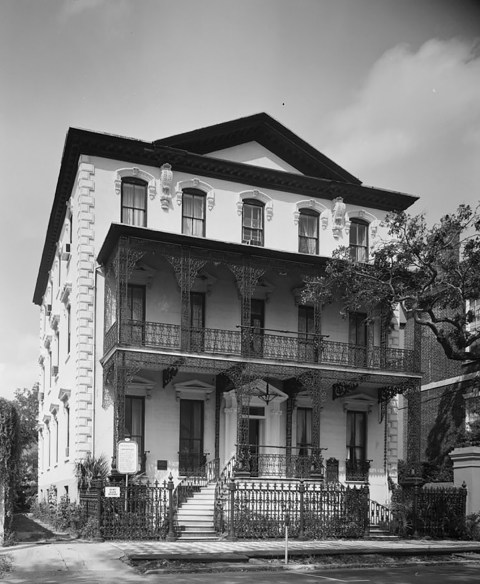
The president had breakfast with Elizabeth Grimke Rutledge at her home on Broad Street (John Rutledge House). Mr. Rutledge (Chief Justice of the S.C. Supreme Court) was on the Circuits and not in the city.

John Rutledge House, 116 Broad Street. Library of Congress.
Later in the day, at his lodgings, he
was visited about 2 oclcock, by a great number of the most respectable ladies of Charleston – the first honor of the kind I had ever experienced and it was flattering as it was singular.
Monday, May 2, 1791
Washington had breakfast at Snee Farm, the home of Gov. Charles Pinckney. Pinckney apologized for the house, calling the home “a place so indifferently furnished and where your fare will be entirely that of a farm.”
After breakfast Washington crossed into Charleston from Haddrell’s Point which was the eastern terminus of the ferry. Washington was rowed across the river on a large barge by “12 American Captains of Ships, most elegantly dressed.” He noted:
There were a great number of boats and barges on the river filled with Gentlemen and Ladies, as well as two boats of musicians, all of whom attended Washington across the river.
Washington was greeted at the Point by city recorder John Bee Holmes, and Gen. Charles Cotesworth Pinckney, and Edward Rutledge. A month after the meeting Washington offered Pinckney and Rutledge a seat on the Supreme Court, a seat that had recently been vacated by Edward’s brother, John Rutledge. Both men declined due to family finances.
Once in Charleston Washington was greeted by Lt. Gov. Isaac Holmes, Charleston intendant (mayor) Arnoldus Vanderhorst, and S. Carolina’s two U.S. Senators – Pierce Butler and Ralph Izard. The president was greeted at the Exchange Building where he stood on the balcony facing East Bay Street and watched a “procession in his honor to whom he politely and gracefully bowed as they passed in review before him.”
Washington was then taken to his lodgings on Church Street (Heyward-Washington House) where he was attended by several of Mr. Heyward’s servants.

Thomas Heyward’s house @ 87 Church Street, where George slept.
May 1, 1791
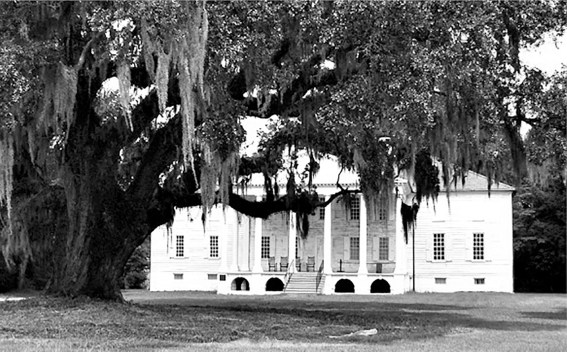
The president’s party had breakfast at Hampton Plantation, the home of the widowed Harriet Pinckney Horry. Her mother, Eliza Lucas Pinckney, had been living with her daughter for several years.
During the visit, Eliza asked Pres. Washington whether a certain oak tree should be cut down to create a better view from the portico. Washington replied that he liked the tree and the view. The tree was saved and from that day it was known as the Washington Oak.

Washington Oak at Hampton Plantation. Photo by author.
John C. Calhoun, at the age of 68, died of tuberculosis on March 31, 1850 at the Old Brick Capitol boarding house in Washington, D.C. Many know his name, but few remember that at one point, he was one of the most powerful figures in American politics.

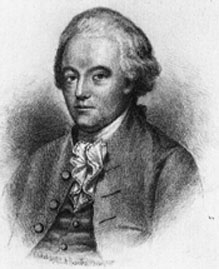
1822 portrait of John C. Calhoun. New York Public Library
Calhoun served in the South Carolina legislature and was elected to the U.S. House of Representatives in 1811, serving three terms. One year later, Calhoun and Henry Clay, two famous “war hawks,” convinced the House to declare war on Great Britain.
From 1817 to 1825 Calhoun served as Secretary of War under Pres. James Monroe. In 1824 he ran for the presidency (against John Quincy Adams, Henry Clay and Andrew Jackson) and ultimately served as vice president under Adams. Four years later, Calhoun was re-elected vice president under Andrew Jackson.
Calhoun supported the Tariff of 1828, in opposition of Pres. Jackson. Calhoun wrote an essay, “The South Carolina Exposition and Protest” in which he advocated that a state had the right to veto any federal law that went beyond the enumerated powers and encroached upon the residual powers of the State.
Also, during this time, Washington D.C. became embroiled in something called “the Petticoat Affair.” Calhoun’s wife, Floride, who was queen of D.C. society, organized Cabinet member’s wives against Peggy Eaton, wife of Sect. of War John Eaton. Floride alleged that John and Peggy had engaged in an adulterous affair while Mrs. Eaton was still married to her first husband. Jackson, who was close friends with Eaton, resented the Calhoun’s attack, creating even more tension between the president and vice president.

Calhoun portrait by Matthew Brady. Library of Congress
In 1832 the South Carolina legislature nullified a Federal agriculture tariff, citing Calhoun’s “Exposition.” Pres. Jackson threatened to send naval war ships to Charleston to hang Calhoun or any man who worked to support nullification or secession unless South Carolina relented. Ultimately, a compromise was reached and passions cooled, but many of the South’s leaders smoldered with resentment of the Federal government’s growing dictatorial power, planting the seeds for the South’s secession, twenty-eight years later.
On December 12, 1832, Calhoun was elected to fill the U.S. Senate seat vacated by Robert Hayne, who had been elected South Carolina governor. On the 28th Calhoun resigned the Vice Presidency, the first man to do so. He was also the second and last vice president to serve under two presidents (George Clinton is the other.)
As a senator Calhoun engaged in one of the Senate’s most famous debates with Daniel Webster over slavery and states’ rights. In 1844 Pres. John Tyler appointed him as Secretary of State for two years during which time Calhoun supervised the Texas annexation and the creation of the Oregon Territory.
Calhoun then returned to the Senate in 1846 where he opposed the Mexican War and helped to defeat the Wilmot Proviso.

New York Public Library
After his death he was buried at St. Philip’s Cemetery in Charleston. Toward the end of the Civil War, Calhoun’s supporters were concerned that Union troops in the city would ransack his grave, so during the night, they removed his coffin to a hiding place beneath the stairs of the church. The next night, they buried the coffin in an unmarked grave. In 1871, it was exhumed and returned to its original spot. In 1884, Calhoun’s brick tomb was replaced by a decorative sarcophagus by the South Carolina government.
In 2000 the U.S. Senate honored Calhoun as one of the seven greatest senators of all time.

Calhoun’s grave at St. Philip’s Church, Charleston. Photo by author
“I have a need to bear witness to what I saw there. I want to tell you how it was. I want precision. I want a murderous, stunning truthfulness.” – from The Lords of Discipline by Pat Conroy
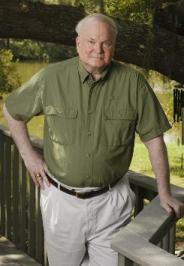
Sad day. Pat Conroy died of pancreatic cancer. He wrote books where passion and enthusiasm dripped from the pages like butter sauce from freshly sauteed shrimp. After you were finished the sensation lingered, something to savor and remember. “Music could ache and hurt, that beautiful music was a place a suffering man could hide.” ― from Beach Music by Pat Conroy.
“Walking the streets of Charleston in the late afternoons of August was like walking through gauze or inhaling damaged silk.” – Pat Conroy