Today In Charleston History: December 17

1677

The Grand Council voted that Charles Town should move to Oyster Point.

1679
Joel Gascoyne map 1682

Joel Gascoyne map 1682

Governor West and the Grand Council wrote the Proprietors:

We are informed that this Oyster Point is not only a more convenient place to build a town on than that formerly pitched on by the first settlers, but that the people’s inclinations turn thither; we let you know that Oyster Point is the place we do appoint for the port town of which you are to take notice and call it Charles Town.

1765 – SLAVERY.

A possible slave revolt was suspected when slaves were heard on the streets shouting “Liberty!” Henry Laurens thought the threat was exaggerated. In his opinion he believed the slaves merely “had mimck’d their betters by crying out ‘Liberty!’”

Lt. Gov. Bull ordered 100 militia out “to guard the city” and for sailors to stand nightly sentinel duty on the wharves during the holiday season. Whether the slave revolt threat was real or not, it did act as a calming influence on Gadsden and Timothy, as leaders of the mob actions. As Henry Laurens wrote, the hotheads:

did not slacken in their opposition to the introduction of Stamps, but except for a little Private cruising along the Waterside at Nights to see if anything is moving among the Shipping they are pretty quiet & I have been assur’d that more than a few of their Brethren declare their repentance …

1803 – SLAVERY.

Foreign trade was reopened; more than 40,000 slaves would be imported into South Carolina during the next four years.

1817

Moultrieville on Sullivan’s Island was incorporated.

1831

The Medical College of South Carolina was chartered.

1860,  Secession Convention Opens. And Adjourns.  

At noon, 169 delegates gathered at the First Baptist Church in the South Carolina capital, Columbia. Included among the delegates were four former governors, four former U.S. Senators, judges, and more than 100 planters.
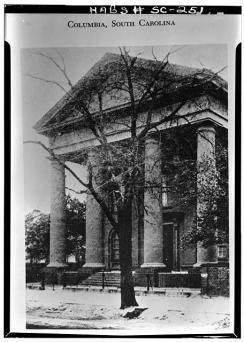
first baptist columbia

First Baptist Church, Columbia. Library of Congress

To the disappointment of Barnwell Rhett, David J. Jamison was chosen chairman of the convention. Jamison, a planter of 2,000 acres and seventy slaves opened the convention by quoting Georges-Jacques Danton, leader of the French Revolution, urging the delegates “To dare! And dare again! And without end dare!” The fact that Danton was beheaded for his radical leadership went unacknowledged by the delegates.

A resolution was agreed upon that “South Carolina should forthwith secede” and an ordinance be drafted “to accomplish this purpose” was passed. After that, the members began to clamor for adjournment and move the convention to Charleston. Historically, the reason given has always been of a small pox outbreak in Columbia. However, many of the delegates complained about the “meager accommodations in Columbia.” Charleston, however, offered luxurious hotels and the opulent homes of friends. As John A. Inglis, a delegate from Chesterfield County exclaimed, “Is there any spot in South Carolina more fit for political agitation?”

John Archer Elmore, the Alabama Secession Commissioner, told the crowd:

There should be no hesitation – no faltering and no delay upon the part of this Convention. [South Carolina’s] Ordinance of Secession should take effect at once! … [giving] strength not only to Alabama, but in other states united with her in sentiment.

Charles Hooker, Mississippi’s Commissioner followed Elmore to the podium and declared that South Carolina should:

Snatch her star from the galaxy in which it has hitherto mingled and plant her flag earliest in the breech of battle, sustaining revolution by the bold hearts and willing arms of her people.

While the argument about moving the convention was being held, Charleston delegates had already wired home, and given orders to secure Institute Hall, and as many rooms at the Mills House that could be procured. William Porcher Miles, however, thought that moving after a day was a mistake. He told the delegates, “We would be sneered at. It would be asked … is this chivalry of South Carolina? They are prepared to face the world, but they run away from the smallpox.”

However, the delegates voted to adjourn and make the seven-and-one-half hour train trip to Charleston together. The Columbia-based newspaper, South Carolinian, the next day published this story:

Charleston Police Look Out!

By a letter from New York, there is reason to apprehend that the Lincoln men have been gathering up all the rags they can find from the small-pox hospital, and intend an incursion in the South, to chase the secession conventions and legislature from place to place until they are made powerless.   

1919

The Coterie of Friends at the London Academy of Music performed a concert at Wigmore Hall in London. The publication West Africa described the concert as a tribute to the greatest musical composer of the African race, Samuel Coleridge-Taylor.

Mr. Edmund T. Jenkins will be the first coloured conductor, other than Coleridge-Taylor himself, to render his work before a British audience. Miss Coleridge-Taylor, the late composer’s daughter, will contribute a musical monologue, set to music by her father.

Edmund Thorton Jenkins

Edmund Thorton Jenkins

Edmund Jenkins was the son of Rev. Daniel Jenkins, founder of the Jenkins Orphanage in Charleston. Jenks (as Edmund was called) had grown up playing with the Jenkins Band and attended Morehouse College in Atlanta to study music. He had traveled to London in 1914 with the Jenkins Band to perform at the Anglo-American Expo. When the Expo was shut down by the events that led to World War I, Jenks convinced his father to allow him to remain in England and enroll in the Royal Academy.


Today In Charleston History: December 8

1769 England  – John Wilkes Affair.

The South Carolina Assembly voted to send to £1500 sterling to help pay the debts of John Wilkes “for the support of the just and constitutional rights and liberties of the people of Great Britain and America.”  (See November 21 post for explanation of the John Wilkes affair.)

The Sons of Liberty, who met at the Liberty Tree, considered this part of “their resistance to the arbitrary rule by the same Parliament that had imposed unconstitutional taxes on America.” At the behest of Christopher Gadsden, the Assembly ordered Jacob Motte, the public Treasurer, to send £10,500 provincial currency to the John Wilkes Fund in London “for assisting in the support of the just and constitutional rights of the People of Great Britain and America.” Only seven members of the Assembly voted against the measure, including Speaker Peter Manigault. This action shocked and infuriated government officials in both London and Charlestown, as it undermined official authority over the financial purse-strings of the colony.

1808
Langdon Cheves

Langdon Cheves

Langdon Cheves was elected Attorney General of South Carolina. He would later be elected to the House of Representatives and served as Speaker of the House 1814-15.

1817

John C. Calhoun took the oath of office as Secretary of War under Pres. James Monroe.

1822 – Slavery.

Intendent (Mayor) James Hamilton introduced a bill to grant “compensation [to] those persons whose slaves have been executed” associated with the Denmark Vesey Rebellion – $122.40 for each slave. 

1864 – Bombardment of Charleston. 
Gen. John G. Foster

Gen. John G. Foster

Gen. John G. Foster, in command of the Department of the South, acknowledged the Federal order to discontinue the bombardment of Charleston … two weeks after receiving it.

Today In Charleston History: November 9

1799 – Slavery

The Charleston City Gazette announced that the “Thirteenth Day’s Drawing” of the East Bay Lottery was ticket #1884. The top prize was $1500. The holder of the wining ticket was a slave named Denmark Vesey, who presented the ticket to his master, Capt. Joseph Vesey. Capt. Vesey agreed to allow Denmark to purchase his freedom for $600.

vesey statue copy

Today In Charleston History: November 1

1670

Ashley Cooper wrote to Captain West and Governor Sayle ordering that the settlement, Albemarle Point, be renamed “Charles Town.”

1765 – Stamp Act.

The Stamp Act went to effect. Ships could not get clearances to leave Charlestown harbor and courts could not conduct any legal business without stamped paper.

1773

Jacob Ramos was convicted of inciting a slave to commit a robbery of Mr. William Sommerfall. The Negro slave was hanged, and Ramos was sentenced to “stand in the pillory for an hour, pay a fine of $350, and receive 39 lashes.” During the time in the pillory Ramos was “most severel & incessantly pelted by an enraged Populace; who nevertheless were so orderly, as to not use any other Materials than rotten eggs, Apples & Onions.”

1775 – American Revolution.

Second Provisional Congress was hastily called into session in to deal with the threat the two British war ships in Charlestown harbor. William Henry Drayton was voted President of the Congress. In anticipation of Lord Campbell sailing up the Cooper River to meet with Loyalists living in the back country, Drayton ordered the blocking of Hog Island Channel by the sinking of four hulks.

1777 – American Revolution

 Upon John Hancock’s retirement due to ill health, Henry Laurens was elected President of the Congress and served until December 9, 1778. During his term, Laurens dealt with the conspiracy to replace George Washington as commander-in-chief, perpetuated by several members of Congress and the military.

dayton and laurens

William Henry Drayton and Henry Laurens

1870

 The South Carolina Institute Fair opened. It was open to all – white and black – from 9:00 a.m. to 5:00 p.m. Tickets were twenty-five cents, with more than 12,000 visitors in one day. Inside the hall visitors could see exhibits featuring the most modern agricultural equipment, sewing machines and steam engines. The main building for the South Carolina Institute Fair was on the site of the present day Citadel softball stadium. The building was 300 feet long by 80 feet wide by forty feet tall, had 154 windows and fourteen doors.The Charleston Daily News wrote:

Charleston will do her part in the grand work of building up South Carolina, and extends a cordial welcome to all her visitors, whether they come from North or West or South. There is no sectionalism in commerce, and we can promise to all who now pay our city a visit a hearty and generous reception.


Today In Charleston History: October 31

1769 – Slavery

 The Sally brought slaves to Charlestown. Henry Laurens wrote:

A third poor pining creature hanged herself with a piece of small vine which shows her carcass was not very weighty … who that views the above Picture can love the African trade?

Laurens rationalized his role as a slave trader using what was to become a tried and true Charleston excuse – tradition.

These Negroes were first enslaved by the English … I was born in a Country where Slavery had been established  by the British Kings & Parliaments … I found the Christian Religion & Slavery growing under the same authority … I am not the Man who enslaved them, they are indebted to English men for that …

African American History Slave Ships


Today In Charleston History: October 8

1678

Captain Florence O’ Sullivan claimed two town lots on Oyster Point.

1698 – Slavery

The Assembly passed “An Act for the Encouragement of the Importation of White Servants.” Afraid of the growing number of blacks who had been imported as slaves, the South Carolina Assembly passed a law granting £13 to anyone who would bring a white male servant into the province as “…the great number of negroes which of late have been imported into this Colony may endanger the safety thereof.”

The Act also set out terms of indenture service: those over sixteen years old should serve at least four years, those under sixteen no less than seven years.

1817

John C. Calhoun was appointed Secretary of War by Pres. James Monroe. He would hold the position for eight years.

John_C_Calhoun_by_Mathew_Brady,_1849

Today In Charleston History: September 24

1789

The Judiciary Act of 1789 was passed by Congress and signed by President George Washington, establishing the Supreme Court of the United States. That day, President Washington nominated John Jay to preside as chief justice, and John Rutledge (Charleston), William Cushing, John Blair, Robert Harrison, and James Wilson to be associate justices. On September 26, two days later, all six appointments were confirmed by the U.S. Senate.

1796 – Slavery

Noel, a “french negro” was convicted of theft and sentenced “to Receive thirty & nine Lashes on the Bare back at the Lower Market.” The same day a slave named Silvan was also whipped for theft.

Today In Charleston History: September 16

1706 – Queen Anne’s War.

A joint French and Spanish attack upon Charles Town during Queen Anne’s War was repulsed when Colonial forces capture a French vessel and it crew. Governor Nathaniel Johnson and Lieutenant Colonel William Rhett lead the successful defense of Charles Town against a combined force of Spanish, French, and Native American combatants who sailed into Charleston harbor from St. Augustine.

1781 – Slavery. Denmark Vesey.

Capt. Joseph Vesey of Charles Town purchased 390 slaves in St. Domingue. One of the slaves he purchased was a young boy “about 14 years old” named Telemaque. Vesey also noted the boy had a “beauty, alertness and intelligence.”  Instead of keeping the boy chained below decks Vesey”adopted the boy as the “ship’s pet and plaything.” Vesey gave the boy a new set of clothes and used him as his cabin boy.

vesey statue copyWhen the ship arrived at Cap Francois, Haiti, Vesey decided he “had no use of the boy” and turned him over to the slave agents Lory, Plomard and Compagnie. Little did he know that young boy would become a constant feature of his life for the next 30 years, and ultimately … for the next 200 years. 


Today In Charleston History: September 9

1670 – Carolina Colony

The Carolina sailed to back to Barbados for passengers and supplies. A letter asking for a clergyman was written and signed by Florence O’Sullivan, Stephen Bull, Joseph West, William Scrivener, Ralph Marshall, Paul Smith, Samuel West, Joseph Dalton and Governor Sayle.

            Florence O’Sullivan also wrote a letter to Ashley Cooper:

… the country proves good beyond expectation, abounding in all things, as good oak, ash, deer, turkeys, partridges, rabbits, turtle and fish; and the land produces anything that is put into it – corn, cotton, tobacco … with many pleasant rivers … pray send us a minister qualified according to the Church of England and an able councellor [lawyer] to end controversies amongst us and put us in the right way of the managem’t…

            Joseph West wrote to Ashley Cooper, with a warning:

Our Governor … is very aged, and hath much lost himself in his government … I doubt he will not be so advantageous to a new colony as we did expect.

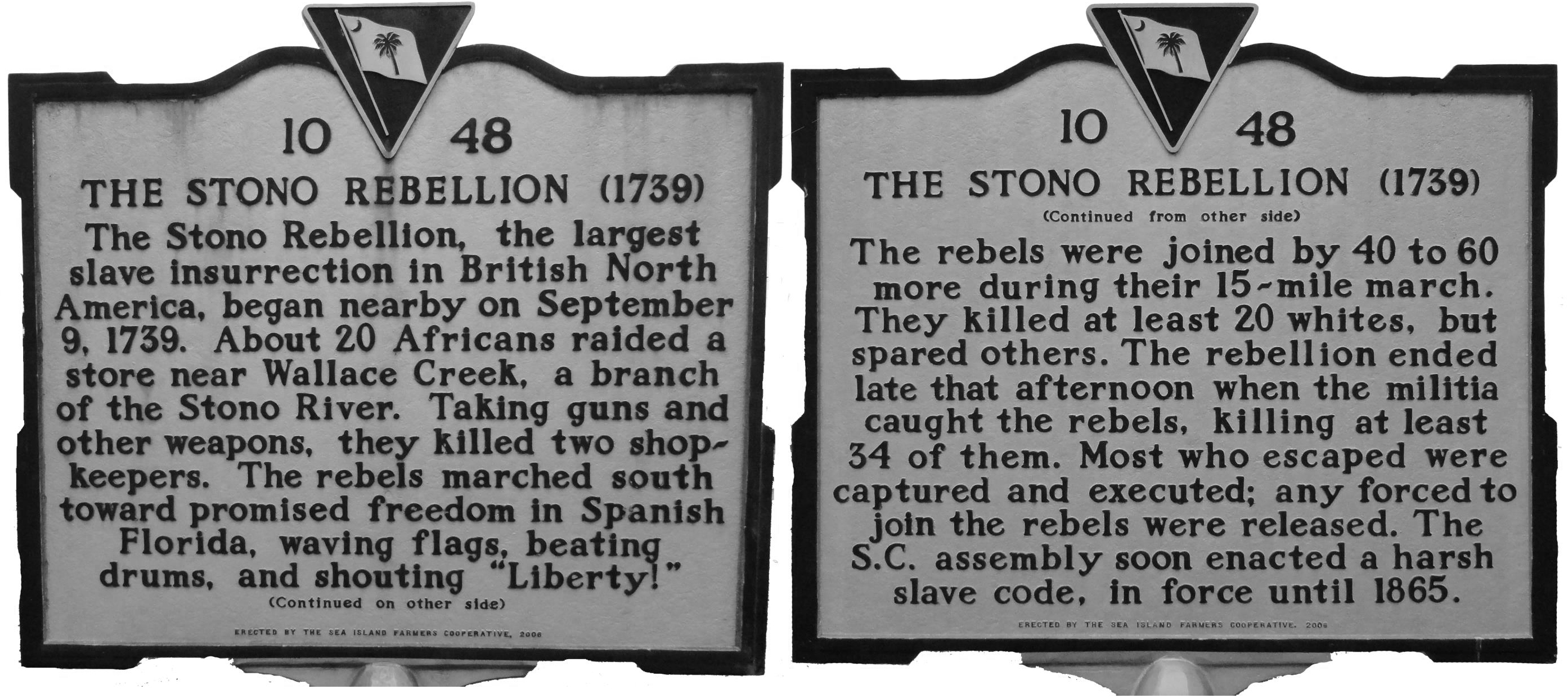
1739 – Slavery – The Stono Rebellion.

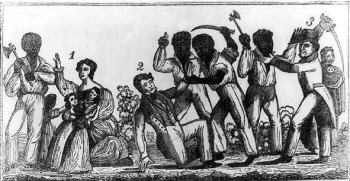
The largest slave revolt in the British colonies prior to the Revolution took place about 20 miles from Charleston.

stono markersstono_rebellionLed by an Angolan named Jemmy, a band of twenty slaves organized a rebellion on the banks of the Stono River. After breaking into Hutchinson’s store the band, now armed with guns, called for their liberty.  As they marched, overseers were killed and reluctant slaves were forced to join the company. The band reached the Edisto River where white colonists descended upon them, killing most of the rebels.  The survivors were sold off to the West Indies. More than 40 blacks and 20 whites were killed during the insurrection. 

The revolt led to stricter slave codes with the Negro Act of 1740, dictating such things as how slaves were to be treated, punished, and dressed. It forbade them from assembling with one another or being taught to read or write. The 1740 slave codes were largely unaltered until emancipation in 1865.

      William Bull submitted his account of the Rebellion to the British authorities:

My Lords,                                                            
I beg leave to lay before your Lordships an account of our Affairs, first in regard to the Desertion of our Negroes. . . . On the 9th of September last at Night a great Number of Negroes Arose in Rebellion, broke open a Store where they got arms, killed twenty one White Persons, and were marching the next morning in a Daring manner out of the Province, killing all they met and burning several Houses as they passed along the Road. I was returning from Granville County with four Gentlemen and met these Rebels at eleven o’clock in the forenoon and fortunately deserned the approaching danger time enough to avoid it, and to give notice to the Militia who on the Occasion behaved with so much expedition and bravery, as by four a’Clock the same day to come up with them and killed and took so many as put a stop to any further mischief at that time, forty four of them have been killed and Executed; some few yet remain concealed in the Woods expecting the same fate, seem desperate . . .         

It was the Opinion of His Majesty’s Council with several other Gentlemen that one of the most effectual means that could be used at present to prevent such desertion of our Negroes is to encourage some Indians by a suitable reward to pursue and if possible to bring back the Deserters, and while the Indians are thus employed they would be in the way ready to intercept others that might attempt to follow and I have sent for the Chiefs of the Chickasaws living at New Windsor and the Catawbaw Indians for that purpose. . . . 

My Lords,

 Your Lordships Most Obedient and Most Humble Servant 
Wm Bull 

1776 

The Continental Congress formally declares the name of the new nation to be the “United States” of America. This replaced the term “United Colonies,” which had been in general use. The delegates wrote, “That in all continental commissions, and other instruments, where, heretofore, the words ‘United Colonies’ have been used, the stile be altered for the future to the “United States.”

1920 – Jenkins Orphanage
jenks001

Edmund Thornton Jenkins … Jenks.

Edmund Thornton Jenkins performed a concert at his father’s church, the Fourth Tabernacle Baptist. Jenks (as he was called) grew up performing with the Jenkins Orphanage Band. His father, Daniel Jenkins, had established the Orphan Aid Society in 1891 for the “black lambs” of Charleston. Jenks attended the Royal Academy of Music for seven years in London and became an accomplished composer, pianist, and multi-instrumentalist. After graduation, he returned to visit his family in Charleston and discovered that, after years in Europe, he could no longer live in the South comfortably as a black man.