Today In Charleston History: November 1

1670

Ashley Cooper wrote to Captain West and Governor Sayle ordering that the settlement, Albemarle Point, be renamed “Charles Town.”

1765 – Stamp Act.

The Stamp Act went to effect. Ships could not get clearances to leave Charlestown harbor and courts could not conduct any legal business without stamped paper.

1773

Jacob Ramos was convicted of inciting a slave to commit a robbery of Mr. William Sommerfall. The Negro slave was hanged, and Ramos was sentenced to “stand in the pillory for an hour, pay a fine of $350, and receive 39 lashes.” During the time in the pillory Ramos was “most severel & incessantly pelted by an enraged Populace; who nevertheless were so orderly, as to not use any other Materials than rotten eggs, Apples & Onions.”

1775 – American Revolution.

Second Provisional Congress was hastily called into session in to deal with the threat the two British war ships in Charlestown harbor. William Henry Drayton was voted President of the Congress. In anticipation of Lord Campbell sailing up the Cooper River to meet with Loyalists living in the back country, Drayton ordered the blocking of Hog Island Channel by the sinking of four hulks.

1777 – American Revolution

 Upon John Hancock’s retirement due to ill health, Henry Laurens was elected President of the Congress and served until December 9, 1778. During his term, Laurens dealt with the conspiracy to replace George Washington as commander-in-chief, perpetuated by several members of Congress and the military.

dayton and laurens

William Henry Drayton and Henry Laurens

1870

 The South Carolina Institute Fair opened. It was open to all – white and black – from 9:00 a.m. to 5:00 p.m. Tickets were twenty-five cents, with more than 12,000 visitors in one day. Inside the hall visitors could see exhibits featuring the most modern agricultural equipment, sewing machines and steam engines. The main building for the South Carolina Institute Fair was on the site of the present day Citadel softball stadium. The building was 300 feet long by 80 feet wide by forty feet tall, had 154 windows and fourteen doors.The Charleston Daily News wrote:

Charleston will do her part in the grand work of building up South Carolina, and extends a cordial welcome to all her visitors, whether they come from North or West or South. There is no sectionalism in commerce, and we can promise to all who now pay our city a visit a hearty and generous reception.

 

Today In Charleston History: October 28

 1736

First Masonic Lodge in Charlestown was organized under a warrant issued by Lord Weymouth of England, Grand Master of the Ancient and Honorable Society of Free and Accepted Masons. An announcement in the Gazette said:

Last night a Lodge of the Ancient and Honorable Society of Free and Accepted Masons, was held, for the first time, at Mr. Charles Shepheard’s, in Broad Street, when John Hammerton, Esq., Secretary and Receiver General for this Province was unanimously chosen Master, who was pleased to appoint Mr. Thomas Denne, Senior Warden, Mr. Tho. Harbin, Junior Warden, and Mr. James Gordon, Secretary.

sheapheard's tavern2

Shepheard’s Tavern (corner of Broad & Church Streets), circa 1740s; In the distance on the left hand corner can be seen St. Philip’s Church

1752

Gov. Glen proposed a plan for repairing and improving the city’s fortifications. He claimed the defenses were “piece-meal” and suggested the hiring of a “regular Engineer.” Without consulting the Assembly, Glen hired German-born engineer William De Brahm.

1765 – Stamp Act

Due to political pressure and threats of violence, George Saxby and Caleb Lloyd, stamp officer and stamp distributor, publically promised not to perform their duties.

Lt. Gov. Bull called the Gazette the “Conduit Pipe of northern propaganda … poisoning the minds … against the Stamp Act.” In an effort not “to directly support and engage in the most violent Opposition” Peter Timothy temporarily suspended the publication of the South Carolina Gazette.

1790   

Charleston City Council passed an ordinance that established the Charleston Orphan House. Until a structure could be built Mrs. Elizabeth Pinckney provided a building on Market Street, close to the Sailors’ Homes, for children too young to be bound out.

Today In Charleston History: October 27

1775

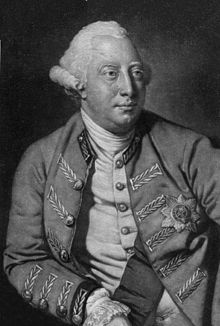
King George III declares the American colonies to be in open rebellion, due to traitorous behavior. He stated:

Many of these unhappy people may still remain their loyalty, and may be too wise not to see the fatal consequence of this usurpation, and wish to resist it, yet the torrent of violence has been strong enough to compel their acquiescence, till a sufficient force shall appear to support them.

220px-George_III_Zoffany

Today In Charleston History: October 26

1759 – French and Indian War.

Governor Lyttleton left Charlestown, marching for Fort Prince George (present-day Pickens County, South Carolina) with 1500 troops (including Christopher Gadsden) to put down the Cherokee rebellion.

Fort Prince George

Fort Prince George


1765 – Stamp Act.

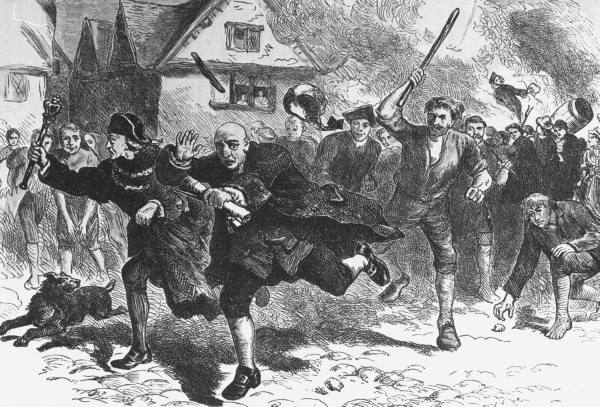
A mob of citizens marched the streets threatening to kill the two stamp agents, George Saxby and Caleb Lloyd, unless they resign.

Stamp Act Rioting

Stamp Act Rioting

Today In Charleston History: October 23

1704 – Religion

 Francis Simonds, a widow, donated a plot of land for the construction of a dissenting church building, the White Meeting House – the site of the current Circular Church on Meeting Street.

1754 – Births

t. pinckneyThomas Pinckney born in Charleston, second son of Charles and Eliza Pinckney.

1764 – Stamp Act

 A masked and armed mob (probably members of the Sons of Liberty) of “about 60 to 80” marched on Henry Laurens’ house at midnight, suspecting that he held the stamps. Lauren’s coolness toward the Patriot cause made him suspicious in the eyes of the public. The mob held “a brace of cutlasses across my breast” and for the next hour the house was searched.  Laurens was amazed by the lack of damage to his house:

Is it not amazing that such a number of Men many of them heated with Liquor & all armed with Cutlasses & Clubbs did not do one penny damage to my Garden not even not even to walk over a Bed & not damage to my Fence, gate or House?

1830

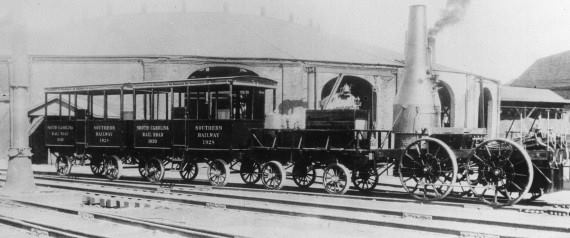
 The Best Friend arrived in Charleston on the freighter Niagra, in parts, and was taken to the shop of Thomas Dotterer where it was reassembled.

best friend

The Best Friend