Today In Charleston History: March 29

1722 – Religion.
St. Philips Church, 1723

St. Philips Church, 1722

On Easter Sunday, the congregation of St. Philip’s worshipped for the first time in their new church. The structure was described as a

work of … Magnitude Regularity Beauty … not paralleled in his majesty’s Dominions in America … lofty arches and massive pillars, an octagonal tower topped by a dome and a quadrangular Lantern and weathervane soared eighty feet above the church.

1780 – The Seige of Charlestown.

The British army crossed the Ashley River and landed on the Charlestown peninsula, two miles north of the Continental lines, approximately near the present-day site of the Citadel. 

Due to lack of men the Continental army could not stop the British crossing. Gen. Lincoln was so determined to save Charlestown that he gambled by keeping the bulk of the Southern Army within the city. However, he did order a light infantry unit led by Col. John Laurens to take post outside the city’s fortifications “to watch the motions of the Enemy and prevent too sudden an approach.” He also wrote to the Continental Congress:

We have to lament that, from the want of Men, we are denied the advantages of opposing them with any considerable force in crossing this river.


Today In Charleston History: March 27

1780 – The Siege of Charlestown.

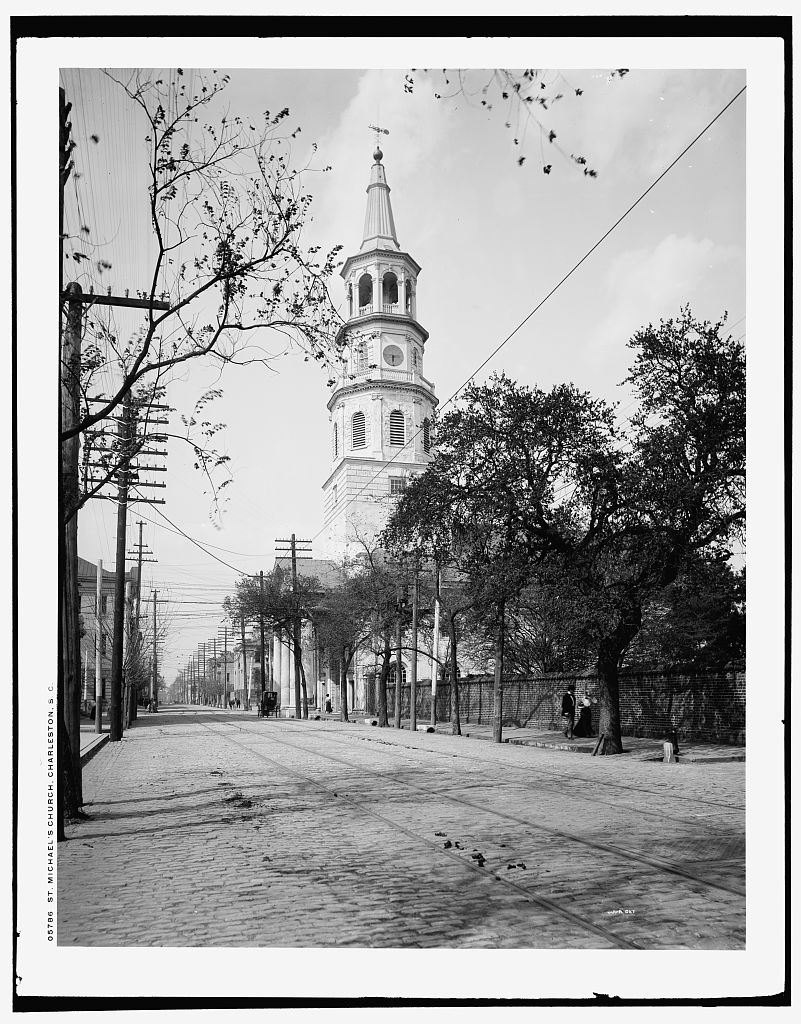
From St. Michael’s steeple, Peter Timothy reported over thirty British flatboats along the Wappoo Cut “skulking in the marsh.”

St. Michael's Church

St. Michael’s Church

During the months leading up to the British siege of Charlestown, St. Michael’s steeple was used as a lookout tower to report on troop movements outside the city. Peter Timothy, editor/publisher of the South Carolina Gazette was a Revolutionary and published passionate pro-Patriot stories. After the British successfully captured Charlestown, Timothy was one of thirty-three patriots arrested and placed in the provost dungeon of the Exchange Building.

During their passage to exile in St. Augustine, Timothy was “lost at sea” according to British reports. 

1812.

Robert Newman Gourdin was born at Buck Hall Plantation in St. John’s Parish. He was the son of Dr. Samuel Gourdin and Mary Doughty Gourdin.

Gourdin graduated from South Carolina College in 1831, read law, and was admitted to the bar in 1834. He and his brother Henry were members of the prosperous mercantile firm Gourdin, Matthiessen, and Company of Charleston. Robert Gourdin was active in city and state affairs; he served as an alderman in Charleston and toward the end of the Civil War he served as a colonel in the South Carolina reserves.

Gourdin was a signer of the Ordinance of Secession from St. Philip and St. Michael’s Parishes, Charleston, at the Secession Convention of South Carolina; he was listed in the Journal of the Convention as a commission merchant, age 48, in 1860. He was chairman of the Executive Committee of the “1860 Association” of Charleston. Gourdin, who never married, died in Charleston February 17, 1894, and is buried in Magnolia Cemetery, Charleston, South Carolina.

1860. Road To Disunion.

Population trends were going against the South, and Southerners were also becoming dependent on Northern manufacturers. The Mercury noted that:

A church built in Charleston was apt to have its doors, windows, and even pulpit made to order in the North. We thus starve our own artisan-laborers and send out money away to strengthen, enrich and fatten those who are ready to draw the sword of extermination on us.

1888. Lily Langtry Plays Charleston.

The “fair Jersey lily” as she was called, appeared on the Charleston stage at the Academy of Music. As a young woman, Lily Langtry had been celebrated in New England society for her “beauty and charm. Her looks and personality attracted interest and invitations from artists and society hostesses.” In 1874, the 20-year old Lily married Irish landowner Edward Langtry. For the next decade she became famous in European society, becoming the mistress of the Prince of Wales, Albert Edward, and was befriended by Oscar Wilde and actress Sarah Bernhardt. She also became the mistress of German Prince Louis of Battenberg and Charles Chetwynd, Earl of Shrewsbury.

lily langtry - two views

Lily Langtry, two views. Courtesy of the Library of Congress

In 1881, due to her husband’s financial difficulties (and Lily no longer the official mistress of Prince Albert) she became an actress and quickly was drawing large crowds to the theater, more due to her scandalous celebrity than her skill on the stage.

Her appearance in Charleston met with mixed reviews. Her beauty and style were fawned over in local papers, filled with detailed descriptions of her costumes:

The lower skirt was of satin brocade, trimmed in waves of golden beads, the tight-fitting bodice covered with three glittering pendants … a short puffed sleeve … on the right arm, while from the bare left arm fell a drapery of white crepe which, with the crepe over-skirt and train, gave a very Grecian effect to the whole.

Every seat at the Academy of Music was priced at $1.50; there were no “cheap seats” for Lily’s performance. Although she was praised as a beauty, a reviewer reported that “it was doubtful that one in twenty would care to see her again.”


Today In Charleston History: March 1

1711 – Religion
St. Philips Church, 1723

St. Philips Church, 1723

At the urging of Rev. Gideon Johnston, a law was passed for “Erecting a New Brick Church,” a new St. Philip’s on “the east side of Church-street, a few poles north of Queen-street.”  The Assembly realized the true entrance of the city was not by road (Broad Street) but by ship, so it was determined to build the new church closer to the harbor.

1755

The new State House at Broad and Meeting streets opened. It was the largest and grandest building in South Carolina described as a

“two-story, large, commodious Brick Building … of about 120 by 40 feet … decorated with four … columns.”

1771 – Slavery

Edmund Jones and Joseph Jordan were hanged for “aiding runaway slaves.” Jones, the master of the schooner Two Josephs, and Jordan, a sailor, allegedly had stolen the schooner, taking with them several slaves. Several slaves who had run away on the Two Josephs, were hanged together with Jordan and Jones.

1774
Edward Rutledge

Edward Rutledge

Edward Rutledge married Henrietta Middleton, daughter of Henry Middleton, one of the wealthiest and most influential men in South Carolina with 50,000 acres and 800 slaves. This marriage solidified many alliances with other prominent South Carolina families that would play important roles in the coming Revolution. 

Today In Charleston History: February 28

1752 – Births
William Washington

William Washington

William Washington was born in Stafford County, Virginia. He was second cousin to George Washington and would later play an important role during the Revolution in South Carolina.  

Washington was elected a captain of Stafford County Minutemen on September 12, 1775, and became part of the 3rd Virginia Regiment, Continental Line on February 25, 1776, commanding its 7th Company. His lieutenant and second-in-command was future President of the United States James Monroe. 

On November 19, 1779, was transferred to the Southern theatre of war, and marched to join the army of Major General Benjamin Lincoln in Charleston, South Carolina. On March 26, Washington had his first skirmish with the British Legion, under command of Lieutenant Colonel Banastre Tarleton, which resulted in a minor victory near Rantowle’s Bridge on the Stono River in South Carolina. Later that same day, during the fight at Rutledge’s Plantation Lt. Col. Washington again bested a detachment of Tarleton’s dragoons and infantry.

Washington and Tarleton at the Battle of Cowpens

Washington and Tarleton at the Battle of Cowpens

During the Battle of Cowpens, January 17, 1781, Washington’s cavalry was attacked by Tarleton’s forces again. Washington managed to survive this assault and in the process wound Tarleton’s right hand with a sabre blow, while Tarleton creased Washington’s knee with a pistol shot that also wounded his horse. For his valor at Cowpens, Washington received a silver medal awarded by the Continental Congress executed under the direction of Thomas Jefferson.

September 8, 1781, the Battle of Eutaw Springs was the last major battle in the Carolinas, and Washington’s final action. Midway through the battle,  Washington charged a portion of the British line positioned in a blackjack thicket along Eutaw Creek. The thicket proved impenetrable and British fire repulsed the mounted charges. During the last charge, Washington’s mount was shot out from under him, and he was pinned beneath his horse. He was bayoneted and taken prisoner, and held under house arrest in the Charleston area for the remainder of the war.

The British commander in the South, Lord Cornwallis, would later comment that “there could be no more formidable antagonist in a charge, at the head of his cavalry, than Colonel William Washington.”

After the war Washington married Jane Elliott of Charleston and for the remainder of his life lived at 8 South Battery and on the Elliott family plantation at Rantowles.

William Washington House, 8 South Battery, Charleston

William Washington House, 8 South Battery, Charleston

1758

A “New Barracks” of pine-timber was constructed for British soldiers on what is now the site of the College of Charleston. Lt. Col. Bouquet again demanded that the Assembly pay the officers’ rents in private homes. The legislature refused, claiming that the traditional right of Englishmen to be free of quartering soldiers was being violated. 

1774

The South Carolina Gazette reported of “a most infamous and dangerous Set of Villains, of whom the Public had entertained very little Suspicion.” Two slaves were arrested as “Principals” in “several of the Burglaries and Robberies, which had been so frequent of late.” After questioning the slaves, authorities also arrested “John Thomson, an Umbrella-maker and Shop-keeper, Richard Thomson, who kept a Livery Stable, and George Vargent, a Coachman.”

The two slaves received a death sentence and were hanged a few days later. The three white men were sentenced to sit twice in the pillory where they were “most severely pelted,” given a whipping of thirty-nine lashes each, and fine from 25 to 500 pounds.

Today In Charleston History: February 25

1746 – Births

Charles Cotesworth Pinckney, a Future signer of the U.S. Constitution, was born in Charles Town. He was the eldest son of Charles and Eliza Pinckney. Seven years later, he accompanied his father, who had been appointed colonial agent for South Carolina, to England. As a result, Cotesworth enjoyed a European education.

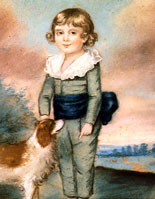
SC-C117key

Charles Cotesworth Pinckney, age 6

He received tutoring in London, attended several preparatory schools, and went on to Christ Church College, Oxford, and graduated in 1764. Pinckney next pursued legal training at London’s Middle Temple. He was accepted for admission into the English bar in 1769. He then spent part of a year touring Europe and studying chemistry, military science, and botany under leading authorities.

In late 1769 Pinckney sailed home. He entered private practice in South Carolina and was elected to the provincial assembly. In 1773 he acted as attorney general in the colony. In 1775 he was a supporter of the patriot cause and was elected to the provincial congress. The next year he was elected to the local committee of safety and made chairman of a committee that drew up a plan for the interim government of South Carolina.

When hostilities broke out, Pinckney, who had been a royal militia officer since 1769, pursued a full-time military calling and joined the First South Carolina Regiment as a captain. He rose to the rank of colonel and fought in the South in defense of Charleston and at the Battles of Brandywine, PA, and Germantown, PA. He commanded a regiment in the campaign against the British in the Floridas in 1778 and at the siege of Savannah. When Charleston fell in 1780, he was taken prisoner and held until 1782. The following year, he was discharged as a brevet brigadier general.

19065-004-E8F2454A

Pinckney, military officer for Continental Army

After the war, Pinckney resumed his legal practice and the management of estates in the Charleston area but found time to continue his public service, which during the war had included tours in the lower house of the state legislature (1778 and 1782) and the senate (1779).

Pinckney was one of the leaders at the Constitutional Convention. He was present at all the sessions, and strongly advocated for a powerful national government. He proposed that senators should serve without pay, but that idea was not adopted, but he exerted influence in such matters as the power of the Senate to ratify treaties and the compromise that was reached concerning abolition of the international slave trade. 

Pinckney became a devoted Federalist. Between 1789 and 1795, he declined presidential offers to command the U.S. Army, to serve on the Supreme Court and as Secretary of War and Secretary of State. In 1796, he accepted the post of Minister to France, but the revolutionary regime refused to receive him and he was forced to proceed to the Netherlands. The next year, however, he returned to France when he was appointed to a special mission to restore relations with that country. During the ensuing XYZ affair, refusing to pay a bribe suggested by a French agent to facilitate negotiations, he was said to have replied “No! No! Not a sixpence!”

When Pinckney arrived back in the United States in 1798, he found the country preparing for war with France. That year, he was appointed as a major general in command of American forces in the South and served in that capacity until 1800, when the threat of war ended. That year, he represented the Federalists as Vice-Presidential candidate, and in 1804 and 1808 as the Presidential nominee, but was defeated on all three occasions.

pinckney_1_lg

An elderly Cotesworth Pinckney

For the rest of his life, Pinckney engaged in legal practice, served in the legislature, and was active in many philanthropic activities. He was:

  • a charter member of the board of trustees of South Carolina College (later the University of South Carolina)
  • first president of the Charleston Bible Society
  • chief executive of the Charleston Library Society

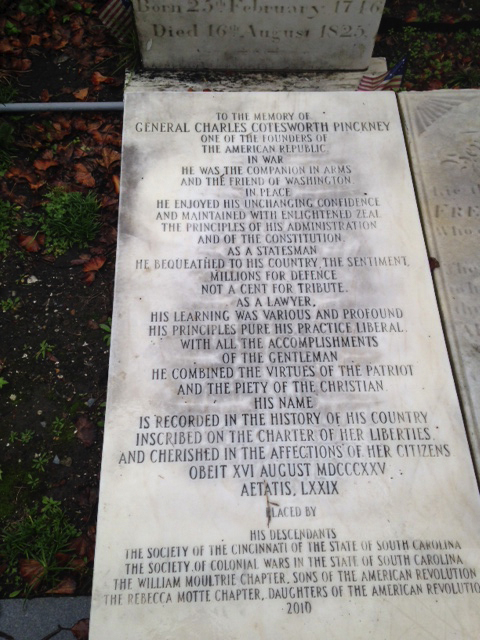
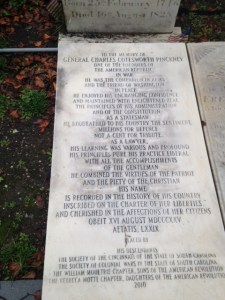
During the later period of his life, Pinckney enjoyed his Belmont estate and Charleston high society. He was twice married; first to Sarah Middleton in 1773 and after her death to Mary Stead in 1786. He died in Charleston in 1825 at the age of 79 and was interred there in the cemetery at St. Michael’s Episcopal Church.
Charles-Cotesworth-Pinckney-Grave-Charleston-SC

Grave of Charles Cotesworth Pinckney, St. Michael’s Church

1807

George Alfred Trenholm  was born in Charleston, South Carolina. Due to his father’s death, George left school at age 16 to work for a major cotton broker, John Fraser and Company in Charleston. By 1853 he was head of the company, and by 1860 he was one of the wealthiest men in the United States with financial interests in steamships, hotels, cotton, plantations, and slaves. His fortune including owning real estate worth $90,000 and personal property (including slaves) valued at about $35,000.  About 39 enslaved persons lived with Trenholm’s family as domestic staff in Charleston.

GATrenholm

George Trenholm

When the War broke out, Trenholm immediately moved his company’s head office from New York to the Bahamas, Bermuda and Liverpool. He was appointed to South Carolina’s State Marine Battery Commission, where he oversaw construction of the Confederate ironclad Chicora. Trenholm also personally financed construction of a twelve-vessel flotilla for Charleston’s defense. During the War, his company – now called Fraser, Trenholm and Company – became the Confederate government’s overseas banker. From their Liverpool office, they arranged cotton sales and financed its own fleet of blockade runners, profiting more than $9 million.

Confederate Secretary of the Treasury, Christopher Memminger, used Trenholm as an unofficial adviser. When Memminger resigned, Trenholm was appointed to that post on July 18, 1864.

When Richmond fell to Federal troops, Trenholm fled with the rest of the government in April 1865 and reached Fort Mill, South Carolina. Due to illness he asked President Jefferson Davis to accept his resignation, which Davis accepted with his thanks on April 27, 1865. Trenholm was later briefly imprisoned at Fort Pulaski near Savannah, Georgia. He was pardoned by President Andrew Johnson and ordered released on October 11, 1865. 

E. Lee Spence wrote a book in 1995, Treasures of the Confederate Coast: The ‘Real Rhett Butler’ & Other Revelations, which effectively argued the case that Trenholm was the inspiration for the character of Rhett Butler in Margaret Mitchell’s Gone with the Wind.

1910

The South Carolina Military Academy officially changed its name name to “The Citadel, The Military College of South Carolina.” The word “Academy” had become synonymous with secondary schools and the public had the misconception that the South Carolina Military Academy was a preparatory school.

1920px-The_Citadel_at_the_start_of_the_Civil_War._Image_on_display_at_Fort_Sumter_National_Monument

The South Carolina Military Academy, c. 1861. 

Today In Charleston History: February 15

1780-The Seige of Charlestown.

Peter Timothy, editor of the South Carolina Gazette, took the post in the steeple of St. Michael’s Church to report on British land and sea movements. He could see smoke from the British encampments on John’s Island and numerous ships off the Charlestown bar.

The British army crossed the Stono River from John’s Island to James Island, giving them a staging area and view of Charlestown across the Ashley River. They settled in to wait for the British navy to cross the Charleston bar to reinforce and re-supply the army. Over the next five weeks, Clinton’s army seized corn, oxen, cattle, horses, pigs and other supplies from dozens of plantations in the area.

1792

The first Race Week was held at the new Washington Race Course, won by Fox Hunter, owned by Mr. Lynch.

WashingtonCourse_650x650

1857 view of the grandstand, published in John Beaufain Irving’s the South Carolina Jockey Club.


Today In Charleston History: February 9

1760 – England

 John Rutledge was called to the English bar and sailed home for Charlestown soon after.

1776 – American Revolution

The South Carolina delegation returned from the Continental Congress. During the return trip from Philadelphia aboard the Hawke, the British man-o-war Syren bore down on the small pilot boat. Capt. Joseph Vesey sailed hard for the shore and beached the Hawke on the North Carolina coast. The delegates and crew scrambled to safety in a nearby swamp and made their way overland to Charles Town, leaving the Hawke as a prize for the British.

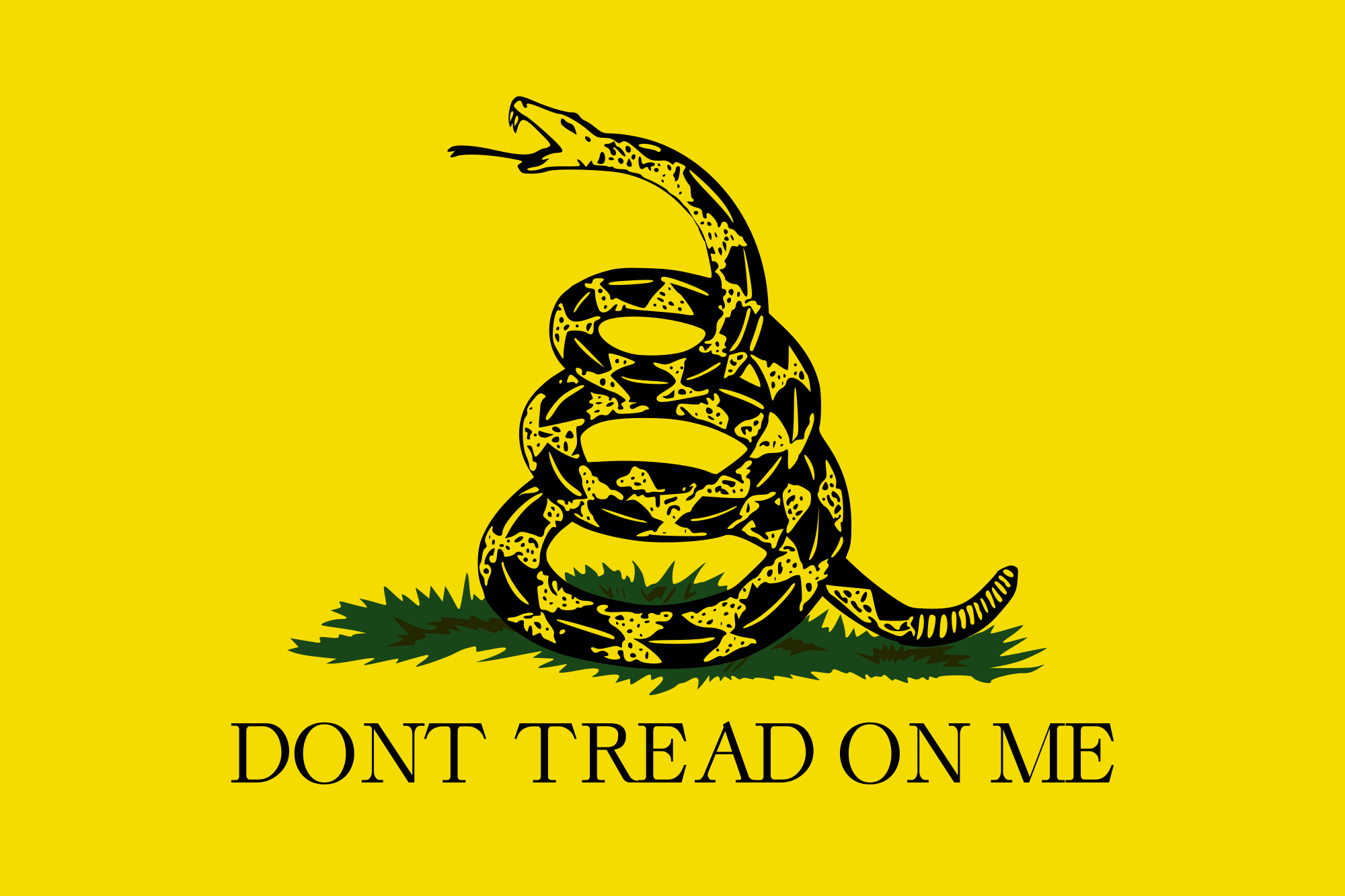
2000px-Gadsden_flag.svgOnce in Charlestown John Rutledge warned that a British attack in the South was probable. Christopher Gadsden presented his “Don’t Tread on Me” flag to the Provincial Congress. As recorded in the South Carolina congressional journals the proclamation read: 

Col. Gadsden presented to the Congress an elegant standard, such as is to be used by the commander in chief of the American Navy; being a yellow field, with a lively representation of a rattlesnake in the middle in the attitude of going to strike and these words underneath, “Don’t tread on me.”

Gadsden also a presented copy of Thomas Paine’s just published Common Sense, which helped inflame local political sensibilities.


Today In Charleston History: February 8

1671 – Arrivals  

Forty-two settlers arrived in Charles Town from Barbados on the ship John and Thomas, named for the two men who outfitted the vessel, John Strode and Thomas Colleton.

1780 – The Seige of Charlestown

Colonel Charles Cotesworth Pinckney, commander of Ft. Moultrie, complained to Gen. Lincoln he was short both men and ammunition. He requested 1215 troops to man the walls, artillery and defensive works. He only had 200. He wrote:

“If half cannot be obtained, I shall make the best defense in my power with the number that may be allowed me.”

1824 – Births

Barnard Elliott Bee Jr.  was born in Charleston, South Carolina, the son of Barnard Elliott Bee, Sr., and Ann Wragg Fayssoux, in his grandfather’s house on Tradd Street.  Bee graduated from the United States Military Academy in 1845, thirty-third in his class and assigned to the 3rd U.S. Infantry. He accumulated many demerits while at West Point, including several for chewing tobacco while on duty.

Bee became a career United States Army officer and a Confederate States Army general during the American Civil War. Bee was appointed brigadier general and given command of the third brigade of the Army of the Shenandoah, under Brig. Gen. Joseph E. Johnston.

During the subsequent battle, known as the First Battle of Bull Run, or Manassas. Bee used the term “stone wall” in reference to Brig. Gen. Thomas J. Jackson and his men, giving rise to the name “Stonewall Jackson” and his Stonewall Brigade. There has been debate over whether this nickname was meant in admiration or as an insult due to Jackson’s men not advancing –  “stone wall’ symbolizing being immobile.

Bee was mortally wounded as the Confederates began to gain the upper hand in the battle. He died the following day – one of the first general officers to be killed in the war. As a result, it could not be determined whether his naming of Stonewall Jackson was intended as praise, a condemnation. He is buried in Pendleton, South Carolina. 

Bernard Bee; Peter Fayssoux House, Tradd Street, Charleston

L: Bernard Bee. R: Peter Fayssoux House, Tradd Street, Charleston


Today In Charleston History: January 31

1780 – The Seige of Charlestown

Continental Army General Benjamin Lincoln requested that Governor John Rutledge “order 1500 Negroes to assemble in the vicinity of this town with the necessary tools for throwing up lines immediately.”

1800

Charles Pinckney delivered a speech in the U.S. Senate on the subject of trial by jury.

Viewing as I do impartial juries as among the most indispensable ingredients of a free government, it is my duty to declare … that in those states in which the federal marshals have a right to summon jurors as they please, the people are not free!

1863 – Civil War
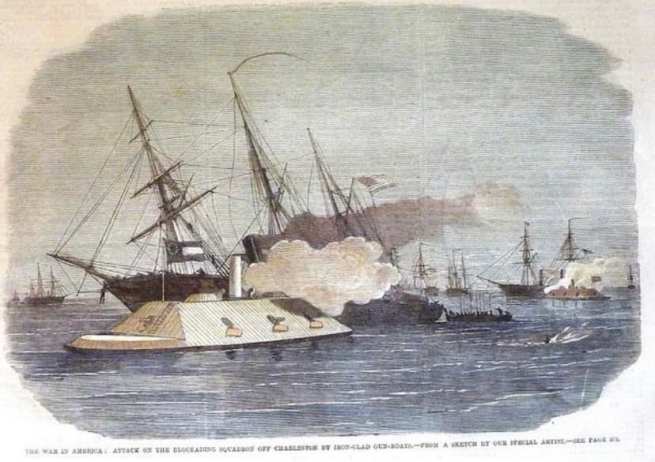
At about 5am, Confederate ironclads CSS Palmetto State and CSS Chicora attack the Union blockade outside of Charleston harbor. The Palmetto State rammed bow first into the Mercedita’s port quarter, ripping a hole in the ships keel. The Confederate crew fired its point blank into the Mercedita, bursting the ship’s boilers, immediately crippling the ship. The Chicora  and the USS Keystone State exchanged fire, with a Confederate shot hitting the steam drum on the Keystone State. The explosion killed 20 men. The Chicora signaled for the ships surrender but there was no reply.
Union ships began to arrive and both sides fired at one another until sunrise, when the wooden Union navy retreated, unable to inflict damage upon the iron side Confederate warships.

ironclad attack - 1863

 1864 – Civil War   

 Colonel W.W.H. Davis took in three Confederate Irish deserters from Charleston who complained they were “much pinched for food.” From the deserters accounts Davis reported that:

Our shells have done considerable damage in Charleston. Most of the shells explode, but as yet few people have been injured by them. Charleston is depopulated, except by the very poorest class of people, and they have moved as far uptown as they can get. Beauregard’s headquarters and all the public offices have been removed to the upper part of the city. 

meetingengraving

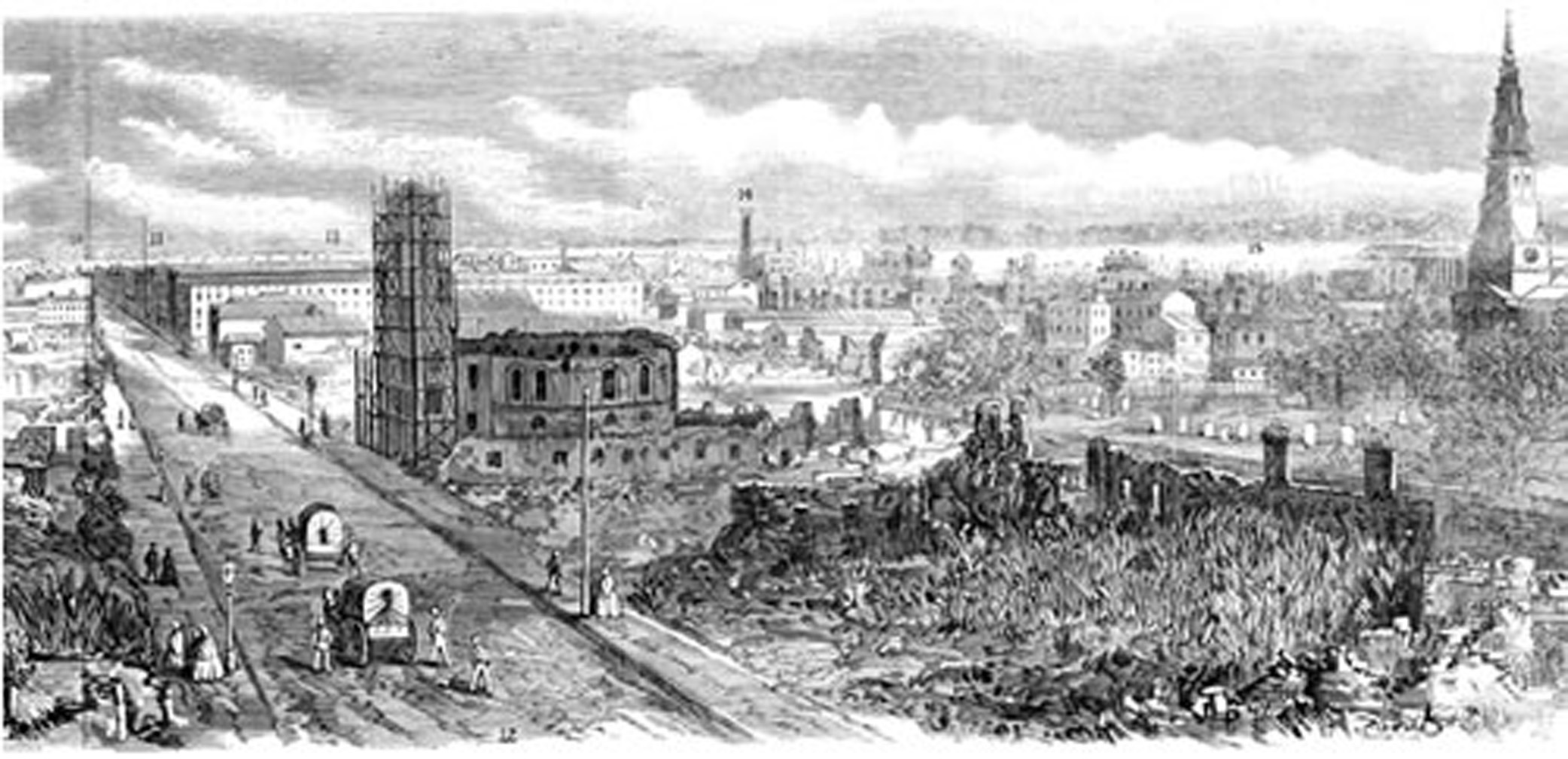
Charleston, Meeting Street, circa 1865 – Ruins of the Circular Church after the 1861 fire and Federal Bombardment.

Today In Charleston History: January 28

1787 – Marriage

Dr. David Ramsay married Martha Laurens.

Ramsay had been married twice, and tragically lost both wives within a year of being married. Martha was the beloved daughter of Henry Laurens, former President of Continental Congress, and the first American imprisoned in the Tower of London (he was arrested by the British while acting as an agent for Congress raising funds for the Revolution in Europe.) Ramsay met Martha while he was researching his History of the Revolution of South Carolina. 

1861 – Secession 
Pierre Gustave Toutant Beuaregard

Pierre Gustave Toutant Beauregard

P.G.T. Beauregard was removed as Superintendent of the U.S. Military Academy at West Point. It was the shortest tenure of any superintendent – five days. His orders were revoked when his native Louisiana seceded from the Union. Beauregard protested to the War Department that they had cast “improper reflection upon [his] reputation or position in the Corps of Engineers” by forcing him out as a Southern officer before any hostilities began.

Within a month he resigned his commission and became the first Brigadier General of the Confederate Army. He served in Charleston and ordered the firsts shots of the War be fired at Fort Sumter. 

1866 – Civil War

The melted fragments of St. Michael’s bells were shipped to England by Fraser, Trenholm and Company. 

The bells for St. Michael’s were cast in 1764, by Lester & Pack in London. When the British evacuated Charleston in 1782 as part of their plunder, the eight bells of St. Michael’s were taken back to England. Shortly afterward, a merchant in London secured the bells and returned them to a grateful Charleston. 

st. michael's - postcard

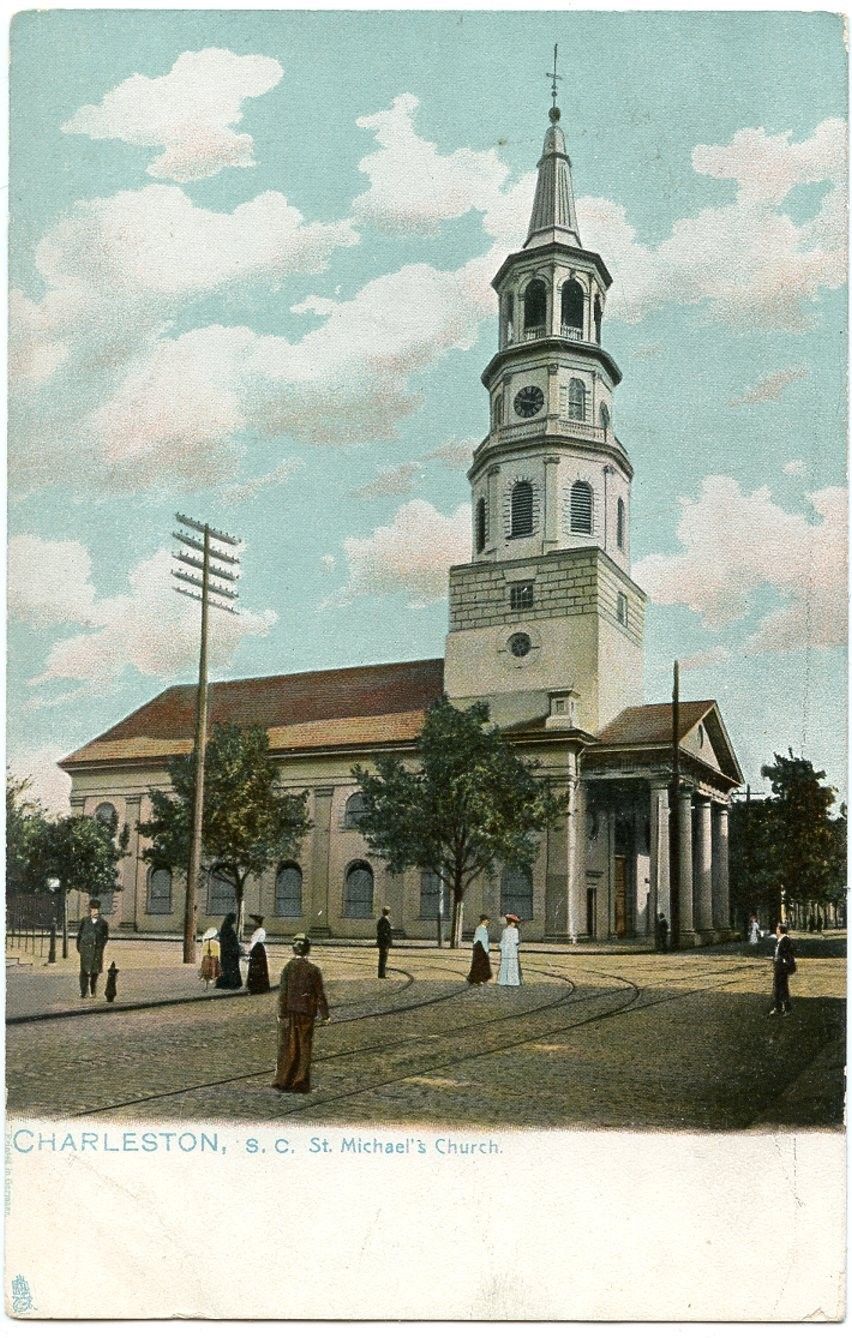
St. Michael’s Church

In 1864, when Sherman made his march through the South Carolina, Charleston expected to be in his path, so the bells were sent to Columbia for safe-keeping.  Sherman by passed Charleston and burned Columbia, the state capital. The shed in which the bells were stored was burned and the bells were reduced into molten slag. The metal was salvaged and the bells were sent to London to be recast by Lester & Pack – today in history.The bells were returned in 1868 and resumed their place in the church.

In 1989, the bells were damaged by Hurricane Hugo in 1989. They once again were shipped to London for repair. They can be heard chiming in Charleston today on an hourly basis.