Sir John Yeamans died in Carolina. He was one of original landgraves of the Carolina colonial and became governor. In 1674 Yeamans was removed from office, and at once sailed for Barbados, where he soon afterward died. Robert Weir wrote:
Yeamans epitomized the enterprising Barbadians who played a large part in settling South Carolina. That some, like him, resembled pirates ashore probably both promoted and retarded development of the colony; it certainly contributed to political factionalism endemic during the early years.
1769 – American Revolution – Foundations.
William Henry Drayton was a twenty-seven year old planter who refused to join the Association. Educated in England, Drayton had expensive tastes and his fondness for gambling left him deeply in debt. He was described as “a rather frivolous young lightweight, unable to get his life in order.”
When Drayton discovered there was no market for his plantation goods, he attacked the Association in the Gazette. The publication of his name was “an infringement of individual rights” and “only the legislature could brand a man an enemy of his country.” He contemptuously called Gadsden: “either traitor or madman who looks upon himself as a monarch … the ruler of the people …[who should be] locked in an insane asylum until the change of the moon.”
1776 – American Revolution – Continental Congress.
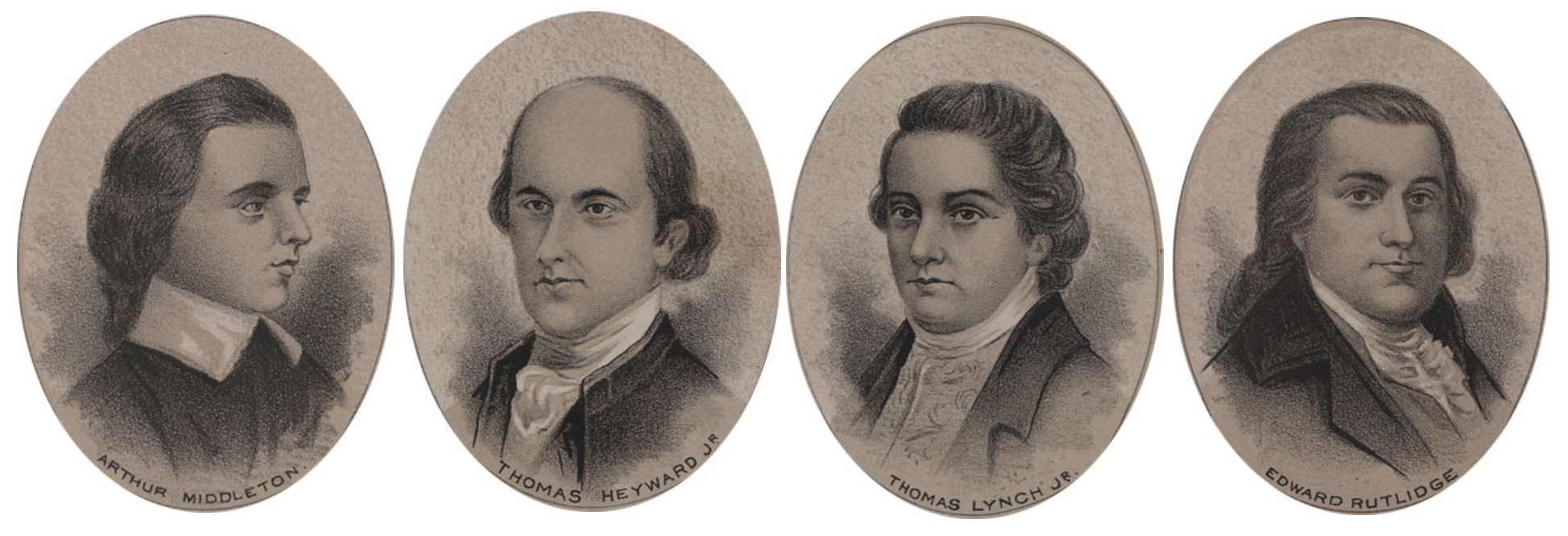
Most of the members of the Continental Congress officially signed the Declaration of Independence on this day. They then turned their attention to creating a union of the thirteen colonies. South Carolina signers were: Edward Rutledge, Arthur Middleton, Thomas Heyward, Jr. and Thomas Lynch, Jr.
South Carolina signers of the Declaration of Independence.
1781 – British Occupation.
A group of citizens meet Lord Rawdon at the Miles Brewton House to plead for Issac Hayne’s life. Col Hayne’s son, William Hayne wrote:
I recollect also going with my brother Issac & sister Sarah in Company of my Aunt Peronneau to Lieut. Col. Balfour … and on our knees presenting a petition to him in favor of my father but without effect.
1807
The trial of Aaron Burr began before a packed house. His daughter,Theodosia Burr Alston, sat in the courtroom next to her Charleston husband, Joseph Alston, during the trial. It was written about her:
There is nothing in human history that is more touching than her devotion during this ordeal. Beautiful, intelligent far beyond the average woman of her time, she was the center of admiration throughout the trial.
1836 – Religion.
Angelina Grimke Weld
Angelina Grimke was moved to speak at a silent prayer at the Orange Street Quaker Meeting in Philadelphia. She was interrupted by Jonathon Edwards, suggesting that she stop speaking. This convinced Angelina that she could no longer live in Philadelphia, since the Quakers were not supportive of her abolitionist views. She wrote, “The incident has proved the means of releasing me from those bonds which almost destroyed my mind.”
She became a full-fledged public abolitionist.
1864 – Bombardment of Charleston.
In the North Channel just outside the Charleston harbor during the morning, Union officers were exchanged for an equal number of Confederate officers.
Why are there no members of the world famous Jenkins Orphanage Band in the South Carolina Entertainment and Music Hall of Fame, or the Lowcountry Music Hall Of Fame? The Hall has such luminaries as Andie McDowell (we still watch “Groundhog Day” despite her being in it), Leeza Gibbons (celebrity-news reader) and Vanna White (the only professional letter-turner in the Hall of Fame.) The Hall also counts as members Rob Crosby, Bill Trader and Buddy Brock. (Yeah, I know, you’ll probably have to Google them to find out who they are too.)
I am not saying that any of these people don’t deserve to be in the Hall – they probably do. But not to the exclusion of more deserving artists. I would like to nominate several artists currently not in the Hall who influenced and enriched American culture in more deserving ways than interviewing celebrities on “Entertainment Tonight” or being eye candy for a game show.
From the 1890s to the 1940s the Jenkins Orphanage Band traveled across the United States and across Europe performing on street corners, on Broadway and for royalty. Members of the Jenkins Band were instrumental in transforming the music performed during 19th century minstrel shows into blues, ragtime and ultimately, jazz. My nominees are:
EDMUND THORNTON JENKINS
Edmund Thorton Jenkins
Born – April 9, 1894, Charleston, South Carolina Died- September 12, 1926, Paris, France
His father, Rev. Daniel Jenkins operated the Orphan Aid Society (a.k.a. the Jenkins Orphanage) which operated a boy’s brass band as a fundraising tool, as a kind of minstrel show on the sidewalks of towns up and down the East Coast. Called “Jenks” by everyone, he received private piano lessons from a white man in Charleston, Mr. Dorsey, and quickly mastered the piano, clarinet and violin. His father insisted that he work as a music instructor for the Jenkins Band, and also travel with them. Jenks resented having to lead a group of ragamuffin orphans who mugged, strutted and played-the-fool during their street performances. He felt it was beneath him. He wanted to play serious music. The kids, of course, made fun of the prim and dandified Jenks.
In 1910 Jenks enrolled in Morehouse College in Atlanta, Georgia to study music. Two years later he was forced by his father to leave college in order to accompany the Jenkins Band to London, where it was a featured act at the Anglo-American Expo. When the Expo came to an abrupt close, due to the outbreak of World War I, Jenks convinced his father to pay his tuition to the Royal Academy of London. For seven years Jenks excelled in his studies, winning awards for composition, and becoming a master in several instruments. During his time at the Academy he composed “Charlestonia: A Rhapsody.”
After graduation he moved to Paris where he became one of the most sought after musicians in the most popular Parisian nightclubs. Paris was “jazz mad” in the 1920s and for several years Jenks embraced the glamorous, hedonistic life of Paris. However, in 1925 he began to compose an opera, “Afram” and expanded and orchestrated “Charlestonia: A Rhapsody” which he conducted successfully in Belgium with a full orchestra. In July 1926, he was admitted to a Parisian hospital for appendicitis. He contracted pneumonia and died on September 12, 1926, cutting short the career of a promising young black composer. He is buried at the Humane Friendly Cemetery in Charleston, SC.
Listen to “Charlestonia”, composed by Edmund Thornton Jenkins.
TOMMY BENFORD
Tommy Benford in 1978
Born – April 19, 1905, Charleston, West Virginia. Died – March 24, 1994, Mount Vernon, New York.
Benford became the Jenkins Orphanage Band’s ace drummer. In 1920 he was playing in New York City and gave drumming lessons to a young wunderkind named Chick Webb. In 1928, he was the drummer for some of the most influential jazz music ever recorded as part of Jelly Roll Morton’s Victor Records sessions.
During the Depression Benford moved to Europe and for the next 30 years recorded hundreds of songs with more than a dozen bands. His most famous recording session was with Coleman Hawkins, Django Reinhardt, Stephane Grapelli and Bennie Carter, released as Coleman Hawkin’s All-Stars.
He continued to play music until his death in 1994, a career that spanned seventy years.
Watch/listen here: “Sweet Georgia Brown” by Coleman Hawkins’s All-Stars (featuring Tommy Benford).
JABBO SMITH
Jabbo Smith
Born – December 25, 1908, Pembroke, Georgia. Died, New York City – January 1991.
Raised in the Jenkins Orphanage, Jabbo quickly became one of the best Jenkins Band musicians during the years of 1915-1924. Brash and flamboyant, he was a natural performer. At age 17 he was playing in New York City at Smalls Paradise, the second most popular club in Harlem (most popular was the Cotton Club.) He became the hottest trumpet player in the city, which is like being the hottest guitar player in the hottest rock and roll band (think Eric Clapton, Jimmy Page and Eddie Van Halen.)
In 1927 he recorded one track with the Duke Ellington orchestra (“Black and Tan Fantasy”) filling in for the ailing Bubber Miley. Duke offered him a permanent job with the Ellington Orchestra, which Jabbo turned down because Duke only offered $90 a week, and Smith was making $150 with the Paradise Orchestra.
In 1928-29 Jabbo played with James P. Johnson (composer of the song “Charleston”) and Fats Waller in the Broadway show Keep Shufflin. When the show closed in Chicago Jabbo recorded nineteen historic songs for the Brunswick Record Company that are still considered some of the most influential jazz recordings. They are considered to be the first cool jazz improvisations and be-bop style playing.
By the 1950s Jabbo Smith was out of music, living in Wisconsin. As a swan song, in the 1980s he returned to Broadway in the show One Mo’Time and became the darling of New York for several months. Jabbo is a key link in the development of modern jazz trumpet playing: Louis Armstrong →Jabbo Smith →Roy Eldridge →Dizzy Gillespie→Miles Davis→Wynton Marsalis.
Watch/listen here: “Lina Blues” by Jabbo Smith.
FREDDIE GREEN
Freddie Green
Born – March 31, 1911, Charleston, S.C. Died – March 1, 1987, Las Vegas, Nevada.
Freddie Green had the longest job in jazz history, guitar player for the Count Basie Orchestra from 1937 to his death in 1987 – fifty years. He was in the Basie Orchestra longer than Count Basie himself!
As a child Freddie used to sing and dance on the streets of Charleston and became friends with members of the Jenkins Orphanage Band. Though never an orphan, he played with the Band and remained in New York City during their tour in 1932. Five years later he was discovered playing at the Black Cat Club in Harlem and asked to join the Basie Orchestra, forming what became known as the All-American Rhythm section: Basie-piano, Green-guitar, Walter Page – bass, and Jo Jones-drums.
For the next 50 years Freddie Green became the “left hand” of the Basie Orchestra, the spiritual force that held the music together. Across the world he became known a “Mr. Rhythm,” the greatest rhythm guitar player in jazz history. It is almost impossible to find a photo of the Basie Orchestra that does not include Green.
He became a composer and arranger for the orchestra and the arbitrator of good music. Byron Stripling, trumpet player for Basie said, “If an arranger comes in and his work is jive, Freddie just shakes his head and it’s all over.”
Green died in Las Vegas after a Basie Orchestra performance ending one of the quietest most legendary musical careers of the 20th century. Irving Ashby described Freddie Green’s influence on music as: “Rhythm guitar is like vanilla extract in cake, you can’t taste it when it’s there, but you know when it’s left out.”
Watch/listen here: “Corner Pocket” by the Count Basie Orchestra (written and arranged by Freddie Green.)
CAT ANDERSON
Cat Anderson
September 12, 1916, Greenville, South Carolina.
Died – April 29, 1981, Los Angeles, California.
During the late 1930s, Anderson became the latest in a line of hot trumpet players in the Jenkins Band. He developed a technique of playing in high registers, two octaves above the rest of the band. It was Anderson’s way of showing off, and getting the girls in the audience to notice him. Wynton Marsalis called Anderson “one of the best” scream trumpet players ever.
After leaving the Jenkins Band in 1937, Anderson played for several bands, and performed at the Apollo Theater in Harlem. During World War Two, Anderson played in a Special Services Army Band, performing for troops on bases across the world.
In 1945, he joined Lionel Hampton’s Band and then was hired by Duke Ellington, and became a featured player for the Duke during the next 20 years. Ellington re-arranged many of his classic songs to take advantage of Anderson’s talent for “scream” trumpet playing. Anderson is heavily featured in one of the most popular jazz recordings ever, the 1956 Newport Jazz Festival.
Through the 50s, 60s and 70s Anderson led several bands himself, and recorded several solo classic LPs with various Ellington sidemen.
Watch/listen here: Cat Anderson trumpet solo w/ the Duke Ellington Orchestra.
If you agree these men should be in the South Carolina Entertainment Music Hall of Fame, please forward/share/like /comment this article. You can read the entire story of the Jenkins Orphanage in my book, DOIN’ THE CHARLESTON.
Magnolia Cemetery is one of the greatest unknown treasures in Charleston, South Carolina. Hopefully, this book will help spread the word. For years, I’ve been hearing about this manuscript. People waxing enthusiastically about “this manuscript Ted has about Magnolia.” They kept promising it was going to dig up some dirt of those buried there (pun intended). I even ran into a couple of people who had a copy of it and promised to let me read it … to no avail.
I met Ted once in passing, through a mutual friend – it was a mere introduction, “hello”, “how are you?” and it was over. Within a year he was gone, so I never had the chance to discuss this work with him.
I have spent many pleasant hours wandering beneath the oaks and Spanish moss and taking hundreds of photos. Magnolia is thoroughly Southern (and soooo Charleston), filled with Gothic flourishes and amazing history etched on the headstones. When tourists ask me what is the one thing to see in Charleston my answer is always “Magnolia Cemetery.”
Magnolia Cemetery
City of the Silent is a simple book – several hundred concise bios of some of the notables buried in the cemetery. If you’re a Charleston history neophyte, you will learn some interesting stuff. There is a preponderance of Civil War figures (of course!), politicians, writers of questionable importance, society belles, gangsters, lawyers, and one madam. One. So much for the dirt.
If you’re a Charleston history nut (guilty) … you already know most of this stuff. So I was (and I am) a bit disappointed with the info contained within – most of it is already available in published form in one book or another.
However, the book is worth it’s hefty cover price (well, almost) for the map of the cemetery and the locations of everyone mentioned. With this book in hand, and the map you can take a stroll and find the graves and read the stories. And that is what you should do with it. Read it, mark your favorite people (see my list below) and then take a trip to Magnolia Cemetery and spend an afternoon in the tranquil presence of history – scoundrels and heroines – and everything in between.
Magnolia Cemetery, pyramid tomb
MY LIST OF FAVORITE PEOPLE IN MAGNOLIA CEMETERY
Daisy Breaux Calhoun – real name: Margaret Rose Anthony Julia Josephine Catherine Cornelia Donovan O’Donovan Simonds Gummere Calhoun. (I’m not joking.)
Langdon Cheves, Jr. – father of the Confederate Air Force.
Susan Pringle Frost – patron saint of Charleston preservationists.
Frank Hogan – bootlegger, murder victim
Leon Dunlap – bootlegger, acquitted murderer (who shot Frank Hogan)
The Crew of the H.L. Hunley – Confederate submariners.
Tristam Tupper Hyde – Charleston mayor who enforced Prohibition. (served one term)
Thomas McDow – doctor and murderer.
Josephine Pinckney – the best Charleston writer and period – period! Two classics: Three O’Clock Dinner, a superb comedy of society manners and Great Mischief, a delicious little horror book where the entrance to hell is somewhere around the corner of King and Broad Streets.
Robert Barnwell Rhett – Secessionist firebrand and newspaper editor.
George Trenholm – Confederate financier, and model for Rhett Butler.
Julius Waties and Elizabeth Waring – probably my all time favorite Charleston story. If you want to know the story … buy this book, or pick up of my own modest books about Charleston, Wicked Charleston, Volume II: Prostitutes, Politics & Prohibition. The story of the judge and his second wife is covered in great detail.
Recently I had the opportunity to talk to Savannah author, James Caskey, about his new book,Charleston’s Ghosts: Hauntings in the Holy City(Manta Ray Books, 2014). Caskey is a kindred spirit – tour guide, researcher, storyteller and curious about the historical truth, no matter how many toes and sensibilities get stepped on. We met several years ago when Caskey was the writer and producer of a television program, Phantoms of History. He kindly asked me and my wife, Rebel Sinclair, to be a part of the show, which illustrated (and de-constructed) some of Charleston’s most famous ghost stories. Since that time, we have managed to find several opportunities to meet and talk (usually over food and spirits.)
JONES: I understand why you wrote your first book,Haunted Savannah.You are a Savannah tour guide and operate a ghost tour business, so the book was a natural extension of your research for your tours. What inspired you to expand your research to other cities?
CASKEY: I’ve always been a storyteller. When I was younger I was an artist—I actually went to art school, and even in that creative medium, my paintings had a strong linear narrative. My art told historical stories, even the portraiture. Then in 2001 I got introduced to the world of guided walking tours, and it was just a natural fit for me: I had already been telling ghost stories for years, and it was sort of funny that there was this flash like: Wait, I can get paid for this?
James Caskey
I had been researching ghost stories even before I opened Cobblestone Tours, and what I found surprised me: not only were most of the ghost stories which other guides were telling as accepted truth sometimes wrong, but their history was frequently way off base, as well. The nighttime tour landscape back then was dotted with fictional tales of monsters (presented as fact) that lived in lairs under the cemetery, that sort of thing. I wanted to do better than that. I began writing initially as a way of giving my own employees a study manual for their stories, my version of ‘Cliffs Notes for Ghost Tours.’ I found that I really enjoyed the research aspect, and loved sharing the stories because the true history was so much better than the bogus folklore, most of the time. True life is almost always better than fiction. Well, my little hobby grew from there. I was three years into this process when I realized I was writing a book, a volume which eventually becameHaunted Savannah.It published in 2005. This is a very roundabout way of explaining that once the Savannah book was in stores, I really missed that ‘researching and writing’ process. It took me a long time to muster up the courage to tackle another major writing project. Once I decided to do it, though, I really wanted to engage a city with which I was completely unfamiliar. I mean, New Orleans is over eleven hours away by car, one way, and I knew very little about it. It was a big leap. The book is very much about that journey and exploration, and fortunately I get a lot of feedback from readers that they find that level of honesty refreshing. There was definitely a fear of failure, and some moments of confusion, mixed in with the joy of unveiling an exotic and personally unknown place. New Orleans has some great stories.
JONES: Your books are as much history as they are ghost stories. What are the major problems you encounter in this type of research?
CASKEY: Well, you have a certain type of person who prefers the erroneous folklore: some just really want their pre-conceived notions confirmed. However, the documented history I present in my books is unvarnished, and often less tidy than the version you might hear on a ghost tour. It can be an uncomfortable thing, to eviscerate a legend that another person believes as fact. I know from our discussions that you experienced the same exact thing regarding Lavinia Fisher when you wroteWicked Charleston—the fictionalized wedding dress, the erroneously high body count, etc. People will really argue for the campfire tale sometimes, even if you can back your assertations up, point by point. I want to present both sides: the legend AND the facts. If people just want a recounting of the bogus folklore, well… those books are already out there. Don’t get me wrong, I love a good story and folklore can be very entertaining, but you’re also going to learn the truth from my books. I don’t research and write to satisfy people’s expectations: my writing is really a process of discovery.
JONES: Why did you choose Charleston as the subject for your third book?
CASKEY: Charleston SC is one of the most tragic and historically violent places in North America. It is haunted by more than just ghosts: secession, slavery, great fires, yellow fever, and a uniquely brutal timeline. There was no question whether or not I was going to write about it, the only question was when.
JONES: Are there major differences in the paranormal history between New Orleans, Savannah and Charleston? If so, what are they?
CASKEY: Honestly, I’m more fascinated by the similarities. Each location once had a huge Native American population, if you go back to before their contact with Spanish and English explorers. There was a horrific genocide in the American South, starting in the mid-1500’s, on a scale which is scarcely conceivable today. The American Indian populations were largely eradicated. All three towns had their formation shortly after that cauldron of disease, war, and death. It’s no wonder so many Southern seaport cities have such haunted reputations!
JONES: What was your favorite Charleston ghost story before you wrote the book? Is it still your favorite?
CASKEY: I probably liked the Old Exchange and Provost Dungeon the most, going in. I still love it, but there are other stories which sparked my interest a little more, like Madame Talvande and the Sword Gates on Legare Street. Charleston has such a wonderfully twisted history, and is a fertile ground for storytellers.
JONES: What was the most surprising story you uncovered during your research about Charleston?
CASKEY: There are more than a few good candidates, but I would have to say that the story that most surprised me was the Tavern on East Bay. It’s just this tiny little liquor store; looking at it from the outside, one would never expect the supercharged ghost story it holds within. I talked to owner Gary Dow for hours, and it was by far the most entertaining day I’ve ever had as a researcher. The real surprise was his attitude toward the supernatural things happening to him on a nearly daily basis: he is fiercely protective of his ghosts. If you think the TV program ‘Ghost Adventures’ is the way to deal with spirits, you know, taunting and aggressive, well, Gary will politely take you to school on that subject. He likes his ghosts, and by every indication, the feeling is mutual.
JONES: What is the most haunted location in Charleston, and why?
CASKEY: I would have to say that block on Queen Street between Meeting and King is the most haunted, if you’re asking about concentration of stories. The Mills House, Poogan’s Porch, and Husk all have stories. Following a hunch, one day I had lunch at 82 Queen in that same block, and I casually asked my server if that spot was haunted. He looked at me like I was crazy and said, “Yes, of course it is.” I do know that area burned in the Great Fire of 1861, so perhaps the high number of hauntings in that area has something to do with that tragic event.
JONES: Any plans to research and write about other cities?
CASKEY: Yes, although I plan on taking a little break, I definitely would like to continue writing. There are a number of cities on my haunted hit-list.
JONES: Other than reading your new book, what are some of the must-do things to do during a visit to Charleston?
CASKEY: Eating and drinking have to be high on the list for anyone visiting Charleston. It’s a city famous for its food and hospitality. During one of my research trips while writing the book, I observed a family checking in to the hotel that had packed coolers full of cheap processed lunchmeat and sodas, and I couldn’t help but think that they were missing a major component of their vacation. It was oddly sad. To me, to not partake of the local cuisine would be like visiting Nashville (Music City) and only listening to ‘bubblegum pop’ the entire time. Other than that, I’d recommend taking a cultural tour of Charleston. Try a carriage or walking tour, and a couple of different house museums or heritage sites. The Old Slave Mart Museum on Chalmers Street is especially worthwhile. Oh, and you simply have to experience sunset at a rooftop bar. The view of the church-steepled skyline is pretty spectacular.





 MarkJonesBooks