
1651 – English Roots of Charles Town
Charles II and James, sons of the Charles I, fled England to escape Cromwell’s army. Landing in Normandy, France they would live in exile for nine years.
1864 – Bombardment of Charleston
Gus Smythe wrote to his sister Sarah Annie:
I am sorry to tell you that St. Michael’s steeple has been struck as last, this morning at 10 o’c., a shell entering and bursting in it. Fortunately it came in just by a window, so the wall is little injured, not at all of any account. The just before that one, entered the church, going through the south east corner of the roof, but not bursting. This church … has had now two shells in it, besides one in the steeple, & has been hit several times by fragments.
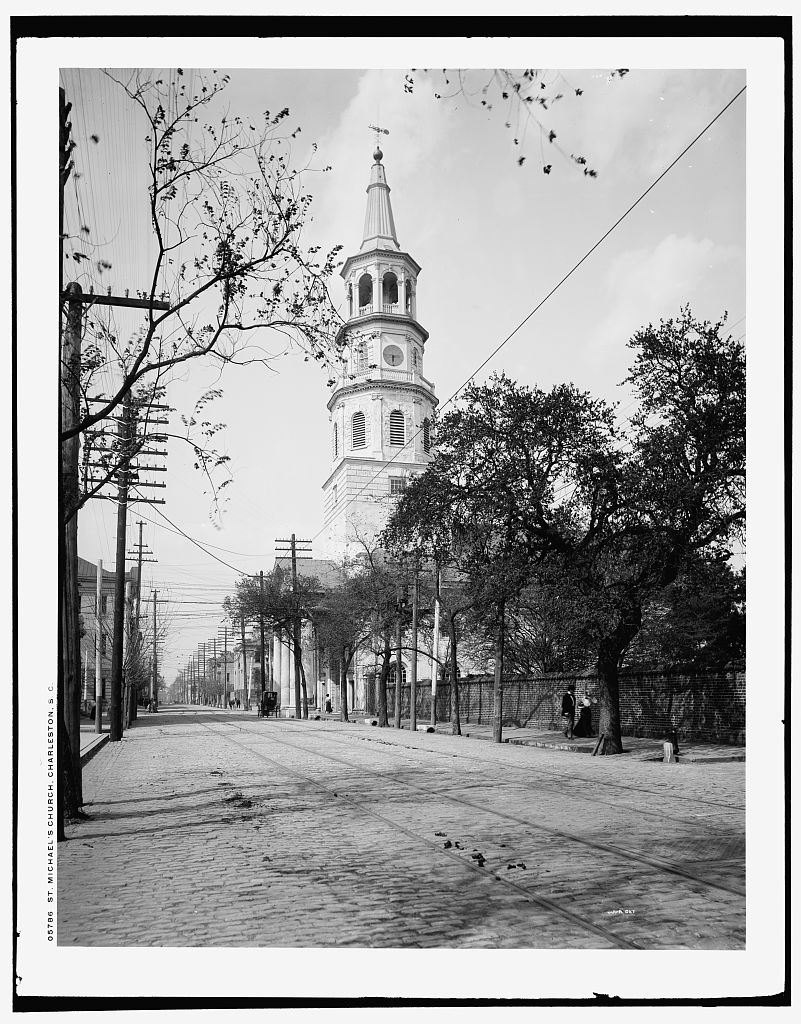
St. Michael’s Church
1876 – Reconstruction
A joint political meeting took place near Cainhoy, South Carolina, a small town located approximately nine miles northeast of Charleston. A group of about one-hundred and fifty Democrats traveled to the site by steamboat “Pocosin” and met their political opponents at “Brick Church.” The leadership from both sides had agreed beforehand that participants would not bear arms at the meeting, but many of the Republicans, mindful of the sort of violence that had occurred previously in places like Hamburg, arrived to the meeting with their personal firearms. Other black Republicans had hidden weapons in the surrounding woods and swamps.

Brick Church at Cainhoy.
During a speech by Republican W.J. McKinlay, the hidden weapons were discovered. A riot broke out when the black Republicans heard that the whites had seized their weapons and that a white man had drawn a pistol in self-defense. The blacks rushed from the swamps with their guns and pursued the Democrats into the church., where they were held at bay, with a gun battle between the Democrats and Republicans lasting several hours. Members of Democratic controlled rifle clubs from Charleston quickly organized and arrived on the scene in force within a few hours, Tensions remained high, but no more organized fighting took place.
The “Pocosin” was quickly loaded with the wounded and returned from Charleston with 100 armed men of the Palmetto Guard to provide protection for the white citizens of Cainhoy. A small detachment of U.S. military forces arrived a few days later in order to maintain the tenuous peace.
The massacre at Cainhoy resulted in the deaths of six white men and wounding sixteen while only one black man was killed.

 MarkJonesBooks