Today In Charleston History: February 19

1865

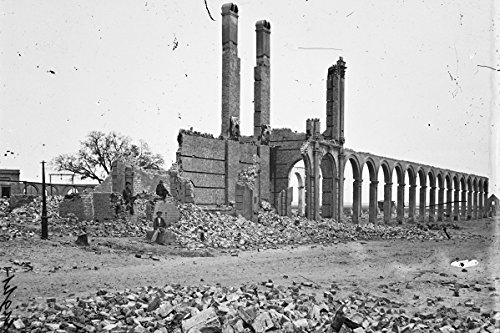
A 100-gun salute fired by the Union fleet off the harbor and a 38-gun salute from a land battery celebrated the capture of Charleston. Union photographer began to take pictures of the ruins across the city while Federal troops began a systematic looting spree throughout the city, stealing furniture, pictures, mirrors, statues, pianos, books and silverware. The black population of Charleston freely paraded through the streets carrying a coffin which read “Slavery Is Dead.”

Lt. Colonel Augustus G. Bennett had accepted the city’s surrender the day before. His troops were met at the intersection of Broad and East Bay Streets by  city councilman, George W. William who handed the colonel a note to from Mayor Macbeth which read:

The military authorities of the Confederate States have evacuated the City. I have remained to enforce law and preserve order until you take such steps as you think best.

exchange 1865

Exchange Building (c. 1866.) View from East Bay Street. Courtesy of the Library of Congress

Today In Charleston History: February 18 – Charleston Firsts

1735 – Charleston Firsts

The first public presentation of an opera in the colonies is performed at Broad and Church – Shepherd’s Tavern. The opera was titled Flora or Hob In The Well.  Local musicians provided the musical accompaniment on organ and fiddle.

1820 – Execution

 John and Lavinia Fisher were executed. Contrary to what everyone seems to believe (due to lazy tour guides and myth-perpetuating web pages)  they were NOT convicted of murder. Their crime was highway robbery. And also contrary to what everyone seems to believe, she was NOT hanged in her wedding dress. Also, contrary to what everyone seems to believe, she was NOT the first female serial killer. Enough said, let’s move on. 

For more accurate info, refer to my book, Wicked Charleston: The Dark Side of the Holy City (pg. 77-84), or James Caskey’s Charleston Ghosts: Hauntings in the Holy City, (pg. 37-44) or Six Miles From Charleston by Bruce Orr.  

1850

James Petigru’s wife, Adele, attempted suicide by chloroform.

1865 – Civil War

Early in the morning, the Northeastern Railroad Depot accidently blew up, killing and wounding hundreds of evacuating civilians. The Confederates had stored a large quantity of gunpowder there prior to abandoning the city. Children playing with a candle ignited the powder, and over 150 people died in the explosion. Fires started by the rain of flaming debris destroyed more buildings.

railroad depot

Ruins of the depot

Later that morning Union Lt. Col. Augustus Bennett landed at Mills Wharf (East Bay and Broad Streets) with a small party of twenty-two men. They raised a regimental flag over the post office (Old Exchange Building) – the first U.S. flag to fly over Charleston since 1860 on the same pole on which the first secession flag was raised on December 1860.

At 10 o’clock, Bennett’s troops were supplemented by the Fifty-second Pennsylvania and the Third Rhode Island artillery. They moved through the city and established headquarters at the Citadel building on Marion Square. He immediately dispatched troops “with instructions to impress negroes where ever found and to make them work the fire apparatus until all fires were extinguished.”

Bennett secured the arsenal and guarded the largest stores of cotton, tobacco, rice and other foodstuffs in the city.  Later that day Gen. Gillmore wired Army chief of staff Halleck in Washington, D.C.:

The city of Charleston and its defenses came into our possession this morning, with over 200 pieces of good artillery and a supply of fine ammunition. The enemy commenced evacuating all the works last night, and Mayor MacBeth surrendered the city to the troops of Gen. Schimmelfenneg at 9 o’clock this morning, at which time it was occupied by our forces … Nearly all the inhabitants remaining in the city belong to the poorer classes.

Today In Charleston History: February 17

1627 – Founding

Barbados was settled by Englishman Henry Powell, who arrived with 80 settlers and 10 slaves who were kidnapped, lower class English or Irish youth. The island was established as a proprietary colony, funded by Sir William Courten, a London merchant who owned the title to Barbados. The first colonists were technically tenants and much of the profits were returned to Courten.  

1748 – Weather

The temperature fell to ten degrees Fahrenheit, the coldest day in Charlestown in the 18th century. The cold killed the orange trees in the area.

1864 – Charleston Firsts

H.L. Hunley Submarine Sinks U.S.S. Housatonic (CLICK HERE For Entire  Hunley Story)

1865 – Civil War

Sherman’s troops burned Columbia, South Carolina. The bells of St. Michael’s Church, hidden beneath the floorboards of a shed next to the construction site of the new State House, were “melted and calcinated from a state of former beauty to little more than lumps.”

The_burning_of_Columbia,_South_Carolina,_February_17,_1865

Today In Charleston History: February 8

1671 – Arrivals  

Forty-two settlers arrived in Charles Town from Barbados on the ship John and Thomas, named for the two men who outfitted the vessel, John Strode and Thomas Colleton.

1780 – The Seige of Charlestown

Colonel Charles Cotesworth Pinckney, commander of Ft. Moultrie, complained to Gen. Lincoln he was short both men and ammunition. He requested 1215 troops to man the walls, artillery and defensive works. He only had 200. He wrote:

“If half cannot be obtained, I shall make the best defense in my power with the number that may be allowed me.”

1824 – Births

Barnard Elliott Bee Jr.  was born in Charleston, South Carolina, the son of Barnard Elliott Bee, Sr., and Ann Wragg Fayssoux, in his grandfather’s house on Tradd Street.  Bee graduated from the United States Military Academy in 1845, thirty-third in his class and assigned to the 3rd U.S. Infantry. He accumulated many demerits while at West Point, including several for chewing tobacco while on duty.

Bee became a career United States Army officer and a Confederate States Army general during the American Civil War. Bee was appointed brigadier general and given command of the third brigade of the Army of the Shenandoah, under Brig. Gen. Joseph E. Johnston.

During the subsequent battle, known as the First Battle of Bull Run, or Manassas. Bee used the term “stone wall” in reference to Brig. Gen. Thomas J. Jackson and his men, giving rise to the name “Stonewall Jackson” and his Stonewall Brigade. There has been debate over whether this nickname was meant in admiration or as an insult due to Jackson’s men not advancing –  “stone wall’ symbolizing being immobile.

Bee was mortally wounded as the Confederates began to gain the upper hand in the battle. He died the following day – one of the first general officers to be killed in the war. As a result, it could not be determined whether his naming of Stonewall Jackson was intended as praise, a condemnation. He is buried in Pendleton, South Carolina. 

Bernard Bee; Peter Fayssoux House, Tradd Street, Charleston

L: Bernard Bee. R: Peter Fayssoux House, Tradd Street, Charleston


Today In Charleston History: January 31

1780 – The Seige of Charlestown

Continental Army General Benjamin Lincoln requested that Governor John Rutledge “order 1500 Negroes to assemble in the vicinity of this town with the necessary tools for throwing up lines immediately.”

1800

Charles Pinckney delivered a speech in the U.S. Senate on the subject of trial by jury.

Viewing as I do impartial juries as among the most indispensable ingredients of a free government, it is my duty to declare … that in those states in which the federal marshals have a right to summon jurors as they please, the people are not free!

1863 – Civil War
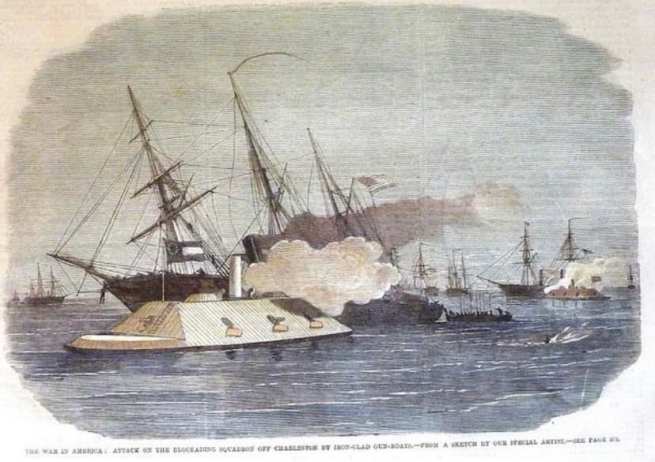
At about 5am, Confederate ironclads CSS Palmetto State and CSS Chicora attack the Union blockade outside of Charleston harbor. The Palmetto State rammed bow first into the Mercedita’s port quarter, ripping a hole in the ships keel. The Confederate crew fired its point blank into the Mercedita, bursting the ship’s boilers, immediately crippling the ship. The Chicora  and the USS Keystone State exchanged fire, with a Confederate shot hitting the steam drum on the Keystone State. The explosion killed 20 men. The Chicora signaled for the ships surrender but there was no reply.
Union ships began to arrive and both sides fired at one another until sunrise, when the wooden Union navy retreated, unable to inflict damage upon the iron side Confederate warships.

ironclad attack - 1863

 1864 – Civil War   

 Colonel W.W.H. Davis took in three Confederate Irish deserters from Charleston who complained they were “much pinched for food.” From the deserters accounts Davis reported that:

Our shells have done considerable damage in Charleston. Most of the shells explode, but as yet few people have been injured by them. Charleston is depopulated, except by the very poorest class of people, and they have moved as far uptown as they can get. Beauregard’s headquarters and all the public offices have been removed to the upper part of the city. 

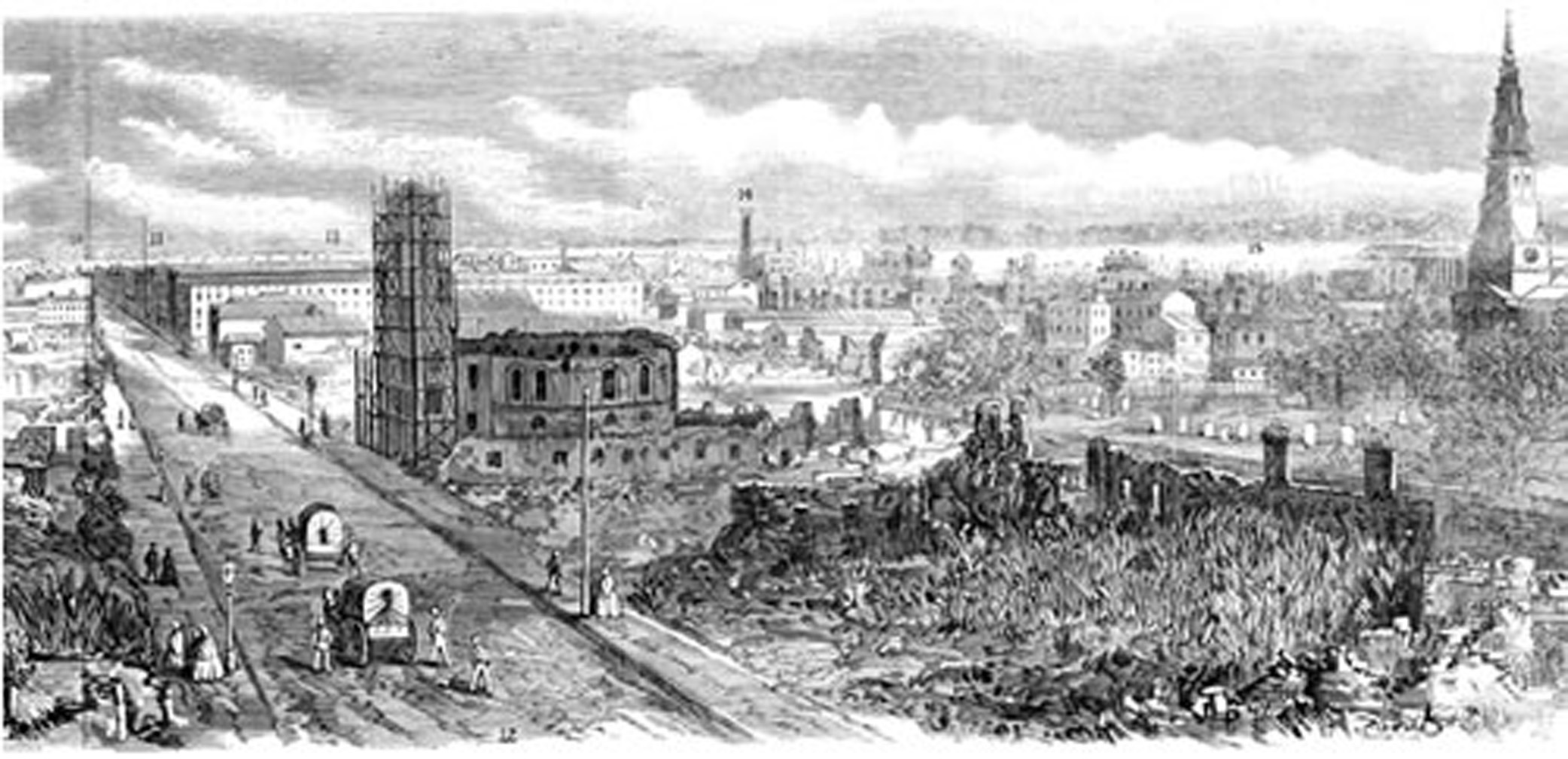
meetingengraving

Charleston, Meeting Street, circa 1865 – Ruins of the Circular Church after the 1861 fire and Federal Bombardment.

Today In Charleston History: January 28

1787 – Marriage

Dr. David Ramsay married Martha Laurens.

Ramsay had been married twice, and tragically lost both wives within a year of being married. Martha was the beloved daughter of Henry Laurens, former President of Continental Congress, and the first American imprisoned in the Tower of London (he was arrested by the British while acting as an agent for Congress raising funds for the Revolution in Europe.) Ramsay met Martha while he was researching his History of the Revolution of South Carolina. 

1861 – Secession 
Pierre Gustave Toutant Beuaregard

Pierre Gustave Toutant Beauregard

P.G.T. Beauregard was removed as Superintendent of the U.S. Military Academy at West Point. It was the shortest tenure of any superintendent – five days. His orders were revoked when his native Louisiana seceded from the Union. Beauregard protested to the War Department that they had cast “improper reflection upon [his] reputation or position in the Corps of Engineers” by forcing him out as a Southern officer before any hostilities began.

Within a month he resigned his commission and became the first Brigadier General of the Confederate Army. He served in Charleston and ordered the firsts shots of the War be fired at Fort Sumter. 

1866 – Civil War

The melted fragments of St. Michael’s bells were shipped to England by Fraser, Trenholm and Company. 

The bells for St. Michael’s were cast in 1764, by Lester & Pack in London. When the British evacuated Charleston in 1782 as part of their plunder, the eight bells of St. Michael’s were taken back to England. Shortly afterward, a merchant in London secured the bells and returned them to a grateful Charleston. 

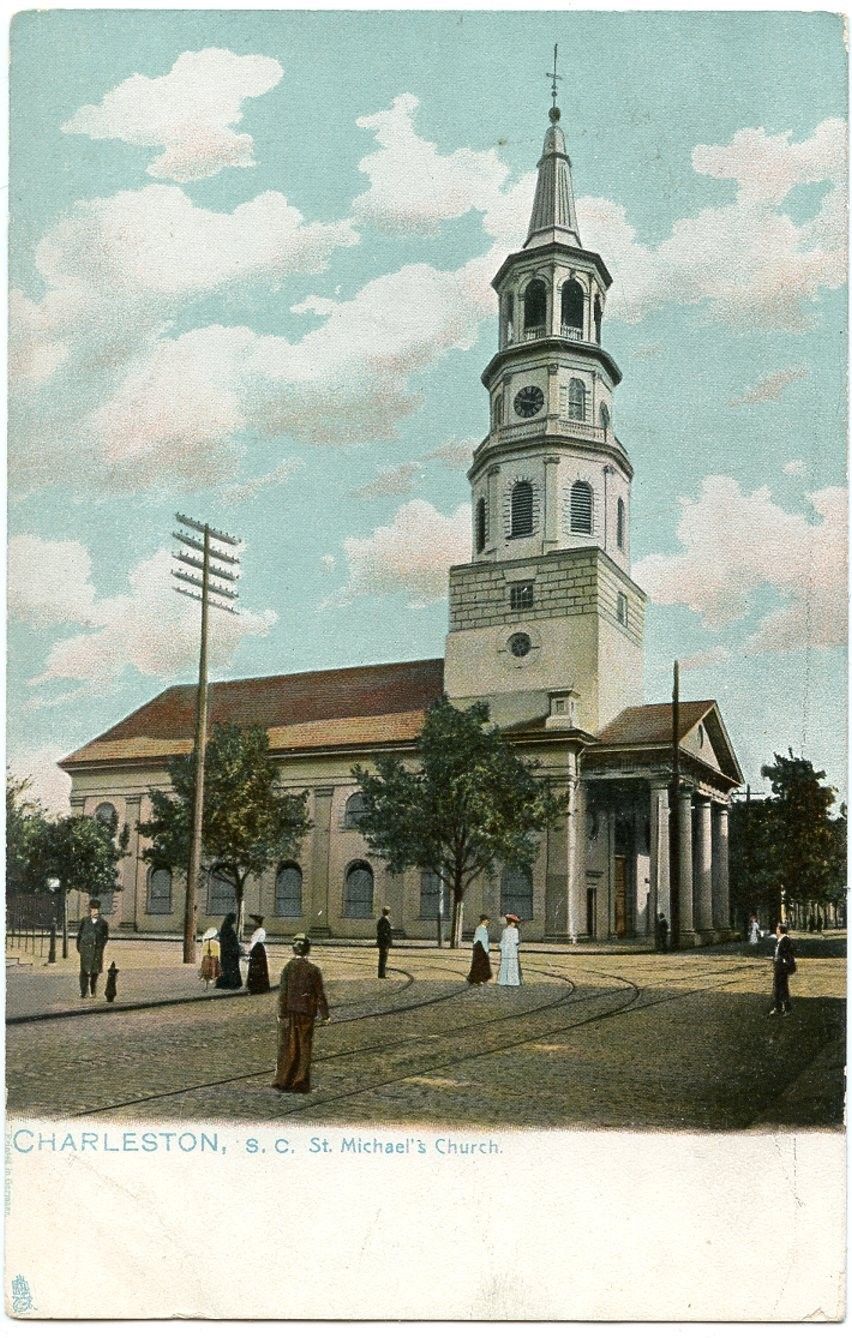
st. michael's - postcard

St. Michael’s Church

In 1864, when Sherman made his march through the South Carolina, Charleston expected to be in his path, so the bells were sent to Columbia for safe-keeping.  Sherman by passed Charleston and burned Columbia, the state capital. The shed in which the bells were stored was burned and the bells were reduced into molten slag. The metal was salvaged and the bells were sent to London to be recast by Lester & Pack – today in history.The bells were returned in 1868 and resumed their place in the church.

In 1989, the bells were damaged by Hurricane Hugo in 1989. They once again were shipped to London for repair. They can be heard chiming in Charleston today on an hourly basis.

Today In Charleston History: January 23

1800 – Deaths.

 Governor Edward Rutledge died “with perfect resignation, and with perfect calmness.” He was buried in the family plot in St. Philip’s graveyard. He was replaced as governor by John Drayton.
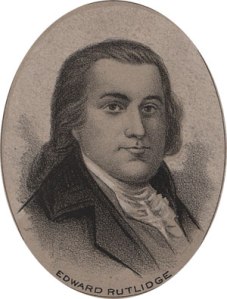
Edward Rutledge

Edward Rutledge

Born to an aristocratic family, Edward Rutledge spent most of his life in public service. He was educated in law at Oxford and was admitted to the English Bar. He and his older brother John both attended the Continental Congress and unabashedly supported each other. Edward attended Congress at the remarkable age of 26 and was the youngest man to sign the Declaration of Independence.

During the Revolution he served as a member of the Charleston Battalion of Artillery, and attained the rank of Captain. The colonial legislature sent him back to Congress in 1779 to fill a vacancy. During the defense of Charleston, Rutledge was captured and held prisoner until July of 1781.

In 1782 he served in the state legislature, intent on the prosecution of British Loyalists. In 1789 he was elected Governor.

1861 – Secession.

Pierre Gustave Toutant Beauregard was appointed superintendent of the U.S. Military Academy at West Point. It was the shortest term in the post ever. Six days later his commission as superintendent was revoked, the day after his native Louisiana seceded from the Union. The Federal powers-that-be did not trust Beauregard’s Southern sympathies. One month later, Beauregard resigned his captaincy in the U.S. Army Engineers and offered his services to the Confederate government being formed in Montgomery, Alabama.

Pierre Gustave Toutant Beuaregard

Pierre Gustave Toutant Beuaregard

Beauregard was born into a prominent Creole family in St. Bernard Parish, Louisiana and raised on a sugarcane plantation outside of New Orleans. He was appointed to the United States Military Academy at West Point in 1834 at age sixteen and became a popular cadet, earning several nicknames including “Little Napoleon” and “Little Creole,” due to his slight statue – 5’7”, 150-pounds. His favorite teacher was his professor of artillery, Robert Anderson. He graduated second in his class in 1838 and remained at the school to serve as Anderson’s assistant artillery instructor.

During the Mexican War he serving under Gen. Winfield Scott and during the 1850s served as a military engineer clearing the Mississippi River of obstructions. He also spent time as an instructor at West Point before becoming the school’s superintendent for less than a week.

On February 27 in Montgomery, Alabama, Beauregard was appointed the first brigadier general of the Confederate Army and sent to Charleston. On April 12, he ordered the first shot of the Civil War fired at Fort Sumter, commanded by his former West Point instructor, Major Anderson.

Today In Charleston History: January 18

1788 – U.S. Constitution

The Assembly, at the urging of John Rutledge, Cotesworth Pinckney and Charles Pinckney, agreed on a holding a ratifying convention for the Constitution. It was scheduled for May 12 at the Exchange Building.

1865 – Civil War
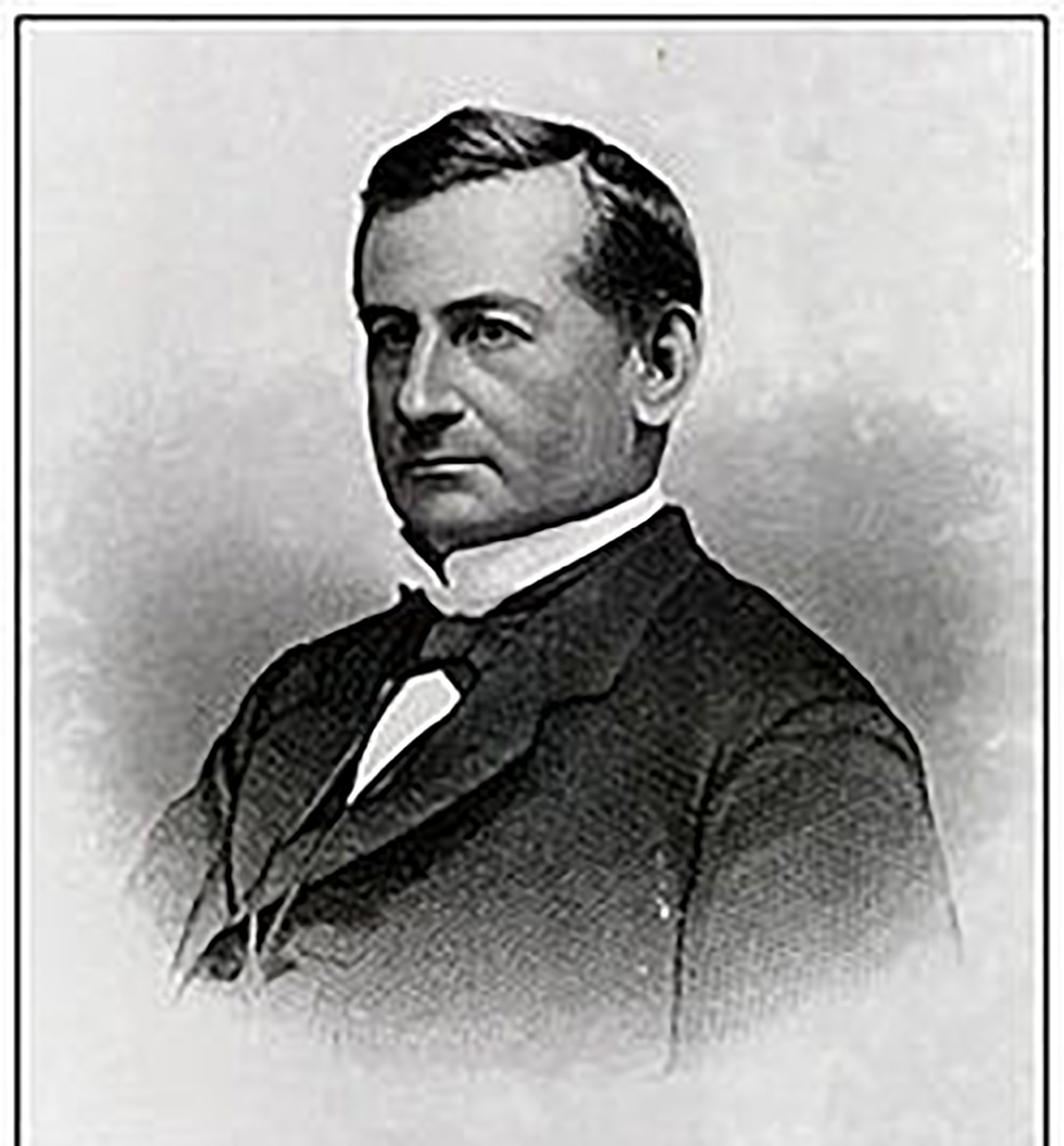
Andrew Gordon Magrath

Andrew Gordon MacGrath

South Carolina governor, Andrew Magrath, pleaded with Confederate President Jefferson Davis to protect Charleston. There was great and reasonable fear that Sherman’s troops, breaking their Christmas camp in Savannah, were next heading for Charleston. 

Magrath is most famous for resigning his judgeship when Abraham Lincoln was elected  president in 1860. In U.S. District court on the day after Lincoln’s election, November 7, 1860, Magrath rose from the bench and said:

In the political history of the United States, an event has happened of ominous import to fifteen slaveholding States. The State of which we are citizens has been always understood to have deliberately fixed its purpose whenever that event should happen … So far as I am concerned, the Temple of Justice, raised under the Constitution of the United States, is now closed. If it shall be never again opened, I thank God that its doors have been closed before its altar has been desecrated with sacrifices to tyranny.

Magrath was active during the Secession Convention and served as Secretary of State for South Carolina. As the War was coming to a conclusion, Magrath was appointed governor by the S.C. Legislature in December 1864. He served for less than a year as governor, was arrested by the Union Army on May 25, 1865 and sent to Fort Pulaski for imprisonment. Magrath was released in December and resumed the practice of law in Charleston. He died on April 9, 1893, and was buried at Magnolia Cemetery.

1908 – Murder!

One chain gang inmate was hanged in Charleston for the murder Captain Herman Stello. The captain was killed when his throat was slit by the inmates during an escape attempt from the Seven Mile Stockade at Ashley Junction.

The inmates feigned illness in order to remain at the stockade while the other prisoners worked on the chain gang for the Drainage and Sanitary Commission. One of the inmates asked Captain Stello for water and when he opened the door to deliver it he was attacked. He was struck over the head with the bucket before one of the inmates cut his throat with a knife.

 Captain Stello was placed into their cell along with two other inmates who refused to participate in the escape. Then the three subjects fled the camp. The man who cut Captain Stello’s throat was arrested a short time later. He was convicted of Captain Stello’s murder, sentenced to death, and subsequently executed by hanging on January 18th, 1908.

Today In Charleston History: January 14

1784

Congress ratifies the Treaty of Paris, officially ending the American Revolutionary War. The treaty was negotiated in 1783 by Benjamin Franklin, John Jay, John Adams and Charleston’s own Henry Laurens, who had been imprisoned in the Tower of London as a traitor to the King. The secretary for the American delegation was Lauren’s teenage daughter, Martha Laurens (later Ramsay).

treaty of paris

1785
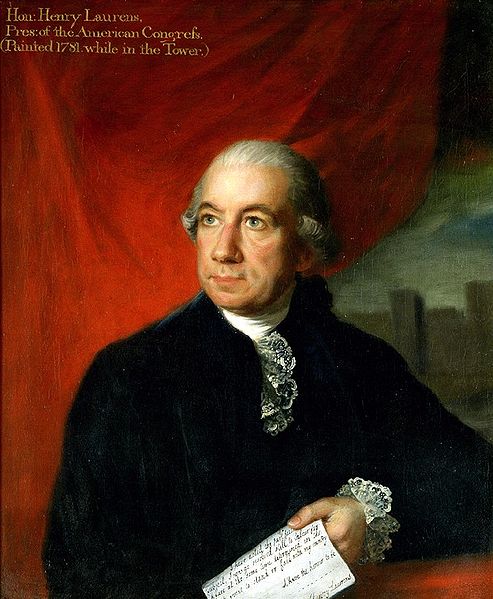
Henry Laurens

Henry Laurens

Henry Laurens returned to Charleston. He had been absent for more than five years as a prisoner of the British.

In 1780, the Continental Congress appointed Laurens as American minister to the Netherlands, in order to procure financial support for the Revolution. Laurens was captured by the British on the open sea, declared a traitor and imprisoned in the Tower of London for 16 months, where his health steadily deteriorated. 

After his release, Laurens spent the next two years recuperating in Europe. Upon his return to South Carolina,  he wrote that he had “become a stranger in my native land.” He estimated that damage to his property exceeded £40,000.

1864 – Bombardment of Charleston  

Gen. Beauregard wired the Confederate government in Richmond, Va.:

Fire of enemy on city for last two days has been almost continuous … Although averaging over 100 shots a day, only one person wounded … enemy threw yesterday 273 shells at city; over one fourth fell short; some ranged nearly five miles. Two fires occurred; not much damage; nobody hurt.

bombardment illustration

1868
South Carolina Constitutional Convention meets with a black majority for the first time in history. It included 76 Blacks and 48 whites, and all but four were Republicans. 
     The Convention met in Charleston for fifty-three days at the Charleston Club House on Meeting Street (current location of the Waties Waring Judicial Center), completing their work on March 17, 1868. A few of the most important changed in the new constitution were: 
     (1) Confirmed South Carolina’s membership in the Union. (2) Prohibited discrimination based on race or color. (3) Gave women the right to control their own wealth, and to get divorced. (4) Declared public schools to be available to ALL citizens. As Nic Butler declared, it was “the most democratic and equitable of the seven constitutions in the history of this state.” 
     On March 16, 2018, a historical marker on the site of the former Charleston Club, was erected commemorating the 1868 South Carolina Constitutional Convention was unveiled. To read the proceedings of the Convention, CLICK HERE.
charleston club - robert stockton - the great shake

Charleston Club, c 1887. Severely damaged by the 1886 earthquake. From Robert Stockton, “The Great Shake.”

Today In Charleston History: January 13

1680

Four acres of land were granted to Anglican minister, Rev. Atkin Williamson, by Originall Jackson who wrote he was:

excited with a pious zeal for the propagation of the true religion which we profess … the divine service according to the form and liturgy now established to be duly and solemnly performed by Atkin Williamson.

One year later, Rev. Williamson was dismissed from the pulpit “for baptizing a bear while drunk.” Whether it was the bear or the reverend that was drunk was never specified. 

1733 – Arrivals
James Oglethorpe

James Oglethorpe

James Oglethorpe and the first settlers for Georgia arrive in Charlestown on the Anne. The merchants of Charlestown were excited and supportive of the new Georgia colony. An English settlement between St. Augustine and Charlestown to them it meant greater security against the Spanish.

The Assembly voted £2000 for the assistance of the Georgia effort and Colonel William Bull accompanied the expedition several days later when they sailed to Beaufort.

1865

Preparations for Sherman’s expected attack on Charleston were under way. Charleston’s military officials had reports that both the Union Seventeenth and Fifteenth corps were moving up the coast from Savannah.