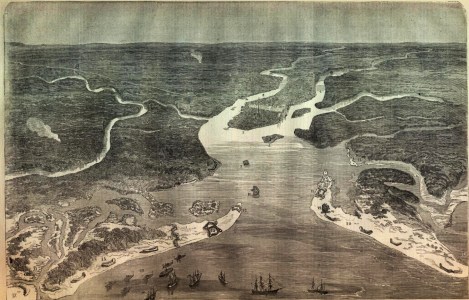
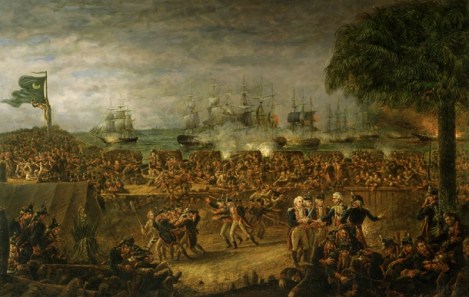
JUNE 13, 1777. That afternoon, a French vessel sailed into Town Creek at North Island, Georgetown, South Carolina. On board was the 19-year old Marquis de Lafayette, who had purchased the ship for the voyage to American colonies. Lafayette, along with other French noblemen, had all been promised commissions in the “Armies of the States” by Silas Deane, American agent in Paris.

Marquis de Lafayette
Local plantation owner, Major Benjamin Huger (pronounced “hue-gee), a French Huguenot, welcomed the young Frenchmen to his home before they proceeded north to join the American army. During the stay at the plantation, Lafayette met Huger’s 3-year old son, Francis Kinloch. As a result of that brief meeting, seventeen years later Francis Huger participated in an odd, swashbuckling episode during a plot to liberate Lafayette from an Austrian prison.
AUGUST 10, 1792. Lafayette was serving as general of the Northern Army in France, when an angry crowd in Paris, consisted of citizens and soldiers, attacked the Tuileries Palace where King Louis XVI resided. The King’s guards were killed, forcing the royal court to flee, where they became prisoners of the Assembly. The king was “temporarily removed from his duties,” and the Assembly passed a decree calling for Lafayette’s arrest as a traitor. Hoping to take refuge in a neutral country he escaped to Austria where he was promptly arrested and sent to Prussia for confinement.
French exiles in London, outraged by the arrest, sent Dr. Justus Erich Bollman to Prussia as their agent to negotiate for Lafayette’s release. Dr. Bollman had already acquired a reputation as a man who enjoyed adventure by smuggling the Comte de Narbonne, France’s ex-minister of war, to England, leading some to claim he was the basis of the fictional hero, the Scarlet Pimperenel, an English aristocrat who rescues French nobles.

1793. Bollman arrived in Berlin and appealed for Lafayette’s freedom. Lafayette was being held at Prison Magdeburg in Saxony but was moved to a prison on the Neisse River along the borders of Prussia, Poland and Czechia (modern Czech Republic), and then moved to an undisclosed location in Austria. The Austrian emperor considered Lafayette personally responsibly responsible for the downfall of Louis VXI, and was determined to keep him hidden.
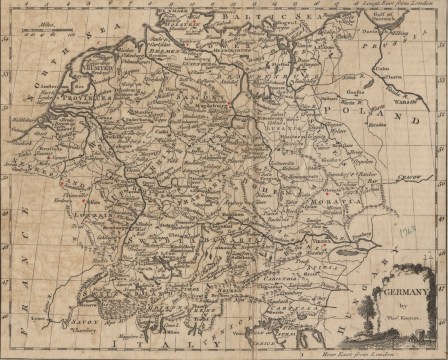
Map of the area in which Bollman searched for Lafayette: Prussia, Saxony, Austria, Czechia, etc …
Meanwhile, Bollman travelled to Magdeburg only to discover Lafayette gone. Three months later, after searching across Prussia and Austria, Bollman arrived in Olmutz, the Monrovian section of Austria, part of Czechia. He checked into the Golden Swan and in the taverns and cafes, Bollman heard the citizens talk about increased security at the prison due to the “recent arrival of some important prisoners.” It was reported that even the guards were forbidden to talk to the new prisoners who were locked behind two doors, one wood, the other iron. Bollman became convinced that Lafayette was one of the “important prisoners” and made friends with the prison physician, Dr. Heberlein. Patiently cultivating his friendship with Haberlein, the doctor at some point confirmed Lafayette was indeed imprisoned at Olmutz.

Prison at Olmutz
Bollman convinced Haberlein to deliver messages to Lafayette, thinking they were simply encouraging notes. Unbeknownst to the doctor, Bollman was writing secret messages with one of the oldest forms of disappearing ink – lemon juice.
To allay suspicions, Bolllman eventually moved on to Vienna, where he met a young American, Francis Kinloch Huger. In 1794, Huger had completed his studies in England, and before returning home to enroll in medical school, he decided to travel across Europe and witness the effects of the war between France and her neighbors. Throughout his journeys he heard rampant speculation about Lafayette’s whereabouts. In Vienna he met Bollman, and according to Huger’s later recollections, he had a conversation with Bollman about Lafayette’s fate, and told the doctor of the Frenchman’s visit to his family home in 1777. It was then he learned of Bollman’s mission to rescue Lafayette.
Huger listened as Bollman traced the events of the past few years. He told of finding Lafayette and revealed he had not been in Hungary at all during the past week, but in Olmütz, working out the details of an escape. He had contacted Lafayette through Dr. Haberlein, and had worked out a plan.
For his health, every second day, Lafayette was driven into the countryside under close guard. In one of his return messages to Bollman, Lafayette wrote, in lemon juice in the margins of a letter:
We are in a phaeton, nobody with me but the corporal – who, by the by, is afflicted with a rupture – and a clumsy driver … Have a trusty man with you. Stop the driver. I engage to frighten the little cowardly corporal with his own sword. Bring a third horse. I will not have the least difficulty to jump on a led horse of your man …

19th century Phaeton
Bollman informed Lafayette that when all was ready, he would wait beside the road and, when Lafayette’s carriage passed, Bollman would make a signal with a handkerchief. That would be the signal that the rescue attempt would be made two days later.
When Bollman laid out the details of the plan, Huger immediately agreed. He later wrote, “I saw an opportunity to restore liberty to a man who at my own age had risked everything for me.” To Huger it was a simple matter of family honor, and American pride.
NOVEMBER 5, 1794. Bollman and Huger checked into the Golden Swan in Olmutz, and the next morning, they were sitting on their horses. As Lafayette’s carriage roll past, Bollman wave his handkerchief.
NOVEMBER 8, 1794. That Saturday morning, Bollman and Huge checked out of the Golden Swan. They sent a servant by carriage ahead to the village of Hoff, twenty-miles down the road. The servant was to wait for their arrival. They then sat by the road, awaiting Lafayette’s carriage. They had decided against bringing three horses, thinking it may arouse suspicion. Instead, Huger had acquired a horse trained to carry two riders. The plan was to let Lafayette ride alone on Bollman’s horse while they followed on the other.
As they were riding down the road, within sight of the prison fortress, and with peasants working in the fields on either side, Lafayette’s phaeton appeared. The corporal sat beside Lafayette, the driver sat in front, and another soldier rode behind the carriage. Bollman and Huger continued down the road a short distance, then turned and trotted after the carriage. When it halted by the roadside, they also stopped and watched as Lafayette and the corporal got out, began walking through a field, and then paused, engaged in conversation.
Huger and Bollman spurred their horses, galloping up as Lafayette pulled the corporal’s sword out of its sheath. However, the “little cowardly corporal,” as described by Lafayette, failed to be frightened; he grabbed the sword blade, cutting his hands, and yelled for help. The peasants looked up, but merely watched the struggle; the driver also, for some reason, failed to respond. He merely sat there. Only the mounted soldier took action, riding back toward the fortress, shouting and waving his hat to attract the attention of the sentries on the walls of the fortress, which was some distance off but still visible across the flat plain.
Lafayette struggled with the corporal over possession of the sword. Bollman leapt from his horse, and tossed the reins to Huger. Frightened, the horse lurched and it galloped away. Bollman pulled the corporal away from Lafayette, but the little man seized Lafayette by the cravat, and gripped his neck within his bloody hands.
Huger joined the fight, and managed to pull the bloody hands away from the general’s throat. Bollman and Huger dragged the corporal down, pinning him and pushing a handkerchief into his mouth.
Huger then shouted to Lafayette to take his horse and “get to Hoff,” the village where the servant had been sent. The general mounted and started to trot away, then stopped, apparently unwilling to leave the two behind. Waving him on, Huger anxiously repeated “get to Hoff!” and the marquis rode off. Bollman and Huger conferred for a moment and then released the corporal, who took off on foot.
A peasant boy managed to stop Bollman’s frightened horse and was returning with the prize when Huger spotted him. He and Bollman mounted it and took off after Lafayette. Unfortunately Bollman’s horse, was was not trained for double riders, and he bucked Bollman. When urged faster than a trot, he gave a buck that dumped Bollman, who was then unable to climb back up. Huger dismounted and helped his companion into the saddle and told Bollman to take the horse and follow Lafayette. He would follow on foot.
Huger ran along a road leading to the mountains pursued by three men running after him. He hoped to reach the mountains and slip into Prussian Silesia, but was soon overtaken by a peasant on horseback who had joined the chase. Seeing that it was impossible to escape, Huger gave himself up to the horseman. The three on foot joined them, and Huger was escorted back to Olmütz, where he was turned over to General D’Arco, the commandant of the fortress, for examination. Huger answered the questions truthfully and in some detail, telling of his meeting with Bollman and the events surrounding the escape itself. He said he felt justified in what he had done: “I did not think of harming any one; and I was assured that it was the purpose of M. Lafayette to cross immediately to America and not to mix himself any more in the affairs of the Empire.”
D’Arco noted at the end of the transcript of the examination: “The culprit was turned over by the military authorities to the ordinary Olmütz court, put in irons, as a criminal, and held in the strictest custody.” Huger’s possessions were taken, iron cuff put around one ankle, another around a wrist. He was then chained to the wall over the wooden bench that served as his bed.
Lafayette, meanwhile, was alone in an unfamiliar area. Complicating matters further, Bollman had never told Lafayette what escape route they would follow. During the confusion resulting from the corporal’s resistance, Lafayette had misunderstood Huger’s shouted order for him to “get to Hoff.” Not recognizing the name of the city, he thought the American had simply told him to “get off.” Separated and lost, the general reached a fork and chose the road leading him away from Hoff and the waiting coach and servant.
Covered with mud and blood from the fight, Lafayette rode into a village and offered two thousand crowns for a fresh horse. The large sum, his accent, and his disheveled appearance aroused suspicion, and he was taken into custody, where the mayor insisted he be taken to Olmütz.
Bollman was the only one to reach Hoff. Not finding Lafayette there, he guessed that the general had gotten lost. Crossing the border into Silesia, he searched for Lafayette, hoping he had been able to make it into Prussia along a different route. A week later, Bollman, too, was arrested, and after two weeks he was taken to Olmütz to join Huger.
In the meantime the civil examination of Huger had begun. Since Huger spoke no German, a Professor Passi, a tutor employed by a Russian nobleman living in the vicinity of Olmütz, served as interpreter.
JANUARY 5, 1795 . Huger managed to smuggle letters out to Thomas Pinckney, former governor of South Carolina, who was then the American minister in London. He first wrote him on, asking Pinckney to write his mother and closing with the plea “Don’t forget us.”
In South Carolina Huger’s family wrote to George Washington, asking that the President intervene to obtain his freedom. Secretary of State Timothy Pickering informed them that the President was concerned, but “the cause of Mr. Huger’s confinement would render an application delicate and difficult, the United States having no public functionary in the Austrian dominions….”
FEBRUARY 1795. Huger and Bollman were kept in solitude for three months and brought separately before the tribunal for examination. The judges determined the two had worked independently of any local help and for the sole purpose of freeing Lafayette. The charges were reduced to “forcing a military post,” and after that they were allowed a little more freedom and better food. But the examinations continued, this time on the revised charge.
In Olmütz the prisoners had more influential help. It seems that their interpreter, Passi’s, regular employer, was Count Mitrowsky, was sympathetic to their cause. He gave Passi the money necessary to bribe the judges, and when Bollman and Huger were found guilty the sentence was unusually light: one month’s labor in irons, followed by banishment from Austria. With a little more encouragement from Mitrowsky the judges reduced the sentence to fourteen days’ further confinement and banishment. Eight months after the attempted rescue Huger and Bollman were released. Passi had made all the necessary arrangements for them, and they hurried across the border.
Bollman sailed with Huger to the United States in 1796.

Dr. Francis Kinloch Huger
1797. Huger finished work on his degree, graduating from the medical school of the University of Pennsylvania. He returned to South Carolina, married one of Thomas Pinckney’s daughters, and divided his time between his plantation on the Santee River and a summer home in Statesburg, choosing the life of a rice farmer instead of that of a doctor. He served as member of the South Carolina House of Representative and in the South Carolina Senate. He also studied artillery engineering and was commissioned as a colonel of artillery during the War of 1812.
SEPTEMBER 19 1797. Napoleon Bonaparte invaded the Austria, and soon was negotiating their surrender. The French general demanded the release of Lafayette and the others at Olmütz as a condition to a peace settlement. Lafayette was freed September 19, five years after his arrest along the frontier.

Lafayette, captive in Ormutz
1805. Bollman became an agent of Aaron Burr, serving the former Vice President as a land promoter but soon became entangled in Burr’s alleged scheme to establish a western empire in the Louisiana Territory. In late 1806, shortly after delivering an incriminating message from Burr to General James Wilkinson, Bollman was arrested and—for the second time in twelve years—imprisoned. He declined Jefferson’s offer of a pardon on the ground that it would be tantamount to an admission of guilt, but regained his freedom when the case against Burr failed to stand up. In his later years he wrote several pamphlets on the banking systems of the United States and England; he died in Jamaica in 1821.
1824. Lafayette arrived in America for a tour that took him to every part of the country. After landing in New York City contacted Huger by letter, Referring to him as “my dear deliverer,” Lafayette asked him to join his party in New York. Huger did so and then accompanied the general to Yorktown for special ceremonies there.
Huger joined Lafayette during his visit to South Carolina. Meeting in Columbia, they traveled together to Charleston. Auguste Levasseur, a member of Lafayette’s traveling party, wrote:
At the dinner, at the theatre, and the ball, in short everywhere, the name of Huger was inscribed with that of Lafayette …
This story of an American who was sent to prison in an attempt to rescue Lafayette had such romantic appeal that it was mentioned in many of the popular accounts of the general’s life that appeared in the mid-1820’s. The event was turned into a popular play, entitled Lafayette, or the Castle of Olmütz, that, much like Hollywood today, played fast and loose with the facts, which greatly amused Huger.
FEBRUARY 14, 1855. Huger died in Charleston. Whenever he was asked about his role in the Lafayette escape he always relied, “I simply considered myself the representative of the young men of America, and acted accordingly.”
 The first of two Beatles songs on this list. The idea for the song came from one of Ringo Starr’s malapropisms. Lennon wrote the song in one day, and it was recorded in three hours. Lennon shared vocals with McCartney (who could reach the high notes in the bridge – “When I’m hooome!”). Musically, the song opens with George Harrison’s iconic Rickenbacker 12-string “mighty chord” and features one of Harrison’s greatest early guitar solos. The song closes with Harrison playing an arpeggio of the opening chord for the fade-out. A classic early Beatles rocker.
 From a movie so bad, it inspired the creation of the Golden Raspberry Awards to mock the worst from Hollywood. However, as bad as it is (and it’s pretty awful) the music is consistently excellent, mainly thanks to the involvement of Jeff Lynne who wrote five songs for the film. John Lennon, shortly before his death, committed on how much he liked “All Over the World.” The song became a Top 20 hit in America, and was famously well used in the Simon Pegg sci-fi comedy Paul. Forty years later, it is still a concert highlight for Jeff Lynne.
 This beautiful classic poetic ballad was written by lyricist Howard Ashman and composer Alan Menken, specifically for the Disney film. They encouraged Lansbury to “sing it as she saw it.” Lansbury was worried that her aging voice was not up to the challenge but recorded her version in one take, which wound up being used in the final film. Producer Don Hahn recalled that the actress simply “sang ‘Beauty and the Beast’ from beginning to end and just nailed it.”
 Written by Jerry Reed and Dick Feller, the song was a massive hit for Reed (#2 Country Charts; #3 Billboard Pop). During filming, Hal Needam, director of “Smokie and the Bandit”, commented that he didn’t have any music for the film. Two days later, Reed came back with three songs that were used in the movie unchanged, including ‘East Bound and Down.’
 “Eye of the Tiger” is the song for the most famous work-out montage of all time, and is still the greatest tune to run up art museum steps to.
 Co-written and recorded by American singer-songwriter Kenny Loggins, the song spent three weeks at number one, March 31—April 14,1984 on the US Billboard Hot 100, and was the first of two number-one hits from the film. Billboard ranked it at the No. 4 song for 1984.
 The first single from the 1972 soundtrack album for the film Super Fly. The single was released before the Super Fly album, and in fact before the film itself was in theaters. The song peaked at #4 on the U.S. Billboard Hot 100 and #2 on the R&B chart.
 The first of two Judy Garland appearances on this list. Written by Hugh Martin and Ralph Blane, the was introduced by Judy Garland in the 1944 musical Meet Me in St. Louis. On Christmas Eve, Judy Garland’s character, Esther, sings the song to cheer up her despondent five-year-old sister, Tootie, played by Margaret O’Brien. In 2007 it was ranked as the third most performed Christmas song and is a bone fide classic American song.
 Written by John Lennon (with help from Paul McCartney.) According to Lennon’s cousin and Stanley Parkes, “Help!” was written after Lennon “came in from the studio one night. ‘God,’ he said, ‘they’ve changed the title of the film: it’s going to be called ‘Help!’ now. So I’ve had to write a new song with the title called ‘Help!’” Lennon later recounted: “The whole Beatles thing was just beyond comprehension. I was subconsciously crying out for help.”
 Even before the movie began filming, Bond producers invited Paul McCartney to write the theme song utilizing the title. McCartney asked to be sent a copy of Ian Fleming’s novel. “I read it and thought it was pretty good. That afternoon I wrote the song and went in the next week and did it … It was a job of work for me in a way because writing a song around a title like that’s not the easiest thing going.”
 “Mrs. Robinson” became the duo’s second chart-topper, hitting number one on the Billboard Hot 100, and peaking within the top 10 of multiple other countries. In 1969, it became the first rock song to win the Grammy Award for Record of the Year.
 Written by Hal David and Burt Bacharach it won an Academy Award for Best Original Song.. In the film version of the song, B.J. Thomas had been recovering from laryngitis, which made his voice sound hoarser than normal. Billboard Magazine also ranked the song 15th on its Top 50 Movie Songs of All Time list in 2014.
 Composed by Harold Arlen with lyrics by Yip Harburg for the movie The Wizard of Oz and sung by Judy Garland. It won the Academy Award for Best Original Song and became Garland’s signature song.
 “Who’s the black private dick, that’s a sex machine to all the chicks? / (Shaft!) Ya damn right”
 The greatest disco song ever? Possibly. This song, and the rest of the soundtrack, pushed a mediocre movie into the stratosphere, and turned John Travolta into a movie star.
 This classic power ballad, written by Terry Britten and Graham Lyle, who had written Turner’s massive comeback hit the year before What’s Love Got To Do With It”, were able to repeat the success with this song, giving Turner a second massive worldwide hit (#2 America). Co-starring with Mel Gibson in the 3rd of the Mad Max blockbuster, also helped ignite her career.
 The lead single from his 1984 album Purple Rain, Prince performs all vocals and plays all instruments on the track. It was a worldwide hit, and his first American number one single, topping the charts for five weeks. It is unusual due to the fact there is no bass line in the song, unheard of in a 1980s dance track. After Prince’s death in 2016, the song re-entered the Billboard Top Ten and has become one of his most iconic songs.


 Too bad, Atkins stayed with the formula of the latter Spenser books. Spenser meets a client. Spenser has dinner or sex (both) with Susan where she uses her “brilliance as a therapist” to ask Spenser questions in which he impart his fears/concerns etc … Oh God … how tedious. I’m guessing that since Susan is obviously a romanticized version of Parker’s wife, Joan, that maybe Atkins was contractually obligated to make sure Susan has a large role. Any other reason makes no sense whatsoever.