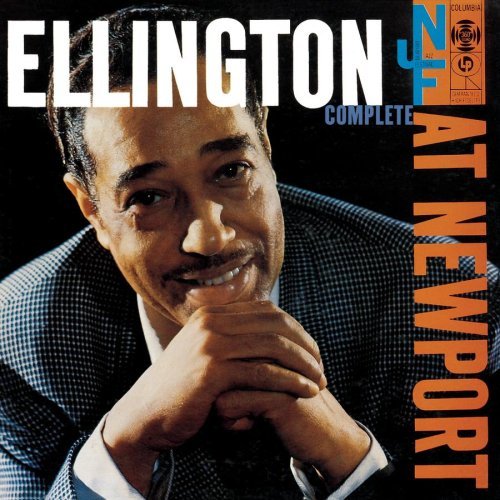
ESSENTIALS: Ellington At Newport 1956

albumcoverEllingtonAtNewportBy the mid-1950s many of the big bands had folded. Jazz music had been brought to its knees by the explosion of rock ‘n roll – Bill Haley, Buddy Holly, Chuck Berry and Elvis.  In addition, jazz was going through a radical change. The traditional swing big bands were being usurped by the harder-edged Be Bop and smooth West Coast Cool schools of music.

Duke Ellington had managed to financially keep his band together through the royalties of his popular compositions in the 1920s and 40s. They occasionally played shows at ice-skating rinks. In 1956 Ellington did not even have a recording contract.

On the night of July 7, 1956 at the Newport Jazz Festival, after a series of thunderstorms had dampened the collective spirits of the Eastern Seaboard patrons, The Duke Ellington Orchestra took the stage. Ellington paid for the performance to be recorded out of his own pocket.

Ellington at Newport 1956 was to become Ellington’s biggest selling recording, although only about 40% of the original recording was actually live. The remainder was recorded in the studio to provide “patches” and filler for the less than perfect live portions.
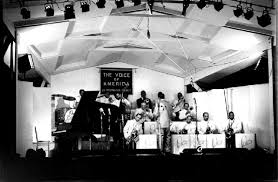
Ellington Orchestra on the Newport stage

Ellington Orchestra on the Newport stage

During the concert the Duke announced that they were pulling out “some of our 1938 vintage.” It was a pair of blues, “Diminuendo in Blue” and “Crescendo in Blue.” The two songs were to be joined by an improvised interval played by tenor saxophonist Paul Gonsalves. Ellington had been experimenting and reworking the songs for several years before the Newport performance. The night of the show, Ellington told Gonsalves to “blow as long as you feel like blowing.”

As performed at Newport, the new version kick-started Ellington’s waning career and secured the band financially for the rest of Ellington’s life. Gonsalves played a 27-chorus solo backed only by bassist Jimmy Woode, drummer Sam Woodyard, and Ellington himself punctuating piano chords. Through-out the song there are several audible comments from the band members. The Duke himself is often heard urging the saxophonist, shouting “Come on, Paul — dig in! Dig in!” About five minutes into Gonsalves’ solo, the sedate wine-and-cheese crowd realized they were witnessing a magical moment. They started dancing in the aisles and can be heard cheering and shouting at the band.

The usually sedate wine-and-cheese crowd at Newport dancing to Gonsalves' solo

The usually sedate wine-and-cheese crowd at Newport dancing to Gonsalves’ solo

When the solo ended Gonsalves collapsed in exhaustion, and the full band returned for the “Crescendo in Blue” portion. The real crescendo of “Crescendo in Blue” however starts at the 13:15 minute mark, as trumpet player Cat Anderson (of Charleston, SC) stands up and begins to play several octaves above the Orchestra for the final minute of the song. In a moment worthy of any classic rock concert, the already excited crowd is brought to the edge of hysteria by Anderson’s screaming trumpet. When the song ends, pandemonium ensues for several moments as the Duke tries to quiet the crowd.

Truly one of the most classic recorded moments in jazz history.

“Diminuendo And Crescendo In Blue”

Remastered 1999 CD: Ellington at Newport (Complete)

Disc one

  1. “The Star Spangled Banner” – 1:10
  2. Father Norman O’Connor Introduces Duke & the Orchestra / Duke Introduces Tune & Anderson, Jackson & Procope – 3:36
  3. Black and Tan Fantasy” – 6:21
  4. Duke Introduces Cook & Tune – 0:26
  5. “Tea for Two” – 3:34
  6. Duke & Band Leave Stage / Father Norman Talks About The Festival – 2:30
  7. Take the ‘A’ Train” – 4:27
  8. Duke Announces Strayhorn’s A Train & Nance / Duke Introduces Festival Suite, Part I & Hamilton – 0:41
  9. “Part I – Festival Junction” – 8:10
  10. Duke Announces Soloists; Introduces Part II – 0:38
  11. “Part II – Blues to Be There” – 7:09
  12. Duke Announces Nace & Procope; Introduces Part III – 0:19
  13. “Part III – Newport Up” – 5:33
  14. Duke Announces Hamilton, Gonsalves & Terry / Duke Introduces Carney & Tune – 0:25
  15. Sophisticated Lady” – 3:52
  16. Duke Announces Grissom & Tune – 0:17
  17. Day In, Day Out” – 3:50
  18. Duke Introduces Tune(s) and Paul Gonsalves Interludes – 0:23
  19. “Diminuendo In Blue and Crescendo In Blue” – 14:20
  20. Announcements, Pandemonium – 0:44
  21. Pause Track – 0:06

Disc two

  1. Duke Introduces Johnny Hodges – 0:18
  2. “I Got It Bad (and That Ain’t Good)” – 3:38
  3. “Jeep’s Blues” – 4:36
  4. Duke Calms Crowd; Introduces Nance & Tune – 0:42
  5. “Tulip or Turnip” – 2:49
  6. Riot Prevention – 1:08
  7. “Skin Deep” – 9:13
  8. Mood Indigo” – 1:30
  9. Studio Concert (Excerpts) – 4:01
  10. Father Norman O’Connor Introduces Duke Ellington / Duke Introduces New Work, Part I & Hamilton – 1:02
  11. “Part I – Festival Junction” – 8:46
  12. Duke Announces Soloists; Introduces Part II – 0:32
  13. “Part II – Blues To Be There” – 7:48
  14. Duke Announces Nance & Procope; Introduces Part III” – 0:16
  15. “Part III – Newport Up” – 5:20
  16. Duke Announces Hamilton, Gonsalves & Terry / Pause / Duke Introduces Johnny Hodges – 0:41
  17. “I Got It Bad (And That Ain’t Good)” – 3:47
  18. “Jeep’s Blues” – 4:31
  19. Pause Track – 0:09

THE BAND

  • Piano: Duke Ellington
  • Bass: James Woode
  • Drums: Sam Woodyard
  • Trumpet: Cat Anderson, Clark Terry, John Willie Cook, Ray Nance
  • Trombone: John Sanders, Britt Woodman, Quentin Jackson
  • Alto Sax: Johnny Hodges, Russell Procope
  • Baritone Sax: Harry Carney
  • Tenor Sax: Paul Gonsalves
  • Clarinet: Jimmy Hamilton
  • Voice: Jimmy Grissom             

Why Are There No Members of the Jenkins Orphanage Band in the South Carolina Entertainment and Music Hall of Fame?

Why are there no members of the world famous Jenkins Orphanage Band in the South Carolina Entertainment and Music Hall of Fame, or the Lowcountry Music Hall Of Fame?   The Hall has such luminaries as Andie McDowell (we still watch “Groundhog Day” despite her being in it), Leeza Gibbons (celebrity-news reader) and Vanna White (the only professional letter-turner in the Hall of Fame.)  The Hall also counts as members Rob Crosby, Bill Trader and Buddy Brock. (Yeah, I know, you’ll probably have to Google them to find out who they are too.)

I am not saying that any of these people don’t deserve to be in the Hall – they probably do. But not to the exclusion of more deserving artists. I would like to nominate several artists currently not in the Hall who influenced and enriched American culture in more deserving ways than interviewing celebrities on “Entertainment Tonight” or being eye candy for a game show.

From the 1890s to the 1940s the Jenkins Orphanage Band traveled across the United States and across Europe performing on street corners, on Broadway and for royalty. Members of the Jenkins Band were instrumental in transforming the music performed during 19th century minstrel shows into blues, ragtime and ultimately, jazz.  My nominees are:


EDMUND THORNTON JENKINS 

Edmund Thorton Jenkins

Edmund Thorton Jenkins

Born – April 9, 1894, Charleston, South Carolina  Died- September 12, 1926, Paris, France

His father, Rev. Daniel Jenkins operated the Orphan Aid Society (a.k.a. the Jenkins Orphanage) which operated a boy’s brass band as a fundraising tool, as a kind of minstrel show on the sidewalks of towns up and down the East Coast. Called “Jenks” by everyone, he received private piano lessons from a white man in Charleston, Mr. Dorsey, and quickly mastered the piano, clarinet and violin. His father insisted that he work as a music instructor for the Jenkins Band, and also travel with them. Jenks resented having to lead a group of ragamuffin orphans who mugged, strutted and played-the-fool during their street performances. He felt it was beneath him. He wanted to play serious music. The kids, of course, made fun of the prim and dandified Jenks.

In 1910 Jenks enrolled in Morehouse College in Atlanta, Georgia to study music.  Two years later he was forced by his father to leave college in order to accompany the Jenkins Band to London, where it was a featured act at the Anglo-American Expo. When the Expo came to an abrupt close, due to the outbreak of World War I, Jenks convinced his father to pay his tuition to the Royal Academy of London. For seven years Jenks excelled in his studies, winning awards for composition, and becoming a master in several instruments. During his time at the Academy he composed “Charlestonia: A Rhapsody.”

After graduation he moved to Paris where he became one of the most sought after musicians in the most popular Parisian nightclubs. Paris was “jazz mad” in the 1920s and for several years Jenks embraced the glamorous, hedonistic life of Paris. However, in 1925 he began to compose an opera, “Afram” and expanded and orchestrated “Charlestonia: A Rhapsody” which he conducted successfully in Belgium with a full orchestra.  In July 1926, he was admitted to a Parisian hospital for appendicitis. He contracted pneumonia and died on September 12, 1926, cutting short the career of a promising young black composer. He is buried at the Humane Friendly Cemetery in Charleston, SC. 

  Listen to “Charlestonia”, composed by Edmund Thornton Jenkins.


TOMMY BENFORD

Tommy Benford in 1978

Tommy Benford in 1978

Born – April 19, 1905, Charleston, West Virginia. Died – March 24, 1994, Mount Vernon, New York. 

Benford became the Jenkins Orphanage Band’s ace drummer. In 1920 he was playing in New York City and gave drumming lessons to a young wunderkind named Chick Webb. In 1928, he was the drummer for some of the most influential jazz music ever recorded as part of Jelly Roll Morton’s Victor Records sessions.

During the Depression Benford moved to Europe and for the next 30 years recorded hundreds of songs with more than a dozen bands. His most famous recording session was with Coleman Hawkins, Django Reinhardt, Stephane Grapelli and Bennie Carter, released as Coleman Hawkin’s All-Stars.

He continued to play music until his death in 1994, a career that spanned seventy years.

 Watch/listen here: “Sweet Georgia Brown” by Coleman Hawkins’s All-Stars (featuring Tommy Benford). 


JABBO SMITH

Jabbo Smith

Jabbo Smith

Born – December 25, 1908, Pembroke, Georgia.       Died, New York City – January 1991.

Raised in the Jenkins Orphanage, Jabbo quickly became one of the best Jenkins Band musicians during the years of 1915-1924. Brash and flamboyant, he was a natural performer.  At age 17 he was playing in New York City at Smalls Paradise, the second most popular club in Harlem (most popular was the Cotton Club.) He became the hottest trumpet player in the city, which is like being the hottest guitar player in the hottest rock and roll band (think Eric Clapton, Jimmy Page and Eddie Van Halen.)

In 1927 he recorded one track with the Duke Ellington orchestra (“Black and Tan Fantasy”) filling in for the ailing Bubber Miley. Duke offered him a permanent job with the Ellington Orchestra, which Jabbo turned down because Duke only offered $90 a week, and Smith was making $150 with the Paradise Orchestra.

 In 1928-29 Jabbo played with James P. Johnson (composer of the song “Charleston”) and Fats Waller in the Broadway show Keep Shufflin. When the show closed in Chicago Jabbo recorded nineteen historic songs for the Brunswick Record Company that are still considered some of the most influential jazz recordings. They are considered to be the first cool jazz improvisations and be-bop style playing.

By the 1950s Jabbo Smith was out of music, living in Wisconsin. As a swan song, in the 1980s he returned to Broadway in the show One Mo’Time and became the darling of New York for several months. Jabbo is a key link in the development of modern jazz trumpet playing: Louis Armstrong →Jabbo Smith →Roy Eldridge →Dizzy Gillespie→Miles Davis→Wynton Marsalis.

Watch/listen here: “Lina Blues” by Jabbo Smith.


FREDDIE GREEN

Freddie Green

Freddie Green

Born – March 31, 1911, Charleston, S.C. Died – March 1, 1987, Las Vegas,  Nevada.

Freddie Green had the longest job in jazz history, guitar player for the Count Basie Orchestra from 1937 to his death in 1987 – fifty years. He was in the Basie Orchestra longer than Count Basie himself!

As a child Freddie used to sing and dance on the streets of Charleston and became friends with members of the Jenkins Orphanage Band. Though never an orphan, he played with the Band and remained in New York City during their tour in 1932. Five years later he was discovered playing at the Black Cat Club in Harlem and asked to join the Basie Orchestra, forming what became known as the All-American Rhythm section: Basie-piano, Green-guitar, Walter Page – bass, and Jo Jones-drums.

For the next 50 years Freddie Green became the “left hand” of the Basie Orchestra, the spiritual force that held the music together. Across the world he became known a “Mr. Rhythm,” the greatest rhythm guitar player in jazz history. It is almost impossible to find a photo of the Basie Orchestra that does not include Green.

He became a composer and arranger for the orchestra and the arbitrator of good music. Byron Stripling, trumpet player for Basie said, “If an arranger comes in and his work is jive, Freddie just shakes his head and it’s all over.”

Green died in Las Vegas after a Basie Orchestra performance ending one of the quietest most legendary musical careers of the 20th century. Irving Ashby described Freddie Green’s influence on music as:  “Rhythm guitar is like vanilla extract in cake, you can’t taste it when it’s there, but you know when it’s left out.”

Watch/listen here: “Corner Pocket” by the Count Basie Orchestra (written and arranged by Freddie Green.)


CAT ANDERSON

Cat Anderson

Cat Anderson

September 12, 1916, Greenville, South Carolina.

Died – April 29, 1981, Los Angeles, California.

During the late 1930s, Anderson became the latest in a line of hot trumpet players in the Jenkins Band. He developed a technique of playing in high registers, two octaves above the rest of the band. It was Anderson’s way of showing off, and getting the girls in the audience to notice him. Wynton Marsalis called Anderson “one of the best” scream trumpet players ever.

After leaving the Jenkins Band in 1937, Anderson played for several bands, and performed at the Apollo Theater in Harlem. During World War Two, Anderson played in a Special Services Army Band, performing for troops on bases across the world.  

In 1945, he joined Lionel Hampton’s Band and then was hired by Duke Ellington, and became a featured player for the Duke during the next 20 years. Ellington re-arranged many of his classic songs to take advantage of Anderson’s talent for “scream” trumpet playing. Anderson is heavily featured in one of the most popular jazz recordings ever, the 1956 Newport Jazz Festival.

Through the 50s, 60s and 70s Anderson led several bands himself, and recorded several solo classic LPs with various Ellington sidemen.  

Watch/listen here: Cat Anderson trumpet solo w/ the Duke Ellington Orchestra.


If you agree these men should be in the South Carolina Entertainment Music Hall of Fame, please forward/share/like /comment this article. You can read the entire story of the Jenkins Orphanage in my book, DOIN’ THE CHARLESTON. 

marks books - doin book cover