At 8:45 p.m. on February 17, 1864, the Confederate submarine H.L. Hunley attacked and sank the USS Housatonic just outside Charleston harbor. It was the first successful military submarine attack in history. Unfortunately, the Hunley never returned from its mission. Her crew of eight were all lost.
The story of the Hunley is one of most amazing episodes in American history, spanning over 150 years from her construction, tragic test runs, historic mission and her amazing discovery and recovery at the turn of the 21st century. It’s the type of story that creates legends.
*****
Horace L. Hunley was a wealthy, prominent lawyer and planter, who served in the Louisiana State legislature. Southern patriotism inspired him to support the Confederate War effort and he poured much of his personal wealth into the cause. In June 1861 he led a blockade-running mission to Cuba for munitions and arms for the Southern cause.
Then he met an ingenious young engineer named James McClintock. As a youth McClintock joined the crew of a Mississippi river boat and by the time of the Civil War he was known as “the youngest steamboat captain on the river.” He also developed his skills as an engineer and inventor. When he found himself stuck in New Orleans due to the War, he started a business constructing steam gauges in a machine shop just off the French Quarter.
By the fall of 1861 Hunley and McClintock decided to attempt the construction of a “fish-boat,” a submersible boat that might help combat the superior power of the Union Navy. With Hunley and other southern patriots bankrolling the effort, McClintock used an old iron boiler – 34 feet long, 4 feet wide and 4 feet tall – to construct the hull. A crew of three would sit inside the boat, two facing each other while cranking a screw propeller and the third would stand in a conning tower to steer with ropes attached to a rudder and simple diving fins that moved up and down. The boat would tug a mine with a contact trigger at the end of a long rope. The named it Pioneer.
They tested the Pioneer on Lake Pontchartrain. It was slow, making 2 knots, nowhere close to the speed needed if they were going to attack much faster Union vessels. There was also no way to transport the 4-ton boat over land. Despite its severe limitations, the Confederate government, intrigued by the possibilities, issued a privateering license to Hunley and McClintock.
When New Orleans surrendered to the Union in May 1862, the fate of Pioneer was sealed. They sank the boat in a deep channel and fled to Mobile, Alabama where they walked into the machine shop of Thomas Park and Thomas Lyons, who were making weapons for the Confederacy. As Hunley and McClintock explained their plans to construct a second, improved “fish-boat”, a young man working in the shop immediately became interested, and excited – George E. Dixon.
Dixon was a recently promoted second lieutenant in the Confederate Army. His mechanical talents, and injuries sustained on the battlefield, had landed him a job at the machine shop. In a story of unbelievable luck, and which would take on mythic proportions in later years, Dixon had been shot in the thigh during the battle of Shiloh. The bullet, however, had hit a $20 gold coin in Dixon’s pants pocket. Instead of blowing off his leg, it merely wounded him to the point where he walked with a limp the rest of his life.
The fortuitous coin was a gift from Dixon’s girlfriend, Queenie Bennett. She gave it to him the day he left with the Twenty-first Alabama on their way to Tennessee. On April 6, 1862, during the battle of Shiloh, under the command of General Beauregard, the bullet impacted Dixon’s thigh with such force he felt as if his leg was on fire. When he awoke he realized his amazing stroke of luck – the coin had taken the impact, placing a permanent dent in the gold piece. It had saved his leg, and his life. From that day forward, Dixon was never without the coin. He grew into the habit of rubbing it with his fingers, his personal good luck charm. He actually had the coin inscribed: “Shiloh, April 6, 1862. My life preserver. G.E.D.”
During the summer of 1862, the men worked on the construction of the new boat, which was named American Diver. With the ever cautious McClintock in charge, the Diver performed well during trial runs in Mobile Bay, with Dixon as part of the test crew. However, their attempt to attack and sink a Union ship failed. As the Diver was being towed to its destination near Sand Island, a violent storm suddenly appeared and Hunley, McClintock and the crew watched the Diver sink in the waters of Mobile Bay.
Determined that their concept was sound, McClintock and Hunley immediately began designing a third boat. Using their past experience, and failures, the new boat was engineered with a much improved design.
The main hull was a railroad boiler – four feet wide and twenty-five feet long – cut in half lengthwise and then two 12-inch iron strips were added on either side. They also added two tapered iron plates fore and aft which enabled the boat to move more easily through the water. A hand crank was installed for propulsion, and a tiller similar to the previous models. To increase its speed, the boat was designed for seven people to man the cranks.
Tanks at each end of the vessel could be opened manually and flooded to allow the boat to submerge. Hand-operated pumps could be used to expel water to allow her to surface. The finished boat was 60 inches wide, about thirty feet long, and five feet tall. They christened it the H.L. Hunley.
The South had already constructed a small fleet of semi-submersible torpedo boats called “Davids” which sat very low in the water and attacked Union ships with varying success.
The David was built from a design by St. Julien Ravenel of Charleston as a private venture. The operation of a semi-submersible was simple: water was taken into ballast tanks so that it would ride low in the water making it difficult to see. At night it would appear to be nothing more than a piece of floating debris. Eventually more than twenty torpedo boats were constructed. The boats carried an explosive charge of 134 pounds gunpowder at the end of a spar that projected forward from the bow.
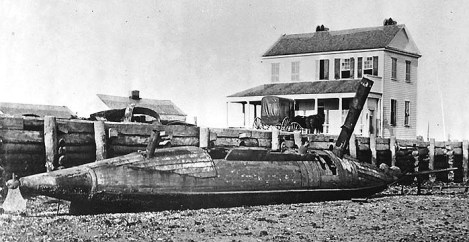
CSS David – one of the semi-submersible torpedo boats utilized by the Confederacy. Pictured here run abandoned in Charleston. Courtesy Library of Congress
By this time, Gen. Beauregard was back in command of Charleston’s forces and was attempting to clear the city of the Union naval blockade using the Davids. Beauregard was desperate. Charleston had been strangled by the blockade for almost two year by more than a dozen Federal ships. The city – indeed the entire South – was feeling the economic pinch. There was virtually no foreign trade and the Confederacy realized no matter how many battles Rebel soldiers won, on the economic front, the South was losing badly.
Charleston, in particular, was a passionate target, not only for Union forces, but for the civilian population in the North. As the main aggressor for secession and firing the first shot of the War, hatred toward Charleston was fierce. They wanted Charleston to suffer severe punishment.
The Hunley was ordered to Charleston to assist in the defense of Charleston. She was cut in half, loaded on railcars and camouflaged for the overland journey, with scaffolding build over it to hide its shape and covered. Dixon, however, was left behind in Mobile. A new crew would be assembled in Charleston to operate the boat, with McClintock in charge of training them.
FIRST CREW
The Hunley arrived on August 12, 1863. McClintock was offered $100,000 ($1.6. million in current currency) to sink either the New Ironsides or the Wabash, two of the Federal ships in the blockade. With a crew of volunteers, the McClintock conducted a week of safe tests in the harbor between Ft. Johnson and Fort Moultrie, away from the eyes of the Federal blockade. Beauregard quickly became frustrated by McClintock’s caution. He asked that a Confederate Navy man sail on the submarine. When McClintock refused, Beauregard ordered the submarine seized by the Confederate Navy and a crew of volunteers take over its operation.
McClintock was so disgusted he left Charleston.
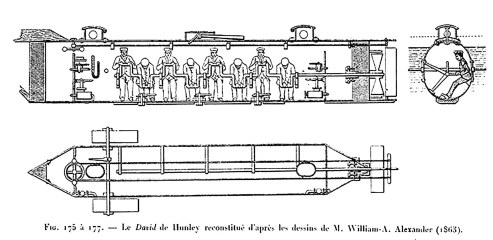
Sketch of the Hunley at the direction of William Alexander, depicting the interior design, for his 1902 article, “Hunley.” Courtesy Naval Historical Center
On August 29, a crew of eight Confederal Navy volunteers, commanded by Lt. John A. Payne, boarded the Hunley. As they let were releasing the lines the Confederate ship, Etiwan, came steaming by. The wake from the rebel ship washed over the Hunley and water poured through its open hatches. Four crew members, including Payne, escaped but the other five drowned inside the submerged vessel.
Three days later Beauregard gave orders to “adopt immediate measures to have it raised at once.”
SECOND CREW
Horace Hunley arrived in Charleston that day and was stunned to discover that for the third time in two years, his submarine had sunk. When he discovered the particulars of the accident he was enraged. He blamed the accident on government ineptitude. He wrote a curt note to Beauregard:
Sir – I am part owner of the torpedo boat the Hunley. I have been interested in building this description of boat since the beginning of the war … I feel therefore, a deep interest in its success. I propose if you will place the boat in my hands to furnish a crew (in whole or in part) from Mobile who are well acquainted with tis management and make the attempt to destroy a vessel of the enemy as early as practicable.
Very respectfully, Your Obedient Servant,
H.L. Hunley
Within a week, Hunley was in charge of his boat which had been salvaged from 42-feet of water in Charleston harbor. The first order of business was the removal of the bodies of the five drowned crew members. Their bodies were so bloated they had to be chopped into pieces to be removed. It was horrific and grisly work. They spent more days with soap and brushes cleaning the inside of the boat, removing the silt, mud and stench of decaying flesh. Many of the soldiers began to call Hunley the “iron coffin.”
Hunley telegraphed the machine shop in Mobile, asking that they send workers familiar with the boat to Charleston. Within a few days, six men from Mobile arrived. Much to his dismay, George Dixon was not one the men chosen. For more than a month, Hunley drilled the crew in the operation of the submarine, until the operation of the vessel was smooth.
On October 15, 1863, Horace Hunley and seven crew members boarded the submarine at Adgers Wharf. There was a small crowd assembled on the dock to watch a demonstration of the Hunley’s capabilities, a dress rehearsal for an actual attack. They were to take the submarine out into the harbor, submerge beneath the Confederate ship Indian Chief and surface on the other side.
The crowd watched the Hunley cruise away from the dock, submerge and … it never came back up. The next day, the Charleston Daily Courier posted this notice:
Melancholy Occurrence – On Thursday morning an accident occurred to a small boat in Cooper River, containing eight persons, all of whom drowned.
When word reached the machine shop in Mobile, all the men were shocked. The lives of George Dixon and William Alexander, two of the original test crew, had been saved by the luck of not being chosen to go to Charleston. However, they knew the boat would be raised for the recovery of the bodies, and they were both confident that the Hunley could be used successfully. They left for Charleston the next day.
Beauregard ordered that the submarine be raised and then grounded. It had killed thirteen Confederate men, and not a single Yankee. “It is more dangerous to those who use it than the enemy” he said.
Due to weather conditions in Charleston harbor, it took more than a month for the recovery to take place. It was 60-feet below the surface, nose buried in silt. On Saturday, November 7, several divers, including Angus Smith who had lifted the Hunley the first time, managed to wrap enough chains around the vessel to raise it to the surface. When the Hunley was finally on the dock at Mt. Pleasant, Dixon and Alexander were present for the grim task of removing the eight corpses.
Beauregard wrote, “It was indescribably ghastly. The unfortunate men were contorted into all kinds of horrible attitudes.”
THIRD CREW & HISTORIC MISSION
Dixon and Alexander, however, were not ready to give up on the submarine. They managed to set up a meeting with Beauregard who was living at 192 Ashley Avenue. Dixon had served under Beauregard at Shiloh and the general knew Dixon to be a serious and resolute soldier. They convinced the general that ignoring the vessel would be a waste. Dixon pointed out that the Hunley sank this time because the crew forgot to shut off the ballast-tank valves. The latest accident was just that … there was nothing wrong with the submarine itself, as long as it was operated correctly.
Dixon told Beauregard that with him in command, Alexander as his first officer and a crew of their choosing, the Hunley could, and would, sink a Union ship. Beauregard gave Dixon and Alexander permission to prepare the boat and raise a crew – but only of volunteers.
It took more than a month to get the submarine ready. Like before, the bloated bodies were removed in pieces, and the interior of the vessel was cleaned with twenty-one pounds of soap and lime. All the hatches were left open for several days in an attempt air out the stench.
Dixon and Alexander were able to acquire most of the new crew from the Indian Chief, the ship in Charleston harbor the Hunley was attempting to submerge beneath when it sank. They explained how dangerous the mission was going to be … that it would involve twelve hour days of hard labor in a claustrophobic environment, often pitch dark black, in cold, wet, cramped conditions with stale air. He only wanted men willing to work in that environment.
Dixon and Anderson supervised the refitting of the Hunley. One of the main alterations, at Beauregard’s order, was to replace the tugged mine with a mounted spar that had an explosive at the end. They also moved the submarine to the northern end of Sullivan’s Island, at Battery Marshall, across from Breach Inlet on Long Island (present-day Isle of Palms.) This took the boat away from prying eyes in the Charleston harbor during their nighttime training sessions. More importantly, it was also closer to the open ocean which made for easier access to the Federal blockading fleet.

A 1902 sepia-wash drawing of Conrad Wise Chapman’s painting of the Hunley, by R.G. Skerrett. Courtesy Naval Historical Center.
During one of their training missions they wanted to test the limits of how long they could sit on the bottom without refreshing their air. Dixon’s theory was, if they successfully attacked a surface ship, they may need stay submerged for safety and waiting for a tide. They estimated half an hour was the limit.
They flooded the ballast tanks and the Hunley settled on the bottom and the crew sat in silence. Dixon, no doubt, sat silently at the controls, rubbing the warp in the gold coin in his pocket where the Yankee bullet had struck. The only illumination inside the submarine was a flickering candle, which snuffed itself out half an hour later. So the men sat in darkness – with time seemingly standing still – until all of them were light-headed from lack of oxygen. They then began to pump furiously and the bow of the submarine started to rise. However, the stern remained on the bottom.
In the pure darkness, working only by feel and his intimate familiarity with the machinery, Alexander discovered seaweed blocking the valve. He managed to clear the obstruction, pump out the tanks and the Hunley bobbed to the surface. Dixon and Alexander threw open the hatches and the men gasped the fresh sea air.
They had been on the bottom two and a half hours.
The experience convinced the crew to make a decision – if the boat ever became stuck beneath the surface, they would flood the vessel and drown themselves. They preferred the quick death of drowning to the long panicked agony of suffocation.
At the beginning of February, William Alexander was ordered back to Mobile by Gen. Beauregard to help build a rapid-fire repeating gun for the Confederacy. At this point in the War, the Confederacy needed any weapons that could be built.
On a cold, clear night, February 17, 1864, after two months of training the new crew, the Hunley left the wharf at Battery Marshall. After the tide turned, she silently sailed out of Breach Inlet, into the Atlantic Ocean and history. She headed for the Federal blockade, four miles off shore. Dixon was most likely dismayed that it was such a clear night – the Hunley would more easily visible as it approached her target, before she dove.
The plan was simple: after the Hunley had accomplished her mission, she would surface and flash a blue phosphorus lamp. At that signal, the troops on lookout on Sullivan’s Island would light a bonfire on the beach to guide her home.
The USS Housatonic was a 1240-ton screw sloop-of-war launched on November 20, 1861. Eighty-five feet wide, 205 feet long with a beam of thirty-eight feet, the Housatonic, with a crew of 155 men, arrived in Charleston on September 11, 1862 as part of the Federal naval blockade and took a position off the bar.
When the Union authorities had first learned of the existence of the Hunley, and the Davids – and the real possibility of an underwater attack – Admiral John A. Dahlgren wasted no time in laying out defensive plans. He ordered that the ships change anchorage regularly, and keep guns trained on the water at all time. He also advised them:
… not to anchor in the deepest part of the channel, for by not leaving much space between the bottom of the vessel and the bottom of the channel it will be impossible for the diving torpedo to operate except on the side, and there will be less difficult in raising a vessel if sunk.
It would soon prove to be a prescient order.

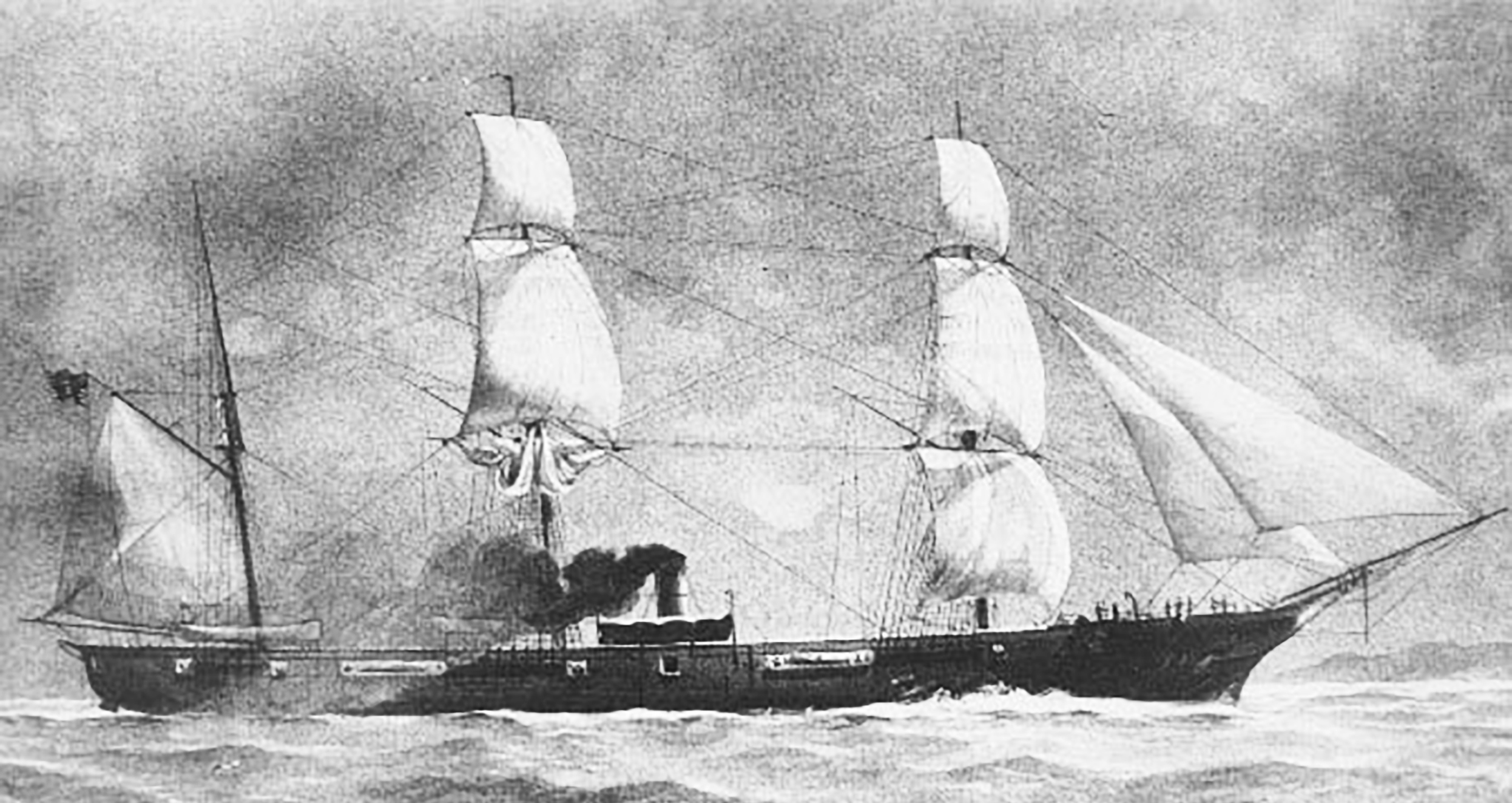
USS Housatonic – first ship to be sunk by a submarine attack. Courtesy Library of Congress
At 8:40 p.m. Robert F. Flemming, a black sailor, saw something usual floating in the moonlit water, about 400 feet away. He reported the sighting to an officer, who, after looking told him, “It’s a log.”
Flemming responded, “It’s not floating with the tide, like a log would, it’s moving across the tide.”
At 8:45 p.m. John Crosby, the Housatonic’s acting master, also saw something in the water glint off the moonlight “like a porpoise coming to the surface to blow.” It was about 100 yards off the starboard beam. When he looked again, it was gone. He called out an order to “slip the chain, back the engine.”
A moment later an explosion rocked the warship – ninety pounds of gunpowder. Water rushed into the engine room, crashing timbers and metal, and the ship lurched to port and continued to list. Most of the men were asleep in their bunks and dozens of them were tossed into the ocean as an entire section of the ship disappeared.
Sailors on deck fired rifles into the water, and soon found themselves standing in water – the ship was sinking. Many of the crew manned lifeboats and began to pick up their mates out of the frigid Atlantic water. Others simply climbed the ship’s rigging to safety.
Within an hour of the explosion the Housatonic was sitting on the bottom, in 25-feet of water, meaning more than ten feet of the ship was above the waterline. Out of a crew of 155 there were only five fatalities.
Robert F. Flemming, the black sailor who first sited the “log,” was hanging from the ship’s rigging, waiting to be rescued. Off the starboard bow he saw a blue light shine for a moment. Then, it was gone. But he saw it.
On the beach at Sullivan’s Island, after the blue light signaled, the soldiers lit the bonfire and kept it burning until dawn, but the Hunley never returned.
The following day, Lt. Colonel O.M. Dantzler sent Beauregard a brief note:
I have the honor to report that the torpedo-boat stationed at this point went out on the night of the 17th instant (Wednesday) and has not returned. The signals agreed upon to be given in case the boat wished a light to be exposed at this post as a guide for its return were observed and answered.
Over the next few days the story of the attack was pieced together. Beauregard sent a telegram to the Confederate command in Richmond:
A gunboat sunken off Battery Marshall. Supposed to have been done by Mobile torpedo boat, under Lieutenant George E. Dixon, Company E, Twenty-first Alabama Volunteers, which went out for that purpose, and which I regret to say has not been heard of since … There is little hope of the safety of that brave man and his associates, however, as they were not captured.
The news of the successful attack was greeted with excitement across the South, positive that was greatly needed for the southern psyche. On February 29, the Charleston Daily Courier reported:
The glorious success of our little torpedo-boat, under the command of Lieutenant Dixon, of Mobile, has raised the hopes of our people, and the most sanguine expectations are now entertained of our being able to raise the siege in a way little dreamed of by the enemy.
The excitement was short-lived. On the first anniversary of the Hunley’s attack, February 17, 1865, Federal troops marched into Charleston. At the same time 150 miles to the north, Columbia, the state’s capital city, surrendered to Sherman’s troops after being burned. For South Carolina, the War was over, but the story of the Hunley had another 140 years to reach a conclusion.
DISCOVERY & RECOVERY
As the years passed, and countless histories of the War were written, through the mist of memory the Hunley became little more than a footnote, a factoid. In 1870 Jules Verne wrote a fantastic story, Twenty Leagues Under the Sea, about the adventures of a submarine, the Nautilus.
Verne was obviously well aware of the American Civil War. European newspapers covered the war in full, and often sensational, detail. In 1865 Verne published a short story “The Blockade Runners,” in which a Scottish merchant captain uses a ship named Dolphin to break the Union blockade of Charleston harbor.
In 1872-73, the former Confederate diver, Angus Smith, who lived on Sullivan’s Island, was given a contract to remove old wrecks from the channel. Smith was a member of the dive team which had raised the Hunley both times they sank in Charleston harbor. He was very familiar with the boat.
A couple of years later Smith responded to a request for his memories about the torpedo boat from former General P.G.T. Beauregard, who was putting papers together about the War. Smith claimed to have attempted a salvage of the Hunley. He wrote to Beauregard:
I went to work to save the torpedo boat, and I got on top of her, and found out the cause of her sinking. The boat is outside or alongside the Housatonic. She can lifted any time our people wish … she can be saved and my opinion is she is as good as the day she was sunk.
In all likelihood, that was the last sighting of the Hunley for more than 100 years.

Marker on Sullivan’s Island, with Breach Inlet in the background. Photo by author.
Sometime in the late 1870s P.T. Barnum, master showman and businessman, offered a $100,000 reward to anyone who could salvage the Hunley for his traveling show of oddities. The staggering amount of money sparked off a round of searches and explorations that yielded nothing.
About the same time, the government began the construction of the stone jetties off the coast of Sullivan’s Island – four-mile long groins designed to alter the flow of sand from filling the main channel into Charleston harbor. Not only did the altered sand flow change the contour of Sullivan’s Island, and erode most of Morris Island, it also slowly, but inevitably buried the Hunley deeper.
In 1970, a Charleston-based professional diver, Edward Lee Spence dove off the side of a fishing boat in 27-feet of water, in an attempt to free the line of a fish trap for his friend. Spence, a Civil War naval history expert, was intimately familiar with the thousands of wrecks up and down the Charleston coast. As he went over into the cold November water, he also knew he was close to the site of the Housatonic.
Along the bottom he found where the line was snagged on something that resembled a ledge. Upon closer examination it was solid, a black iron tube, about twenty-feet long, with the rest of it buried beneath the sand. With a flash, he realized what he was touching.
A moment later Spence surfaced and he screamed out to his friends on the boat, “The Hunley! I’ve found the Hunley!” He tossed a buoy, and for claim purposes, he drew a crude map in an effort to mark the location. For next twenty years, Spence crusaded everyone who would listen about his discovery. Problem was, he could never find it again, he had no proof and he refused to release its location, for looting purposes.
In 1994, two groups combined forces in an effort to find the Hunley. The South Carolina Institute of Archeology and Anthro-pology (SCIAA) issued all permits for anything excavated from South Carolina waters. Employee Mark Newell, was an experienced diver and Civil War buff. His days off were often spent diving off the Charleston coast, mostly around the Housatonic site, looking for the Hunley. He agreed to a joint venture with a non-profit business, NUMA – National Underwater and Marine Agency, operated by best-selling novelist, Clive Cussler. It was a bit of real life following fiction.
Cussler’s fictional character, Dirk Pitt, is kind of a maritime James Bond. Pitt, who works for an organization called NUMA, first appeared in the 1973 novel The Mediterranean Caper. However, it was the third Pitt novel, Raise The Titanic which vaulted Cussler to mega-selling status, making him a wealthy man with more than 40 million books sold.
This wealth made it possible for Cussler to establish a real-life version of NUMA in an effort to search for lost maritime treasures across the world. They had great success, discovering more than sixty vessels. Cussler, however, vowed that before he died, he would find the Hunley.
Unfortunately, the joint NUMA/SCIAA mission was unsuccessful; it was marked with animosity and ended with no love-lost between the two groups. However, the NUMA team continued to search. Financed by Cussler, Ralph Wilbanks, Wes Hall and Harry Pecorilli continued to search for the Hunley. Periodically Cussler would fax them a new chart with search locations marked on them, but after a dozen or so dives, their confidence was lagging. Cussler kept telling them “the damn things are never where they’re supposed to be.”
On May 3, 1995, Hall and Pecorilli dove a site they had mapped and explored earlier. During the previous dive, the floor had been covered by a bed of oyster shells, but this time, it was clear. Pecorilli began his exploration, poking his stainless steel probe into the sand when he made contact with a solid object. Using the vacuum hose he cleared an area three-feet wide while Hall explored the surface of the metal with his hand. Suddenly he grabbed Pecorilli’s arm and began to gesture. The two men surfaced a few minutes later next to the dive boat. Wilbanks, on board, looked down at them in the water. Hill said, “It’s the Hunley.”
A week later, May 11, Clive Cussler met with the media in front of the iron replica of the Hunley outside the Charleston museum. He played a videotape the divers had made of their discovery. When asked for the coordinates he refused. Only the rightful owners, whoever that was determined to be, will be shown its location, he said. He remarked:
I didn’t spend fifteen years looking for it only to have it broken up by amateurs. Until I see a comprehensive plan put together by qualified people, they won’t get any cooperation from me.
Within days, South Carolina was in another skirmish against the United States government – over the ownership of the Hunley. Under the rules of war, the United States government owned all Confederate vessels. So technically, it was owned by the Navy and the General Services Administration would make the decision.
State Senator Glenn McConnell, from Charleston, rushed a resolution through the legislature asking Congress to give South Carolina title to the vessel. Congressman Mark Sanford, also from Charleston, quickly registered a bill to that effect in Congress, followed almost immediately by Alabama. Both southern states had good claims to the rights of the Hunley – constructed in one state, and seeing action and lost in the other. They were also both fearful that the Smithsonian Institute would use its formidable power and claim the Hunley for their collection.
South Carolina then fire a shot across the bow of the U.S. government’s claims. McConnell, who at this time was chairman of the hastily formed Hunley Commission, claimed that the U.S. government had no claim, since the Hunley was never a Confederate vessel – it was a privateer, designed and built with private money. Lawyers produced papers from Horace Hunley’s business concerns in Mobile that proved McConnell’s supposition. The lawyers argued that, according to South Carolina state law, for any private property abandoned for more than a year and a day, rights were forfeited.
They also argued that the Federal jurisdiction only extended three miles into the ocean. Since the Hunley was almost four miles from shore, she was out of the jurisdiction of the Federal government.
Finally, an agreement was worked out: The U.S. government kept title to the Hunley, and the submarine would stay in Charleston. The SCIAA, National Park Service and the Naval Historical Center were to be involved in the recovery of the submarine and Hunley Commission was appointed to direct and manage the display of the vessel.
Cussler gave up his coordinate numbers and within the year, a platoon of divers/ archeologists from all the agencies verified the claim – it was the Hunley.
Five years later, August 8, 2000, the H.L. Hunley broke the surface of the Atlantic Ocean for the first time in 136 years. With a crowd of hundreds of boats dotting the surface, carrying thousands of on-lookers, the raising of the Hunley was broadcast to the world.
Thousands of people in Charleston, from all across the South, ditched work and found some location to watch the historic event. Hanging from her secure sling, the Hunley, and a flotilla of hundreds of boats, sailed into Charleston harbor, past Fort Sumter, past Castle Pinkney, and up the Cooper River. More than 20,000 people lined Charleston’s Battery sea wall, beaches, parks and marinas to watch the submarine’s procession.
As the parade approached the USS Yorktown, a World War II aircraft carrier that is a permanent museum on the Cooper River, a regiment of Confederate reenactors fired a twenty-one gun salute from the deck. A lamp on the carrier was lit with a blue light, signaling “Mission Accomplished,” one-hundred and thirty-six years later.
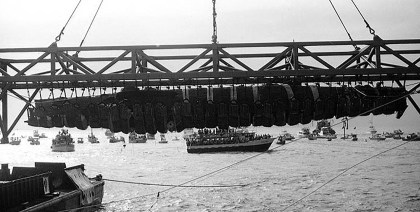
The H.L. Hunley breaks the surface for the first time in 136 years, August 8, 2000. Courtesy Naval Historical Center
The submarine was placed in a deep water tank at the Charleston Navy base. The next step was her conservation and her excavation.
In March 2001, chief archeologist Maria Jacobson was the first person to fully enter the submarine. As she cleared away the thick muddy sediment which filled the iron tube, she came across the body of the first crewman. Over the next few weeks they discovered six other remains – seven of the crew were still inside. The body of George Dixon, they hoped, would most likely be in the forward conning tower.
Meanwhile, in addition to the careful extraction of the bodies, there was a steady stream of artifacts being recovered almost daily – pipes, clothing, buttons, pocketknives, as the submarine slowly reveled her secrets.
On May 17, 2001, they discovered a signaling lamp in the conning tower, and also, the body of Lt. George E. Dixon. Five days later, Maria Jacobson was working on preparing Dixon’s body for removal when her fingers ran across a small, solid circular object near Dixon’s pelvis. She held the object out in her muddy hand and as water was poured over it, a warped gold coin was revealed. She turned it over, and read the inscription “Shiloh. April 6th 1862. My life Preserver. G.E.D.”
Other than the recovery of the bodies of the crew, the discovery of Dixon’s coin was the most sought after artifact from the Hunley.
The last funeral of the War Between the States fittingly took place in Charleston on April 17, 2004. The third crew of the Hunley took their final voyage, a 4-and-a-half mile journey from White Point Garden in downtown Charleston to Magnolia Cemetery. More than 400 journalists from across the world covered the event. Ten thousand reenactors participated, and more than 50,000 people lined the streets of Charleston to watch the procession pass.
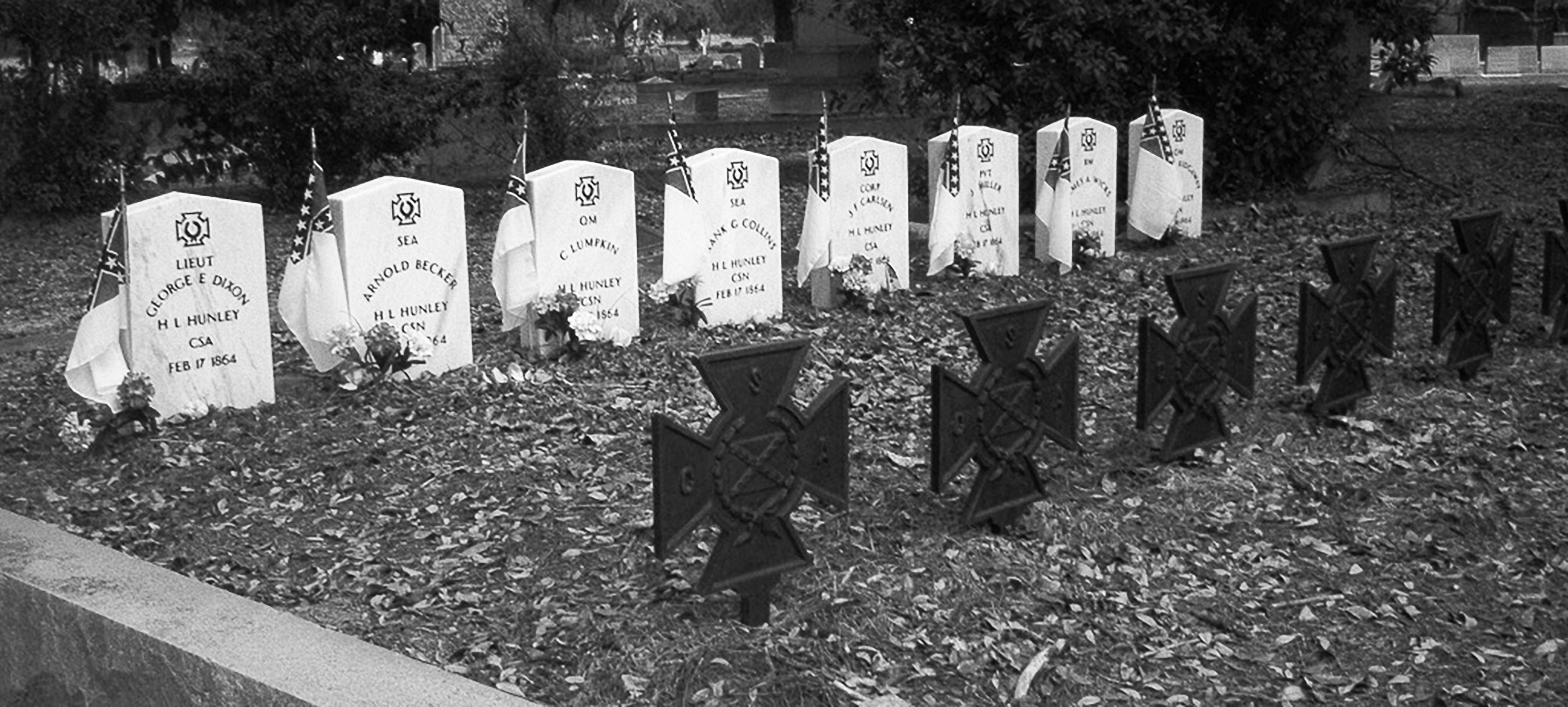
After a memorial ceremony at 9:15 a.m., horse-drawn caissons carried the crew down East Bay Street to Magnolia Cemetery, where they were interred next to the first two crews of the Hunley.

The third crew of the Hunley, at Magnolia Cemetery, Charleston. Photo by author.
IN MEMORIUM
H.L. Hunley
FIRST CREW: AUGUST 29th, 1863
Michael Cane
Nicholas Davis
Frank Doyle
John Kelly
Absolum Williams
SECOND CREW: OCTOBER 15, 1863
Horace Hunley – captain
Robert Brookbank
Joseph Patterson
Thomas W. Park
Charles McHugh
Henry Baird
John Marshall
Charles L. Sprague
THIRD CREW: FEBRUARY 17, 1864
Lieutenant George E. Dixon
Arnold Becker
C.F. Carlson
Frank Collins
James A. Wicks
Joseph Ridgeway
Simpkins
Unknown

 In Allen’s two most recent novels, The Peach Keeper and Lost Lake, that formula was beginning to feel a bit worn. Neither of those books had the freshness and the storylines felt forces. With First Frost, Allen returns to form a bit, mainly because it is a revisit to the fertile ground where the template was established – the Waverly sisters.









 MarkJonesBooks