1787 – Deaths
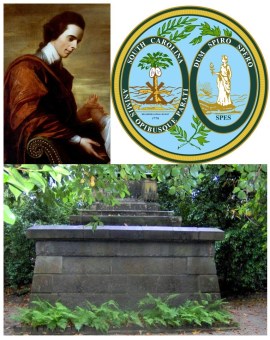
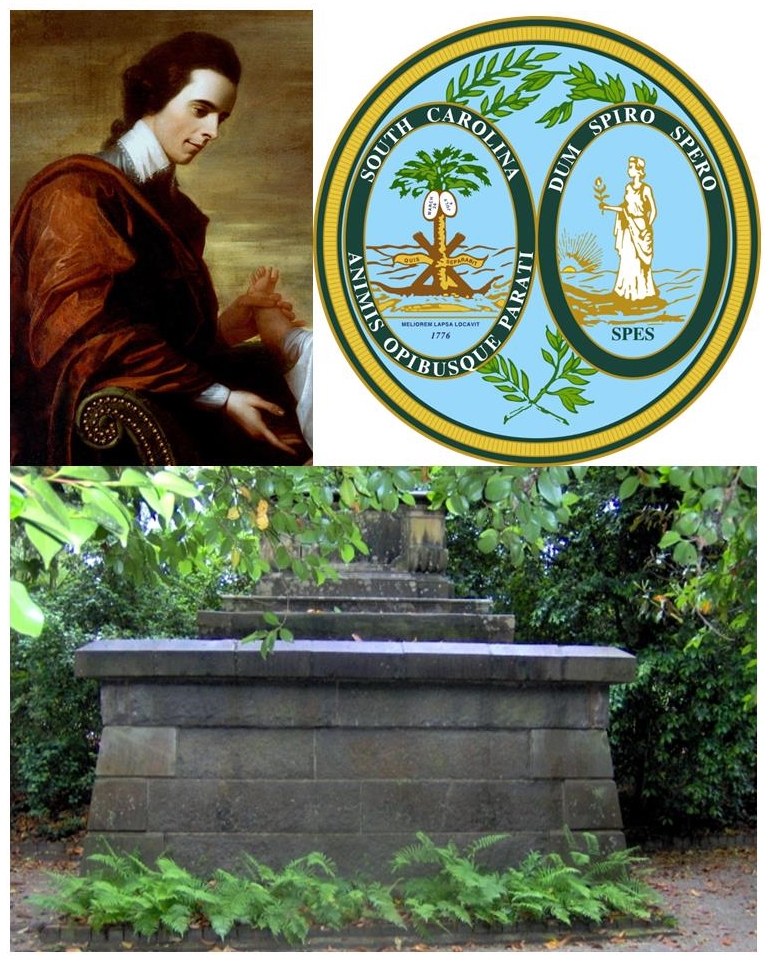
TOP: Arthur Middleton & the Great Seal of South Carolina BOTTOM: Middleton tomb at Middleton Place
Arthur Middleton died and was buried at Middleton Plantation. The death notice from the State Gazette of South-Carolina described him as a “tender husband and parent, humane master, steady unshaken patriot, the gentleman, and the scholar.”
He was educated in Britain, at Westminster School, and Trinity Hall, Cambridge.He then studied law at the Middle Temple and traveled extensively in Europe where his taste in literature, music, and art was developed and refined. In 1764, Arthur and his bride Mary Izard settled at Middleton Place.
Arthur Middleton was one of the more radical thinkers in South Carolina politics – a leader of the American Party in Carolina and one of the boldest members of the Council of Safety and its Secret Committee. His attitude toward Loyalists was said to be ruthless. In 1776, Arthur signed the United States Declaration of Independence and designed the Great Seal of South Carolina with William Henry Drayton.
During the American Revolutionary War, Arthur served in the defense of Charleston. After the city’s fall to the British in 1780, he was one of the 30+ Patriot leaders imprisoned in St. Augustine, Florida.
1788
The City Gazette reported that a man “was paraded through the streets, covered with feathers, stuck in a coat of tar, as a spectacle for the execration of others more honest than himself.”
No, it was not a drunken New Years Eve celebration. Apparently, the man had gone “on board of a vessel, where he saw some goods so bewitching as to induce him to break at least one of the commandments, which says ‘Thou shalt not steal.’”
1808 – Slavery.
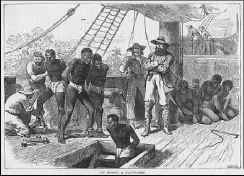 The foreign slave trade ended by Federal law, as negotiated during the creation of the U.S. Constitution. When the US Constitution was written in 1787, a generally overlooked and peculiar provision was included in Article I, the part of the document dealing with the duties of the legislative branch:
Section 9. The migration or importation of such persons as any of the states now existing shall think proper to admit, shall not be prohibited by the Congress prior to the year one thousand eight hundred and eight, but a tax or duty may be imposed on such importation, not exceeding ten dollars for each person.
In other words, the government could not ban the importation of enslaved people for 20 years after the adoption of the Constitution. And as the designated year 1808 approached, those opposed to enslavement began making plans for legislation that would outlaw the trans-Atlantic trade of enslaved people.
1865 – Civil War
Maj. John Johnson, a Confederate engineer wrote, “The first of January 1865, found Charleston gathered within her circle of defenses – Not invested, but much perplexed.”

 MarkJonesBooks