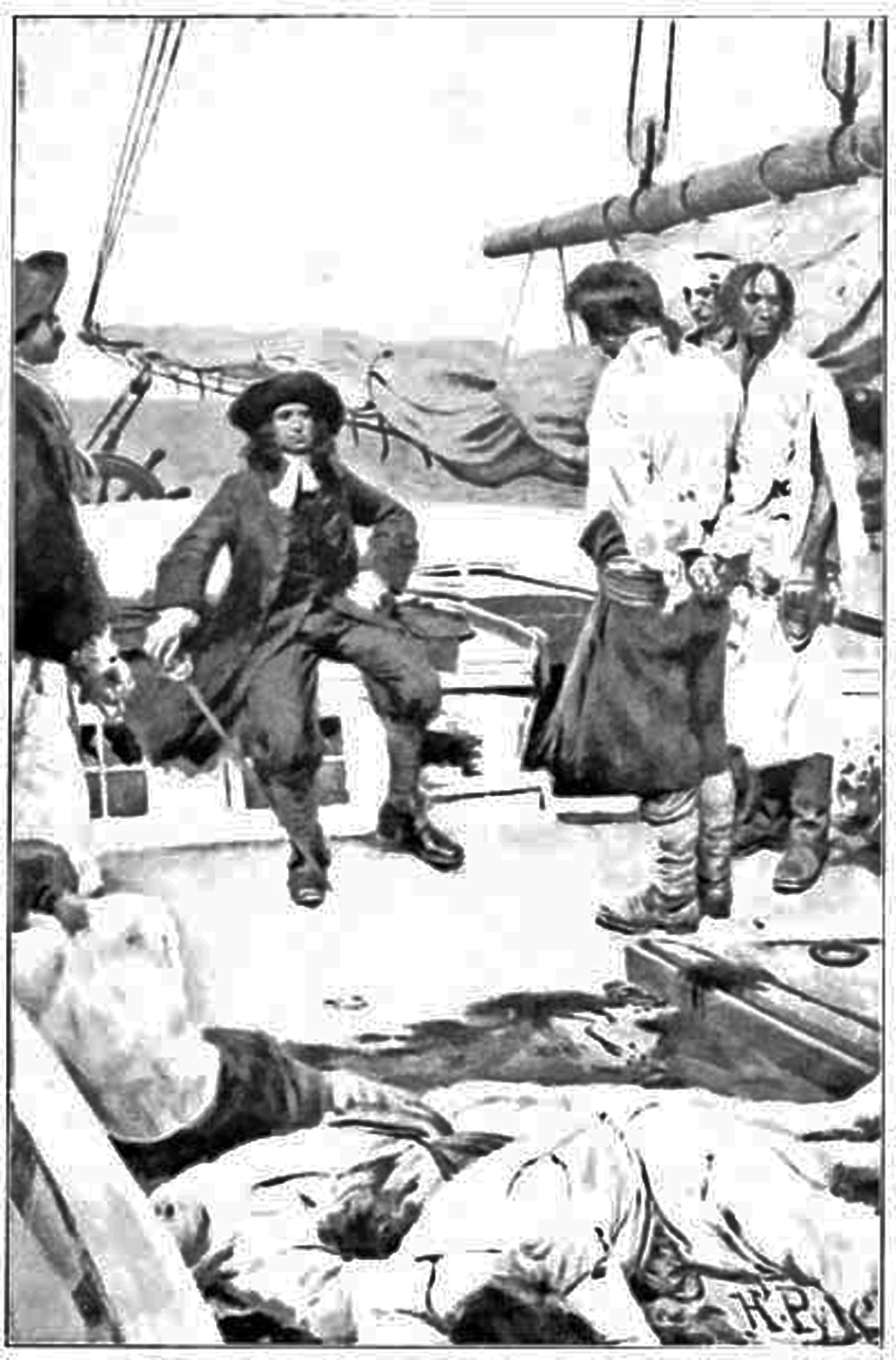
Today In History: Volstead Act Passed By Congress

October 28, 1919

Congress enacted legislation called the National Prohibition Act, better known as the Volstead Act, It was vetoed by President Woodrow Wilson on October 27, 1919. Later that day, the veto was overridden by the House on October 27, 1919 (175–55) and by the Senate (65-20). It became law on October 28 and was one of the most disastrous Acts ever passed by Congress.

volstead act

The three distinct purposes of the Act were:

  1. to prohibit intoxicating beverages,
  2. to regulate the manufacture, sale, or transport of intoxicating liquor (but not consumption), and
  3. to ensure an ample supply of alcohol and promote its use in scientific research and in the development of fuel, dye and other lawful industries and practices, such as religious rituals.

It provided further that “no person shall manufacture, sell, barter, transport, import, export, deliver, or furnish any intoxicating liquor except as authorized by this act.” It did not specifically prohibit the use of intoxicating liquors. The act defined intoxicating liquor as any beverage containing more than 0.5% alcohol by volume and superseded all existing prohibition laws in effect in states that had such legislation.

Prohibition came into force at midnight on January 17, 1920. The first documented infringement of the Volstead Act occurred in Chicago on January 17 at 12:59 a.m. Six armed men stole $100,000 worth of “medicinal” whiskey from two freight train cars. This trend in bootlegging liquor created a domino effect, with criminals across the United States. In fact, some gang leaders were stashing liquor months before the Volstead Act was enforced. The ability to sustain a lucrative business in bootlegging liquor was largely helped by the minimal police surveillance at the time. There were only 134 agents designated by the Prohibition Unit to cover all of Illinois, Iowa, and parts of Wisconsin. According to Charles C. Fitzmorris, Chicago’s Chief of Police during the beginning of the Prohibition period: “Sixty percent of my police [were] in the bootleg business.”

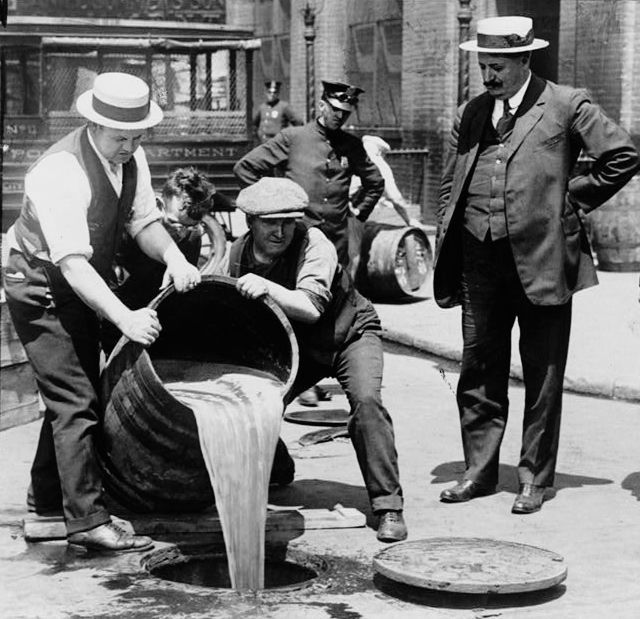
5 Prohibition Disposal(9)Section 29 of the Act allowed 200 gallons (the equivalent of about 1000 750 ml bottles) of “non-intoxicating cider and fruit juice” to be made each year at home. “Intoxicating” was defined as anything more than 0.5%, but the Bureau of Internal Revenue soon struck that down and this effectively legalized home wine-making. For beer, however, the 0.5% limit remained until 1933.

The Act contained a number of exceptions and exemptions. Many of these were used to evade the law’s intended purpose. For example, the Act allowed a physician to prescribe whiskey for his patients, but limited the amount that could be prescribed. Subsequently, the House of Delegates of the American Medical Association voted to submit to Congress a bill to remove the limit on the amount of whiskey that could be prescribed and questioning the ability of a legislature to determine the therapeutic value of any substance. 

The Act called for trials for anyone charged with an alcohol-related offense, but juries often failed to convict their fellow citizens of a “crime” of which they were also guilty. 

Today In Charleston History: October 27

1775

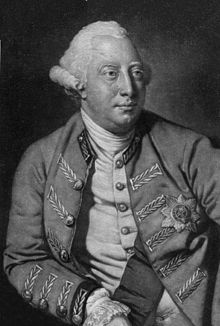
King George III declares the American colonies to be in open rebellion, due to traitorous behavior. He stated:

Many of these unhappy people may still remain their loyalty, and may be too wise not to see the fatal consequence of this usurpation, and wish to resist it, yet the torrent of violence has been strong enough to compel their acquiescence, till a sufficient force shall appear to support them.

220px-George_III_Zoffany

Today In Charleston History: October 26

1759 – French and Indian War.

Governor Lyttleton left Charlestown, marching for Fort Prince George (present-day Pickens County, South Carolina) with 1500 troops (including Christopher Gadsden) to put down the Cherokee rebellion.

Fort Prince George

Fort Prince George


1765 – Stamp Act.

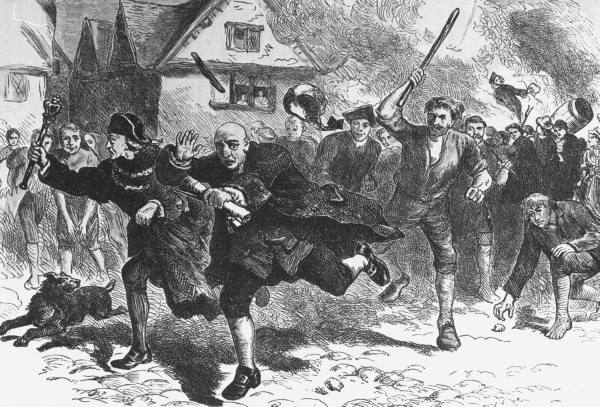
A mob of citizens marched the streets threatening to kill the two stamp agents, George Saxby and Caleb Lloyd, unless they resign.

Stamp Act Rioting

Stamp Act Rioting

Writers on Writing: Stephen King, Kurt Vonnegut & Elmore Leonard

STEPHEN KING
stephen-king_0

Stephen King

Like your bedroom, your writing room should be private, a place where you go to dream. Your schedule — in at about the same time every day, out when your thousand words are on paper or disk — exists in order to habituate yourself, to make yourself ready to dream just as you make yourself ready to sleep by going to bed at roughly the same time each night and following the same ritual as you go.

In both writing and sleeping, we learn to be physically still at the same time we are encouraging our minds to unlock from the humdrum rational thinking of our daytime lives. And as your mind and body grow accustomed to a certain amount of sleep each night — six hours, seven, maybe the recommended eight — so can you train your waking mind to sleep creatively and work out the vividly imagined waking dreams which are successful works of fiction.

The adverb is not your friend.

Adverbs … are words that modify verbs, adjectives, or other adverbs. They’re the ones that usually end in -ly. Adverbs, like the passive voice, seem to have been created with the timid writer in mind. … With adverbs, the writer usually tells us he or she is afraid he/she isn’t expressing himself/herself clearly, that he or she is not getting the point or the picture across.

I’m convinced that fear is at the root of most bad writing. If one is writing for one’s own pleasure, that fear may be mild — timidity is the word I’ve used here. If, however, one is working under deadline — a school paper, a newspaper article, the SAT writing sample — that fear may be intense. Dumbo got airborne with the help of a magic feather; you may feel the urge to grasp a passive verb or one of those nasty adverbs for the same reason. Just remember before you do that Dumbo didn’t need the feather; the magic was in him.

Consider the sentence He closed the door firmly. It’s by no means a terrible sentence (at least it’s got an active verb going for it), but ask yourself if firmly really has to be there. You can argue that it expresses a degree of difference between He closed the door and He slammed the door, and you’ll get no argument from me … but what about context? What about all the enlightening (not to say emotionally moving) prose which came before He closed the door firmly? Shouldn’t this tell us how he closed the door? And if the foregoing prose does tell us, isn’t firmly an extra word? Isn’t it redundant?

KURT VONNEGUT
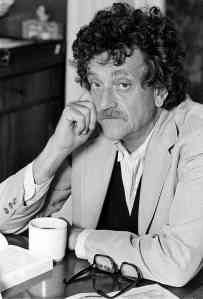
kurt-vonnegut

Kurt Vonnegut

Use the time of a total stranger in such a way that he or she will not feel the time was wasted.

Give the reader at least one character he or she can root for.

Every character should want something, even if it is only a glass of water.

Every sentence must do one of two things — reveal character or advance the action.

Start as close to the end as possible.

Be a Sadist. No matter how sweet and innocent your leading characters, make awful things happen to them-in order that the reader may see what they are made of.

Write to please just one person. If you open a window and make love to the world, so to speak, your story will get pneumonia.

Give your readers as much information as possible as soon as possible. To hell with suspense. Readers should have such complete understanding of what is going on, where and why, that they could finish the story themselves, should cockroaches eat the last few pages.

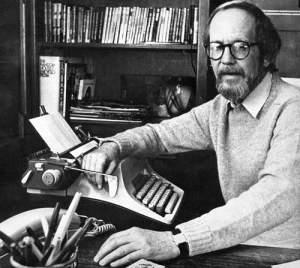
ELMORE LEONARD RULES
  1. Never open a book with weather.

If it’s only to create atmosphere, and not a character’s reaction to the weather, you don’t want to go on too long. The reader is apt to leaf ahead looking for people. There are exceptions. If you happen to be Barry Lopez, who has more ways to describe ice and snow than an Eskimo, you can do all the weather reporting you want.

  1. Avoid prologues.
elmore

Elmore Leonard

They can be annoying, especially a prologue following an introduction that comes after a foreword. But these are ordinarily found in nonfiction. A prologue in a novel is backstory, and you can drop it in anywhere you want.

There is a prologue in John Steinbeck’s ”Sweet Thursday,” but it’s O.K. because a character in the book makes the point of what my rules are all about. He says: ”I like a lot of talk in a book and I don’t like to have nobody tell me what the guy that’s talking looks like. I want to figure out what he looks like from the way he talks. . . . figure out what the guy’s thinking from what he says. I like some description but not too much of that. . . . Sometimes I want a book to break loose with a bunch of hooptedoodle. . . . Spin up some pretty words maybe or sing a little song with language. That’s nice. But I wish it was set aside so I don’t have to read it. I don’t want hooptedoodle to get mixed up with the story.”

  1. Never use a verb other than ”said” to carry dialogue.

The line of dialogue belongs to the character; the verb is the writer sticking his nose in. But said is far less intrusive than grumbled, gasped, cautioned, lied. I once noticed Mary McCarthy ending a line of dialogue with ”she asseverated,” and had to stop reading to get the dictionary.

  1. Never use an adverb to modify the verb ”said” . . .

. . . he admonished gravely. To use an adverb this way (or almost any way) is a mortal sin. The writer is now exposing himself in earnest, using a word that distracts and can interrupt the rhythm of the exchange. I have a character in one of my books tell how she used to write historical romances ”full of rape and adverbs.”

  1. Keep your exclamation points under control.

You are allowed no more than two or three per 100,000 words of prose. If you have the knack of playing with exclaimers the way Tom Wolfe does, you can throw them in by the handful.

  1. Never use the words ”suddenly” or ”all hell broke loose.”

This rule doesn’t require an explanation. I have noticed that writers who use ”suddenly” tend to exercise less control in the application of exclamation points.

  1. Use regional dialect, patois, sparingly.

Once you start spelling words in dialogue phonetically and loading the page with apostrophes, you won’t be able to stop. Notice the way Annie Proulx captures the flavor of Wyoming voices in her book of short stories ”Close Range.”

  1. Avoid detailed descriptions of characters.

Which Steinbeck covered. In Ernest Hemingway’s ”Hills Like White Elephants” what do the ”American and the girl with him” look like? ”She had taken off her hat and put it on the table.” That’s the only reference to a physical description in the story, and yet we see the couple and know them by their tones of voice, with not one adverb in sight.

  1. Don’t go into great detail describing places and things.

Unless you’re Margaret Atwood and can paint scenes with language or write landscapes in the style of Jim Harrison. But even if you’re good at it, you don’t want descriptions that bring the action, the flow of the story, to a standstill.

And finally:

10. Try to leave out the part that readers tend to skip.

A rule that came to mind in 1983. Think of what you skip reading a novel: thick paragraphs of prose you can see have too many words in them. What the writer is doing, he’s writing, perpetrating hooptedoodle, perhaps taking another shot at the weather, or has gone into the character’s head, and the reader either knows what the guy’s thinking or doesn’t care. I’ll bet you don’t skip dialogue.

My most important rule is one that sums up the 10.

If it sounds like writing, I rewrite it.

Or, if proper usage gets in the way, it may have to go. I can’t allow what we learned in English composition to disrupt the sound and rhythm of the narrative. It’s my attempt to remain invisible, not distract the reader from the story with obvious writing. (Joseph Conrad said something about words getting in the way of what you want to say.)

If I write in scenes and always from the point of view of a particular character — the one whose view best brings the scene to life — I’m able to concentrate on the voices of the characters telling you who they are and how they feel about what they see and what’s going on, and I’m nowhere in sight.

What Steinbeck did in ”Sweet Thursday” was title his chapters as an indication, though obscure, of what they cover. ”Whom the Gods Love They Drive Nuts” is one, ”Lousy Wednesday” another. The third chapter is titled ”Hooptedoodle 1” and the 38th chapter ”Hooptedoodle 2” as warnings to the reader, as if Steinbeck is saying: ”Here’s where you’ll see me taking flights of fancy with my writing, and it won’t get in the way of the story. Skip them if you want.”

”Sweet Thursday” came out in 1954, when I was just beginning to be published, and I’ve never forgotten that prologue.

Today In Charleston History: October 25

1718 –Piracy  
col rhett and bonnet

Col. Rhett and Stede Bonnet

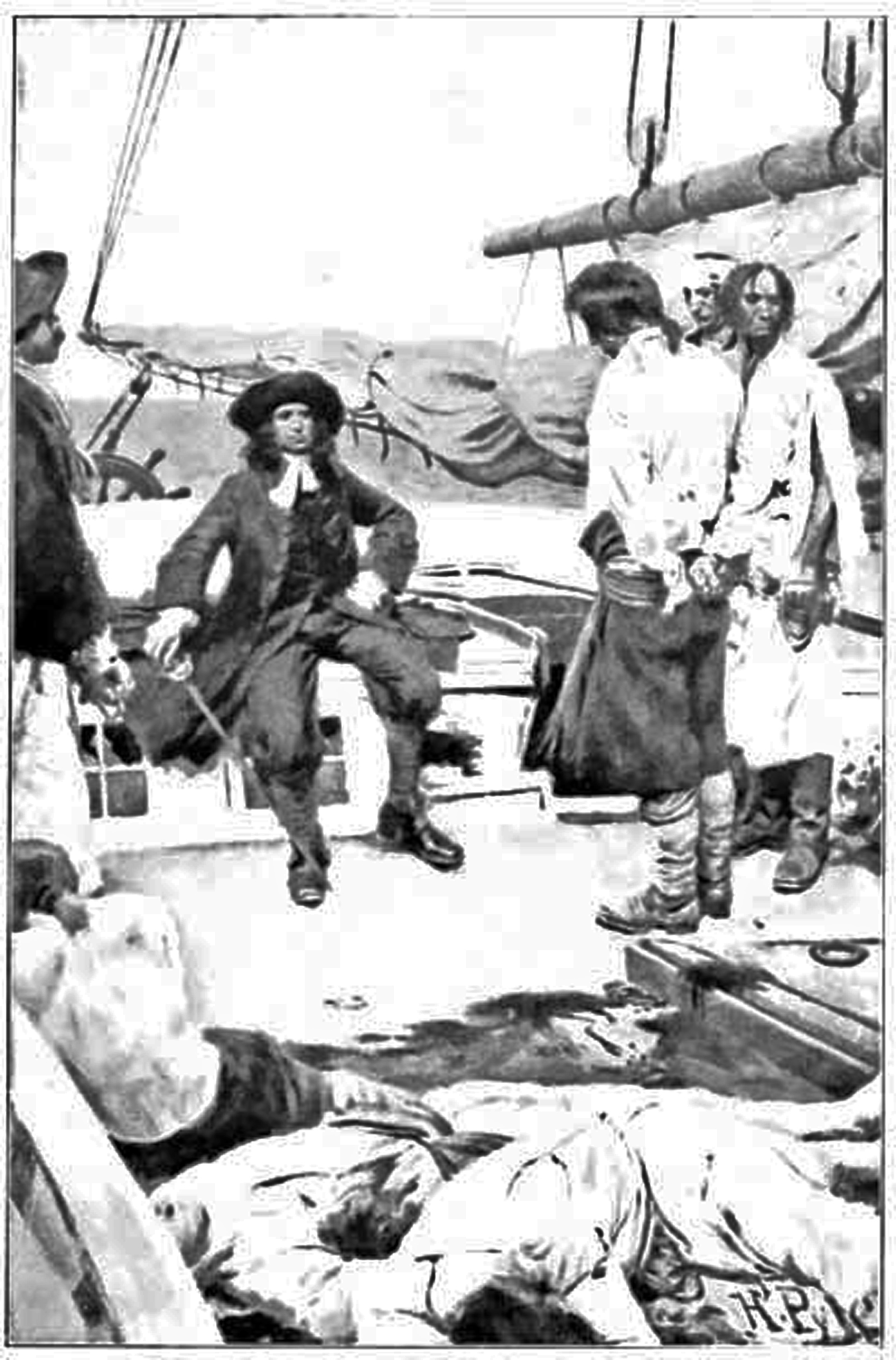
Some local merchants were nervous about the recently captured pirate, Stede Bonnet. They were afraid his testimony at his trial may link them to the buccaneer’s trade. Due to the lax security (and most likely a bribery of gold by merchant Richard Tookerman) at Capt. Partridge’s home, Stede Bonnet and David Herriot escaped. Bonnet disguised himself as a woman to escape undetected.

Accompanied by a slave and an Indian, they stole a small boat and planned to leave the harbor under cover of night and rendezvous with Moody’s ship, Cape Fear.  However, foul winds and lack of supplies forced the four of them onto Sullivan’s Island., where they cowered. Gov. Johnson at once placed a £700 bounty on Bonnet’s head and dispatched search teams to track him down, led by Col. William Rhett.


1757-Births

Charles Pinckney, son of Charles Pinckney, Junior and Francis Brewton Pickney, and cousin to Charles Cotesworth Pinckney, was born in Charlestown. He would later sign the U.S. Constitution with his cousin.

Charles Pinckney

Charles Pinckney

Today In Charleston History: October 24

1671

 The Grand Council appointed a group of citizens to “examine the banks of the Ashley and the Wando, or Cooper River, and to make a return of what places might be most convenient to situate towns upon.” It was an order to begin the surveying of Oyster Point.

1808

The cornerstone of the Charleston Homespun Company was laid at the west end of Wentworth Street – the first manufacturing company incorporated in Charleston. 

1824 – Births

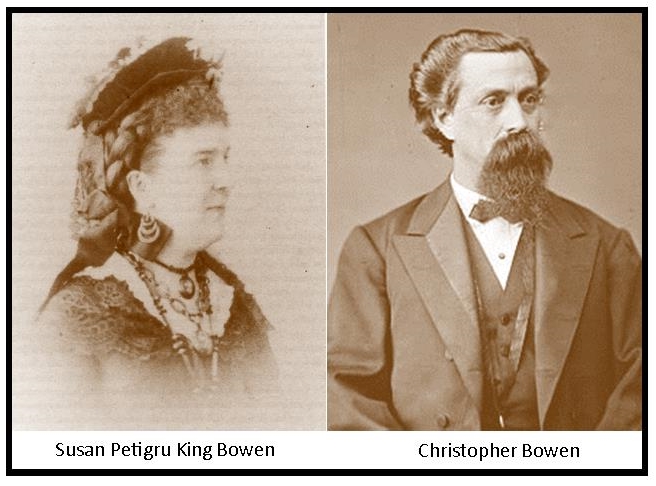
 Susan Dupont Petigru was born, the youngest of four children. She was raised in her family’s Broad Street house, at the center of Charleston’s elite business and social district. Sue attended school first at Madame Talvande’s French School for Young Ladies in Charleston, along with classmate Mary Boykin Chesnut, and later at Madame Binsse’s in Philadelphia. At Talvande’s, in particular, she received a heavy dosage of French, the required language for both instructional and social dialogues, but she also studied chemistry, botany, astronomy, literature, rhetoric, German, art, dancing, and music. 

Her marriage to Henry King was unhappy and in 1861 the couple was separated. Due to laws at the time, divorce was not an option. When Henry was killed in 1862 at the Battle of Secessionville, Sue donned “widow’s weeds”  but her cousin Carey North said that Sue had to “act considerably in doing so.”

She became a fiction writer and novelist. Her work, which included Busy Moments of an Idle Woman (1853), Lily: A Novel (1855), Sylvia’s World: Crimes Which the Law Does Not Reach (1859), and Gerald Gray’s Wife (1864), focused on subversive portrayals of South Carolina aristocracy, in which men toyed with women’s affections, women plotted against one another’s best interests, and mothers forced daughters to choose wealth over romance.

In December 1863 Sue moved to Columbia, S.C. where she was determined “to make herself notorious during the sitting of the Legislature,” at which she succeeded.Sue dressed in lavish outfits of bright coloring, equipped with the finest accouterments her meager estate could provide. Her flirty behavior attracted the attention of a number of young soldiers and married officers from the Confederate army. Later in 1865, Sue was seen cavorting with victorious Yankees in Charleston, to which one gentleman responded: “There goes Mrs K driven by a Yankee thief in my uncle’s Stolen Buggy.”

However, it was in 1870, while working as a foreign-language clerk in Washington’s Post Office Department, that Sue committed her most scandalous and damning public affair – her marriage to Radical Republican and carpetbagger Christopher Columbus Bowen. Eight years her junior, Bowen was even more notorious than Sue.  Born in Rhode Island, Bowen eventually moved to Georgia, where he volunteered for the Confederate cavalry, after being threatened with conscription. He was court-martialed and dishonorably discharged for forging a commanding officer’s signature on a furlough pass to gamble in Charleston and Savannah, Bowen hired a fellow soldier to murder the officer, for which he was arrested and imprisoned in Charleston. While Bowen was awaiting trial, the city of Charleston was successfully invaded by Union forces and Bowen, among other prisoners, was released. He then began working for the Freedmen’s Bureau, which he was fired from shortly thereafter for “irregularities in his accounts.” Afterwards, he began acting as a pro-bono lawyer for newly freed slaves, and the connections he developed allowed him to become first a Republican delegate to South Carolina’s 1868 constitutional convention, and later the elected representative of its first congressional district.

sue king

In 1871, after marrying Sue, Bowen was arrested and tried on charges of bigamy brought by two former wives, one of which owned several brothels and was later convicted as a serial killer. Sue deftly and adamantly defended her husband both in court and in public, writing to one Washington newspaper that she knew:

“that he had been an orphan boy, without relations or friends; had drifted into the company of gamblers and prostitutes, and had lived their life until it had pleased the good god to lift him from the mire.”

Bowen received a two-year prison sentence and a $250 fine, but Sue appealed to President Ulysses S. Grant, who eventually offered Bowen a full pardon. Bowen was reelected to Congress in 1872, but an investigation by the House of Representatives deemed both his and his opponent’s campaigns too corrupt to be officially recognized. Yet Bowen had also been elected as sheriff of Charleston County, a position he would hold until Sue’s death in 1875.

Today In Charleston History: October 23

1704 – Religion

 Francis Simonds, a widow, donated a plot of land for the construction of a dissenting church building, the White Meeting House – the site of the current Circular Church on Meeting Street.

1754 – Births

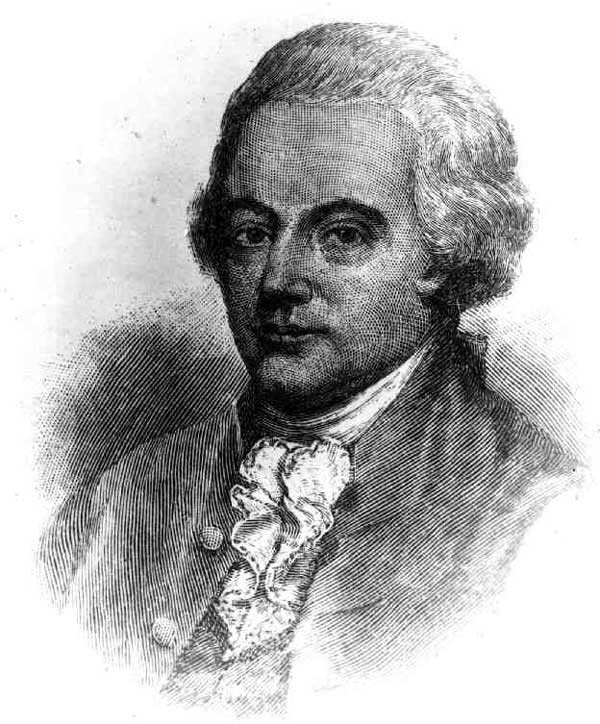
t. pinckneyThomas Pinckney born in Charleston, second son of Charles and Eliza Pinckney.

1764 – Stamp Act

 A masked and armed mob (probably members of the Sons of Liberty) of “about 60 to 80” marched on Henry Laurens’ house at midnight, suspecting that he held the stamps. Lauren’s coolness toward the Patriot cause made him suspicious in the eyes of the public. The mob held “a brace of cutlasses across my breast” and for the next hour the house was searched.  Laurens was amazed by the lack of damage to his house:

Is it not amazing that such a number of Men many of them heated with Liquor & all armed with Cutlasses & Clubbs did not do one penny damage to my Garden not even not even to walk over a Bed & not damage to my Fence, gate or House?

1830

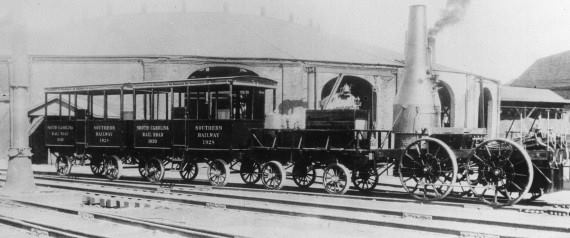
 The Best Friend arrived in Charleston on the freighter Niagra, in parts, and was taken to the shop of Thomas Dotterer where it was reassembled.

best friend

The Best Friend

Today In Charleston History: October 22

1774

Henry Middleton served as second president of the Continental Congress.

1862 – Civil War

Gus Smythe enlisted in the Signal Corps in Charleston and reported to Capt. Joseph Manigault. He wrote to his Aunt Janey:

I have not yet been assigned to any station, but trust to be kept at the Bathing House [South Battery] … As to accommodations, they are MUCH better than in camp, as we (in town) all stay in houses …


View of Charleston from Ft. Wagner

View of Charleston from Ft. Wagner

1925 – Doin’ the Charleston

One of the clubs that challenged the Cotton Club in popularity was Small’s Paradise. Ed Smalls was born in Charleston and moved to New York as a young man. Charleston legend claims that he was kin to the legendary Robert Smalls, an African slave who, during the Civil War, stole a steamer in Charleston harbor and delivered it to the Union navy. Untrue.

Another legend states that Ed Smalls was also related to the notorious Sammy Smalls, “Goat Cart Sam,” a crippled beggar who was often seen drunk on the streets of Charleston being pulled around in a goat cart. Sam usually frequented gambling saloons and whorehouses. “Goat Cart Sam” was about to become a legendary and universal character known as Porgy, the title character of Dubose Heyward’s lyrical novel of black life in Charleston. Also untrue.

Ed Smalls opened Small’s Paradise on October 22, 1925. It was housed in a large basement at 2294½ Seventh Avenue at 135th Street and could accommodate 1500 patrons. It offered extravagant floor shows and the Charlie Johnson Orchestra played the hottest jazz music in Harlem. The Paradise also featured a slew of flamboyant, Charleston-dancing gay waiters who served Chinese food and bootleg liquor to the small tables. During those early years, the Charlie Johnson Orchestra featured two former Jenkins Orphanage trumpet players: Gus Aiken and Jabbo Smith, who had just recently “escaped” from the orphanage.

smalls

Smalls Paradise, New York City. Author’s Collection

Today In Charleston History: October 21

1718 – Piracy

 Governor Johnson wrote to the Commissioners of trade and expressed his apprehension that “the pirates who infest the coast in great numbers would be much irritated” at the actions of Col. Rhett. (Rhett had recently captured the pirate Stede Bonnet who had blockaded Charles Town harbor with Blackbeard.) Johnson again asked for a permanent vessel be sent for the protection of the Carolina coast.

col rhett and bonnet

Col. Rhett’s capture of Stede Bonnet

Almost immediately, word arrived that a pirate ship named Cape Fear, captained by Christopher Moody, was off the bar with a vessel carrying fifty guns and 200 men. Moody was infamous for giving “no quarter” (sparing of lives). The news spread across the city like wildfire.

The Council approved Johnson’s request to outfit four ships – the Mediterranean (twenty-four guns), the King William (thirty guns), the Sea Nymph (six guns) and, ironically, Stede Bonnet’s former pirate vessel, the Royal James, was outfitted to hunt down pirates. The Council asked for volunteers, promising them a share of all the booty that might be taken.

1779 – American Revolution

Henry Laurens was elected Minister to Holland by the Continental Congress. He was to procure a $10,000,000 loan to finance the war effort.

Today In Charleston History: October 20

1730 – Religion

Rev. Alexander Garden held the first convention of South Carolina clergy at Charlestown.

St. Philips Church, 1723

St. Philips Church, 1723

Garden was educated at the University of Aberdeen and in 1719 he went to South Carolina as the Bishop of London’s Commissary, and became rector of  St. Philip’s Church. Garden became renowned for his efforts to censor the evangelist George Whitefield and prevent his “enthusiastic” type of religious meetings from being held in Charles Town, SC.

As well as supervising other clergymen in the area he took an interest in the Charleston Free School, and established the so-called “Negro School” which was supported by the Church of England’s Society for the Propagation of the Gospel. In the spring of 1754 he retired and went to live in England, but soon went back to the warmer climate of South Carolina and died there in 1756