
August 17
1682 – A fourth version of the Fundamental Constitutions was drawn up by the Lords Proprietors. It was never ratified.
1696 – Arrivals.
John Archdale, a Quaker from London, who owned a Proprietary share in Charles Town, arrived as Governor of Carolina, sent at the behest of the Proprietors. He retained Joseph Blake as Deputy Governor. He wrote to the Proprietors that:
When I arriv’d I found all matters in great confusion and every faction apply’d themselves to me in hopes of relief; I appeased them with kind and gentle words and so soon as possible call’d an assembly.
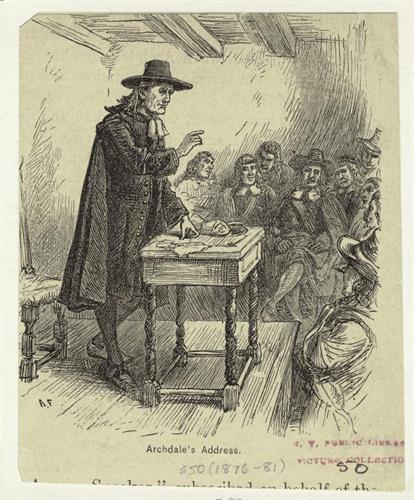 Archdale moderated restrictions against the Indians and was acknowledged for his more humane settlements of conflicts. He also reinforced the liquor act – prohibiting the sale, except by license, of any “beer, cider, wine, brandy, rum, punch or any strong drink whatsoever under the quantity of one gallon.”
He also passed an act stating that “laws passed by the Commons House of Assembly … could not be repealed by London without the consent of the assembly.”
1863 – Bombardment of Charleston.
Under the direction of Union General Quincy Gilmore, Colonel Edward Serrel of the Volunteer Engineers supervised the mounting of a 16,500 pound eight-inch Parrot gun, called the “Swamp Angel.” It was located five miles (8000 yards) south of Charleston, in a muddy stretch of land between Morris Island and James Island.
 The Swamp Angel was a rifled gun, which changed artillery forever. No longer did cannons have to merely shoot round balls, the “rifling” inside the cannon barrel (a series of grooves cast into the gun’s tube) enabled them to shoot a long, slender projectile bullet more accurately, and over greater distances.
 MarkJonesBooks